Study Skills Mastery Checklist
Study Skills Mastery Checklist
Evidence-Based Strategies for Deep Learning & Long-Term Retention
Self-Audit & Action Plan
Student:
Date:
Target Subject:
Rating Scale:
3 Mastered (Always do this) 2 Developing (Sometimes do this) 1 Not Yet (Rarely / passive habit)
1. Active Retrieval Practice
Closed-Book Self-Testing
I test myself from memory before checking my notes or textbook.
1 2 3
The "Blurting" Technique
I write everything I remember on blank paper, then fill gaps in another color.
1 2 3
Feynman Plain-Language Test
I explain tough concepts out loud without jargon as if teaching a 6th grader.
1 2 3
2. Spacing & Interleaving
Distributed Review Intervals
I review content across 3–4 short sessions rather than cramming the night before.
1 2 3
Interleaving Practice Problems
I mix different problem types together instead of doing 20 identical exercises.
1 2 3
Targeted Confidence Sorting
I revisit difficult cards/problems frequently and easy ones less often (Leitner).
1 2 3
3. Focus Architecture
Phone & Notification Lockdown
My phone is out of sight (or on Do Not Disturb in another room) during work.
1 2 3
Pomodoro / Time-Chunking
I work in single-task blocks (e.g., 25 min deep work, 5 min brain break).
1 2 3
Organized Materials Up Front
I gather syllabus, rubric, clean paper, and tools before starting a session.
1 2 3
4. Metacognition & Error Analysis
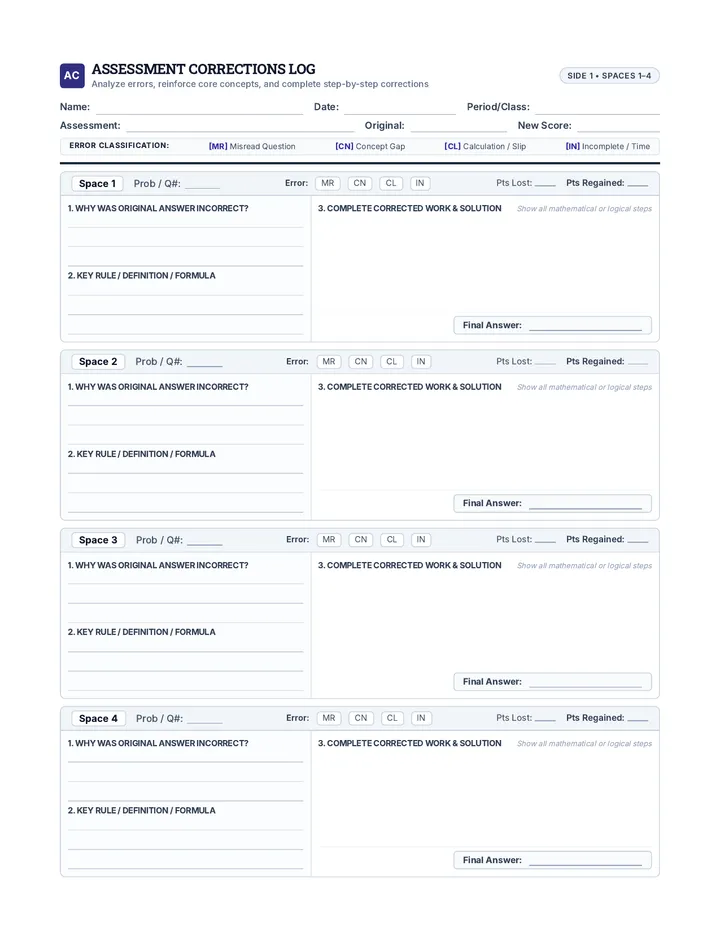
Error Autopsy (Why was it wrong?)
I categorize mistakes (careless slip, formula confusion, or vocabulary gap).
1 2 3
Detecting the "Illusion of Competence"
I don't confuse re-reading or highlighted text with actual mastery.
1 2 3
Proactive Help-Seeking
I bring specific questions to teachers or peers within 24h of being stuck.
1 2 3
Beware the "Passive Study Trap":
Re-reading chapters, copying notes word-for-word, and rainbow highlighting feel productive, but cognitive science shows they produce the lowest retention. Replace them with closed-book retrieval and self-quizzing.
Audit Score Tally
Total Score: ____ / 36 | 28–36: Pro Learner • 19–27: Solid Base • <18: High Priority Reset
1. Which single skill from this checklist will you commit to testing out this week?
2. What specific obstacle could derail this habit, and what is your "If-Then" plan? (e.g., If my phone rings, then...)
Brain Hacks Lab Activity
Brain Hacks Lab Activity
Hands-On Workout: Active Recall, Feynman Simplification & Self-Quizzing
Guided Practice
Student:
Date:
Topic Under Study:
Lab Goal: Select one challenging topic or chapter you are currently learning. Put 3 active cognitive strategies to the test below.
1
Strategy 1: The 3-Minute Blurting Sprint (Retrieval)
Closed-Book → Gap Check
Directions: Close all books and notes. In Box A, write down everything you remember about your topic (definitions, steps, formulas). Then open your notes and write missing points in Box B.
Box A: Pure Recall (From Memory Only)
Box B: Knowledge Gaps (Added After Checking Notes)
2
Strategy 2: The Feynman Technique (Simplification)
Teach It Plainly
Directions: Pick the single most difficult concept from your topic. Explain it below using simple vocabulary and an everyday analogy so that an elementary student would understand it. Strict rule: No textbook jargon!
Concept Name:
Plain-Language Explanation & Everyday Real-World Analogy:
3
Strategy 3: Self-Quiz Generator (Retrieval Cues)
Active Self-Testing
Directions: Turn passive facts into two high-yield quiz questions you can test yourself on tomorrow. Focus on "Why?", "How?", or "Compare", not simple yes/no.
Question 1 ("Why / How / What If?")
Answer / Key Mechanism (To check later)
Question 2 ("What is the difference between...?")
Answer / Key Mechanism (To check later)
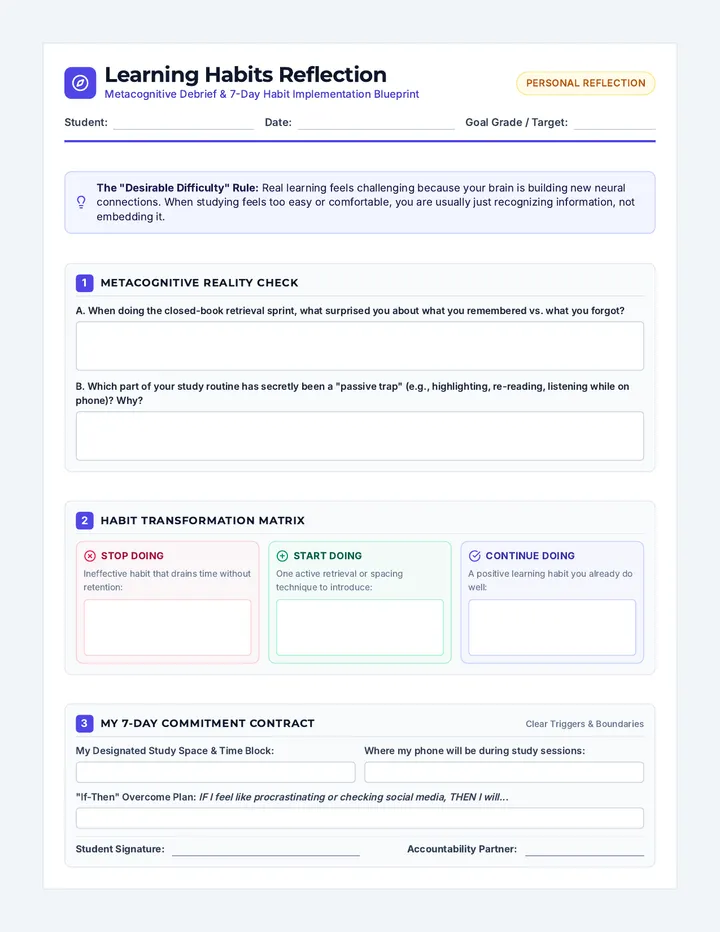
Learning Habits Reflection
Learning Habits Reflection
Metacognitive Debrief & 7-Day Habit Implementation Blueprint
Personal Reflection
Student:
Date:
Goal Grade / Target:
The "Desirable Difficulty" Rule: Real learning feels challenging because your brain is building new neural connections. When studying feels too easy or comfortable, you are usually just recognizing information, not embedding it.
1
Metacognitive Reality Check
A. When doing the closed-book retrieval sprint, what surprised you about what you remembered vs. what you forgot?
B. Which part of your study routine has secretly been a "passive trap" (e.g., highlighting, re-reading, listening while on phone)? Why?
2
Habit Transformation Matrix
STOP DOING
Ineffective habit that drains time without retention:
START DOING
One active retrieval or spacing technique to introduce:
CONTINUE DOING
A positive learning habit you already do well:
3
My 7-Day Commitment Contract
Clear Triggers & Boundaries
My Designated Study Space & Time Block:
Where my phone will be during study sessions:
"If-Then" Overcome Plan: IF I feel like procrastinating or checking social media, THEN I will...
Student Signature:
Accountability Partner: