Sprint Thirty Slides
9th Grade Academic Strategy Lab
Small Group Focus Session
High-Yield Focus Protocol
SPRINT THIRTY
How to cut daily homework fatigue, lock in unbreakable concentration, and master any subject in 30-minute power blocks.
5
Minutes Prep
Zero-friction setup
20
Minutes Deep Work
Active recall engine
5
Minutes Retrieval
Lock in memory
Mindset Shift
Hours Staring vs. Brain Sweating
Focus Reality Check
The "2-Hour" Fake Study Low Return
- Phone buzzing on desk (checking alerts every 4 min)
- Passive rereading with neon highlighters
- Tired brain, zero recall on tomorrow's test
Result: High stress, wasted evening, weak retention.
The 30-Minute Sprint High Impact
- Phone powered down and exiled to another room
- Forcing brain to solve & retrieve cold
- Hard stop at 30 min: 100% guilt-free night earned
Result: Strong retention, free evenings, real confidence.
The Golden Rule: 30 minutes of deep focus beats 2 hours of distracted pretending every time.
Sprint Architecture
The 5 - 20 - 5 Power Formula
Total: Exactly 30 Minutes
PHASE 1 5 MIN
Launch & Eliminate Friction
- Select one specific task
- Phone goes into another room
- Open only essential tools
Goal: Zero setup delays.
PHASE 2 20 MIN
Deep Active Engine
- Timer on (no clock watching)
- Practice testing & solving
- Distraction log for stray thoughts
Goal: Pure locked-in focus.
PHASE 3 5 MIN
Retrieval & Victory Log
- Close books: 2-min brain dump
- Check what you remembered
- Write 1-line victory log & stop!
Goal: Concrete memory lock-in.
When the 30-minute timer beeps, stand up and walk away. Celebrate the win!
Technique Playbook
The 20-Minute Core: Active Recall
Brain Sweat Required
1. The Blurting Method
Read 1 section, close notes, write everything remembered cold. Check in red pen.
2. Teach the Wall (Feynman)
Explain out loud in plain English with zero jargon. Stumbling spots reveal blind spots.
3. Self-Made Quiz
Turn chapter headings into test questions. Answer completely before checking answers.
4. Blind Practice Drill
Solve 4-6 mixed problems without looking at sample solutions. Force retrieval.
Warning: Re-reading notes passively creates the Illusion of Competence. You recognize it, but you don't own it!
Environment Setup
Protecting Your 20 Minutes
Friction Defense
Rule 1: Phone Distance
Phone within eyesight drains working memory, even if face-down on silent.
Fix: Put phone across room or in another room.
Rule 2: Parking Lot Pad
Random thought pops up? Don't switch tabs or reach for your device.
Fix: Jot it on a sticky note. Review at min 30.
Rule 3: Single-Tab Rule
Close 20 open browser tabs. YouTube, Discord, and chats shatter focus.
Fix: Full-screen window with only 1 assignment.
Key Insight: Willpower fails when temptations are easy. Change your space, protect your brain.
Tonight's Mission
Execute Your First Sprint
Take Action
Your 4 Commitments Before Bed:
1
Pick 1 Class / Subject
Not all homework—just your most challenging topic.
2
Exile Your Phone
Put it in another room or give it to a parent for 30 min.
3
Set a Strict 30-Min Timer
5 min setup + 20 min active drill + 5 min check.
4
Log Your Sprint Victory
Fill in Section 4 on your guide & bring it tomorrow!
"Anyone can focus for 20 minutes. Win the sprint, own your night."
Sprint Thirty Protocol
Sprint Thirty Student Guide
High School Academic Strategy Lab • Grade 9
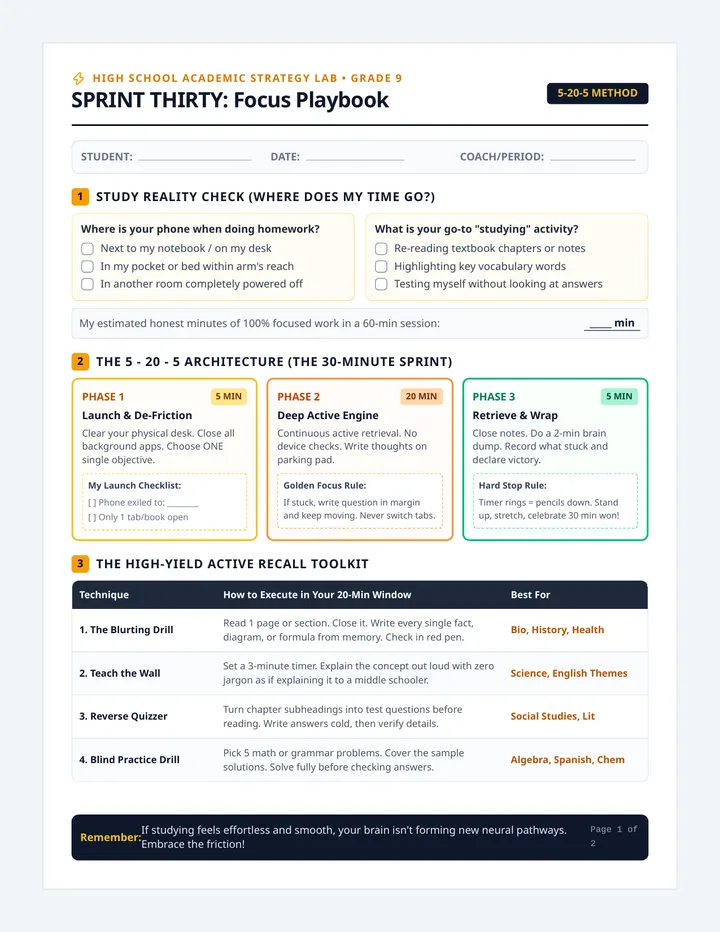
SPRINT THIRTY: Focus Playbook
5-20-5 METHOD
Student:
Date:
Coach/Period:
1
Study Reality Check (Where Does My Time Go?)
Where is your phone when doing homework?
Next to my notebook / on my desk In my pocket or bed within arm's reach In another room completely powered off
What is your go-to "studying" activity?
Re-reading textbook chapters or notes Highlighting key vocabulary words Testing myself without looking at answers
My estimated honest minutes of 100% focused work in a 60-min session: _____ min
2
The 5 - 20 - 5 Architecture (The 30-Minute Sprint)
Phase 1 5 MIN
Launch & De-Friction
Clear your physical desk. Close all background apps. Choose ONE single objective.
My Launch Checklist:
[ ] Phone exiled to: ________
[ ] Only 1 tab/book open
Phase 2 20 MIN
Deep Active Engine
Continuous active retrieval. No device checks. Write thoughts on parking pad.
Golden Focus Rule:
If stuck, write question in margin and keep moving. Never switch tabs.
Phase 3 5 MIN
Retrieve & Wrap
Close notes. Do a 2-min brain dump. Record what stuck and declare victory.
Hard Stop Rule:
Timer rings = pencils down. Stand up, stretch, celebrate 30 min won!
3
The High-Yield Active Recall Toolkit
| Technique | How to Execute in Your 20-Min Window | Best For |
|---|
| 1. The Blurting Drill | Read 1 page or section. Close it. Write every single fact, diagram, or formula from memory. Check in red pen. | Bio, History, Health |
| 2. Teach the Wall | Set a 3-minute timer. Explain the concept out loud with zero jargon as if explaining it to a middle schooler. | Science, English Themes |
| 3. Reverse Quizzer | Turn chapter subheadings into test questions before reading. Write answers cold, then verify details. | Social Studies, Lit |
| 4. Blind Practice Drill | Pick 5 math or grammar problems. Cover the sample solutions. Solve fully before checking answers. | Algebra, Spanish, Chem |
Remember: If studying feels effortless and smooth, your brain isn't forming new neural pathways. Embrace the friction! Page 1 of 2
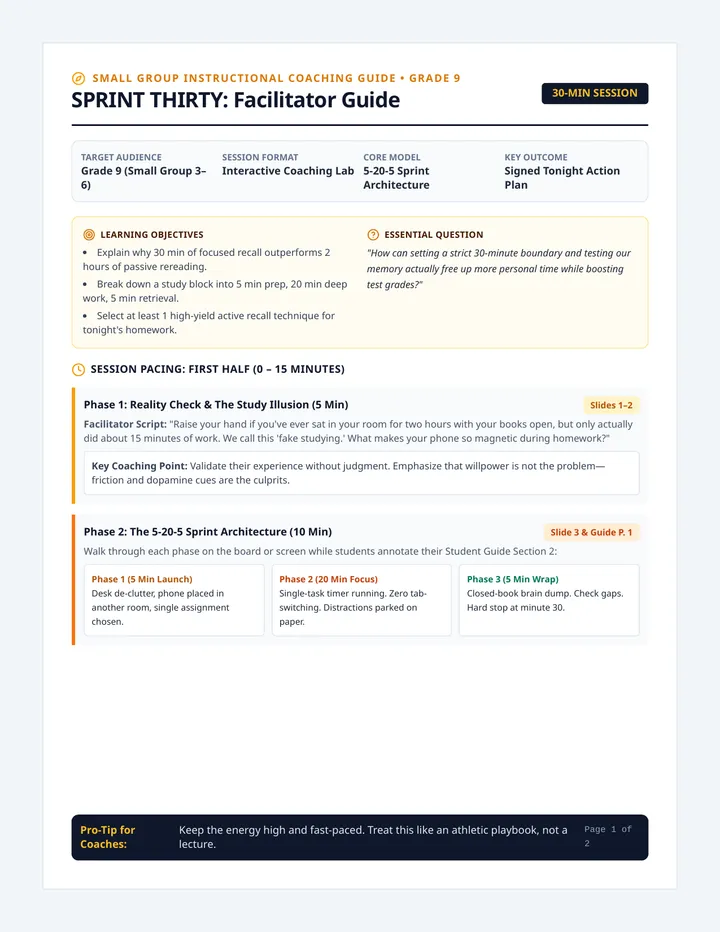
Sprint Thirty Facilitator Guide
Small Group Instructional Coaching Guide • Grade 9
SPRINT THIRTY: Facilitator Guide
30-MIN SESSION
Target Audience Grade 9 (Small Group 3–6)
Session Format Interactive Coaching Lab
Core Model 5-20-5 Sprint Architecture
Key Outcome Signed Tonight Action Plan
Learning Objectives
- Explain why 30 min of focused recall outperforms 2 hours of passive rereading.
- Break down a study block into 5 min prep, 20 min deep work, 5 min retrieval.
- Select at least 1 high-yield active recall technique for tonight's homework.
Essential Question
"How can setting a strict 30-minute boundary and testing our memory actually free up more personal time while boosting test grades?"
Session Pacing: First Half (0 – 15 Minutes)
Phase 1: Reality Check & The Study Illusion (5 Min) Slides 1–2
Facilitator Script: "Raise your hand if you've ever sat in your room for two hours with your books open, but only actually did about 15 minutes of work. We call this 'fake studying.' What makes your phone so magnetic during homework?"
Key Coaching Point: Validate their experience without judgment. Emphasize that willpower is not the problem—friction and dopamine cues are the culprits.
Phase 2: The 5-20-5 Sprint Architecture (10 Min) Slide 3 & Guide P. 1
Walk through each phase on the board or screen while students annotate their Student Guide Section 2:
Phase 1 (5 Min Launch) Desk de-clutter, phone placed in another room, single assignment chosen.
Phase 2 (20 Min Focus) Single-task timer running. Zero tab-switching. Distractions parked on paper.
Phase 3 (5 Min Wrap) Closed-book brain dump. Check gaps. Hard stop at minute 30.
Pro-Tip for Coaches: Keep the energy high and fast-paced. Treat this like an athletic playbook, not a lecture. Page 1 of 2
Session Pacing & Coaching Playbook
Live Micro-Drill & Student Objections
Minutes 15 – 30+
Phase 3: The 2-Minute Live "Micro-Blurt" Practice (8 Min) Slides 4–5
Experiential Drill: Don't just talk about active recall—make them feel it right now in the room:
- Have students read a quick paragraph or review 5 vocabulary words for 60 seconds.
- Instruct them to flip the paper face down completely.
- Start a 90-second timer: "Write down everything you remember. Don't worry about spelling—just dump."