Accountability Culture PD Guide
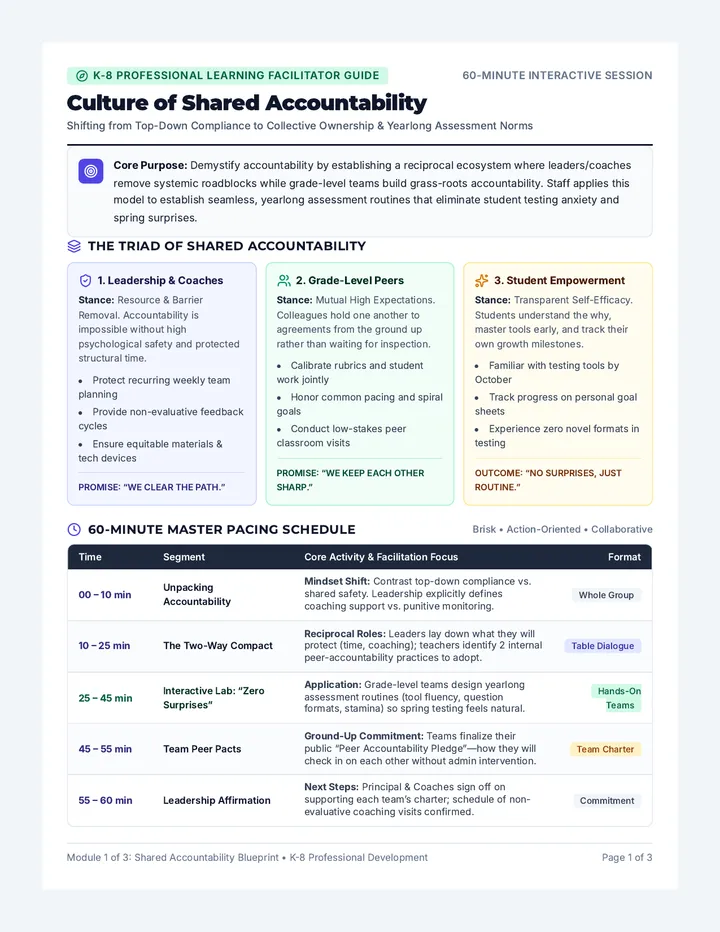
K-8 Professional Learning Facilitator Guide 60-Minute Interactive Session
Culture of Shared Accountability
Shifting from Top-Down Compliance to Collective Ownership & Yearlong Assessment Norms
Core Purpose: Demystify accountability by establishing a reciprocal ecosystem where leaders/coaches remove systemic roadblocks while grade-level teams build grass-roots accountability. Staff applies this model to establish seamless, yearlong assessment routines that eliminate student testing anxiety and spring surprises.
The Triad of Shared Accountability
1. Leadership & Coaches
Stance: Resource & Barrier Removal. Accountability is impossible without high psychological safety and protected structural time.
- Protect recurring weekly team planning
- Provide non-evaluative feedback cycles
- Ensure equitable materials & tech devices
Promise: “We clear the path.”
2. Grade-Level Peers
Stance: Mutual High Expectations. Colleagues hold one another to agreements from the ground up rather than waiting for inspection.
- Calibrate rubrics and student work jointly
- Honor common pacing and spiral goals
- Conduct low-stakes peer classroom visits
Promise: “We keep each other sharp.”
3. Student Empowerment
Stance: Transparent Self-Efficacy. Students understand the why, master tools early, and track their own growth milestones.
- Familiar with testing tools by October
- Track progress on personal goal sheets
- Experience zero novel formats in testing
Outcome: “No surprises, just routine.”
60-Minute Master Pacing Schedule
Brisk • Action-Oriented • Collaborative
| Time | Segment | Core Activity & Facilitation Focus | Format |
|---|
| 00 – 10 min | Unpacking Accountability | Mindset Shift: Contrast top-down compliance vs. shared safety. Leadership explicitly defines coaching support vs. punitive monitoring. | Whole Group |
| 10 – 25 min | The Two-Way Compact | Reciprocal Roles: Leaders lay down what they will protect (time, coaching); teachers identify 2 internal peer-accountability practices to adopt. | Table Dialogue |
| 25 – 45 min | Interactive Lab: “Zero Surprises” | Application: Grade-level teams design yearlong assessment routines (tool fluency, question formats, stamina) so spring testing feels natural. | Hands-On Teams |
| 45 – 55 min | Team Peer Pacts | Ground-Up Commitment: Teams finalize their public “Peer Accountability Pledge”—how they will check in on each other without admin intervention. | Team Charter |
| 55 – 60 min | Leadership Affirmation | Next Steps: Principal & Coaches sign off on supporting each team’s charter; schedule of non-evaluative coaching visits confirmed. | Commitment |
Module 1 of 3: Shared Accountability Blueprint • K-8 Professional Development Page 1 of 3
Facilitator Delivery Playbook Step-By-Step Guidance
Facilitation Script, Prompts & Coaching Stance
1
Opening Hook: Deconstructing the “A-Word” (10 Mins)
00:00 – 00:10
Leader Action: The Principal opens with intentional vulnerability. Acknowledge that “accountability” has historically felt like punitive clipboard walkthroughs or spring panic over test scores.
Facilitator Script Prompt: “True accountability cannot live on a spreadsheet managed by one person in an office. If accountability is only top-down, it builds anxiety and compliance. If it is shared, it builds collective efficacy, mutual pride, and peace of mind for our students.”
Table Turn (3 min): “What is one difference between an environment where people feel inspected versus one where people feel invested?”
2
The Two-Way Street: Leadership Enablers & Peer Ownership (15 Mins)
00:10 – 00:25
What Leadership & Coaches Protect:
- Guaranteed 50 min/week team planning without admin interruptions.
- Coaches model routines in classrooms upon teacher request.
- Interim data is used for grouping & re-teaching, never evaluation.
What Teachers Own Ground-Up:
- Addressing pacing lag directly with grade-level partner before escalations.
- Standardizing grading rubrics so students experience fair scoring.
- Welcoming peer drop-ins (10-min “pineapple visits”) to observe routines.
3
Framing the Interactive Lab: “Assessment Without Surprises” (20 Mins)
00:25 – 00:45
The Problem to Solve: Why do state assessments cause massive stress in April/May? Because the environment, stamina, question framing, and digital tools are often introduced too late.
1. Tool Familiarity Highlighters, equation editors, split-screen reading.
2. Stamina Sprints Building from 10 min (Q1) to 45 min (Q3) focused work.
3. Rigor spiraling Multi-step prompts embedded into weekly quizzes.
4. Calm Environment Lighting, desk arrangement, self-talk routines.
Facilitator Prompt: Direct participants to Page 3. Grade-level teams (K-2, 3-5, 6-8) map out their quarter-by-quarter routines and sign their accountability pact.
4
Closing: The Public Charter & Leadership Pledge (15 Mins)
00:45 – 01:00
Each team reads their Primary Peer Commitment aloud. School leadership writes down the exact support requested and signs their reciprocal backing. Post pledges in the faculty planning room.
Facilitator Tip for Pushback: If teachers say “we don’t want to police our peers,” reframe immediately: “Accountability isn't policing; it's keeping promises to kids and each other so no single teacher carries the burden alone.”
Module 2 of 3: Facilitation Protocol & Delivery Script • K-8 Professional Development Page 2 of 3
Interactive Team Planning Tool 20-Minute Collaborative Lab
The “Zero Surprises” Assessment Architecture & Team Compact
Grade Level / Team:
Team Members Present:
Assigned Coach / Admin Partner:
Part A: Yearlong Routine Cadence (Co-Designing Student Norms)
Embed seamlessly into existing weekly instruction
| Quarter | Core Student Norms to Establish | Our Team’s Concrete Practice Agreement |
|---|
| Q1: Launch Aug – Oct | Platform & Tool Comfort: Logins, scratch paper habits, digital highlighting, strike-through tools, navigating multi-part questions. | |
| Example: Bi-weekly warm-up on test platform; standardized scratch paper protocol across all classes. | | |
|
| Q2: Build Nov – Jan | Pacing & Stamina Sprints: Independent 25-minute quiet focus blocks. Error analysis routines; decoding question stems without adult prompts. |
Our Team Agreement:
|
| Q3: Polish Feb – Mar | Simulated Setting & Stamina: Full testing duration conditions. Affirmation self-talk, breathing routines, reviewing flagged questions. |
Our Team Agreement:
|
| Q4: Execute Apr – May | Zero Shock, Pure Routine: Room environment matches yearlong practice. Students sit down confident because every single norm was rehearsed. |
Our Team Agreement:
|
Part B: Our Ground-Up Peer Accountability Compact
1. As colleagues, we commit to each other that across all our classrooms we will consistently execute:
2. How we will hold each other accountable without admin intervention (e.g., bi-weekly peer work reviews, monthly pacing check-ins):
3. The one specific resource or structural boundary we require school leaders/coaches to protect:
Teacher Team Signatures (Mutual Peer Pact):
Coach / Administrator Sign-Off (Barrier Removal Pledge):
“Shared accountability turns high expectations into collective achievement.” Page 3 of 3
Accountability Culture Slides
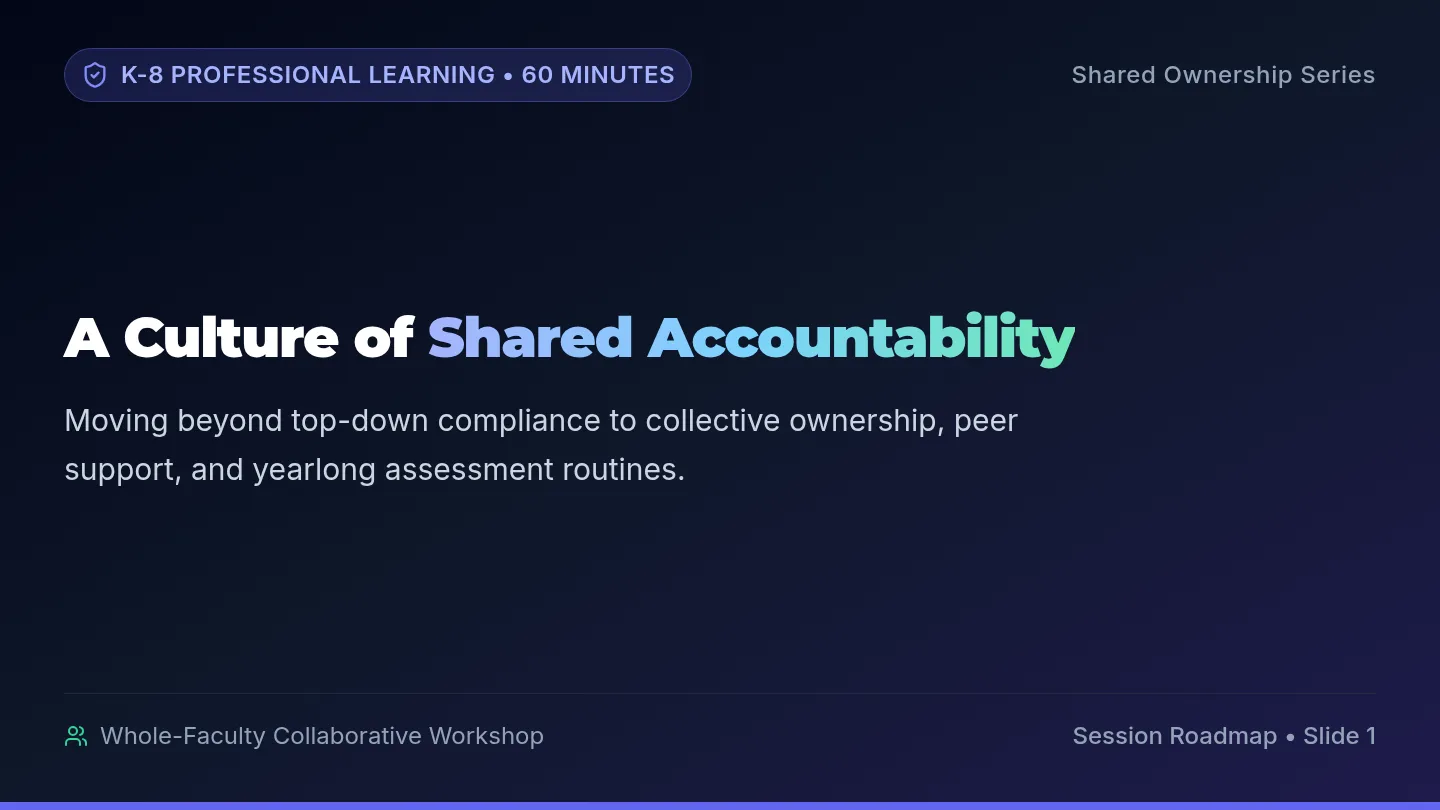
K-8 Professional Learning • 60 Minutes
Shared Ownership Series
A Culture of Shared Accountability
Moving beyond top-down compliance to collective ownership, peer support, and yearlong assessment routines.
Whole-Faculty Collaborative Workshop
Session Roadmap • Slide 1
The Mindset Shift
From Inspection to Collective Investment
Top-Down Compliance
- × Accountability feels like surveillance & inspection
- × Educators isolate behind closed doors in defense
- × April test panic caused by siloed practices
Result: High anxiety • Low psychological safety
Shared Accountability
- ✓ Accountability means keeping mutual promises to students
- ✓ Colleagues openly problem-solve & calibrate together
- ✓ Yearlong routine eliminates spring surprises
Result: High trust • Collective teacher efficacy
Key Question: How do we build accountability from the ground up? Slide 2
Reciprocal Roles
The Two-Way Street of Shared Ownership
Leaders & Coaches Protect
“We remove obstacles so you can focus on excellence.”
Guaranteed Planning Time: Zero non-essential interruptions.
Non-Evaluative Coaching: Modeling lessons & co-planning.
Equitable Tools: Hardware, platforms & materials stocked.
Teams Own Ground-Up
“We keep each other sharp and aligned across classrooms.”
Peer Calibration: Co-scoring student work and open math tasks.
Honest Pacing Checks: Addressing lags directly as peers.
Open Classrooms: 10-minute peer visits for shared routines.
When leadership supports, peer accountability thrives naturally. Slide 3
Applied Practice
Applying Accountability: “Zero Surprises” Assessments
“Students never struggle with what they routinely practice.”
State testing feels stressful only when conditions, tools, and stamina are treated as a spring novelty.
1. Tool Fluency
Logins, scratch paper, highlighters, equations.
2. Stamina Sprints
Scaling from 10 min to 45 min focus blocks.
3. Rigor Spiraling
Multi-step questions baked into weekly work.
4. Calm Norms