Reset Protocol Lesson Plan Educator Facilitation Guide
Reset Protocol Lesson Plan
Grades 6–8 Special Education
45–50 Minutes
Instructional Goal
Identify physical stress alerts and execute 4 somatic regulation moves independently.
Target Skills
Interoceptive awareness, vagal down-regulation, menu-based self-advocacy.
Materials Needed
Slides, Somatic Menu Activity, Desk Strip, wall space, sensory props.
Phase 1: The Body Radar Hook (8 Min)
Whole Group
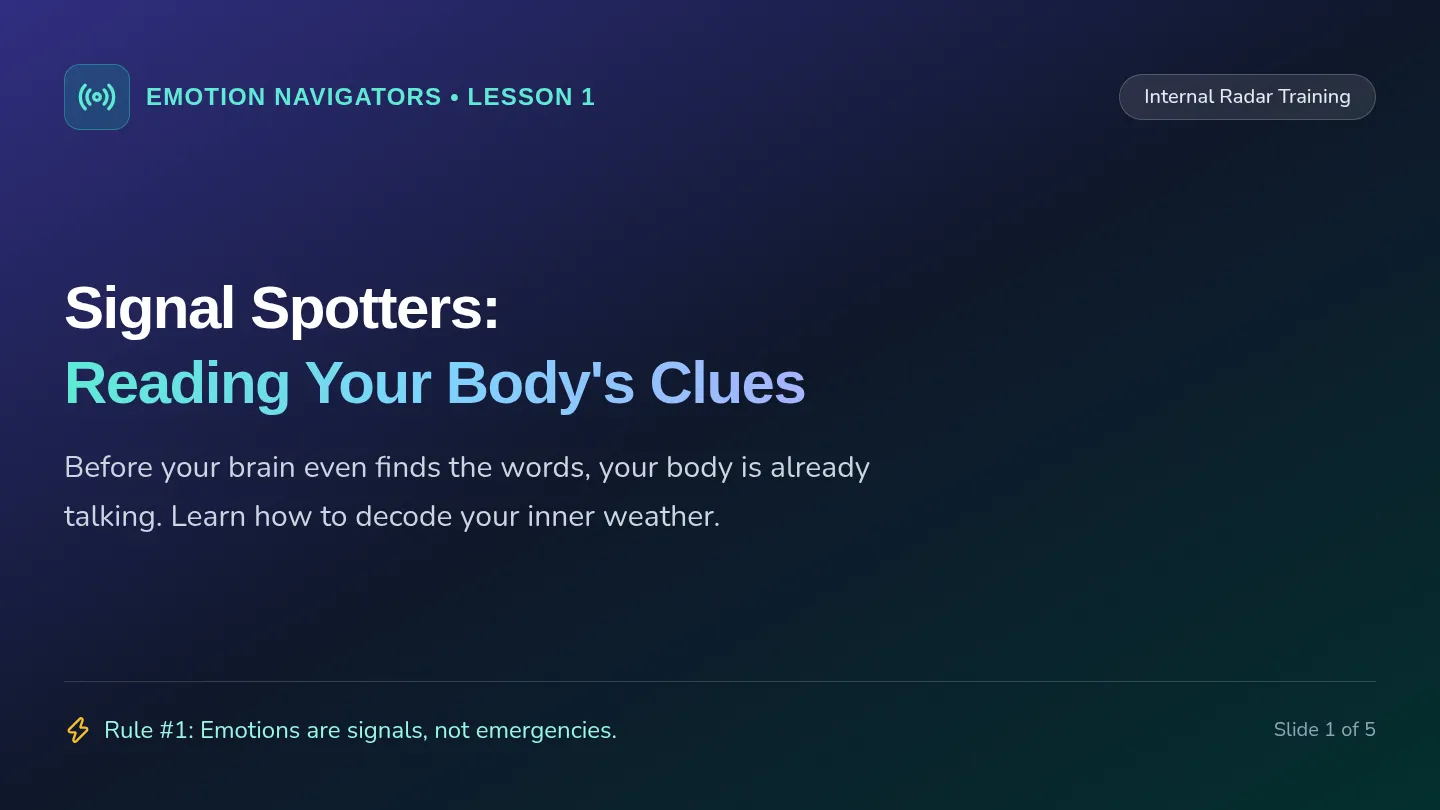
Concept: Our body sounds internal alarm bells before our brain even realizes we are frustrated or overwhelmed. We call this our Body Radar .
Teacher Script (Say Aloud):
"Notice right now: Are your shoulders up by your ears? Is your jaw clenched like a vise? Your body is an engine dashboard. Today we aren't telling you to 'just calm down.' We are learning physical switches to reset your nervous system."
Phase 2: Explicit Somatic Modeling (16 Min)
Model & Mimic
Introduce the 4 somatic resets. Teacher demonstrates physical mechanics first; students replicate.
1. Physiological Sigh (Lungs)
Action: Two quick sharp inhales through the nose, one long slow sigh out the mouth.
Script: "Sniff in once, top it off with one tiny sip of air, then let it melt all the way out like a deflating balloon."
2. Wall Press (Proprioception)
Action: Palms flat against solid wall at shoulder height. Push with 60% force for 7 seconds, release.
Script: "Give the wall heavy work. Push the tension out through your forearms. Feel your feet anchor to the floor."
3. Lemon Squeeze (Release)
Action: Make tight fists and squeeze shoulders high for 5 seconds. Drop instantly to limp spaghetti.
Script: "Squeeze all the sour juice out of the lemons. Hold it... now drop and shake out the noodles."
4. Horizon Scan (5-4-3-2-1)
Action: Orienting neck turn; name 3 blue objects, 2 textures under fingertips, 1 distant hum.
Script: "Turn your chin slowly left, then right. Tell your radar: 'I am safe in this room right now.'"
Trauma-Informed Principle Never force closed eyes or deep breathing if it creates breathlessness. Offer tactile alternatives.
PART 2
Guided Menu Assembly & Differentiation
Reset Protocol Framework
Phase 3: Visual Menu Assembly (15 Min)
Individual & Pairs
Distribute the Somatic Menu Activity . Students identify their personal primary stress signal (e.g., chest tightness vs. restless legs) and curate their top 3 quick-access reset tactics.
Step 1: Circle 2 body cues on the Body Radar map (e.g., clenching jaw, drumming fingers).Step 2: Match each body cue with a "low-profile" move (usable at desk) and a "high-reset" move.Step 3: Rehearse their chosen favorite move in pairs without speaking aloud.
Phase 4: Simulated Stress Drill & Cool-Down (8 Min)
Closing Ritual
Present a realistic middle school trigger (e.g., sudden pop quiz, chaotic hallway, lost assignment). Have students glance at their Pocket Reset Cool-Down strip and silently execute their primary move for 30 seconds.
SPED Differentiation & Accessibility Matrix
Learner Profile Observed Challenge Targeted Adaptation Autistic / Alexithymia Difficulty identifying internal feelings or body states verbally. Use visual heat-map stickers or color indicators (red/yellow) rather than feeling words. ADHD / Motor Restlessness Stillness or breathwork triggers additional fidgeting and impulsivity. Prioritize proprioceptive heavy work (wall push, desk press, chair dips) over stationary breathing. Low Motor Stamina / Dyspraxia Complex coordinated breath or multi-step physical poses cause fatigue. Pair down to 1 single step: "press palms together" or bilateral slow heel-taps. Anxiety / Breath Sensitivity Focusing on lungs or counting seconds can induce hyperventilation. Shift from internal breath focus to external sensory grounding (horizon visual search, cold surface touch).
Facilitator Success Indicators
✓ Student can name at least 1 localized somatic warning cue.
✓ Student selects a calming move without teacher prompting.
✓ Student performs technique without disrupting peers.
✓ Student rates post-reset state accurately on 1–5 scale.
Middle School Tier 1/Tier 2 Self-Regulation Curriculum Page 2 of 2
Body Radar Slides Somatic Self-Regulation Lab
Middle School Edition
The Reset Protocol
Reading Your Body Radar & Flipping Somatic Switches
Your body sounds internal alarm bells before your brain even knows why. Learn how to spot the signals and reset your nervous system.
Step 1: Detect Signals
Step 2: Choose Your Move
Step 3: Recharge Battery
Interoception Awareness
Your Body Is an Engine Dashboard
Warning Lights (Not Bad Choices)
A check-engine light is not in trouble—it is just sharing data. A tight jaw or racing heart is your body saying, "I need support right now."
You cannot talk your body out of stress; you must show it physically.
Somatic Means Physical
Telling yourself "just calm down" almost never works. Somatic resets send physical messages through your nerves directly to your brain's alarm center.
Physical inputs unlock physical calmness.
Today's Mission: Build your personal 3-step menu before the engine overheats.
Signal Detection
Where Do You Feel the Alarm?
Jaw & Face
• Clenched teeth
• Tight brow / forehead
• Hot or flushed cheeks
Chest & Lungs
• Fast shallow breathing
• Racing heartbeat
• Tight heavy band
Hands & Shoulders
• Balld-up fists
• Drumming fingers
• Shoulders up by ears
Belly & Legs
• Fluttering butterflies
• Bouncing knees
• Urge to run or hide
Quick Check: Which zone turned "ON" first for you today?
Technique Demonstration
Switch 1 & 2: Breath & Heavy Work
Move 1 Stealth / In-Seat
The Physiological Sigh
1. Sniff: Take a normal breath in through nose.
2. Extra Sip: Quickly inhale one more tiny bit.
3. Slow Sigh: Long, slow release through open mouth.
Why it works: Pops open collapsed lung sacs and rapidly slows your heart rate.
Move 2 High Proprioception
The Isometric Wall Press
1. Plant: Palms flat against a sturdy wall or heavy desk.
2. Push: Push hard for 7 solid seconds like moving it.
3. Release: Let arms drop limp; feel the tingling rush.
Why it works: Dumps adrenaline and gives joint receptors heavy grounding feedback.
Somatic Menu Activity Interactive Student Workbook
Somatic Menu Activity
The Reset Protocol
Name:
Date:
Period:
Mission: You are the lead engineer of your nervous system. Look over the body radar below. Circle or check the warning signals your body gives you when stress, frustration, or sensory overload starts to build up.
1 Part 1: My Personal Body Radar Scan
Check at least 1 or 2 warning lights that happen to your body:
Zone A: Head & Face
Clenched teeth or jaw ache Hot, red, or flushed cheeks Tight squinting eyes or forehead
Zone B: Chest & Heart
Heart beating fast like a drum Shallow, quick breathing Tight feeling in throat or chest
Zone C: Hands & Arms
Balld-up fists or digging nails Tapping pencil or drumming desk Cold or sweaty fingertips
Zone D: Stomach & Legs
Bouncing knees or kicking feet Knots, flips, or butterflies in stomach Urge to stand up or leave the room
2 Part 2: My #1 Early Alert Signal
A. My single most common physical warning sign is:
B. When this signal turns ON, how does it affect what I'm trying to do in class?
Turn to Page 2 to design your custom Somatic Reset Menu.
Self-Advocacy & Regulation Routine
My 3-Course Somatic Reset Menu
Page 2 of 2
Select 1 technique for each category so you always have an exact move ready when your body radar activates.
Course 1: Stealth Move (At My Desk / Invisible) Quiet Mode
Choose one stealth move to use during quiet work or tests:
Physiological Sigh: 2 quick inhales + 1 long slow exhale out mouth. Under-Desk Palm Press: Press palms down firmly into tops of thighs for 6 sec.
My personal stealth note:
Course 2: Power Move (Heavy Work & Muscle Release) High Tension
Choose one power move to dump physical frustration or high energy:
Isometric Wall Push: Flat hands on sturdy wall, push 7 sec, release. Lemon Squeeze: Tight fists & shoulders pulled high for 5 sec, drop limp.
My personal power note:
Course 3: Sensory Anchor (Grounded Orienting) Brain Reset
Choose one sensory grounding move to stop racing thoughts:
The Horizon Scan: Turn chin left to right; locate 3 blue things in room. Tactile Cold Press: Touch cool metal desk leg or water bottle with 2 hands.
My personal anchor note:
Pocket Reset Cool-Down Exit Ticket & Reflection
Pocket Reset Cool-Down
The Reset Protocol
Name:
Date:
Period:
1. Battery Check-In: How energized / calm does your nervous system feel right now?
1 Overheating
2 Alert / Jittery
3 Balanced
4 Calm / Focused
5 Fully Grounded
2. My primary stress signal is:
3. The 1 move I will try first:
4. When during my school day do I think I will need to use this reset?
Cut Along Dotted Line To Keep At Your Desk or in Binder
Portable Personal Reset Cards (Tear or cut out for daily use)
My Reset Menu DESK STRIP
🫁 1. Physiological Sigh 2 quick nose sniffs + 1 long mouth sigh.
🧱 2. Wall / Desk Push Push palms with 60% force for 7 seconds.
🍋 3. Lemon Squeeze Squeeze fists & shoulders 5 sec → drop limp.
👀 4. Horizon Scan Slow head turn; spot 3 blue things + plant feet.
Body Alarm ON → Pick 1 Move 30 Seconds
Silent Signal Card COMMUNICATION
My Silent Signal to Teacher: Place this card face-up on corner of desk when executing a 1-minute reset.
What I need right now:
1 minute of quiet at my desk Quick water break / hallway wall push Clarification on directions
Self-Regulation in Action Middle School SPED
The Reset Protocol • Somatic Self-Regulation Curriculum