Signal Spotters Slides Emotion Navigators • Lesson 1
Internal Radar Training
Signal Spotters:
Reading Your Body's Clues
Before your brain even finds the words, your body is already talking. Learn how to decode your inner weather.
Rule #1: Emotions are signals, not emergencies.
Slide 1 of 5
The Body as an Early Alert System
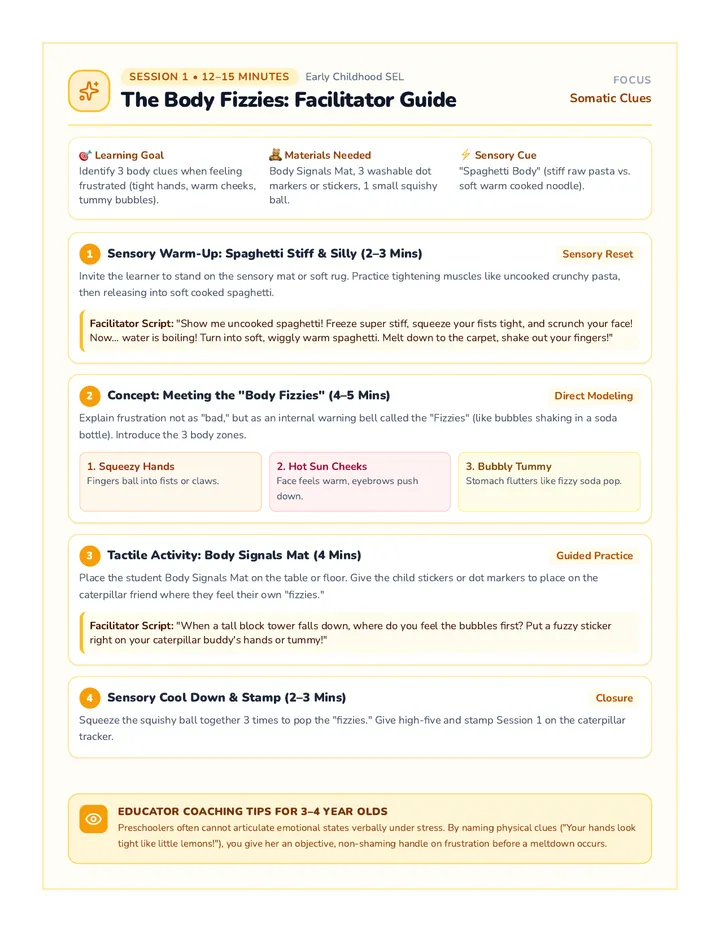
Physical Sensation
Chest & Heart
Rapid thumping, shallow breaths, or a heavy tightening sensation.
Often signals: Nervous, startled, panicked
Muscles & Heat
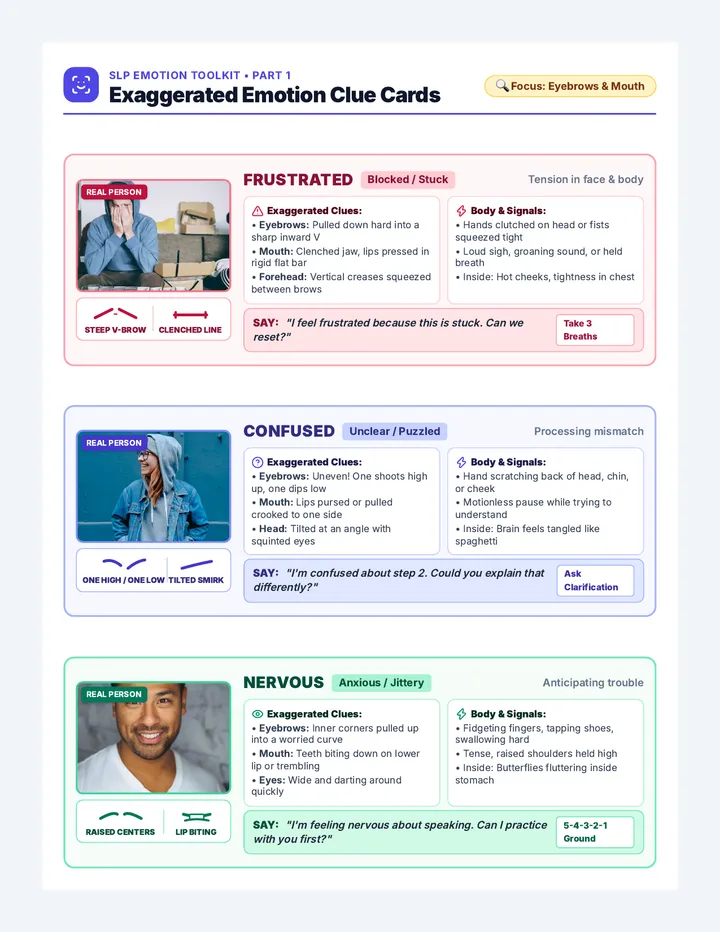
Clenched jaw, tight fists, warm neck, or restless bouncy energy.
Often signals: Frustrated, irritated, guarded
Gut & Shoulders
Fluttering butterflies, a hollow drop, or shoulders hiking up to ears.
Often signals: Anxious, weary, uncertain
Key takeaway: When you notice the physical clue, you can pause before reacting. Slide 2 of 5
The Four Weather States
Naming the Zones
Low Tide
Tired, lonely, sad, bored, or slow moving.
Needs Recharging
Steady Flow
Calm, focused, content, ready to connect.
Ready to Learn
Sparked Up
Frustrated, silly, worried, or restless.
Needs a Pause
Overdrive
Furious, terrified, overwhelmed, explosive.
Needs Immediate Safety
All zones are normal human experiences. There are no "bad" feelings. Slide 3 of 5
The 1-to-5 Intensity Scale
Gauge Your Meter
5
Overwhelmed / Explosive
Thinking brain is completely offline. Immediate timeout and reset needed.
4
Highly Triggered
Voice getting loud, heart racing, hard to listen or follow instructions.
3
Mild Irritation / Nervous Flurry
First physical signs appear. The best moment to use a calming tool.
1-2
Grounded & Settled
Relaxed body, open mindset, ready to collaborate and problem-solve.
Catching your feeling at Level 3 prevents you from spiking to Level 5 . Slide 4 of 5
Partner Check-In Challenge
Put It Into Practice
Turn to your neighbor and complete this 2-step scan:
1 Step 1: Check your physical signal
"Right now, my shoulders feel [tight/relaxed], my breathing is [fast/slow], and my energy is [high/low]."
2 Step 2: Name your number & zone
"I'm at a Level [1 to 5], which puts me in the [Zone Name] state."
🎯 Today's Goal: Build awareness without judgment. Whatever zone you are in is valid!
Next up: Complete your Body Clues Navigator Map. Slide 5 of 5
Body Clues Worksheet Emotion Navigators • Lesson 1
Body Clues Explorer
Name:
Date:
Mission: Notice what your body feels before big emotions take over. Your physical signals are early alerts! Self-Awareness
1
The Body Signal Radar
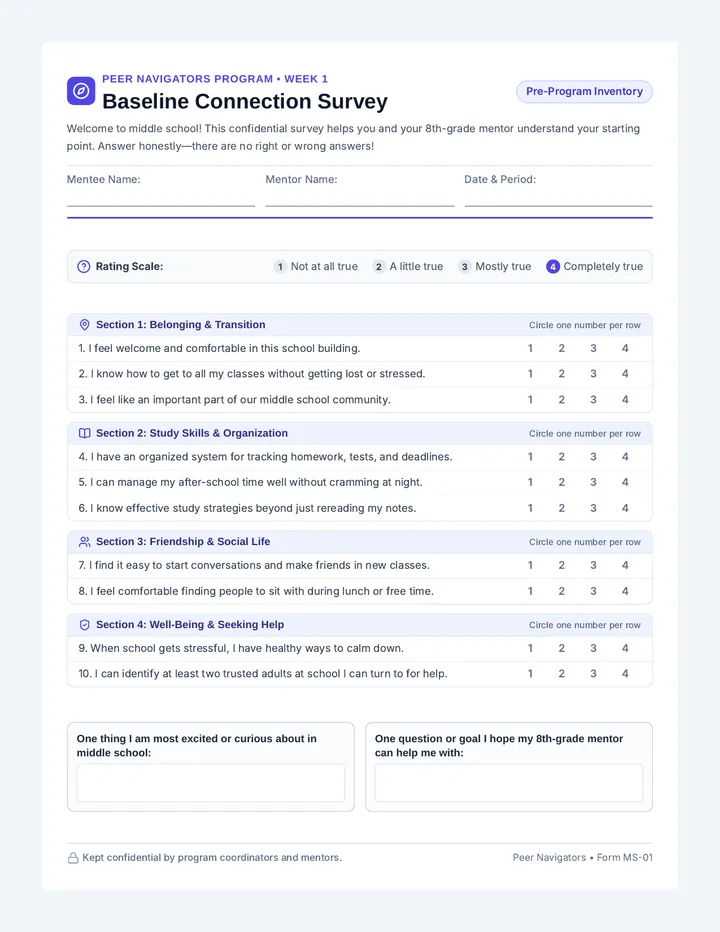
Review the physical clues below. Check the boxes that you notice in your own body when experiencing big feelings.
Head & Face
Racing thoughts / foggy Clenched teeth or tight jaw Warm or blushing cheeks
Heart & Chest
Heart thumping fast Quick, shallow breathing Tight, squeezed chest
Stomach & Hands
Fluttering "butterflies" Clenched fists or fidgeting Hunched / stiff shoulders
2
Emotion Vocabulary Vault
Move beyond "fine" or "mad." Match each word from the bank to its most accurate clue description.
[A] Overwhelmed [B] Restless [C] Frustrated [D] Guarded [E] Content
1. Trying repeatedly to solve a tricky task and feeling heat rise in your neck and hands:
Letter:
2. Too many sounds, deadlines, or people speaking all at once, making your thoughts spin:
Letter:
3. Body feels heavy, arms crossed, wanting to pull away and protect your personal space:
Letter:
3
My Personal Early Warning Signal
Think about the last time you felt annoyed, worried, or rushed. What was the very first clue your body gave you?
My #1 physical clue that my feelings are heating up is:
When this happens, my Emotion Intensity Level (1 to 5) is usually:
Level 1-2 (Mild) Level 3 (Alert) Level 4 (High) Level 5 (Peak)
One word from the vocabulary vault that best describes this state:
Emotion Navigators Workbook • Lesson 1 Practice Remember: Clues are neither good nor bad—they just help you steer!
Calm Control Slides Emotion Navigators • Lesson 2
Regulation Toolkit
Reset & Regulate:
Downshifting Your Alarm System
When feelings spark up to Level 3 or 4, talking won't work until your body feels safe. Here is how to hit reset.
Calming your nervous system is a trainable physical skill.
Slide 1 of 6
The Upstairs & Downstairs Brain
Brain Science
Upstairs Brain
The Prefrontal Cortex: responsible for problem-solving, empathy, patience, and clear speech.
Works best when heart rate and breathing are steady.
Downstairs Brain
The Amygdala: responsible for rapid survival (fight, flight, freeze). Reacts in milliseconds.
Takes over when you feel threatened, frustrated, or rushed.
When the downstairs alarm sounds, your upstairs brain disconnects. Resetting brings it back! Slide 2 of 6
Reset Tool 1: Breathwork Patterns
Somatic Shift
Box Breathing
Equalized pacing that tells the vagus nerve that you are completely out of danger.
Inhale (4s)
Hold (4s)
Exhale (4s)
Hold (4s)
Physiological Sigh
The fastest biological way to drop heart rate in under 30 seconds.
1. Inhale deeply through nose.
2. Add a quick "sip" of air at the top.
3. Long, unhurried mouth exhale (6-8s).
Class rehearsal: Let's do two physiological sighs together right now. Slide 3 of 6
Reset Tool 2: 5-4-3-2-1 Grounding
Sensory Scan
5
5 Things You Can See: Spot subtle items around the room (a shadow, a pattern, a tile line).
4
4 Things You Can Touch: Notice the chair under your legs, desktop surface, fabric of your sleeve.
3
3 Things You Can Hear: Identify quiet ambient sounds (the AC hum, footsteps in hallway, pencil scratch).
2
2 Things You Can Smell: Notice the scent of pencil cedar, fresh air, or clean paper.
1
1 Grounding Truth: Tell yourself: "I am safe in this room right now. I can handle this step by step."
Grounding pulls your attention away from racing thoughts and back to the present moment. Slide 4 of 6
Reset Tool 3: Physical Discharges
Reset Toolkit Activity Emotion Navigators • Lesson 2
Reset Toolkit & Calm Lab
Name:
Date:
Goal: Test each regulation tool, discover what soothes your nervous system, and build your emergency plan. Self-Regulation
1
Strategy Lab: Rehearse & Rate
Try each technique right now for 30 seconds with your class, then rate how calming it feels to your body.
Box Breathing
Breathe in 4 counts, hold 4, breathe out 4, hold 4. Repeat 3 times.
Effectiveness for me:
(1 to 3)
5-4-3-2-1 Grounding
Silently identify 5 sights, 4 physical textures, 3 ambient room sounds.
Effectiveness for me:
(1 to 3)
Muscle Release
Tense shoulders up for 5 seconds, drop completely, or slow butterfly tap.
Effectiveness for me:
(1 to 3)
2
Matching Strategy to the Moment
Different emotional energies need different release methods. Connect each situation to its best reset tool.
Situation A: Your body has intense physical frustration; your fists are clenched and you feel like yelling.
Best tool:
Situation B: Your mind is racing before a presentation; your heart is beating fast and hands are shaky.
Best tool:
Situation C: You feel disconnected, spaced out, or overwhelmed by hallway chatter and bright lights.
Best tool:
3
My Personal Go-To Reset Blueprint
Write down your personal protocol so you don't have to guess when your alarm goes off.
1. When my intensity meter hits Level 3, my primary calming tool is:
2. A physical reset I can do discreetly at my desk without drawing attention:
3. A calming self-talk phrase I will silently repeat to myself:
Emotion Navigators Workbook • Lesson 2 Practice Keep this sheet handy as your personal quick-reference reset manual!
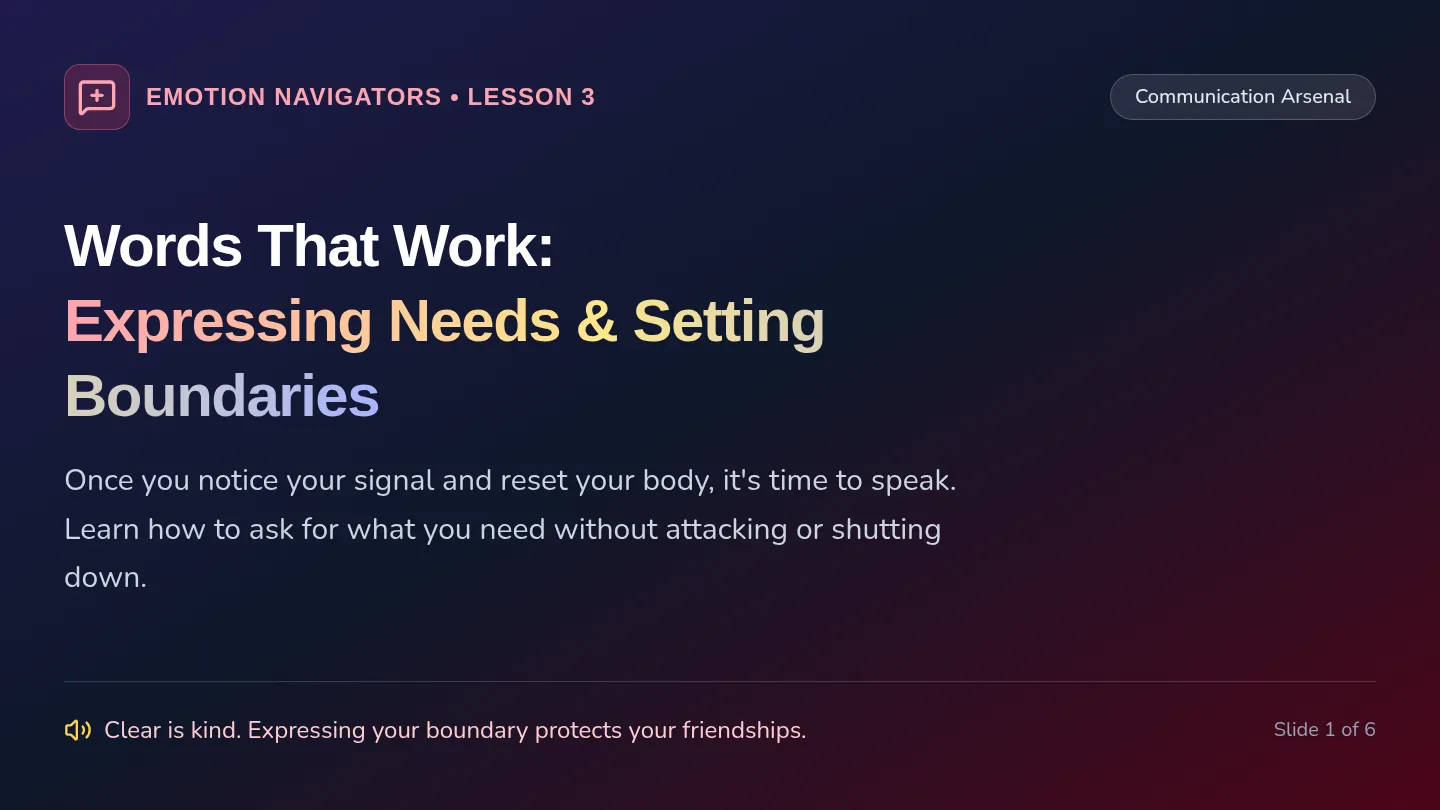
Speaking Up Slides Emotion Navigators • Lesson 3
Communication Arsenal
Words That Work:
Expressing Needs & Setting Boundaries
Once you notice your signal and reset your body, it's time to speak. Learn how to ask for what you need without attacking or shutting down.
Clear is kind. Expressing your boundary protects your friendships.
Slide 1 of 6
Three Ways to Communicate
Finding The Sweet Spot
Passive
Swallowing feelings down, saying "it's fine" when it's not, hoping people read your mind.
Result: Resentment builds inside until you burst.
Aggressive
Blaming, insulting, yelling, using "You always..." or "You never..." accusations.
Result: Others become defensive and stop listening.
Assertive
Honest, calm, firm, and respectful. Naming the issue and stating what you need directly.
Result: You are heard and relationships are preserved.
Assertive communication protects your peace without hurting others. Slide 2 of 6
The 3-Part Voice Formula
Blueprint
Part 1
"I feel [Emotion Word]..."
Name your internal state (overwhelmed, distracted, crowded, rushed) instead of blaming.
Part 2
"...when [Observable Fact] happens..."
Describe the specific event like a video camera recording, without name-calling or judging.
Part 3
"...I need [Concrete Action / Solution]."
Tell the person exactly what would help fix the problem right now.
Example: "I feel stressed when my desk is crowded. I need you to slide your binder to your side." Slide 3 of 6
The Four Essential Requests
Quick Scripts
1. Asking for Space
"I'm feeling overloaded right now. I need 2 minutes of quiet to reset before we talk."
2. Asking for Help
"I feel stuck on step two. I need you to walk me through the first example."
3. Asking for Time
"I feel rushed. I need another minute to finish this sentence before answering."
4. Asking for Comfort
"I had a tough morning. I need someone to sit with me at lunch and just listen."
Notice how every script ends with a specific, doable action. Slide 4 of 6
Social Scenarios in Action
Peer Practice
Scenario: Partner cuts you off during group work Friction
❌ "Stop being so rude and bossy!"
Needs In Action Worksheet Emotion Navigators • Lesson 3
Needs In Action Practice
Name:
Date:
Voice Formula: "I feel [Emotion] when [Trigger]. I need [Request]." Communication
1
Transform the Reaction
Rewrite these reactive knee-jerk statements into assertive 3-part requests.
Situation 1: Group partner keeps tapping pencil loudly and ignoring the assignment. Blaming: "You are so annoying, stop it!"
I feel:
When:
I need:
Situation 2: A peer looks over your shoulder during independent quiet work. Passive: Slumping, covering paper, saying nothing
I feel:
When:
I need:
2
Boundary Bank
Match each request type to the phrase that best fits when speaking with friends, teachers, or family.
A
Need Space: "I'm feeling overwhelmed. I need 3 minutes alone."
B
Need Help: "I'm stuck on question 2. Can you explain the directions?"
C
Need Time: "I feel pressured. Please give me a moment to think."
D
Need Listening: "I don't need advice right now; I just need to be heard."
Take-Home Pocket Cards (Cut & Keep in Backpack or Binder)
Daily Regulation Reference
Pocket Reset Protocol
Notice body clues (jaw, breathing, fists).
Take 3 slow box breaths (4-4-4-4).
Drop shoulders down away from ears.
Pocket Boundary Script
• "I feel [feeling] when [action]."
• "I need [request]."
Clear, calm, and respectful.
Emotion Navigators Workbook • Lesson 3 Practice & Take-Home Resource Expressing your needs is a strength, not a weakness!