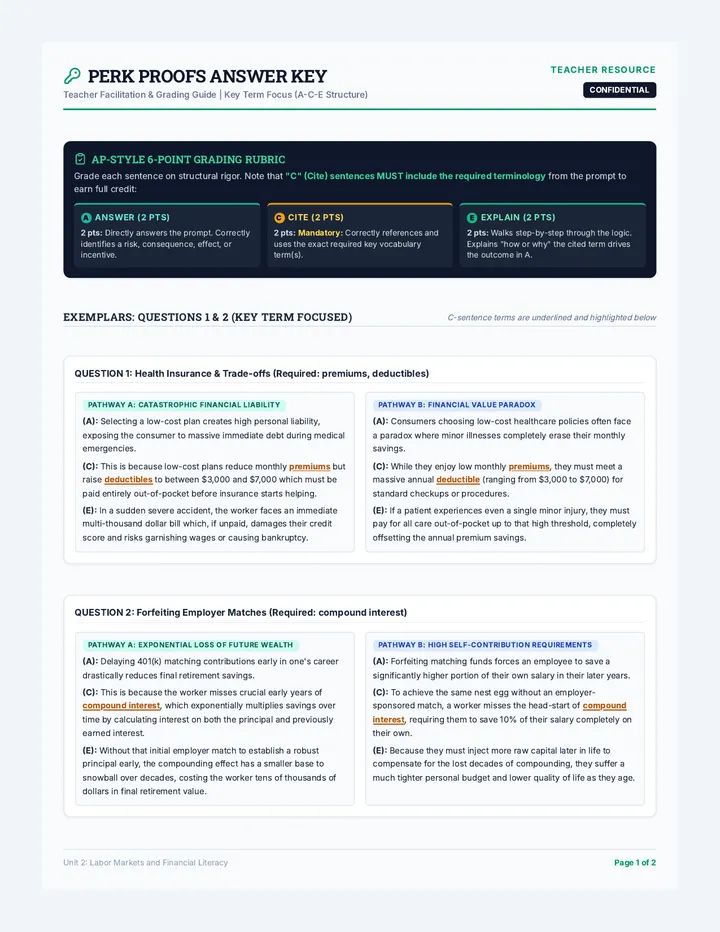
(E): Without that initial employer match to establish a robust principal early, the compounding effect has a smaller base to snowball over decades, costing the worker tens of thousands of dollars in final retirement value.
Pathway B: High Self-Contribution Requirements
(A): Forfeiting matching funds forces an employee to save a significantly higher portion of their own salary in their later years.
(C): To achieve the same nest egg without an employer-sponsored match, a worker misses the head-start of compound interest, requiring them to save 10% of their salary completely on their own.
(E): Because they must inject more raw capital later in life to compensate for the lost decades of compounding, they suffer a much tighter personal budget and lower quality of life as they age.
Unit 2: Labor Markets and Financial Literacy Page 1 of 2
Part 2: Exemplars & Facilitation Tips TEACHER KEY
QUESTION 3: No-Benefit Scenarios (Required: unpaid leave)
Pathway A: Direct Income Volatility
(A): For self-employed individuals, any sickness, holiday, or vacation results in an immediate and direct drop in household income.
(C): This is because self-employed or non-salaried workers fall into the category of unpaid leave, where they earn zero wages for any time spent away from active business operations.
(E): Because there is no corporate safety net to maintain active paycheck cash flows, these workers must absorb 100% of the financial loss, causing high household budget instability.
Pathway B: Business Overhead Costs
(A): Business owners face a double financial penalty when they are injured or take vacation days.
(C): In addition to being subjected to personal unpaid leave where they do not receive a wage, they continue to lose operational money due to ongoing business overhead costs.
(E): Since fixed business costs (like rent or software) must still be paid while the owner is sick and unable to generate active revenues, taking a break directly drains the firm's cash reserves.
QUESTION 4: Employer Tuition Incentives (Required: tuition reimbursement OR professional development)
Pathway A: Workforce Productivity Gains
(A): Companies invest heavily in employee education to optimize staff capabilities and elevate corporate profits.
(C): They achieve this by funding programs like professional development (employer-supported training and certifications) to systematically improve staff career skills.
(E): Because a highly trained employee operates with far greater efficiency, accuracy, and output, the business recaptures the training costs through enhanced organizational revenue and reduced waste.
Pathway B: Talent Recruitment & Retention
(A): Offering education perks acts as a powerful strategic tool for human resource recruitment and retention.
(C): Employers utilize benefits such as tuition reimbursement to pay back the cost of approved college courses, making their job offers highly attractive to top-tier talent.
(E): Because workers value free higher education, they stay with the firm longer, which directly reduces company costs associated with employee turnover and retraining.
Common Student Pitfalls (AP Style):
ACE Framework Grading Hacks:
Unit 2: Labor Markets and Financial Literacy Page 2 of 2