3. Somatic Mapping (5 min): Guide students to trace their hands over their workbook volcano page. "Put your hand on your heart. Can you feel its tap-tap-tap? Now squeeze your shoulders tight up to your ears—feel that tension. That is body fizz!"
The Action: Students wiggle their fingers, toes, and arms quickly, building up somatic "fizz" on command.
The Cues: "Fizzy hands! Fizzy feet! Heat is rising! The volcano is about to erupt..."
The Release: Facilitator calls "SODA TOP ON!" Kids lock hands, take a massive slow breath, and release tension instantly.
Ask: "When our personal volcano erupts in class, how does that affect the classroom weather? How can catching our fizz early show our classmates that we care about keeping them safe?"
Impulse Pilots Curriculum Page 2
Facilitator Handbook: Week 3 Duration: 30 Mins
Focus: Training spatial boundaries, core alignment, and seated physical stability.
Students will conceptualize and practice keeping their somatic energy inside an invisible "Space Bubble" to regulate excessive squirming, sliding, and intrusive touching.
1. Welcome & Volcano Check (5 min): "Did anyone notice their volcano fizzing this week? Where did you feel it?" Celebrate physical self-awareness.
2. Scripted Intro (7 min): "Every astronaut pilot has an invisible flight suit. Inside your suit, you have a Space Bubble. It's about an arm's-length wide all around you. Your Space Bubble keeps your body and wiggles safe inside, and protects your neighbor's bubble too! If you roll out of your chair, touch your friend's hair, or kick their desk, you are popping bubbles! Let's practice blowing our invisible, elastic Space Bubble now."
3. Somatic Mapping (5 min): Have kids extend their arms fully. "Draw the edges of your bubble in the air. Breathe in as it grows. Put your feet firmly on the floor—these are your anchor pads. Squeeze your stomach muscles slightly. Feel how strong and anchored your body feels when you keep it inside your bubble."
The Setup: Students stand and blow an imaginary giant, sticky bubble around themselves.
The Orbit: Students must navigate the room slowly without letting their bubbles touch another person or object.
The Target: On "CAPTAIN CO-PILOT!" they must freeze instantly, lock feet to the ground, and tuck their arms inside.
Ask: "When we pop other people's space bubbles, how do you think they feel? How does keeping our wiggles inside our bubble show our group that we respect them?"
Impulse Pilots Curriculum Page 3
Facilitator Handbook: Week 4 Duration: 30 Mins
Focus: Regulating volume levels (0-4) and building somatic control over vocal cords.
Students will map their vocal outputs onto a 0-4 "Voice Dial" scale and practice the somatic muscles of "voice checking" to prevent blurting out.
1. Welcome & Bubble Review (5 min): "Did you defend your Space Bubble this week? Did you pop anyone else's?" Briefly share.
2. Scripted Intro (7 min): "Have you ever heard a radio blasting music so loud it makes your head throb? (Pretend to cover ears). Our vocal cords have their own volume remote—a Voice Dial from 0 to 4. Level 0 is complete radio silence. Level 1 is a pilot whisper. Level 2 is normal crew chat. Level 3 is playground launch control. Level 4 is emergency screaming. Sometimes, we speak at Level 4 in a Level 1 classroom! Let's master our dial."
3. Vocal Control Exercise (5 min): Guide students to hold their throat gently with two fingers. "Say 'Aah' at Level 2. Feel the vibrations in your throat. Now twist your dial down to Level 0. Squeeze your lips slightly together and hum silently. Feel how you can lock your voice dial in place!"
The Setup: The facilitator holds an imaginary giant dial. Students repeat a fun word (e.g., "Rocket!").
The Dial Adjust: Facilitator changes the dial from Level 2 to Level 0, to Level 1, to Level 3.
The Target: Students must instantly match their voice to the dial, practicing stopping sudden vocal outbursts.
Ask: "When someone uses a Level 3 voice when the class is at a Level 0 or 1, how does that disrupt the team's brainwaves? How does matching our dial help everyone work together?"
Impulse Pilots Curriculum Page 4
Facilitator Handbook: Week 5 Duration: 30 Mins
Focus: Calming high-velocity motor energy through anchoring breaths and muscle relaxation.
Students will master somatic "braking systems"—such as the 4-7-8 anchor breath and progressive muscle clamping—to slow down sudden high-speed physical impulses.
1. Welcome & Voice Dial Review (5 min): "Did anyone catch themselves shouting and turn down their Voice Dial this week?" Reward conscious vocal control.
2. Scripted Intro (7 min): "Imagine a speedboat racing across a lake at full speed. Zoom! (Pretend to zoom across the table). Sometimes our motor energy is like that speedboat. It races ahead and doesn't know how to slow down. If we try to turn or stop too fast without braking, we crash! Today we learn to drop our anchors and slow our speedboats. Our anchors are our lungs and our heavy muscles."
3. Anchor Breath Training (5 min): Guide students to sit back. "Place one hand on your belly. Breathe in slowly through your nose for 4 seconds... hold it for 3 seconds... then breathe out of your mouth with a soft 'whoosh' for 5 seconds. Feel your heavy anchor dropping to the lake floor."
The Setup: Students stand and run/jog rapidly in place, acting like high-speed motorboats.
The Storm: "The waves are high! Speedboat is moving too fast! Prepare to anchor!"
The Drop: On "ANCHOR DOWN!", students sit, plant feet, drop their chin, and execute 3 perfect anchor breaths.
Ask: "When our speedboat is zooming too fast in class, how does that disrupt our classmates? How does dropping our somatic anchor protect our friends and our teachers?"
Impulse Pilots Curriculum Page 5
Facilitator Handbook: Week 6 Duration: 30 Mins
Focus: Post-curriculum assessment, personal goal commitment, and graduation ceremony.
Students will demonstrate self-regulation milestones, complete their post-tests, design an actionable "Personal Flight Plan," and celebrate with a graduation badge.
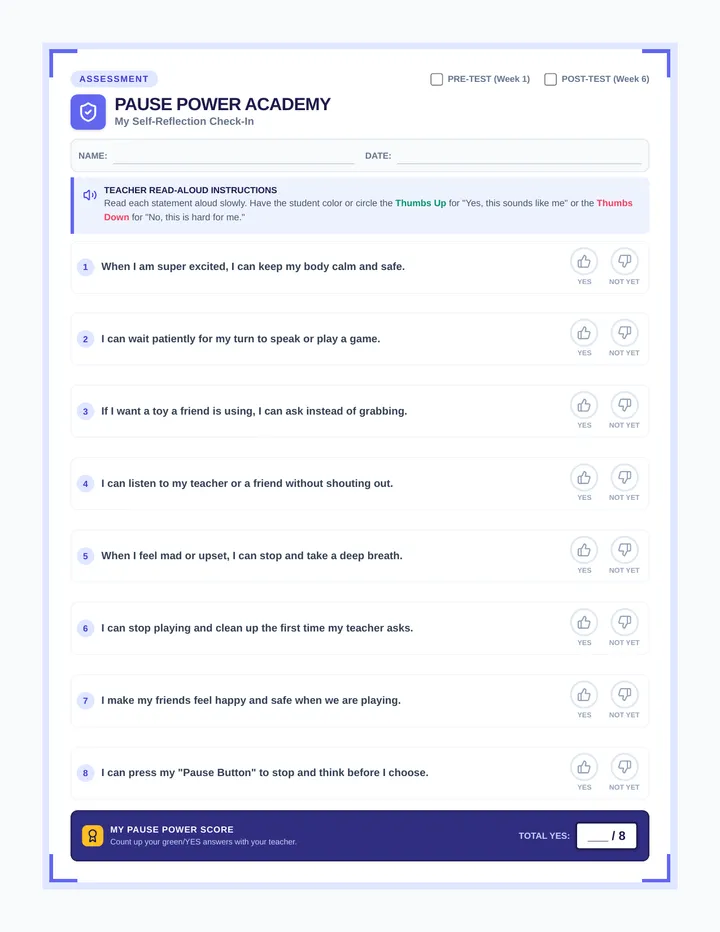
1. Welcome & Post-Test (8 min): Welcome back, pilots! Administer the Flight Check Assessment (Post-Test). Keep scoring light and positive.
2. Scripted Intro & Reflection (7 min): "Cadets, we have trained for 6 weeks. We learned to find our PAUSE button, trace our FIZZ, protect our SPACE BUBBLE, turn down our VOICE DIAL, and drop our SPEEDBOAT ANCHOR. You are no longer cadets—today, you are officially Certified Impulse Pilot Captains! But to fly a plane safely, every captain needs an official flight plan."
3. Designing the Flight Plan (5 min): Guide students to open their workbook graduation page. They will select their favorite somatic "tool" (Remote, Volcano, Bubble, Voice, or Anchor) and draw or write how they will use it when they go back to their regular classrooms.
The Launch: Students stand and pretend to fly their jets gracefully, exhibiting calm body boundaries and a Level 1 humming sound.
Turbulence Challenge: Facilitator calls "Turbulence!" (Students pretend to hit bumpy skies but keep their wings controlled and space preserved).
The Landing: "Safe landing!" Pilots sit down quietly, cross legs, take an anchor breath, and receive their graduation badge.
Ask: "What is your commitment to your classmates and teacher? How will you help make your classroom a calm, safe place for everyone to learn this school year?"
Impulse Pilots Curriculum Page 6
Pilot Cadet Manual Mission 4 (Page 4)
Mission 5: High-Speed Energy Pilot Cadet Workbook
Pilot:
Date:
Use your finger or pencil to trace along the anchor trail. Breathe in as you go up, hold at the peak, and whoosh out as you slide down!
Inhale 4 Sec (Slide Up) Hold 3 Sec (Hold Steady) Exhale 5 Sec (Drop Anchor)
Start Hold Mindfully Anchored
Do this 3 times in a row when your speedboat starts to speed out of control!
Pilot Cadet Manual Mission 5 (Page 5)
Mission 6: Graduation Pilot Cadet Workbook
Pilot:
Date:
Choose your favorite tool and draw/write how you will use it to keep your cockpit calm!
📺 Pause Remote
🌋 Fizz Detector
🫧 Space Bubble
🎛️ Voice Dial
⚓ Anchor Breath
"I promise to use my somatic flight controls to keep my classroom safe, respect my classmates' space, and help our group stay focused and happy!"
Certified Pilot Signature
Co-Pilot (Teacher Signature)
Pilot Cadet Manual Mission 6 (Page 6)