A comprehensive 6-week social work group curriculum for third graders. Focuses on emotion regulation, perspective-taking, sharing, and peer interactions through guided sessions and printable student activity workbooks.
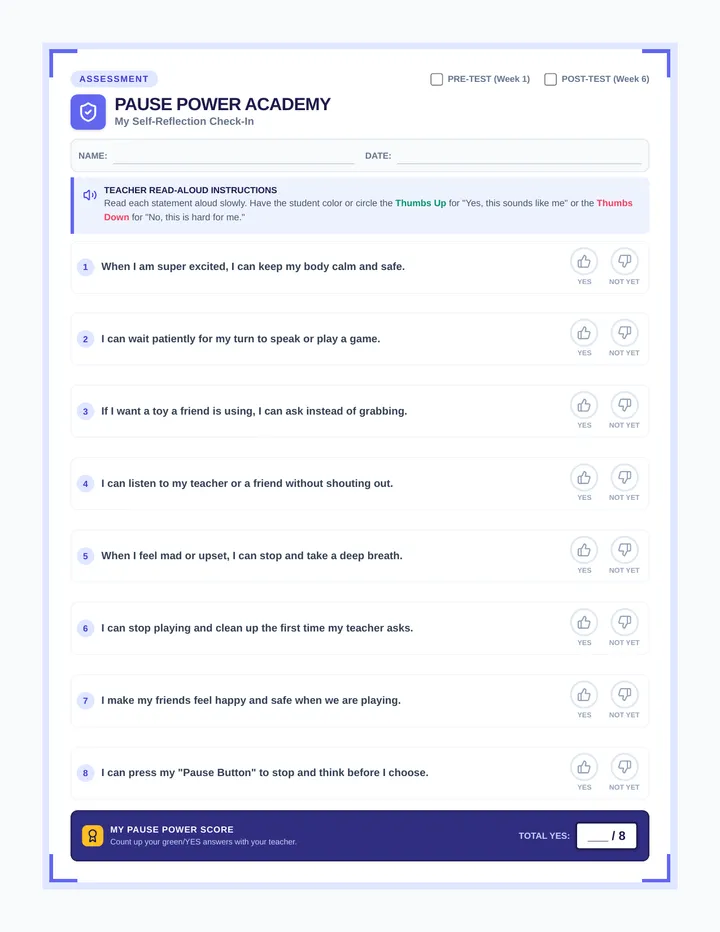
"Scientists, before we start inventing friendship formulas, we need to know where our lab starting point is. I'm handing you each a Friendship Growth Tracker. Read along with me as I read each statement out loud. Think about yourself at school and color the emoji that is the most true. Be completely honest! Nobody else will judge your score."
Step-by-Step Read Aloud Plan:
1. Read statements 1-4 (Emotions & Size of Problem). Check for comprehension on "reactions" vs "situations".
4. Walk students through Page 2. Help them count emojis, write scores, and perform calculations. Write simple goals.
4. Group Check-Out & Lab Goal
5 Mins
Collect the assessments (keep them safe to compare at Week 6!). Instruct students to open their Student Workbooks to Page 1 ("My Friendship Mission") and fill out their names and drawing space.
"You all did brilliant work today! We established our Covenant rules and mapped out our starting coordinates. Next week, we start calibrating our emotional reactions in 'Reaction Radar.' Let's do a closing high-five around the circle!"
Clinical Facilitation Notes & Tips
Handling Resistance:
Students who struggle with emotional control might feel defensive during the tracker self-test. Remind them: "Even the smartest scientists start with experiments that fail! This is our starting blueprint."
Sensory / Focus Needs:
For active students, incorporate a physical stretch right before taking the assessment. Provide a clipboard so they can sit comfortably on the carpet rather than rigid desks.
Friendship Lab • Facilitator Guides Page 2 of 2
Interactive Scenarios for Facilitator Reading:
Case A: "Marcus accidentally bumps your desk and your markers fall. What size problem is it? Tiny (Glitch)! If someone screams 'You did that on purpose!', did the reaction match?"
Case B: "During recess, a classmate keeps blocking you from the slide and calls you a mean name twice. What size is it? Medium (Swerve). How can we speak up safely?"
Case C: "At lunch, a student runs and trips, scraping their knee badly and crying. What size? Huge (Disaster). Who should we call?"
Facilitation Tip: Hand out the plastic cups. Give students small crumpled pieces of paper. Call out scenarios and have them physically toss their "paper reactions" into the cup that represents the correct size of the situation.
4. Self-Calibrating Closing
5 Mins
Have students color the visual thermometer in their student workbook. Review their calming "reset codes" for glitches (deep breath, small shrug, walk away).
"Awesome calibration today, scientists! Remember: when you face a Glitch this week, keep your volume dial at a solid 1 or 2. If it swerves, use a safe, firm voice to ask for help. Next week we put on our Heart Goggles to look through our partners' eyes!"
Clinical Reflection: Why Kids Overreact
For many third graders with ADHD or sensory sensitivities, a "Glitch" genuinely feels like a "Disaster" in their nervous system. Avoid invalidating their physical sensations (e.g., don't say "That's not a big deal!"). Instead, validate first: "Your brain is telling you this is massive. Let's look at the science of the room to help your nervous system calibrate." This reduces defensiveness and builds realistic coping.
Friendship Lab • Facilitator Guides Page 2 of 2
Week 3 Tracker
3. Workbook Lab Work
15 Mins
Direct students to open their workbooks. Read the "Heart Impact Lab" scenarios on Page 2 out loud. Guide them to trace the path of cause and effect (My Action -> Peer's Feeling -> Peer's Response).
Core Cause & Effect Scenarios:
Scenario A: "You lose a board game and sweep all the pieces off the board. Put on your Heart Goggles. What is your opponent's perspective? How do their eyes look? What are they thinking about playing with you again?"
Scenario B: "A peer drops their notebook and you walk past laughing. Put on your Heart Goggles. How does their stomach feel? Does this make them want to share or trust you later?"
Facilitator Trick: Have students act out the scenario in slow-motion, then yell "FREEZE!" and physically tap a student on the shoulder. Ask them: "In this frozen moment, what is this character's heart saying?"
4. Heart Goggles Challenge
5 Mins
Wrap up by inviting each student to name one social clue they will scan for during the week.
"Terrific scientific research today! Our homework assignment this week is simple: wear your invisible Heart Goggles in your regular classroom. If you see someone dropping something, playing alone, or looking sad, try to spot those clues. Next week, we start 'Share Share Revolution' to study the science of taking turns!"
Perspective Taking in Autism / ADHD
Students with executive functioning or social-emotional delays often struggle with "theory of mind" (understanding that others have different desires/beliefs). It is not that they are "unkind"—their brain simply forgets to gather the clues. Using physical glasses ("Heart Goggles") acts as a critical visual schema. It externalizes the internal skill, turning a vague abstract task ("be empathetic") into a concrete action plan ("activate your goggles to inspect the room").
Friendship Lab • Facilitator Guides Page 2 of 2
Facilitating the Compromise Game:
Students roll a die. When they land on a "Resource Block," they are forced to negotiate who gets the color or turn first. Encourage practicing Negotiation Phrases:
🗣️ "May I use that marker when you are finished with that section?"
🗣️ "Let's split this coloring area in half so we both have room!"
🗣️ "If I roll first, you can choose which path we take on the board."
Note: Walk around the room. If you hear a student grab a marker or start an argument, yell "PAUSE EXPERIMENT!" Help them rewind and use a compromise formula instead.
4. Compromise Wrap-Up
5 Mins
Have students complete the Page 1 evaluation of their compromise skills. Discuss the physical sensations of having to wait or share (e.g., tight chest, frustration) and validate them.
"Incredible data tracking today, scientists! Sharing isn't always easy, and waiting for your turn can make your chest feel tight. But when you compromise, your friends feel respected and want to play with you again! Next week we unlock the 'Cool Down Code' to master our internal physical storms!"
Sharing Delays and Executive Control
For students with low impulse control (typical in ADHD), the act of "not grabbing" requires intense prefrontal cortex activity. Do not frame grabbing as "stealing" or "being selfish." Frame it as an impulse glitch. Say, "Your motor system grabbed before your negotiation system loaded! Let's put the marker back, reload your brain, and try the negotiation sentence." This removes shame, making the student much more cooperative.
Friendship Lab • Facilitator Guides Page 2 of 2
1 2 3 4
🏁 Finish! Both win!
Cooperative Debrief Questions
How did you and your partner do? Answer together:
What was the hardest thing to share?
Which sharing formula did you use most?
Friendship Lab Series
SESSION 4 COMPLETE! COOPERATING LIKE PROS!
3. Designing Personal Reset Routines
15 Mins
Guide students to open their Student Workbooks to Page 2 ("My Personal Reset Routine"). Walk them through organizing their individual 3-step calm plan. Emphasize that different bodies need different combinations of codes.
Formulating Personal Calm Recipes:
"Every scientist makes their own custom mixtures. Some bodies need deep breathing; others need to clench and drop their muscles to drain the heat. Let's write down your three personal steps for when a Glitch or Swerve feels too hot."
🔧 Step 1 (Physical Sign): "My body warnings tell me to run code..."
🔧 Step 2 (Safe Calming Action): "I will immediately take 3 deep beaker breaths..."
🔧 Step 3 (Verbal Action): "I will use my calm, safe voice to state my boundary..."
Note: Monitor closely. Make sure students list safe physical outlets (e.g. squishing a ball, asking for a drink of water) and NOT unsafe reactions (screaming, running away from the group).
4. Group Calibration Closing
5 Mins
Conduct a collective deep breathing cooling round before checkout. Praise their work.
"Spectacular engineering today, scientists! You created your very own Cool Down Codes. Practice booting up your reset routines this week when you feel your body getting hot in the cafeteria or recess! Next week is our final laboratory session—Graduation Day! We'll track our massive growth and celebrate our master certificates!"
Somatic Regulation and Sensory Integration
For students with severe emotional dysregulation, asking them to "think logically" mid-tantrum is biologically impossible because their cortex is offline. Somatic, physical techniques (like tightening and dropping shoulders, or deep breathing) act directly on the vagus nerve to calm the nervous system. Ensure you practice these somatic exercises during calm, happy moments so the muscular memory is built before the actual conflict storm arrives.
Friendship Lab • Facilitator Guides Page 2 of 2
15 Mins
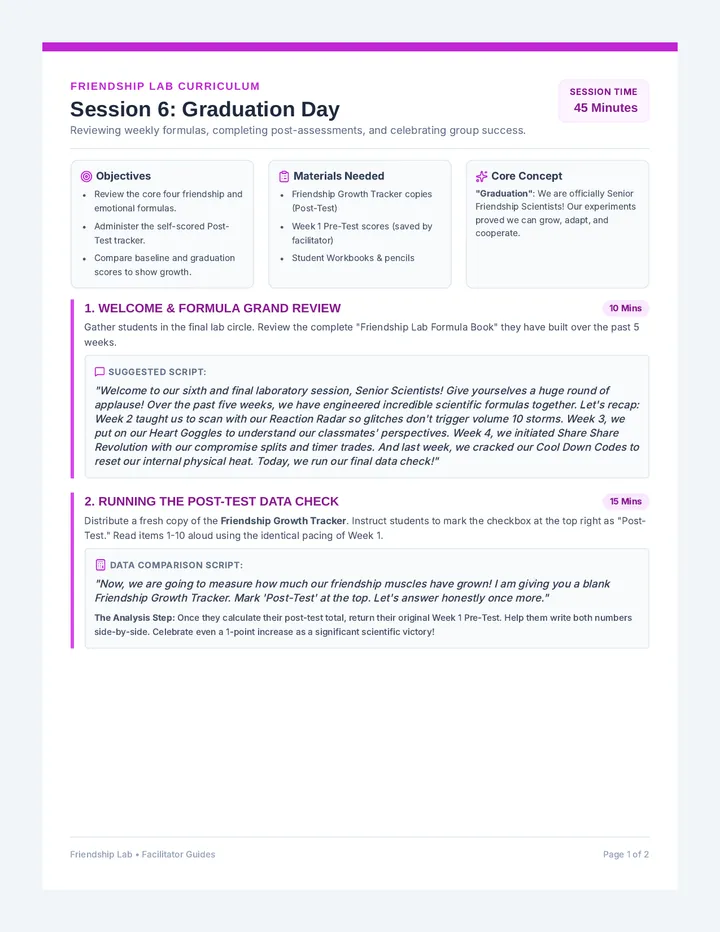
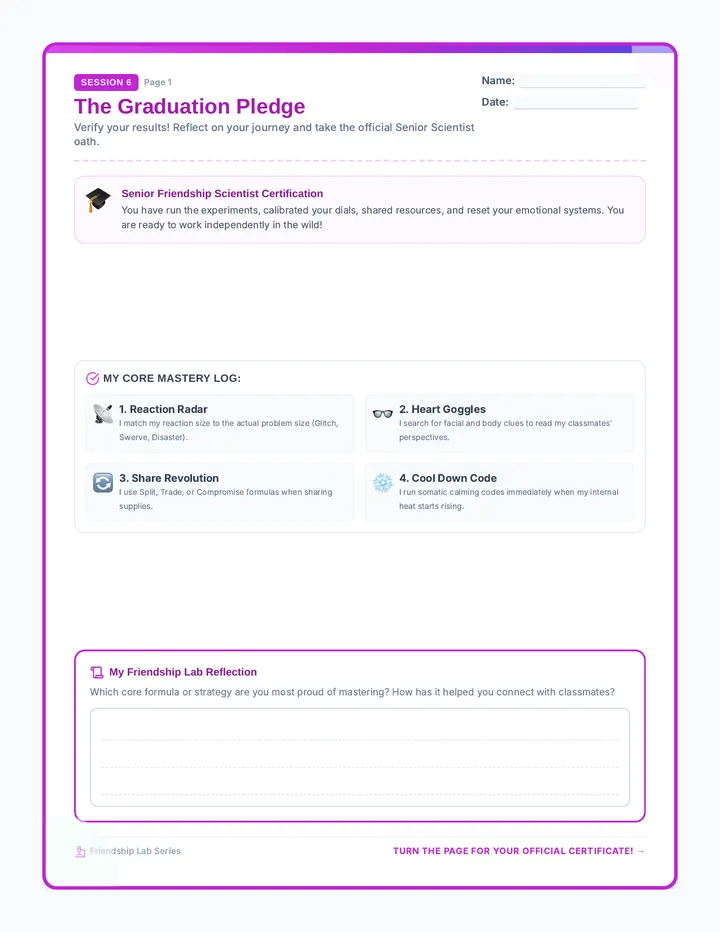
Instruct students to open their workbooks to Page 1 ("The Friendship Master Pledge") and Page 2 ("Graduation Certificate"). Have students stand up and read the pledge aloud as a group, with hand raised like taking an oath.
The Graduation Oath Script:
"Raise your right hands, scientists! Read after me: 'As a certified Senior Friendship Scientist, I promise to carry my formulas with me out into the wild halls of our school. I will always scan for emotional heat, wear my Heart Goggles to read clues, trade and compromise when resources are tight, and run my cool-down codes when storms blow in!'"
Presentation: Call each student up one-by-one with a drumroll (slapping hands on knees). Present their certificate. Sign their workbook certificates using a shiny gold or metallic marker to make it feel incredibly authentic and special!
4. Group Dismissal Check-Out
5 Mins
Run a final round around the circle. Each student states: Name, and one person in this group they are extremely grateful for. Close with a giant group cheer.
"This concludes our final laboratory experiment, Senior Scientists! Keep experimenting, keep caring about other people's hearts, and keep your body dials cool. Our friendship laboratory is officially signing off! 3, 2, 1... GO SCIENCE!"
Maintenance & Skill Generalization Tips
Group therapy is a highly structured, safe environment where skills are easily modeled. The real challenge is **generalization**—applying these formulas in the chaotic, unstructured environment of the recess yard or lunchroom. To aid this, provide a copy of their "Personal Reset Routine" to their regular classroom teachers. Ask teachers to use the group vocabulary (e.g. "I see a Glitch happening, Marcus, do you need a trade formula or your Cool Down Code?") to reinforce the child's learning.