Question Stems Reference Guide
Teacher Desk Guide
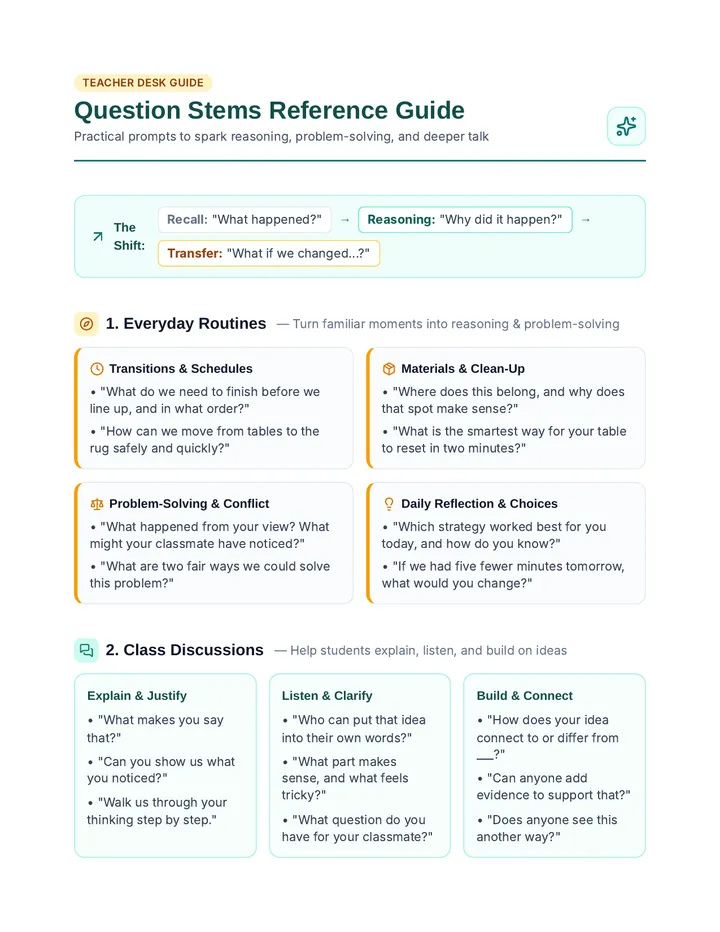
Question Stems Reference Guide
Practical prompts to spark reasoning, problem-solving, and deeper talk
The Shift:
Recall: "What happened?" → Reasoning: "Why did it happen?" → Transfer: "What if we changed...?"
1. Everyday Routines
— Turn familiar moments into reasoning & problem-solving
Transitions & Schedules
- • "What do we need to finish before we line up, and in what order?"
- • "How can we move from tables to the rug safely and quickly?"
Materials & Clean-Up
- • "Where does this belong, and why does that spot make sense?"
- • "What is the smartest way for your table to reset in two minutes?"
Problem-Solving & Conflict
- • "What happened from your view? What might your classmate have noticed?"
- • "What are two fair ways we could solve this problem?"
Daily Reflection & Choices
- • "Which strategy worked best for you today, and how do you know?"
- • "If we had five fewer minutes tomorrow, what would you change?"
2. Class Discussions
— Help students explain, listen, and build on ideas
Explain & Justify
- • "What makes you say that?"
- • "Can you show us what you noticed?"
- • "Walk us through your thinking step by step."
Listen & Clarify
- • "Who can put that idea into their own words?"
- • "What part makes sense, and what feels tricky?"
- • "What question do you have for your classmate?"
Build & Connect
- • "How does your idea connect to or differ from ___?"
- • "Can anyone add evidence to support that?"
- • "Does anyone see this another way?"
3. Question Stems Across Subjects
Adapt these open-ended prompts to spark deeper thinking in every content block
Math
Patterns & Proof
- • "How did you figure that out, and is there another way to solve it?"
- • "Why does that strategy work here? Would it work with bigger numbers?"
- • "What pattern do you notice, and what would come next?"
- • "How can you prove your answer is reasonable?"
Science
Evidence & Inquiry
- • "What do you predict will happen if we change ___? Why?"
- • "What evidence from our investigation supports your claim?"
- • "Why do you think the result was different from what we expected?"
- • "How could we test your idea to be sure?"
Social Studies
Perspective & Impact
- • "Why might two people in this situation view it differently?"
- • "What caused this change, and who was affected most?"
- • "How is life in that community similar to or different from ours?"
- • "What would be a fair rule or solution, and why?"
Literacy
Craft & Inference
- • "Why do you think the character made that choice? What clues tell you?"
- • "How would the story change if told from another character's view?"
- • "What is the author trying to make us feel or think here?"
- • "Do you agree with the character's decision? Why or why not?"
Three Habits That Elevate Any Question
1. Give Wait Time
Pause 3–5 seconds after asking so every student can think, not just fast hands.
2. Follow Up With "Why?"
Ask "How do you know?" for both right and wrong answers to normalize reasoning.
3. Bounce to the Group
Invite peers in with "What do others think?" instead of immediately evaluating.
Classroom Talk Slides
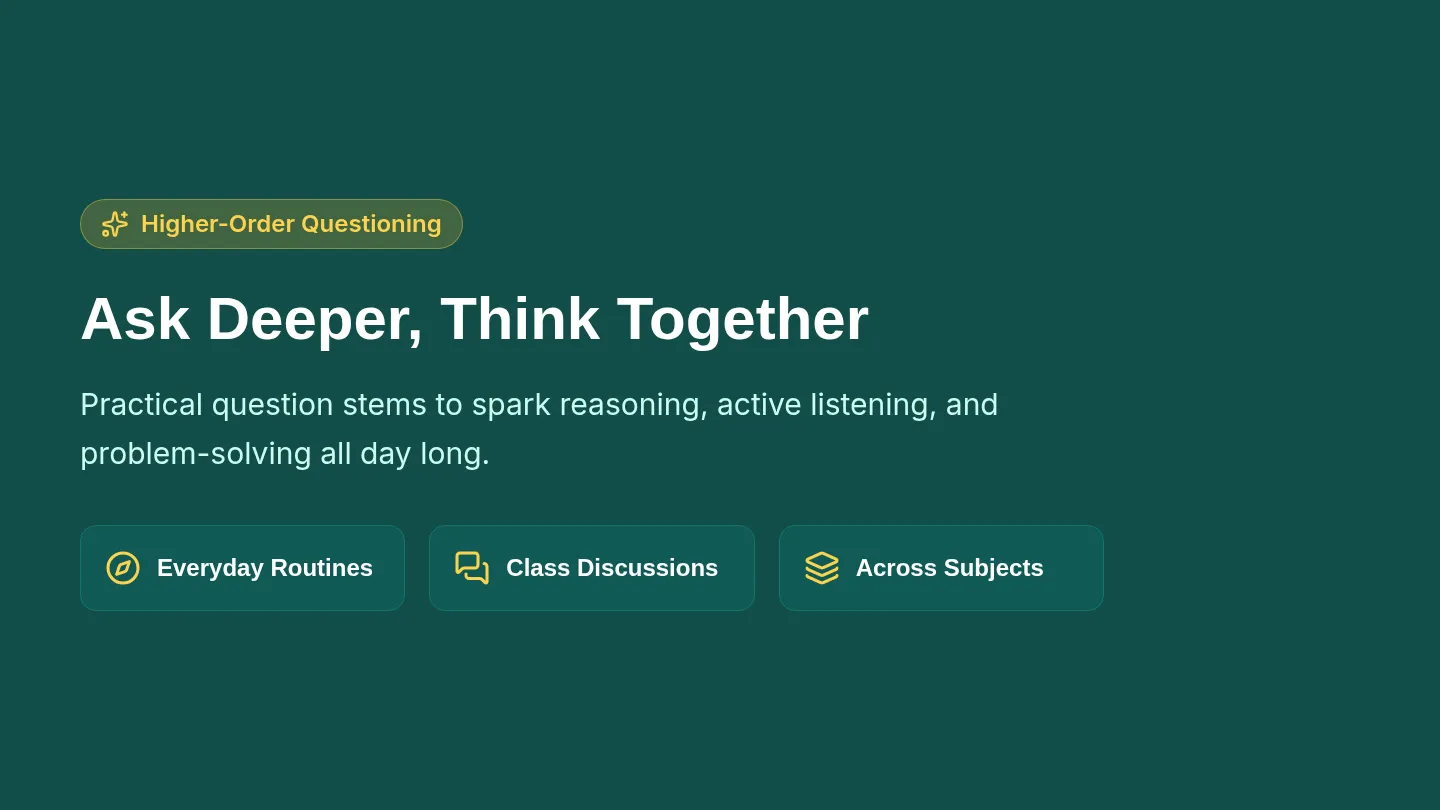
Higher-Order Questioning
Ask Deeper, Think Together
Practical question stems to spark reasoning, active listening, and problem-solving all day long.
Everyday Routines
Class Discussions
Across Subjects
Everyday Routines
Use familiar classroom moments to build reasoning and problem-solving.
Transitions
"What do we need to finish before we line up, and in what order?"
"How can we move safely and quickly?"
Clean-Up
"Where does this belong, and why does that spot make sense?"
"What is the smartest way to reset?"
Problem-Solving
"What happened from your view? What might your peer have noticed?"
"What are two fair solutions?"
Class Discussions
Help children explain ideas, listen closely, and build on classmates' thinking.
Explain
- • "What makes you say that?"
- • "Show us where you noticed that."
Listen
- • "Put that idea into your own words."
- • "What question do you have?"
Build
- • "How does this connect to ___?"
- • "Who can add evidence to that?"
Across Subjects: Math & Science
Math
- • "How did you figure that out, and is there another way?"
- • "Why does that strategy work here?"
- • "What pattern do you notice, and what comes next?"
Science
- • "What do you predict will happen if we change ___?"
- • "What evidence supports your claim?"
- • "How could we test your idea to be sure?"
Across Subjects: Social Studies & Literacy
Social Studies
- • "Why might two people view this differently?"
- • "What caused this change, and who was affected?"
- • "What would be a fair solution, and why?"
Literacy
- • "Why did the character make that choice?"
- • "How would the story change from another view?"
- • "What is the author helping us feel or think?"
Three Habits That Elevate Any Question
Small shifts in how we ask make every student's thinking visible.
1. Wait Time
Pause 3–5 seconds after asking so every student has time to think.
2. Follow Up
Ask "How do you know?" for both right and wrong answers.
3. Bounce It
Invite peers in with "What do others think?" before evaluating.