Chromebook Choices Worksheet Tech Citizenship
Chromebook Choices
Name: ______________________________
Date: ________________
Part 1: Tech Smarts Quick Check
Read each school Chromebook habit. Circle Smart Choice if it keeps your device safe and helps you learn, or Fix It if it needs a better choice.
1. Carrying your closed Chromebook with two hands in the hallway.
Smart Choice Fix It
2. Opening a secret game tab while the class is doing math practice.
Smart Choice Fix It
3. Setting a water bottle right next to your Chromebook keyboard.
Smart Choice Fix It
4. Plugging your Chromebook into the charging cart at the end of the day.
Smart Choice Fix It
Part 2: What Would You Do?
Scenario 1: The Forgotten Password
Maya's friend Leo forgot his Chromebook password. Leo asks Maya, "Hey, can I just log in using your account so I don't get behind on our science slides?"
What should Maya say and do? Why is protecting your school login important?
Scenario 2: The Pop-Up Surprise
While researching habitats for a science report, Jordan accidentally clicks a link and a strange pop-up ad appears on the screen asking to download a free game.
What are the two best steps Jordan should take right away?
Chromebook Choices — Page 2 Name: ________________________
Scenario 3: The Pencil Trap
It is time to line up for recess. Sam is in a hurry, so he leaves his pencil sitting on the keyboard, shuts the Chromebook lid hard, and leaves it teetering on the edge of his desk.
What could go wrong? Describe how Sam should put his Chromebook away safely.
Scenario 4: Kind Words Online
In a shared class Google Doc for a group project, someone in Elena's group deletes her paragraph and types "that idea was dumb" in the comments.
How should Elena handle this situation responsibly using our classroom expectations?
Part 3: My School Chromebook Promise
A school-issued Chromebook is a learning tool we share and care for. Complete your personal promise below:
1. One way I will keep my Chromebook physically safe every day is:
2. One way I will be a respectful digital citizen online is:
Student Signature: ____________________________________ Date: ______________
Direction Detectives Worksheet Classroom Expectations
Direction Detectives
Name: ______________________________
Date: ________________
Part 1: What Does Following Directions Look Like?
1. Eyes & Ears Ready
Look at the teacher when they are speaking. Pause talking and put materials down.
2. Listen All the Way
Wait until the teacher finishes all the steps before you start moving or asking.
3. Start Right Away
Follow directions the first time calmly, quietly, and without arguing.
Part 2: Classroom Case Files — Fix the Expectation!
Read each classroom situation. Write what expectation was missed and what the student should do instead.
Case 1: The Half-Heard Direction
Ms. Rivera says, "In a moment, grab your reading notebook, turn to page 14, and—wait, don't stand up yet!" Before she finishes, Tyler jumps up, walks to his cubby, and starts chatting with a friend.
What should Tyler have done? Why is waiting for the whole direction helpful?
Case 2: The Quiet Transition
The teacher rings the chime and asks the class to line up at a voice level 0 for library. Mia keeps telling a joke to her partner and taps her ruler against the desks as she walks.
How can Mia show respect for the teacher and her classmates during transitions?
Case 3: When You Disagree
Mr. Lee asks Noah to move his seat closer to the board so he can focus during math. Noah crosses his arms, groans loudly, and says, "That's not fair! Why do I have to move?"
What is a respectful way for Noah to follow the direction or share his feelings later?
Direction Detectives — Page 2 Name: ________________________
Part 3: The 4-Step Detective Challenge
Read all four steps before you pick up your pencil. Then follow them in exact order inside the white box below!
Draw a medium-sized star in the top-left corner of the box.
Write your favorite school subject in the center of the box.
Underline your favorite subject two times.
Draw a small smiley face in the bottom-right corner of the box.
Part 4: Thinking Like a Classroom Leader
1. How does following directions the first time help our whole class?
2. Which classroom expectation are you already great at, and which one do you want to practice this week?
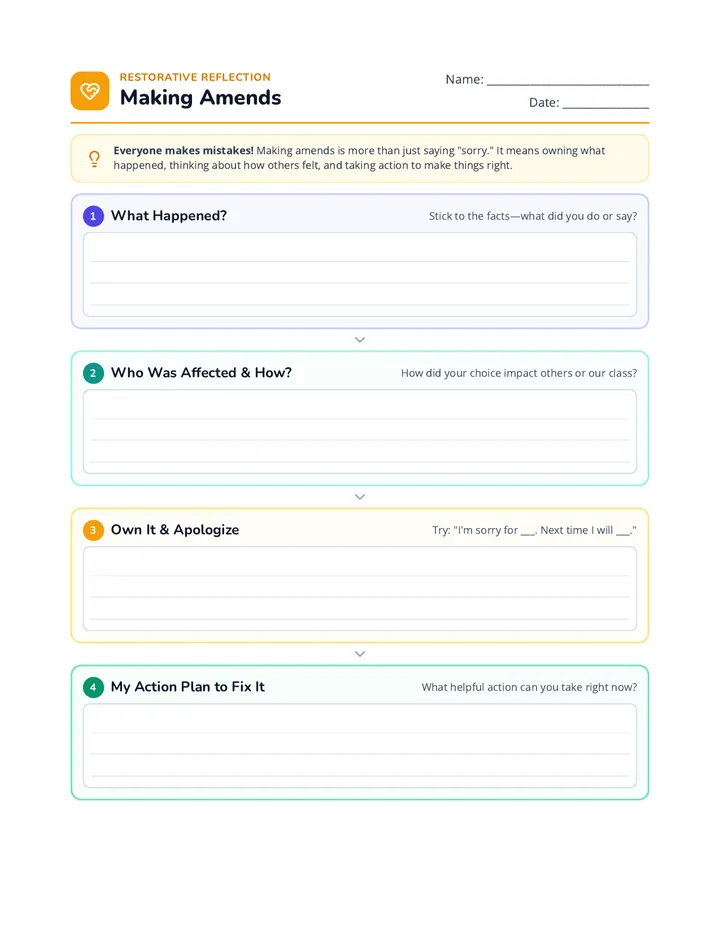
Making Amends Graphic Organizer Restorative Reflection
Making Amends
Name: ______________________________
Date: ________________
Everyone makes mistakes! Making amends is more than just saying "sorry." It means owning what happened, thinking about how others felt, and taking action to make things right.
1
What Happened?
Stick to the facts—what did you do or say?
2
Who Was Affected & How?
How did your choice impact others or our class?
3
Own It & Apologize
Try: "I'm sorry for ___. Next time I will ___."
4
My Action Plan to Fix It
What helpful action can you take right now?