Fair Fix Discussion Cards Fair Fix Discussion Cards
Problem-Solving Toolkit • Cut along the dashed lines (Set 1 of 2)
Cut & Discuss
Generate Fair Solutions #01
Brainstorm Without Judging
Come up with at least three different ways to fix the problem before picking one. Wild or simple ideas both count!
Ask Together
• "What is one idea that helps both of us?"
• "If we started fresh, what could we try?"
Starter: "One option we haven't tried is..."
Generate Fair Solutions #02
Run the Fairness Test
A fair solution respects both people's needs and is realistic to actually do. Test your top idea against both questions.
Ask Together
• "Does this solve the problem for both of us?"
• "Is anyone giving up way too much?"
Starter: "This feels fair to me because..."
Generate Fair Solutions #03
Make a Win-Win Swap
If an idea feels one-sided, don't throw it out yet. Tweak it by trading turns, sharing effort, or combining two ideas.
Ask Together
• "What part of this idea works, and what needs adjusting?"
• "How can we split the effort fairly?"
Starter: "I can do ___ if you can do ___."
Agree on Next Steps #04
Who Does What & When
Good intentions fall apart without a clear plan. Turn your solution into specific actions with a clear owner and deadline.
Ask Together
• "What exact action am I responsible for?"
• "By when will each step happen?"
Starter: "We agree that I will ___ by ___."
Fair Fix Discussion Cards
Problem-Solving Toolkit • Cut along the dashed lines (Set 2 of 2)
Cut & Discuss
Agree on Next Steps #05
Pick the First Small Step
Big promises can feel overwhelming. Choose one small, doable action each person can take in the next 24 hours to rebuild trust.
Ask Together
• "What is the very first thing we can do today?"
• "What will show we are serious about this?"
Starter: "My first step right after this talk is..."
Agree on Next Steps #06
Spot the Roadblocks
Think ahead before you finish: what could make this plan hard to follow, and how will you handle it without starting a new argument?
Ask Together
• "What might tempt us to slip back into the old habit?"
• "How can we remind each other respectfully?"
Starter: "If ___ happens, we'll handle it by..."
Check Repair Worked #07
Schedule the Check-In
Repair isn't finished until you follow up. Pick a specific day and time to check in and make sure the plan is working for everyone.
Ask Together
• "When should we check back in—tomorrow or next week?"
• "Where will we do a quick 2-minute check-in?"
Starter: "Let's check in on ___ at ___."
Check Repair Worked #08
Read the Signs & Adjust
During your check-in, look for real evidence that things feel better. If the plan isn't working yet, adjust it without blaming.
Ask Together
• "What is actually better since we made our plan?"
• "What still feels off, and what's our Plan B?"
Starter: "So far ___ worked, and we should tweak ___."
Fix It Facilitator Guide Facilitator Guide • Lesson Bundle
Fix It Forward: Problem-Solving Repair
Helping students move from conflict to fair solutions, clear agreements, and real follow-through.
Pacing
40 Min
Target Repair Skills
1. Generate Fair Solutions: Brainstorm multiple options and test whether they meet both people's needs.2. Agree on Next Steps: Turn an idea into specific actions with owners, timelines, and roadblock plans.3. Check Repair Worked: Schedule a follow-up and use evidence to decide if the plan holds or needs a Plan B.
Prep & Norms
• Print & cut Fair Fix Discussion Cards (1 set per pair or triad).
• Print Solution Lab Practice Activity & Repair Check Reflection Sheet (1 per student).
• Discussion Norms: Speak for yourself ("I feel/need"), listen without interrupting, and focus on fixing the future—not winning an argument.
40-Minute Lesson Pacing
Time
Phase
Facilitator & Student Actions
0–10 min
Launch & Model
Introduce the 3-stage repair cycle (Solutions → Next Steps → Check-In). Use the Modeling Script on Page 2 to walk through a quick sample conflict with a student volunteer.
10–25 min
Card Practice (Pairs)
Pairs choose a scenario from the Solution Lab Practice Activity . They draw 1 Teal card (#1–3), 1 Amber card (#4–6), and 1 Emerald card (#7–8) to talk through and record a complete repair plan.
25–33 min
Share & Stress-Test
Two pairs join into a quad. Each pair shares their chosen solution and check-in plan; the other pair asks one "Fairness Test" or "Roadblock" question to strengthen it.
33–40 min
Reflect & Close
Students complete the Repair Check Reflection Sheet individually to lock in one sentence starter or strategy they will use in a real disagreement.
Facilitator Tip: Remind students that a good repair plan doesn't require best-friend feelings right away—it only requires a fair agreement both people can live with and a date to check whether it worked.
Facilitation Playbook
Fix It Facilitator Guide • Page 2
How to Sequence the Discussion Cards
Step 1: Teal (#01–#03)
Start here to widen options. Students must name 3 ideas before evaluating them.
Step 2: Amber (#04–#06)
Move here once a solution is picked. Define who does what, when, and Plan B for roadblocks.
Step 3: Emerald (#07–#08)
Finish every conversation by picking a check-in time and naming signs of success.
Sample Modeling Script (3 Minutes)
Scenario: Two lab partners disagree because one person did all the writing while the other felt shut out.
Generate Solutions (Card #01–02): "Let's list 3 ways to fix this: (1) swap roles next lab, (2) split the write-up in half, or (3) draft together on one doc. Option 2 or 3 feels fairest because we both get our ideas in."
Agree on Next Steps (Card #04): "Okay, for Friday's lab, I'll type the data table and you'll write the conclusion, and we'll review both together at 2:00 PM."
Check Repair Worked (Card #07–08): "Let's check in right after Friday's class for two minutes. If both of us felt heard, we keep this system; if not, we'll switch to sharing one doc."
Differentiation & Support Scaffolds
For Reluctant Speakers / MLLs
Allow students to point to the sentence starter at the bottom of each card and read it aloud, or jot their idea on the Practice Activity before speaking.
For High-Emotion Real Conflicts
If emotions run high, pause and use only Cards #01 and #07 first: agree on a cool-down and a specific time to revisit the problem.
Whole-Group Debrief Prompts
• "Which card helped you get unstuck when an idea felt one-sided?"
• "Why is scheduling a check-in just as important as picking the solution?"
• "What is one roadblock that usually trips up agreements in our classroom, and how can we plan for it?"
Solution Lab Practice Activity Solution Lab Practice Activity
Page 1 of 2
Name: _______________________
Partner: _____________________
Date: ________________
Directions: With your partner, choose one conflict scenario below. Use your Fair Fix Discussion Cards to talk through each stage, then record your shared repair plan in the white work boxes.
Step 1: Choose Your Scenario (Check One)
A. Missing Charger
Jordan lent a laptop charger to Sam. Sam accidentally left it on the bus, and now Jordan's battery is at 5% before a test.
B. Unequal Slides
Maya built 8 of the 10 slides for a partner presentation while Alex only added images. Both are stressed right before presenting.
C. Lunch Table Joke
Devon made a joke about Taylor's new haircut at lunch. Everyone laughed, Taylor walked away upset, and now they aren't speaking.
Part 1: Generate Fair Solutions (Cards #01–#03)
Brainstorm 3 possible ways to fix the problem before picking one:
Idea 1
Idea 2
Idea 3
Run the Fairness Test (Card #02): Which solution is fairest to both people, and why?
Use Cards #01–#03 before moving to Page 2. Fix It Forward
Solution Lab Practice Activity
Page 2 of 2
Part 2: Agree on Next Steps (Cards #04–#06)
Break your chosen solution into concrete actions (Who does what, and by when?):
Person A's Action & Deadline
Person B's Action & Deadline
Spot the Roadblocks (Card #06): What might get in the way of this plan, and how will you handle it?
Part 3: Check Whether Repair Worked (Cards #07–#08)
When & where will you check back in?
What signs will show the repair worked?
Plan B Trigger (Card #08): If the plan isn't working at your check-in, what will you adjust?
Ready to share your plan with another pair! Fix It Forward
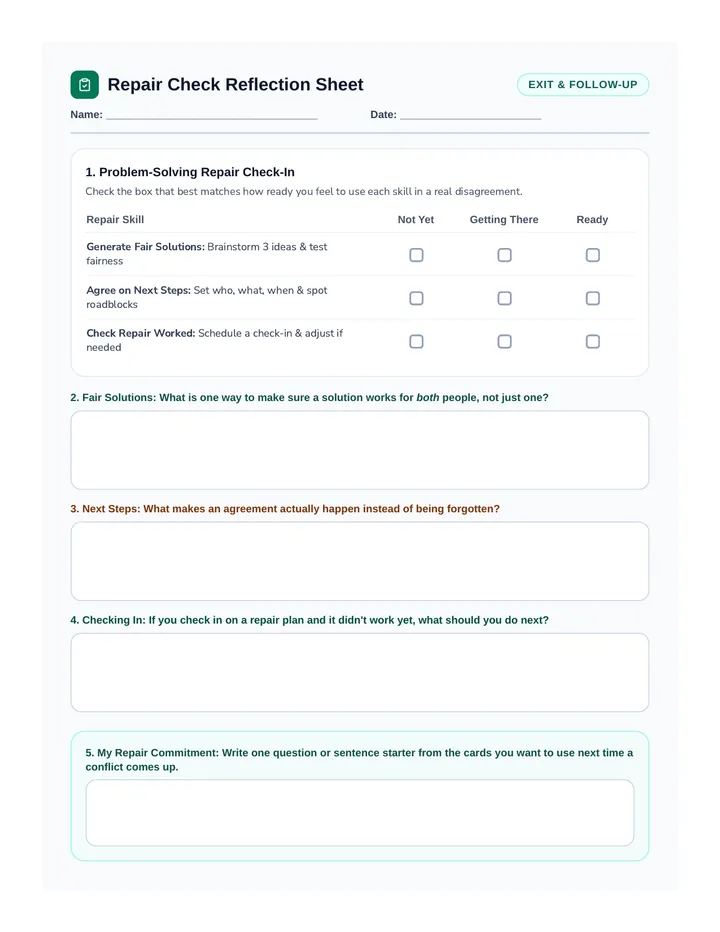
Repair Check Reflection Sheet Repair Check Reflection Sheet
Exit & Follow-Up
Name: ____________________________________
Date: ________________________
1. Problem-Solving Repair Check-In
Check the box that best matches how ready you feel to use each skill in a real disagreement.
Repair Skill
Not Yet
Getting There
Ready
Generate Fair Solutions: Brainstorm 3 ideas & test fairness
Agree on Next Steps: Set who, what, when & spot roadblocks
Check Repair Worked: Schedule a check-in & adjust if needed
2. Fair Solutions: What is one way to make sure a solution works for both people, not just one?
3. Next Steps: What makes an agreement actually happen instead of being forgotten?
4. Checking In: If you check in on a repair plan and it didn't work yet, what should you do next?
5. My Repair Commitment: Write one question or sentence starter from the cards you want to use next time a conflict comes up.