More Than Just Words Lesson Plan More Than Just Words
Instructional Lesson Plan
TIER 1 SEL
Grade 6 • 20 Minutes
Objective
Students will be able to identify at least two unspoken emotions in a social scenario by analyzing tone of voice, body language, and context.
Why It Matters
Understanding unspoken emotions helps students better interpret social situations, improve communication, and build empathy, leading to stronger friendships.
Materials
Whiteboard or projector
Emotion Sleuth Slides
3-5 min film clip (Teacher-provided)
Field Observation Worksheet
Social Scene Discussion Guide
Teacher Prep
Review the Emotion Sleuth Slides and familiarize yourself with the content.
Select an appropriate 3-5 minute film clip (e.g., Pixar short, school-life TV show) featuring subtle body language and tone cues.
Print copies of the Field Observation Worksheet for each student.
Prepare individual slips of paper for "Emotion Charades" (Confused, Excited, Frustrated, Shy).
Instructional Steps
5m
Warm-Up: Emotion Charades
1. Start by explaining that today's lesson is about understanding emotions without words.
2. Play "Emotion Charades": Invite student volunteers to silently act out 3-4 emotions (e.g., confused, excited, frustrated, shy) while others guess.
3. After each guess, ask: "How did you know? What clues did you use?" (Focus on body language and expressions).
5m
Introduction: Subtle Cues
1. Open the Emotion Sleuth Slides .
2. Introduce key concepts: Subtle Cues, Tone of Voice, Body Language, and Social Context.
3. Explain that these clues help us "read the room" and understand feelings even when they aren't directly stated.
7m
Video Analysis Activity
1. Distribute the Field Observation Worksheet .
2. Play the pre-selected film clip (3-5 minutes).
3. Instruct students to watch as "Emotion Sleuths," looking for non-verbal clues.
4. Give students 2-3 minutes after the clip to complete their observations on the worksheet.
3m
Group Debrief
1. Use the Social Scene Discussion Guide to lead a class conversation.
2. Encourage students to share evidence from their worksheets (specific gestures, tones, or situational context).
3. Wrap up by emphasizing how these skills help in navigating daily friendships and interactions.
Emotion Sleuth Slides Emotion Sleuths
More Than Just Words
How do you know what someone is feeling without them saying a single word?
TEACHER NOTES: Welcome students and introduce the concept of emotions. Briefly explain that sometimes people don't say exactly what they feel, but we can still understand them.
Case Evidence
What are Subtle Cues?
Body Language
How someone stands, moves, or holds themselves.
Facial Expressions
The looks on their face—eyes, eyebrows, and mouth.
Tone of Voice
How their voice sounds, not just the words they say.
TEACHER NOTES: Introduce the idea of 'subtle cues.' Ask students for examples of how they might show they're happy or sad without speaking.
Tone: How You Say It!
The way someone's voice sounds can tell you a lot:
Is it fast or slow ?
Is it loud or soft ?
Does it sound happy, sad, or angry ?
TEACHER NOTES: Discuss how tone of voice can change the meaning of words. Give examples like saying 'Okay' in a happy vs. frustrated tone.
Body Language Speaks
Visual Clues
🙅♂️
Crossed Arms?
Maybe defensive or closed off.
😔
Slumped Shoulders?
Maybe sad, tired, or defeated.
👋
Open Hands?
Maybe friendly, honest, or ready to help.
TEACHER NOTES: Talk about body language. Ask students what different postures or gestures might communicate.
Location & Setting
Social Context: Where Are We?
The situation around us changes how we understand emotions.
Where are they? (Party vs. Library)
Who are they with?
What just happened?
TEACHER NOTES: Explain social context. Use an example like someone crying at a wedding vs. someone crying after a bad test.
Reading the Room
Tone
Body
Context
=
CLEAR PICTURE
Combining all the clues helps us understand what's really happening.
TEACHER NOTES: Introduce the idea of 'reading the room'. Emphasize that combining all these clues helps us understand social situations.
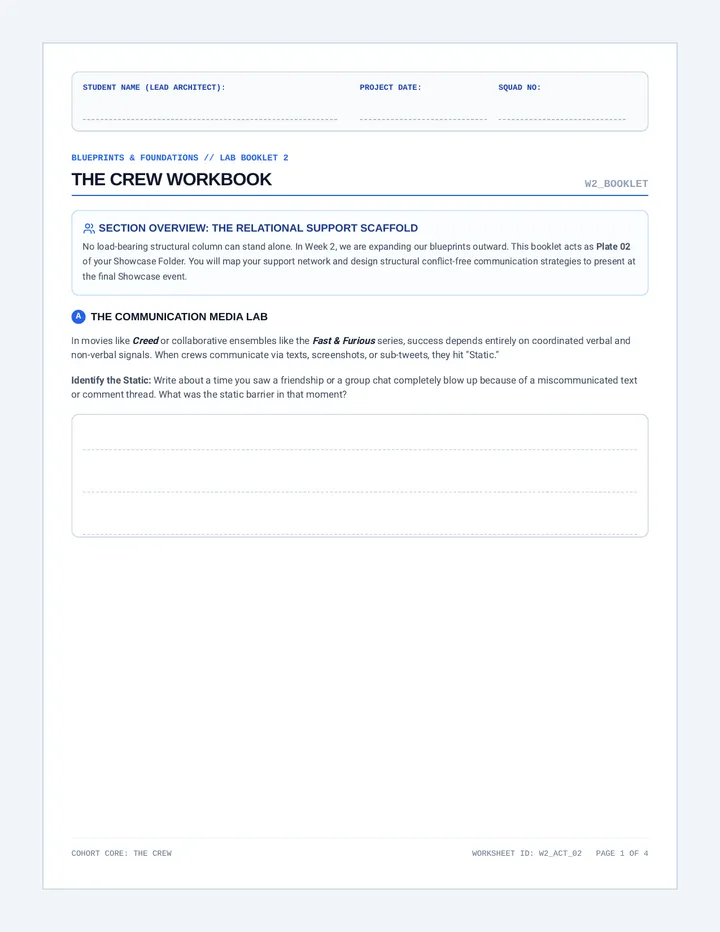
Field Observation Worksheet Operation: Observation
Field Log • Emotion Sleuth Squad
Agent:
Date:
Mission Briefing: As you watch the film clip, pay close attention to the characters. Even if they aren't speaking their feelings, you can still learn a lot from their actions, facial expressions, and voice. Look for the subtle cues that reveal the unspoken.
Target Character 01
ID: ______________________
Primary Unspoken Emotion
(e.g., confused, excited, frustrated, shy, happy, sad, angry)
Tone of Voice (if any)
(Loud, soft, shaky, fast, flat?)
Body Language Evidence
What were their hands, shoulders, and eyes doing?
Social Context Clues
How did the setting or what just happened help you understand them?
Target Character 02
ID: ______________________
Primary Unspoken Emotion
What is the hidden feeling?
Tone of Voice (if any)
How did the words sound?
Body Language Evidence
Detailed movements or gestures observed.
Social Context Clues
Where are they? Who are they with?
Social Scene Discussion Guide Teacher Resource • Post-Observation Debrief
Social Scene Discussion Guide
Ref: MTJW-DEBRIEF-01
Facilitation Notes
After watching the film clip, lead a brief discussion using these questions. Encourage students to refer back to their Field Observation Worksheets . Remind them that in social observation, we are looking for evidence, but interpretations may vary.
1
Establish the Facts:
What was happening in the scene? Briefly describe the social scenario.
2
Identify Unspoken Emotions:
Were there any characters who seemed to be feeling an emotion they weren't directly talking about? Who were they, and what emotion did you observe?
3
Visual Evidence:
What specific body language clues did you notice? (e.g., crossed arms, slumped shoulders, fidgeting, big smiles, eye rolls)
4
Auditory Evidence:
Did you notice anything about their tone of voice? How did it sound, and what did that tell you?
5
Situational Context:
How did the situation or social context (where they were, what had just happened) help you understand their unspoken emotions?
6
Social Navigation:
How do you think understanding these unspoken emotions might change how other characters, or even you, would react in that situation?
7
Real-World Application:
Can you think of a time in real life when you noticed someone feeling something they didn't say out loud? What clues did you use to figure it out?
End of Observation Session