Mindful Moments Lesson Plan Mindful Moments
Tier 2 Group Lesson Plan • 8th Grade
30 Minutes
Why It Matters
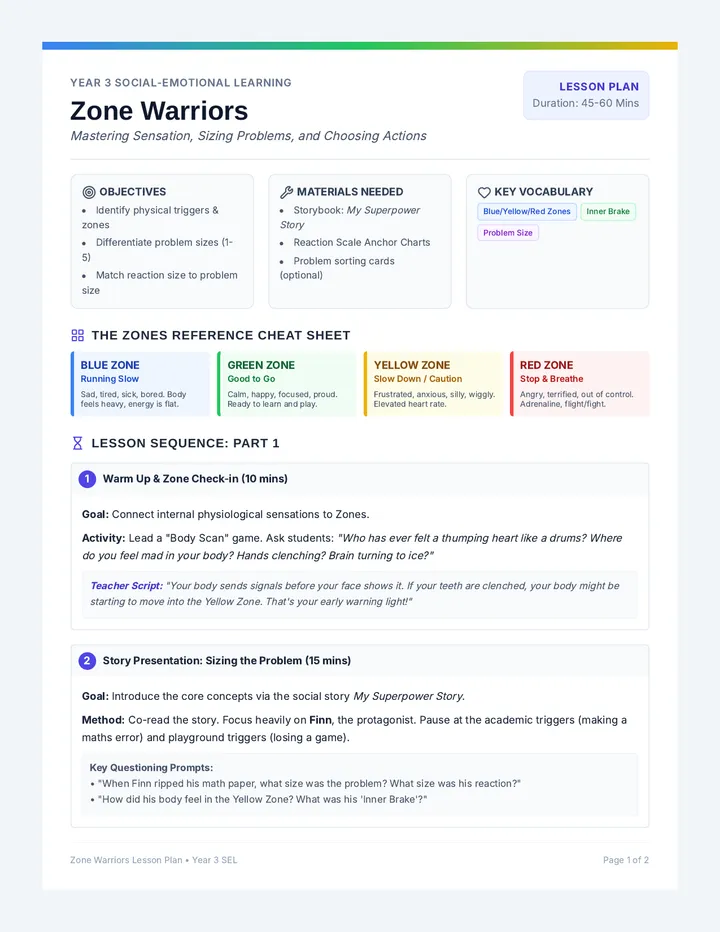
Equipping 8th graders with mindfulness tools supports emotional regulation, reduces anxiety, and boosts concentration, improving both well-being and academic performance.
Preparation
• Review the Guided Breathing Script for pacing.
• Familiarize yourself with the Body Scan Outline.
• Prepare copies of the Mindful Drawing Prompt Sheet.
• Set up a visible timer or chime/bell.
Materials
Breathing Script
Body Scan Outline
Drawing Prompt Sheets
Timer or Bell
Lesson Objective
Students will learn and practice three simple mindfulness activities—guided breathing, body scan, and mindful drawing—to reduce stress and enhance focus in daily life.
5m
Introduction
• Greet students and explain the goal: reducing stress through mindfulness.
• Define mindfulness: non-judgmental awareness of the present moment.
• Overview the three activities: breathing, scanning, and drawing.
7m
Guided Breathing
• Have students sit comfortably with eyes closed or softly focused.
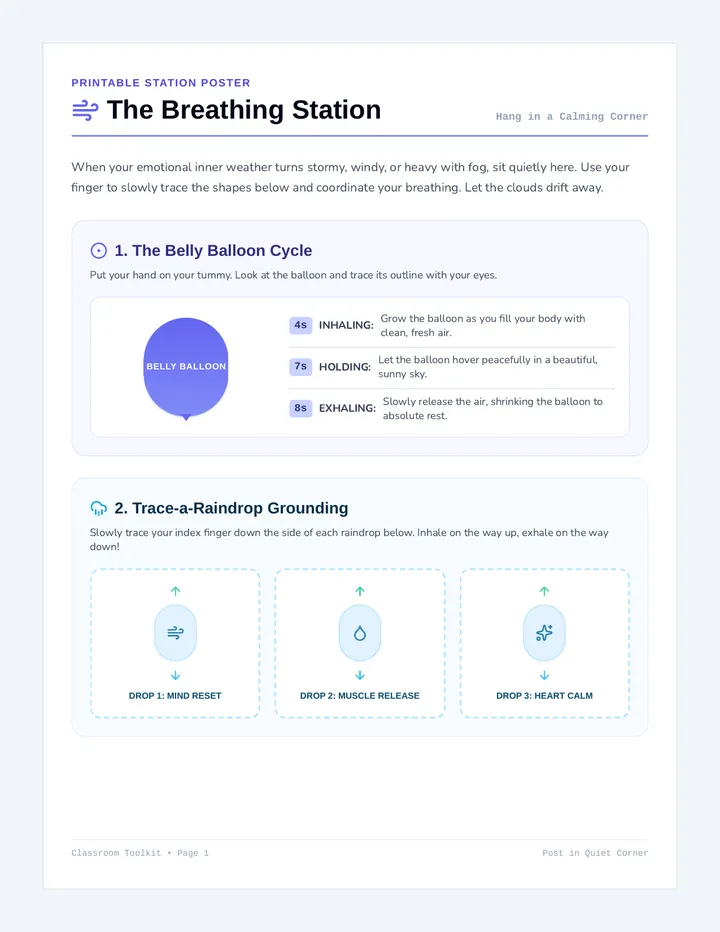
• Lead using the Guided Breathing Script .
• Emphasize deep nose inhales and slow mouth exhales.
8m
Body Scan
• Ask students to lie down or stay seated comfortably.
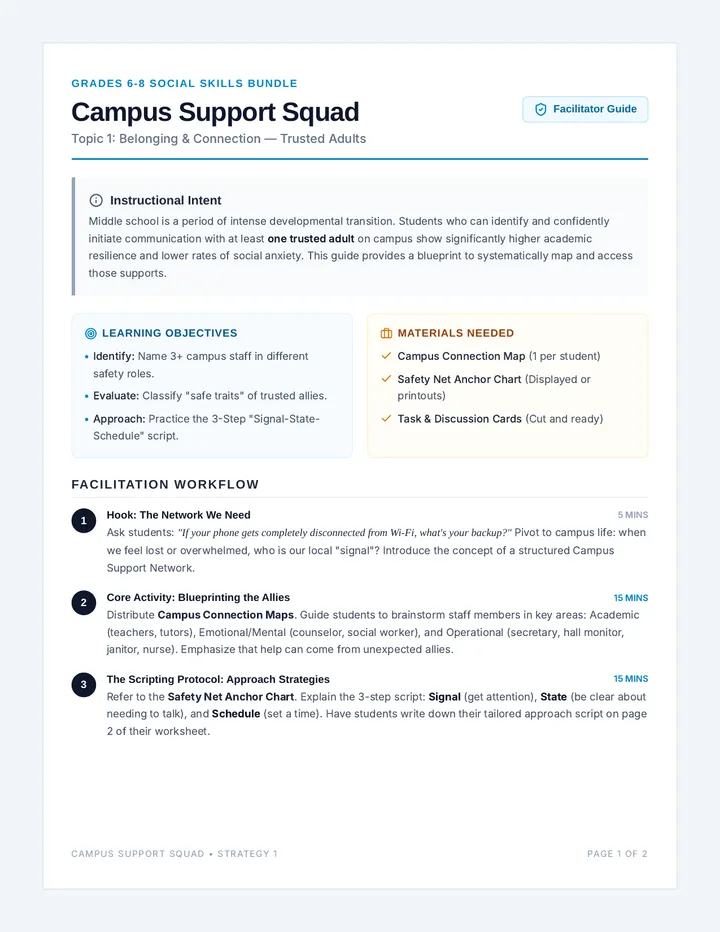
• Guide through the Body Scan Outline , pausing at each region.
• Instruct them to notice tension or relaxation without judgment.
8m
Mindful Drawing
• Distribute Prompt Sheets . Draw slowly, focusing on lines and shapes.
• Remind them to notice sensations: pencil pressure and movement.
• Create a calm atmosphere with soft music or silence.
2m
Reflection & Closing
• Volunteers share their experience or insights.
• Reinforce techniques for tests or daily stress.
Mindful Moments Slides Mindful Moments
Tier 2 Group Lesson | 8th Grade | 30 Minutes
"Mindfulness is the simple act of being present without judgment."
Teacher Notes: Welcome students and introduce the lesson. Explain that they'll learn three tools for stress and focus.
Lesson Objectives
Breathing
Practice guided breathing techniques.
Body Scan
Experience a deep, calming body scan.
Drawing
Explore mindful and slow drawing.
Teacher Notes: Read aloud objectives. Emphasize that these are skills for anytime use.
Why Mindfulness?
Reduces Stress
Calms the nervous system and lowers anxiety before big moments.
Improves Focus
Trains your brain to stay present and block out distractions.
Emotional Balance
Helps you respond to feelings rather than reacting impulsively.
"Between stimulus and response there is a space. In that space is our power to choose our response."
Teacher Notes: Discuss benefits with examples (test anxiety, distractions). Ask for student input.
Activity 1: Guided Breathing
7 Minutes
1 Sit comfortably with eyes closed or softly focused.
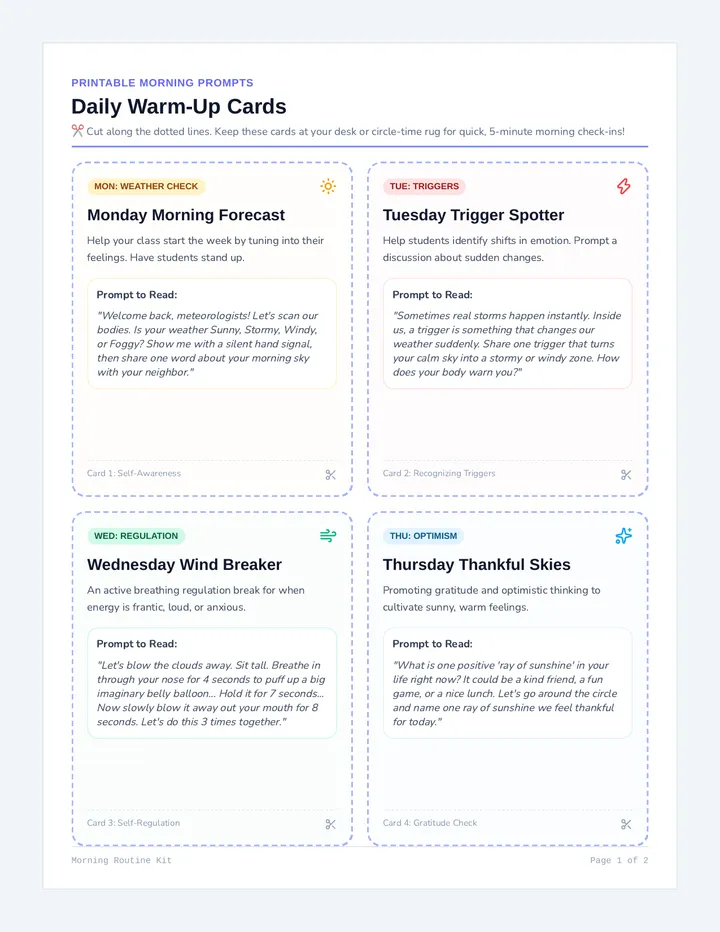
2 Inhale deeply through the nose (count to 4).
3 Exhale slowly through the mouth (count to 6).
4 Notice sensations with each breath.
Focus Point:
The feeling of air entering and leaving your body.
Teacher Notes: Guide step-by-step using the script. Model the 4-6 breathing pattern.
Activity 2: Body Scan
8 Minutes
The Journey
Toes & Feet
Legs & Hips
Torso & Arms
Shoulders & Neck
Face & Head
Instructions:
Notice tension or relaxation in each area. Pause and take a breath at each region.
No need to change anything—just observe.
Teacher Notes: Lead slow body scan from feet to head. Encourage non-judgmental noticing.
Activity 3: Mindful Drawing
8 Minutes
Drawing Prompts
• Flowing Patterns
• Nature's Details
• Geometric Shapes
• Light & Shadow
Remember:
Focus on the pressure of the pencil and the way lines appear on the page.
"The point is not the picture. The point is the process of paying attention."
Teacher Notes: Distribute prompts. Invite quiet drawing. Remind students to stay present.
Reflection & Next Steps
Pair-share your experience with a neighbor.
When might you use these tools this week?
Commit to one practice daily.
Teacher Notes: Ask 2-3 volunteers to share. Discuss practical ways to use these at home/school.
Guided Breathing Script Guided Breathing Script
Teacher Resource • Estimated Time: 7 Minutes
Delivery Guidance
Use a calm, steady, and gentle tone. Avoid rushing. When you see a (Pause) , try to honor the full length of the pause to allow students to settle into the experience.
1
Settle In (30 seconds)
“Let’s begin by finding a comfortable seated position in your chairs. Sit up tall with your back straight but relaxed, feet flat on the floor, and hands resting gently in your lap. When you feel settled, softly close your eyes or let your gaze rest downward.”
Pause 30 seconds
2
Ready Your Breath (10 seconds)
“Bring your attention to your natural breathing. Notice how the air feels as it moves in through your nose and out through your mouth.”
Pause 10 seconds
3
Three Guided Breaths (~1 minute)
“We’ll do three rounds together. Follow my count.”
“Inhale through your nose… 1… 2… 3… 4…” (Pause)
“And exhale gently through your mouth… 1… 2… 3… 4… 5… 6…” (Pause)
“Inhale through your nose… 1… 2… 3… 4…” (Pause)
“Exhale through your mouth… 1… 2… 3… 4… 5… 6…” (Pause)
“Inhale through your nose… 1… 2… 3… 4…” (Pause)
“Exhale through your mouth… 1… 2… 3… 4… 5… 6…” (Pause)
4
Silent Observation (4 minutes)
“Now, allow your breath to flow naturally. Simply observe each inhale and exhale. If your mind wanders, gently guide your focus back to the sensation of breathing. We’ll sit quietly for about four minutes.”
Pause 4 minutes • Consider using a soft bell to signal the start and end of this silence
5
Closing & Return (30 seconds)
“As we come to the end of our practice, take one final deep inhale through your nose… and a full exhale through your mouth.”
“Begin to wiggle your fingers and toes. When you’re ready, softly open your eyes and bring your awareness back to the room. Take a moment to notice how you feel right now. Thank you for practicing with me.”
Body Scan Outline Body Scan Outline
Instructional Guide • Estimated Time: 8 Minutes
Purpose
To guide students through a systematic awareness of physical sensations. Encourage non-judgmental observation—just notice sensations without trying to change them.
1:00 Minutes
Settle In
“Find a comfortable position. Close your eyes or soften your gaze. Begin to notice your natural breath.”
1:00 Minutes
Toes & Feet
“Direct attention to your toes. Notice warmth, tingling, or tension... Now shift to the soles and tops of your feet.”
1:00 Minutes
Lower Legs
“Move awareness to your calves. Notice tightness or ease... Now bring attention to your knees and thighs.”
1:30 Minutes
Hips & Pelvis
“Notice if you’re holding tension or if this area feels relaxed.”
Back & Abdomen
“Feel the rise and fall of your belly with each breath.”
Chest & Upper Back
“Notice expansion on the inhale and softening on the exhale.”
1:00 Minutes
Hands & Arms
“Focus on your hands and wrists first. Then move attention up to your forearms and upper arms.”
2:00 Minutes
Shoulders & Neck
“Notice if shoulders are drawn up or resting naturally. Feel the weight of your head.”
Face & Scalp
“Let your jaw soften. Move awareness to your eyes, forehead, and scalp.”
1:30 Minutes
Full-Body Awareness
“Expand attention to your entire body. Notice how all parts feel together as you breathe.”
Return
“Wiggle fingers and toes. Open your eyes. Notice how you feel now compared to the start.”
Encourage non-judgmental observation throughout the journey.
Mindful Drawing Prompt Sheet Mindful Drawing
Focus on the process, not the product.
Name:
Date:
Choose one or more prompts below. Draw slowly, paying close attention to your pencil’s movement, pressure, and your breath.
1. Flowing Patterns
Draw a continuous, flowing pattern of loops or waves. Focus on the movement of your pencil and the space between lines.
2. Nature’s Details
Sketch a close-up of a leaf, flower, or tree bark. Notice textures, shapes, and lines.
3. Geometric Shapes
Create an arrangement of geometric shapes (triangles, circles, squares) that overlap or connect. Observe edges and symmetry.
4. Light & Shadow
Draw a simple object (like a pencil or eraser) and shade one side to capture light and shadow. Pay attention to pencil pressure.
5. Abstract Emotions
Use lines and shapes to represent a feeling (e.g., calm, excitement, curiosity). Focus on how your mood influences your strokes.
6. Mindful Mandala
Draw a circular mandala starting from the center and adding patterns outward. Stay aware of your breathing as you draw.
Reflection
How did drawing mindfully affect your focus and stress? Write one sentence describing your experience.
What is one word that describes how you feel right now?