Kindness Compass Lesson Plan Educator Instructional Guide
Kindness Compass: Empathy in Action
Grades 3–5
Duration: 45–60 Mins
CASEL Competencies
Social Awareness, Relationship Skills, Responsible Decision-Making
Grouping Strategy
Whole-Class Discussion, Think-Pair-Share, Solo Reflection
Included Materials
Slide Deck, Scenario Sheets, Reflection Exit Cards
Learning Objectives
• Define empathy as perspective-taking ("walking in another's shoes").
• Apply the 3-step empathy model: Notice , Wonder , and Connect .
• Formulate a tangible, supportive response to peer dilemmas.
Essential Questions
• How does understanding someone else's feelings change how we act?
• What is the difference between feeling sorry for someone vs. feeling with them?
• How can one small act of kindness shift our whole classroom climate?
Instructional Roadmap & Pacing
00–10 Min
Hook & Mindset: The "Empathy Glasses"
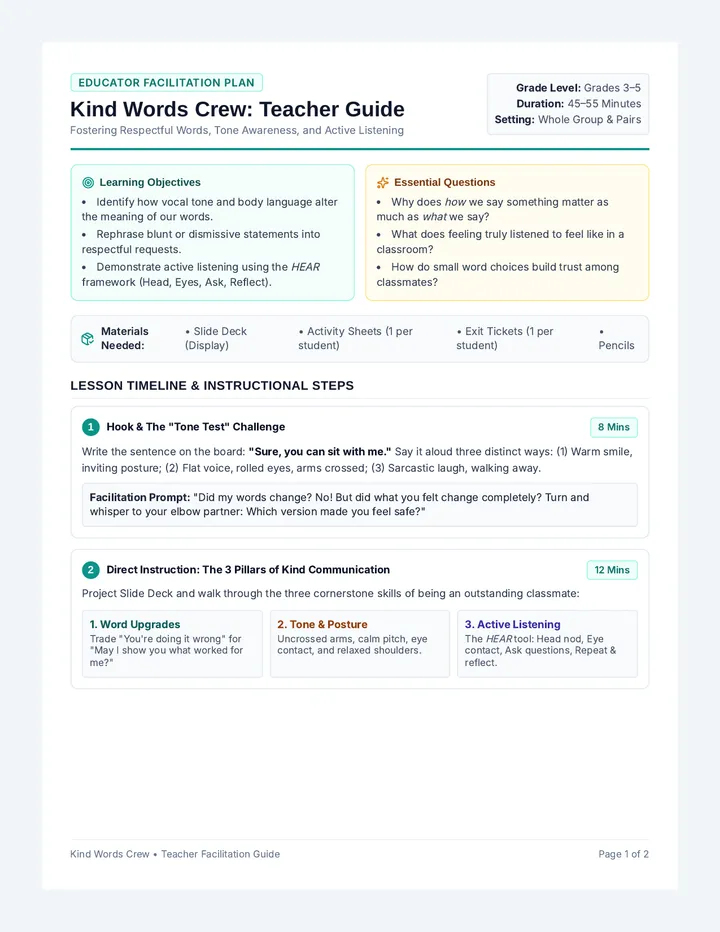
Project Slide 1 & 2. Introduce the optical metaphor: sympathy is looking from far away with pity; empathy is putting on another's glasses to see through their eyes. Quick turn-and-talk on physical clues of emotion.
10–22 Min
Direct Instruction: Notice • Wonder • Connect
Walk through Slide 3. Teach the 3 cognitive tools: Notice (body language, tone), Wonder ("What might be happening in their world?"), and Connect ("What kind words or gestures offer genuine support?"). Model with Recess Scenario (Slide 4).
22–42 Min
Guided Partner Practice: Scenario Investigators
Distribute the Scenario Investigators Activity Sheet . Students work in assigned pairs to analyze real-life peer situations (cafeteria seating, missed sports tryouts, group project tensions) and script proactive empathetic responses.
42–55 Min
Synthesis & Assessment: Kindness Ripple & Pledge
Project Slides 6 & 7. Facilitate brief whole-class share-out of favorite solutions. Hand out Kindness Ripple Reflection for individual assessment and student commitment pledge.
Kindness Compass • Teacher Facilitation Guide Page 1 of 2
Facilitation Scripts & Questioning Prompts
Kindness Compass • Instructional Depth
Teacher Framing Script (Demystifying Empathy vs. Sympathy):
"When someone trips in the hallway and drops their papers, sympathy sounds like standing back and saying, 'Oh no, that's terrible for you.' Empathy is stepping over, kneeling on the floor, picking up sheets alongside them, and remembering what it feels like when everyone is staring at you."
Probing Questions for Discussion
• "What invisible heavy backpack might this student be carrying today?"
• "Can someone be upset even if their face is totally blank? What subtle clues tell us?"
• "How can trying to help sometimes accidentally make someone feel worse? How do we avoid that?"
Common Misconceptions to Address
• Myth: "Empathy means agreeing with everything the other person did."
• Myth: "Kindness must be a big, expensive gift."
Differentiation & Accommodations
Emerging Readers / ELL
Pair with supportive reading buddies. Use emotion icon cards to label feelings before writing. Accept illustrated responses for the action steps.
On-Level Learners
Complete standard scenario prompts with focus on both verbal scripts ("What would you say?") and behavioral actions ("What would you do?").
Advanced / Extension
Draft the student-invented dilemma on Page 2 of the activity. Role-play the conflict resolution using non-violent communication framing.
Formative Assessment Rubric
Criteria Needs Support (1) Proficient (2) Exemplary (3)
Perspective Taking Identifies emotion only as "sad" or "mad" without nuance. Explains how circumstances caused specific feelings for the peer. Articulates multiple conflicting emotions and underlying worries.
Empathy Action Offers generic help ("Tell a teacher", "Cheer up"). Suggests a direct, considerate action tailored to the scenario. Designs a multi-step response that preserves the peer's dignity.
Personal Commitment Pledge is vague or lacks personal responsibility. Names one realistic kindness goal for the current week. Includes clear triggers ("When I see...") and accountable actions.
Kindness Compass • Teacher Facilitation Guide Page 2 of 2
Kindness Compass Presentation Slides Social-Emotional Learning
Grade 3–5 Community Circle
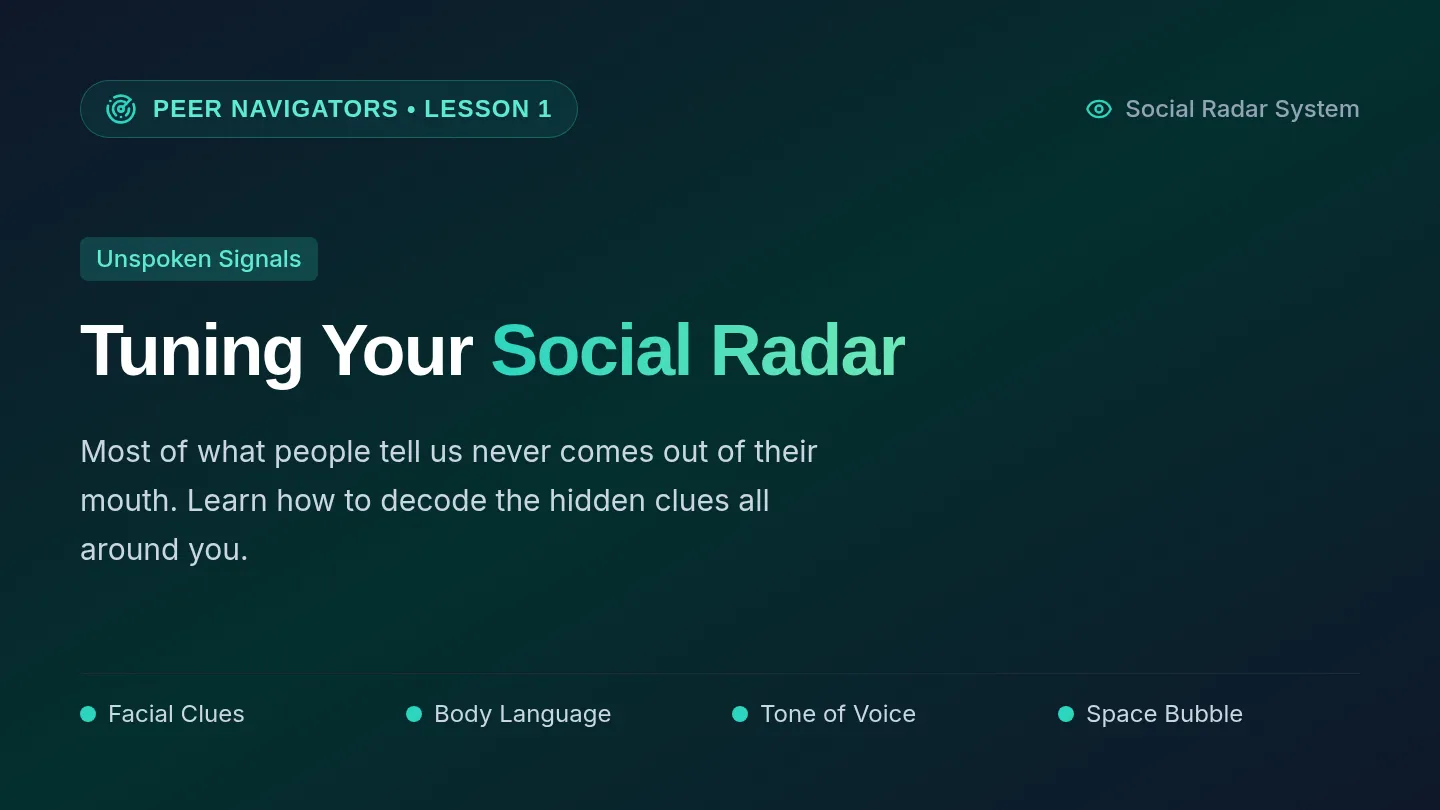
Kindness Compass: Empathy in Action
Understanding what others feel, seeing through their eyes, and choosing everyday kindness.
Opening Wonder: When was a time someone noticed you were having a tough day and did something small that helped?
The Heart Radar
What Does Empathy Really Mean?
Sympathy
Looking from a distance and saying:
"I feel sorry for you over there."
You see someone's struggle, but you stay separate from how they feel.
Empathy
Stepping alongside someone and saying:
"I hear you, I see you, and you are not alone."
You try on their shoes to understand what it actually feels like.
Empathy builds bridges between us; sympathy keeps us standing on opposite sides.
Our 3-Step Strategy
The Kindness Compass in 3 Moves
1
NOTICE
Look for clues! Watch body language, facial expressions, quiet sighs, or changes in how a friend acts.
"What do I see?"
2
WONDER
Ask yourself what could be happening. What would it feel like if you were standing in their spot right now?
"How would I feel?"
3
CONNECT
Take kind action! Speak gentle words, sit beside them, invite them to play, or offer a helpful hand.
"How can I help?"
Notice clues • Wonder about feelings • Connect with kind actions
Scenario 1 • Recess Playground
The Fence Watcher
Partner Discussion
During recess, two teams are picked for kickball. Jordan is not chosen and stands with arms crossed against the chain-link fence, staring down at their sneakers while everyone else cheers and plays.
1. Notice
What physical clues show how Jordan is feeling right now?
2. Wonder
What thoughts might be running through Jordan's head?
3. Connect
What is one kind move a classmate could make in 30 seconds?
Turn to your elbow partner: Share your ideas for step 3!
Scenario 2 • Classroom Challenge
The Missing Assignment
Partner Discussion
Your group is finishing a science poster that is due at the end of class. Sam arrives late, looks tired, and forgot the illustrations they promised to draw. Two teammates start whispering and rolling their eyes.
Scenario Investigators Activity Sheet Partner Investigation Sheet
Scenario Investigators: Heart Radar
Partner 1:
Partner 2:
Date:
1 NOTICE clues
2 WONDER about feelings
3 CONNECT with kind action
Case File 1
The Cafeteria Table Dilemma
The Situation: It's the third week of school. A new student, Leo, gets lunch and walks toward the tables. Two tables are completely full of kids laughing and trading snacks. Leo stops, hugs his lunch tray tightly to his chest, bites his lip, and sits alone at the very end of an empty table.
1. NOTICE: What body language clues show how Leo is feeling right now?
2. WONDER: What might Leo be thinking or worrying about in his head?
3. CONNECT: What specific words or action could you and your partner take to welcome Leo?
Case File 2
The Hallway Tumble
The Situation: In the crowded locker hallway before the bell, Priya trips over a backpack. Her binder bursts open, dumping drawings and homework across the floor. Two older students chuckle as they walk around her without stopping. Priya's face turns bright red.
1. NOTICE & WONDER: How does the laughing make Priya feel beyond just tripping?
2. CONNECT: How can you stand up for Priya and help her without making a huge scene?
Kindness Compass • Scenario Investigators Page 1 of 2
Advanced Investigation & Creator Challenge
Kindness Compass • Activity Part 2
Case File 3
The "I Don't Care" Mask
The Situation: The school basketball roster was posted on the gym doors this morning. Marcus practiced every afternoon all week, but his name isn't on the list. Back in class, when friends ask him about it, he rolls his eyes and loudly says, "Whatever, basketball is stupid anyway!" But his shoulders are slumped and he keeps staring out the window.
1. WONDER: Why do people sometimes act angry or say they "don't care" when they are actually hurt?
2. CONNECT: What is a quiet, empathetic way to support Marcus without calling him out in front of everyone?
Partner Creator Challenge: Real-Life Empathy Dilemma
Design & Solve
Think of a situation that often happens at school (recess games, group projects, bus rides, PE class). Write the scenario below, then write your Compass Solution .
Kindness Ripple Exit Assessment Independent Reflection & Assessment
Kindness Ripple: Empathy Check-In
Name:
Date:
Part 1: My Empathy Radar Self-Check
Be honest with yourself! Circle the number that best matches your habits right now:
1. I notice when a classmate looks left out, sad, or overwhelmed.
1 2 3
2. I try to understand why someone is upset before jumping to conclusions.
1 2 3
3. I take action with kind words or helpful gestures when a peer needs support.
1 2 3
1 = Growing & Learning 2 = Practicing Often 3 = Empathy Champion
Part 2: Heart Radar Written Reflection
A. Think about a time you noticed someone in your grade who needed encouragement. How did putting yourself in their shoes change what you did or said?
B. What is the difference between feeling sympathy ("feeling sorry for someone") and showing empathy ("feeling with someone")?
My Personal Kindness Compass Pledge
Desk / Locker Keepsake
This week, I promise to NOTICE:
When I see someone struggling or left out, I will CONNECT by:
My Signature:
My Accountability Partner:
Kindness Compass • Exit Reflection & Assessment Classroom Community Resource