Inner Compass Session Outline
Session 2 of 6 SEL Group & Mentoring Curriculum
Inner Compass: Session Outline
Focus: Personal Identity, Healthy Self-Esteem & Assertive Communication (Grades 5–8)
45–60 Minutes
Solo or 4–10 Students
Core Objective
Identify core strengths and replace passive/aggressive reactions with assertive "I-statements."
Materials Needed
Student Handout (2 pages), markers/colored pencils, sticky notes, talking piece.
Key Mindset
"Who I am is valuable; speaking my truth with respect protects my boundaries and honors others."
Timed Agenda & Step-by-Step Flow
| Time | Segment | Key Facilitation Actions | Solo Mod |
|---|
| 00–08 m | 1. Arrival & Weather Check-In | Review group norms. Share an "internal weather report" (sunny, hazy, stormy) and a recent win. | Journal or conversational check-in. |
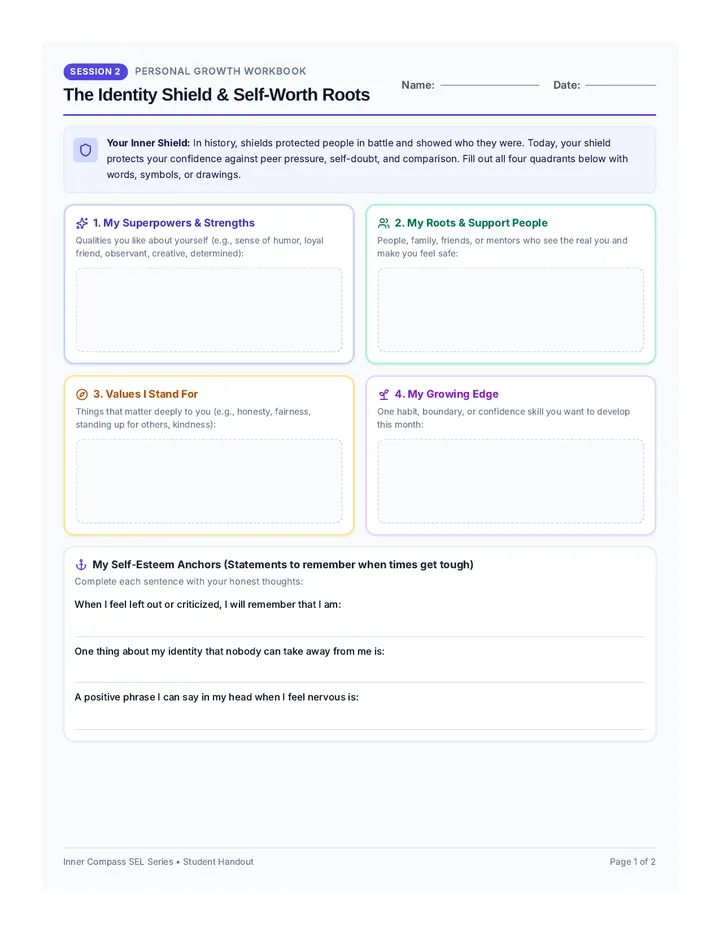
| 08–22 m | 2. Identity Shield & Self-Worth Roots | Distribute Student Handout p. 1. Map 4 quadrants: strengths, support network, values, growing edges. Pair-share. | Facilitator fills own shield alongside student. |
| 22–38 m | 3. Communication Styles & The Script | Introduce 3 styles: Passive (Turtle), Aggressive (Shark), Assertive (Owl). Practice the 3-step "I-Statement" formula. | Role-play a real peer situation they face. |
| 38–48 m | 4. Real-World Roleplay / Solo Tryout | Partners choose a peer scenario (teasing, project stress, boundary setting) and act out assertive solutions. | Rehearse assertive responses aloud. |
| 48–55 m | 5. Closing Check-In & Anchor Card | Write personalized anchor note. Closing circle: "One word describing how I will show up this week." | Keep anchor card in backpack or desk. |
Facilitator Discussion Prompt Bank
Identity & Self-Esteem Prompts:
- "What is something you like about yourself that people don't notice right away?"
- "Where do you feel pressure to fit into someone else's box?"
- "How does knowing your strengths help on hard days?"
Communication & Boundary Prompts:
- "Why is it scary sometimes to be assertive instead of staying quiet?"
- "What's the difference between standing up for yourself and attacking?"
- "What is one boundary you want to hold clearly this week?"
Solo Mentoring & 1-on-1 Adaptation Note: When facilitating one-on-one, prioritize collaborative co-creation. Complete the shield together so the student does not feel scrutinized. If the student struggles with low self-worth ("I don't have strengths"), offer 2–3 genuine, observed strengths from your interactions to seed their list.
Inner Compass Facilitator Guide
Facilitator Guide Session 2 of 6 • Grades 5–8
Inner Compass: Identity, Self-Esteem & Voice
Leader roadmap for fostering authentic self-worth and respectful, assertive self-advocacy.
Format Flexibility Small Circle or 1-on-1 Mentoring
Developmental Context (Ages 10–14)
Students in grades 5–8 experience heightened social comparison and peer sensitivity. They often conflate their self-worth with peer approval or online metrics. Communication swings between silence (withdrawing to avoid conflict) and aggression (defensive snapping). This session provides an objective anchor for personal values and constructive voice.
Brave Space Norms & Safety
- Right to Pass: Students can share as much or as little as they feel comfortable with.
- No Mocking / Zero Sarcasm: Guard vulnerability fiercely against peer irony.
- Confidentiality: What is said in circle stays in circle (unless safety is compromised).
1
Phase 1: Welcome & The Internal Weather Check-In (8 Mins)
Pacing: 00–08m
Purpose: Disarm social performance mode and ground youth in somatic self-awareness.
"Facilitator Script: 'Welcome back everyone. Today we are exploring our Inner Compass—who we are at our core, and how we speak up for ourselves when things get messy. To start, give me your internal weather report: Are you partly sunny, foggy, thunderstorming, or a brisk autumn breeze? No need to explain why unless you want to.'"
Facilitator Tip: Model first with honesty (e.g., "I'm a little overcast because traffic was heavy, but clearing up now"). This removes the pressure to say "I'm good."
2
Phase 2: The Identity Shield & Self-Worth Roots (14 Mins)
Pacing: 08–22m
Hand out Page 1 of the Student Handout. Explain that in ancient times, shields protected warriors from arrows and displayed their true allegiance. Today, an Identity Shield protects our self-esteem from harsh comments, comparison, and doubt.
Quadrant 1 & 2 Focus:
Strengths: Talents, humor, kindness, resilience (not just school grades or sports trophies). Roots & People: Who believes in you when you forget your worth?
Quadrant 3 & 4 Focus:
Core Values: Fairness, loyalty, creativity, honesty. Growing Edge: A quality you are currently building courage around.
Handling Resistance: If a student insists, "I have no strengths," avoid arguing. Instead say: Offer concrete observations (e.g., quiet patience, keen observation, loyalty to friends).
Inner Compass Student Handout
Session 2 Personal Growth Workbook
The Identity Shield & Self-Worth Roots
Name:
Date:
Your Inner Shield: In history, shields protected people in battle and showed who they were. Today, your shield protects your confidence against peer pressure, self-doubt, and comparison. Fill out all four quadrants below with words, symbols, or drawings.
1. My Superpowers & Strengths
Qualities you like about yourself (e.g., sense of humor, loyal friend, observant, creative, determined):
2. My Roots & Support People
People, family, friends, or mentors who see the real you and make you feel safe:
3. Values I Stand For
Things that matter deeply to you (e.g., honesty, fairness, standing up for others, kindness):
4. My Growing Edge
One habit, boundary, or confidence skill you want to develop this month:
My Self-Esteem Anchors (Statements to remember when times get tough)
Complete each sentence with your honest thoughts:
When I feel left out or criticized, I will remember that I am:
One thing about my identity that nobody can take away from me is:
A positive phrase I can say in my head when I feel nervous is:
Inner Compass SEL Series • Student Handout Page 1 of 2
Session 2 • Part 2 Voice & Boundaries
The Communication Styles Decoder
Speaking with Clarity & Respect
🐢 Passive (The Turtle)
Hides in shell. Says "whatever" or "I don't care" when upset.
Body Language: Looking down, quiet voice, slumping.
🦈 Aggressive (The Shark)
Attacks, blames, yells, interrupts, or uses cruel sarcasm.
Body Language: Glaring, crossed arms, shouting or mocking tone.
🦉 Assertive (The Owl)
Calm, clear, and honest. Stands up for self without putting others down.
Body Language: Steady eye contact, calm posture, clear tone.
The 3-Step "I-Statement" Formula
1. When you...
Name the specific action calmly without calling names.
2. I feel...
Share your true emotion (frustrated, ignored, pressured).
3. In the future, I need...
State your clear boundary or request respectfully.
Put It Into Practice: Write Your Assertive Script
Scenario 1 (Group Work): A classmate is on their phone and leaves you to do all the work right before class ends.