Pathfinding Facilitator Guide Future Pathfinding & Stress Relief
Lesson Plan • Career & Life Skills
Duration 60 Min
WHY THIS MATTERS
To equip upperclassmen with practical strategies to navigate future planning anxieties, fostering confidence and well-being as they approach significant life transitions.
AUDIENCE
11th and 12th Grade Students
APPROACH
Interactive discussion, guided reflection, and practical exercises.
PREPARATION CHECKLIST
Review the Charting Your Course slide deck.
Print copies of My Future Path Worksheet for each student.
Print copies of Stress Less Toolkit for each student.
Ensure access to a whiteboard or projector.
Gather pens or pencils for students.
Learning Objective
Students will identify stress related to post-graduation planning, explore decision-making frameworks, recognize support systems, and practice anxiety management techniques.
INSTRUCTIONAL SEQUENCE
10 min Section 1
Introduction & Hook: What's Next?
Begin by projecting the first slide of the Charting Your Course slide deck.
Ask students: "What comes to mind when you think about 'What's Next?' after high school?" Allow for a brief open discussion.
Introduce the lesson's purpose: to explore future paths and learn strategies to manage stress associated with these big decisions. Explain that this lesson will help them feel more in control and less overwhelmed.
15 min Section 2
Exploring Future Paths & Decision Making
Transition to the 'Exploring Your Path' section of the slide deck.
Lead a discussion on various post-graduation options (college, vocational school, gap year, direct employment, military).
Introduce a simple decision-making framework (e.g., pros/cons list, values alignment).
Distribute the My Future Path Worksheet and guide students to begin brainstorming and applying the decision-making framework to their own interests.
10 min Section 3
Identifying Support Systems
Move to the 'Who's on Your Team?' slide.
Discuss the importance of support systems: family, teachers, counselors, mentors, friends.
Encourage students to identify individuals in their lives who can offer guidance and emotional support.
Ask students to add identified support systems to their My Future Path Worksheet .
15 min Section 4
Stress Management Techniques
Introduce the 'Taming the Stress Monster' section.
Briefly explain common stress responses.
Present simple stress management techniques (deep breathing, mindfulness, breaking tasks into smaller steps).
Distribute the Stress Less Toolkit and guide students through practicing one or two techniques together.
10 min Section 5
Wrap-up & Reflection
Conclude with the 'Your Empowered Future' slide.
Ask students to share one new insight or strategy they gained.
Reiterate that feeling anxious is normal, but they have tools and support to navigate their future.
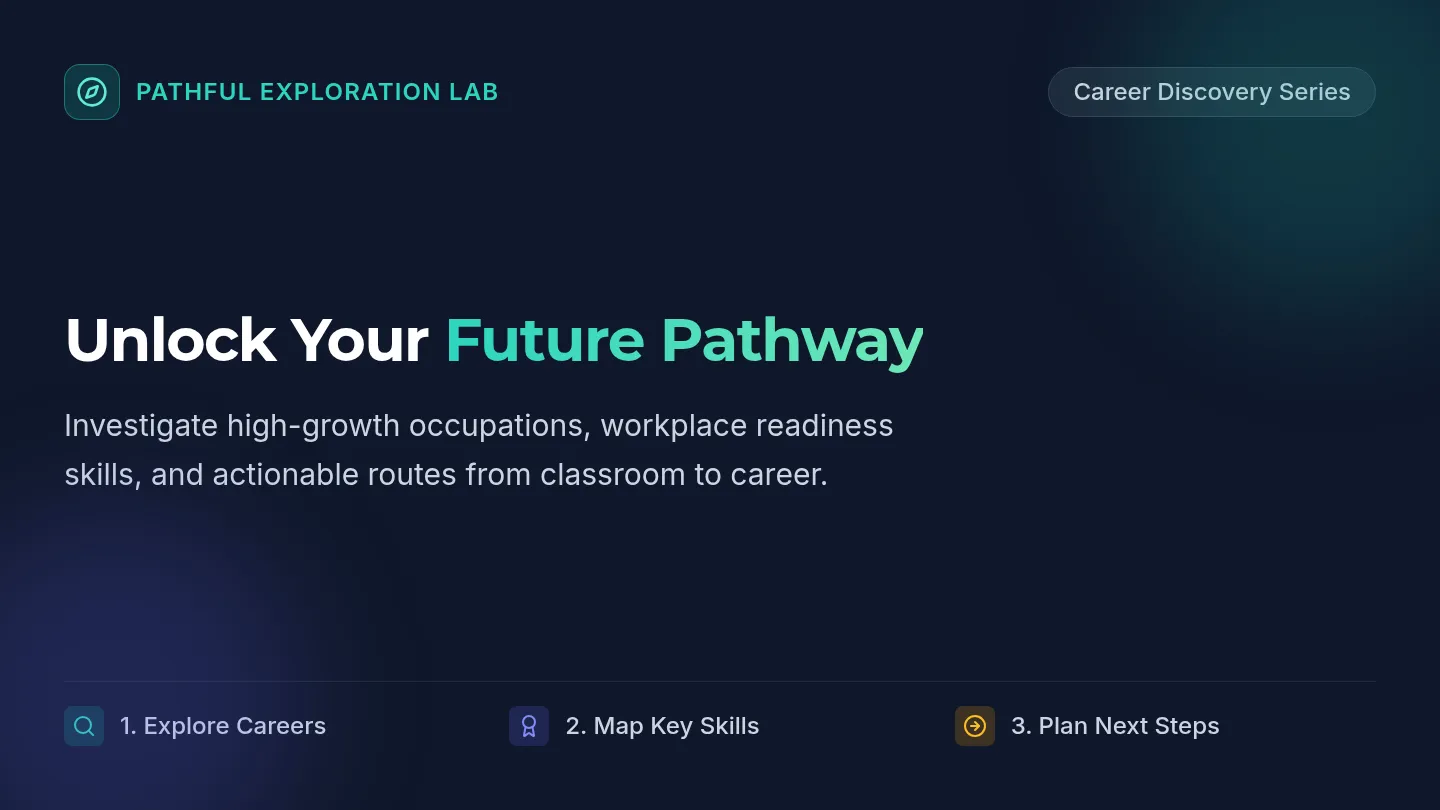
Charting Your Course Slides Pathfinding Series
Charting Your Course
Future Pathfinding & Stress Relief
What's next after high school? Let's explore your journey and conquer stress together.
TEACHER NOTES
Welcome students. Ask them to think about "What's Next?" and share initial thoughts about post-graduation. Emphasize the goal of reducing stress and increasing confidence.
Exploring Your Path
POST-GRAD OPTIONS
College (2-year, 4-year)
Vocational/Trade School
Gap Year
Direct Employment / Military
Decision-Making Tools
01
Pros & Cons Lists
Evaluating risks vs. rewards
02
Values Alignment
Matching paths to what you care about
03
Information Gathering
Researching facts, not just feelings
TEACHER NOTES
Prompt students to consider various paths. Encourage an open discussion, validating all options. Refer to the My Future Path Worksheet .
Who's On Your Team?
"You don't have to navigate this journey alone."
Family
Guardians and relatives who know you best.
School
Counselors and teachers with expert advice.
Mentors
Community leaders and role models.
Who is one person you haven't asked for help yet?
TEACHER NOTES
Lead a discussion about support networks. Encourage students to think broadly. Prompt them to list their team on the My Future Path Worksheet .
Taming the Stress Monster
Common Stressors
Uncertainty
Pressure from others
Fear of failure
Feeling overwhelmed is a normal response to big life changes.
Deep Breathing
The 4-4-6 Method
Micro-Steps
Break it down
Activity
Physical movement
Realistic Goals
Setting bounds
TEACHER NOTES
Acknowledge that stress is normal. Explain signs of stress. Model one technique with the class. Refer to the Stress Less Toolkit .
Your Empowered Future
Key Takeaways
Explore all your options.
Utilize decision-making tools.
My Future Path Worksheet My Future Path
Decision Framework & Planning
NAME:
DATE:
1 PART 1: EXPLORING YOUR OPTIONS
Think about what you want to do after high school. Brainstorm three different paths you might consider. Don't worry about making a final decision yet—just explore the possibilities!
Path Idea #1
Pros (Opportunities & Strengths)
Cons (Challenges & Hurdles)
Path Idea #2
Pros (Opportunities & Strengths)
Cons (Challenges & Hurdles)
Path Idea #3
Pros (Opportunities & Strengths)
Cons (Challenges & Hurdles)
2 PART 2: WHO'S ON YOUR TEAM?
Support systems are vital. List people or groups you could go to for advice, help, or emotional support related to your plans.
Support Person/Group
How can they help you?
Support Person/Group
How can they help you?
Support Person/Group
How can they help you?
3 PART 3: WHAT MATTERS MOST?
What values (e.g., stability, creativity, helping others, independence) are most important to you?
Important Value #1
Important Value #2
How do these values influence your path ideas from Part 1?
"The best way to predict your future is to create it."
Stress Less Toolkit Worksheet Stress Less Toolkit
Managing Post-Graduation Anxiety
Name:
Date:
PART 1: MY STRESS TRIGGERS
What specific things about your future planning make you feel anxious? (Be honest!)
PART 2: QUICK STRESS BUSTERS
Practice these techniques. Which ones work best for you?
1. Deep Breathing
Inhale slowly for 4 counts, hold for 4 counts, exhale slowly for 6 counts. Repeat 3-5 times.
How did you feel after trying this?
2. Mindful Moment
Take 1 minute to focus on one thing in your environment (a sound, a texture, a color). Just notice it, without judgment.
How did you feel after trying this?
3. Break it Down
When a task feels too big (like a college application), break it into smaller steps.
Big Task Example
Micro-Steps
PART 3: MY PERSONALIZED STRESS PLAN
Choose 2-3 techniques to use when you feel overwhelmed. Write down the "When" and "How."
Plan #1: Technique
How/When I will use it:
Plan #2: Technique
How/When I will use it:
You've Got This!
"It's okay to feel stressed, but it's even better to have tools to help you manage it. Take it one step at a time."