Empathy in Action Lesson Plan Empathy in Action
Lesson Plan • 6th Grade Social-Emotional Learning
Duration
60 MIN
Learning Objective
Students will learn to understand and appreciate diverse perspectives, applying empathy to solve problems more effectively and compassionately.
Why This Matters
Developing empathy helps students navigate social situations, build stronger relationships, and contribute to a more inclusive community. It's a vital skill for both academic and personal success.
Teacher Prep
Review all linked materials and slide deck.
Check projector for the Walking in Their Shoes slides.
Print copies of Different Shoes Different Views Scenarios .
Set up desks for small group "Perspective Circles."
Approach
Perspective-taking through scenarios & discussion.
Instructional Steps
10
min
Introduction: What is Empathy?
• Warm Up: Ask students to mirror the facial expressions of a partner (happy, confused, frustrated). Discuss how it feels to try and match someone else's state.
• Introduce empathy using the Walking in Their Shoes slide deck.
• Facilitate a brief discussion using the Perspective-Taking Circle intro questions.
20
min
Exploring Perspectives with Scenarios
• Distribute the Different Shoes Different Views Scenarios .
• Students read scenarios individually or in pairs to identify conflicting needs.
• Use slides to guide discussion: "How does understanding these perspectives change how we solve the problem?"
20
min
Deep Dive: Perspective-Taking Circle
• Break into small groups for the Perspective-Taking Circle activity.
• Each group receives a unique discussion prompt to analyze together.
• Teacher Role: Circulate and encourage active listening. Prompt students to use "I feel..." and "I wonder if they feel..." statements.
05
min
Project Launch
• Introduce the Empathy Challenge Project Guide .
• Explain that students will apply these skills to a real-world school or community issue.
05
min
Cool Down & Reflection
• Empathy Compass: Ask students to write one "direction" they will take this week to show empathy to someone new.
Materials Included:
Slide Deck Scenario Reading Discussion Guide Project Guide
Walking in Their Shoes Slides Walking in
Their Shoes
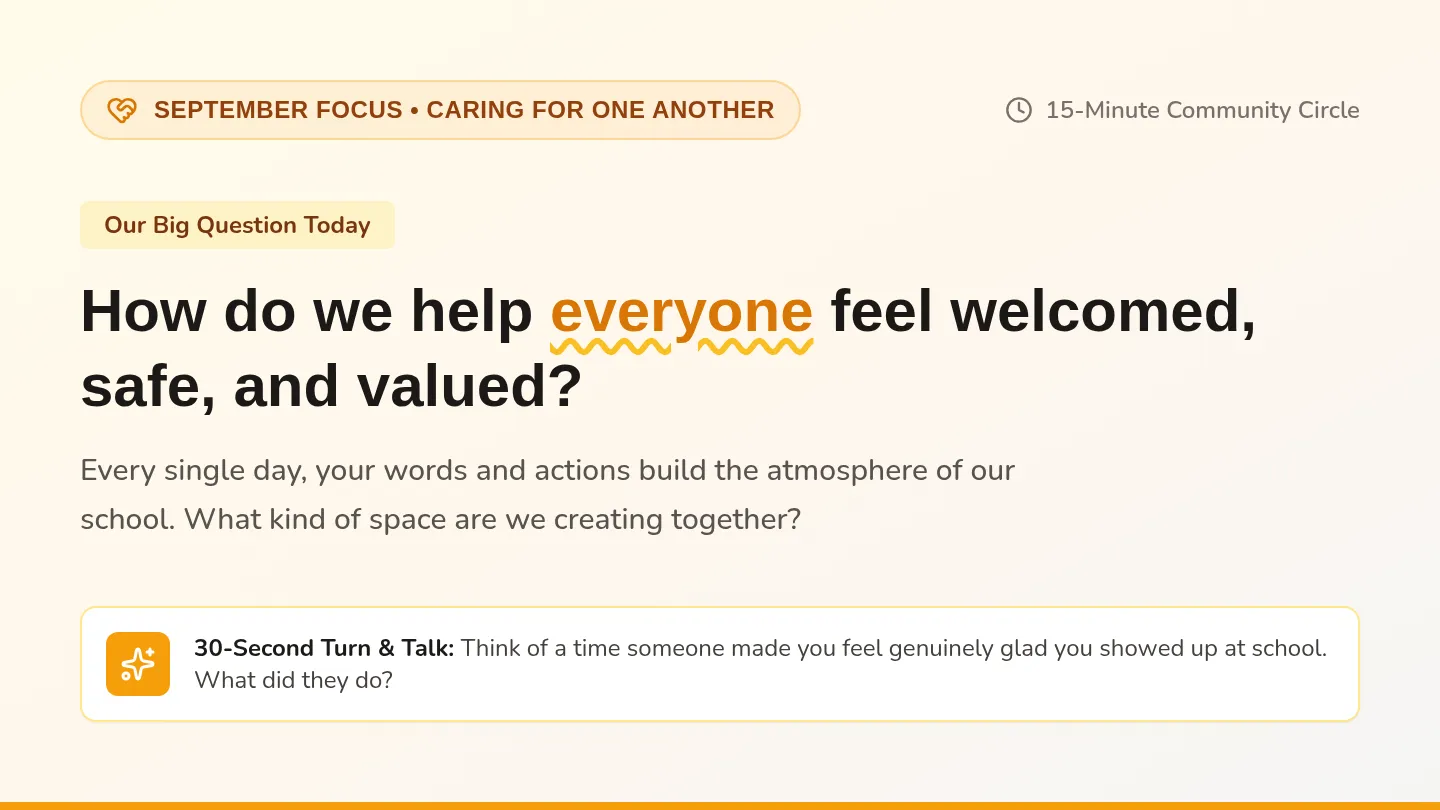
Understanding and navigating the world through empathy.
Perspective Taking
Connection
Teacher: Welcome students and ask what empathy means to them.
Our Compass Goals
01
Understand what empathy actually is.
02
Learn to see things from different points of view .
03
Discover how empathy helps solve problems .
"Think about a time you felt really understood. What was that like?"
Quick Chat
What is Empathy?
Feeling WITH Someone
Sharing the joy or the sadness, not just looking at it from the outside.
Seeing Through Their Eyes
Trying to understand the "why" behind their reactions and feelings.
Why is this important?
Different Shoes, Different Views
You
Friend
Teacher
"One situation, many feelings. People can experience the same moment very differently!"
The Super Problem-Solver
When you use empathy, you can:
Find solutions that work for everyone
Be fair and consistently kind
Avoid messy misunderstandings
Ready to Practice?
"How can understanding a friend's feelings help you solve a disagreement?"
The Empathy Challenge
Project Intro
Phase 1: Notice
Think about problems in our school or community where people feel unheard or misunderstood.
Phase 2: Navigate
How can understanding others help create a real solution? You're the Empathy Champion!
Keep Your Empathy Compass Ready!
Empathy is a powerful tool you carry every day. Use it to navigate challenges, connect with others, and make the world more understanding.
EVERY DAY IS A CHANCE TO WALK IN THEIR SHOES
Different Shoes Different Views Scenarios Different Shoes, Different Views
Case Studies
Name: ___________________________________
Date: __________________
Instructions: Below are three scenarios. For each one, read the situation and then analyze it from the perspective of different people involved. Think about their feelings, their needs, and how empathy could change the outcome.
SCENARIO 1
The Silent Table
"Jamie just moved to a new school. During lunch, Jamie sits at a table where a group of friends is laughing loudly about a joke from a party over the weekend. No one says hello to Jamie, and they keep talking about people Jamie doesn't know. Jamie eats quickly and leaves."
Jamie's View
What is Jamie feeling? Why?
The Group's View
Are they being mean on purpose? What are they focused on?
SCENARIO 2
The Group Project Lag
"Maya is frustrated because her partner, Leo, hasn't finished his part of their science poster. Maya is a straight-A student and wants it to be perfect. Leo has been missing class lately because he has to take care of his younger sister after school while his mom works double shifts."
Maya's View
What are her concerns?
Leo's View
What is he juggling? How might he feel about the project?
The Empathy Solution:
If Maya understood Leo's situation, how could they solve this together?
SCENARIO 3
The Bench Warmer
"Coach Miller keeps Sam on the bench for the entire championship game. Coach wants the team to win and plays the 'star' players the whole time. Sam's parents are in the stands and haven't seen Sam play a single minute. Sam feels like quitting the team."
Sam's View
Coach Miller's View
Perspective Reflection
Why is it often hard to see the "other side" when we are upset or frustrated?
Perspective-Taking Circle Discussion Guide Perspective Circle
Discussion Guide & Activity
Whole Class Intro Question
"If you could trade lives with anyone in this school for just one day, who would it be and why? What is one thing you think they struggle with that you don't?"
Group Discussion Prompts
Cut these cards out or assign one to each group. Each group should discuss their prompt for 10 minutes and prepare one "Empathy Insight" to share with the class.
1
The Teacher's Evening
Imagine your teacher has 120 essays to grade, a meeting until 5:00 PM, and a family to feed at home. When they seem "grumpy" the next morning, what is really going on?
Discuss:
How should the class respond to a stressed teacher using empathy?
2
The "Cool" Kid
Think about someone who seems very popular and always happy. What are some pressures or feelings they might have that they don't show to everyone?
Discuss:
Why is it hard to have empathy for people who seem like they "have it all"?
3
The Rule Follower
Imagine a student who always reminds the teacher about the homework or follows every single rule. Other kids might find them annoying. What might be their motivation?
Discuss:
How can we change our perspective on "annoying" behaviors?
4
The Newcomer
A new student from a different country joins the class. They aren't speaking much and they sit alone. Are they "stuck up" or just shy? What else could they be feeling?
Discuss:
What is the most welcoming thing an empathetic student could do?
Discussion Ground Rules
Listen without interrupting.
Use "I wonder if..." statements.
Respect all points of view.
Keep group stories confidential.
Empathy Challenge Project Guide Empathy Challenge
Project Guide • Real-World Application
Champion
The Mission
Empathy isn't just a feeling—it's an action. Your mission is to identify a "blind spot" in our school or community where people's perspectives are being ignored, and design a solution that uses empathy to fix it.
Your Goal:
"Create a proposal for a change that makes someone's life better by understanding their specific needs."
Key Deliverables
Problem Analysis
Interview or Survey
Empathy Map
Solution Proposal
Navigation Steps
1
Identify the "Invisible" Problem
Look for a situation where people are unhappy, frustrated, or left out. Examples:
• Crowded hallways between classes
• Students with food allergies at lunch
• New students feeling isolated
• Trash on the playground
2
Build an Empathy Map
Choose one person involved in the problem and map their experience:
Says
Thinks
Does
Feels
3
The Compass Solution
Design a fix! Your solution must address at least TWO different perspectives. How does your plan help the teacher AND the student? The quiet student AND the loud one?
Self-Check: Empathy Filter
Before you turn in your project, ask yourself:
Did I talk to at least one person actually affected by this?
Is my solution kind to everyone involved?
Could this really work in our school?
Does my project show I "walked in their shoes"?
Initial Project Idea Brainstorm: