Smart Choices Lesson Plan The Art of Smart Choices
Lesson Plan
50 Minutes
Middle School (Tier 1)
RATIONALE
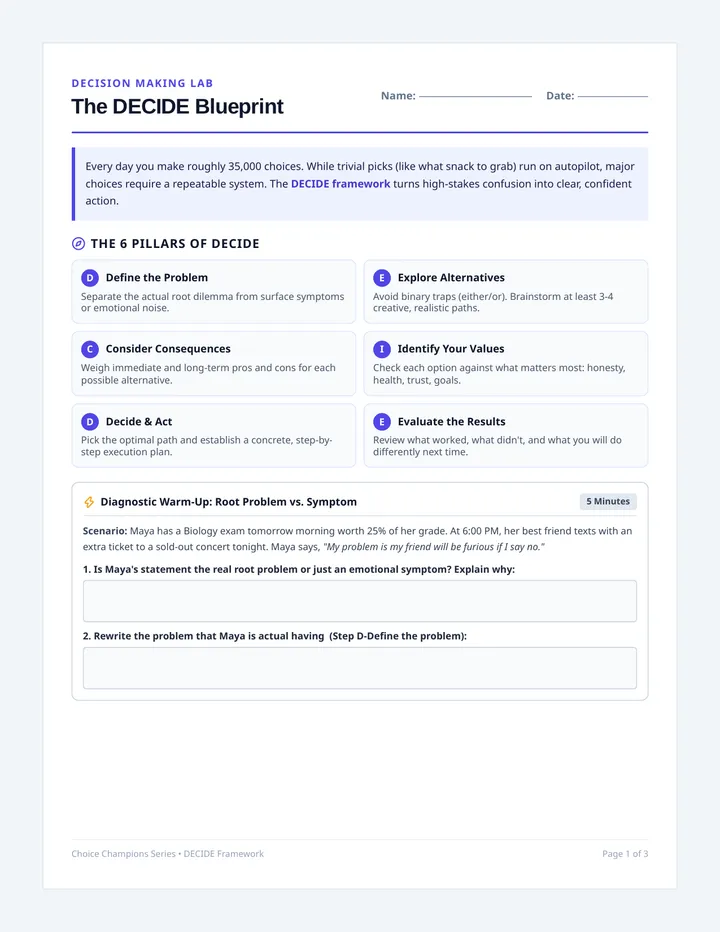
Making smart decisions is a critical life skill. This lesson equips students with a structured framework to approach tough choices, helping them navigate personal and social challenges while aligning their actions with their values.
OBJECTIVE
Students will learn and apply a decision-making framework to analyze real-life dilemmas, considering consequences and ethical implications to make informed choices.
PREPARATION
Review the Decision-Making Compass slide deck.
Print copies of Decision Matrix Explorer for all students.
Prepare copies of Applied Decision Scenarios assessment.
Set up projection for the slide deck.
Instructional Sequence
5 MIN
Introduction: What's Your Dilemma?
Begin with a warm-up: "Think about a time you had to make a tough decision. What made it tough?"
Define decision-making as a skill that can be practiced and mastered.
Goal: Set the stage for why structured thinking matters.
15 MIN
Exploring the Decision-Making Compass
Present the Your Decision-Making Compass slide deck.
Walk through the 6 steps: Identify, Gather, Brainstorm, Evaluate, Decide, and Reflect.
Ask students for quick real-world examples for each step as you go.
15 MIN
Activity: Ethical Choices Debate
Divide students into small groups and distribute the Ethical Choices Debate activity sheet.
Groups analyze a dilemma (Scenario A, B, or C) using the compass framework.
Each group presents their decision and justifies it using the 6 steps.
10 MIN
Decision Matrix Explorer
Distribute the Decision Matrix Explorer worksheet.
Explain how to score options based on criteria.
Model one example (e.g., choosing a pizza topping based on taste, cost, and health).
5 MIN
Wrap-up & Assessment
Summarize the importance of pausing before making big choices.
Assign Applied Decision Scenarios as the final summative assessment.
"The quality of your life is determined by the quality of your decisions."
Your Decision-Making Compass Slide Deck Life Skills Series
Decision Dilemmas:
Navigating Your Choices
Ever faced a tough choice? Today, we'll learn how to make smart decisions with confidence!
Your Decision-Making Compass
Just like a compass guides explorers through unknown territory, our Decision-Making Compass will guide us to the best choices in tough situations.
1
Identify
2
Gather
3
Brainstorm
...
And More
Step One
Identify the Problem
"What is the real issue?"
Step Two
Gather Information
What do you need to know?
Collect facts and details.
Seek different perspectives.
Talk to trusted adults/friends.
Expert Tip
Think about similar situations you've faced in the past. What worked? What didn't?
Step Three
Brainstorm Solutions
"What are your options?"
Come up with as many possible solutions as you can. Use your creativity!
Don't judge ideas yet – just list them!
Step Four
Evaluate Consequences
Pros
What are the good things that could happen from this choice?
Cons
What are the bad things or risks involved in this choice?
Self
How will this affect me?
Others
How will it affect others?
Future
Long-term effects?
Step Five
Make a Choice
Time to decide!
Choose the solution that best fits your values and leads to the most positive outcome for everyone involved.
"The best choice isn't always the easiest one, but it's the one you can stand by tomorrow."
Step Six
Reflect
How did it go?
Ethical Choices Debate Activity Ethical Choices Debate
Putting the Decision-Making Compass to work
Name:
Date:
OBJECTIVE
Apply the decision-making framework to ethical dilemmas and practice defending your choices through evidence-based reasoning.
INSTRUCTIONS
Form Groups: Join your assigned small group.Apply the Compass (10m): Use the 6 steps (Identify, Gather, Brainstorm, Evaluate, Choose, Reflect) to analyze your dilemma.Prepare Argument (5m): Prepare a 2-minute presentation explaining your choice and why it fits your group's values.
Identify
Gather
Brainstorm
Evaluate
Choose
Reflect
STEP 1: SELECT YOUR DILEMMA
Circle one scenario for your group to analyze.
Scenario A: The Accidental Discovery
You find a wallet on the ground. Inside, there is $100 in cash and an ID card. You know the person on the ID lives across town. What do you do?
Scenario B: The Group Project Slacker
A group member isn't doing any work. The deadline is tomorrow. If you don't do their part, everyone's grade will suffer. If you do it, they get credit for your work. What do you do?
Scenario C: The Harmful Secret
Your best friend tells you a secret: they've been pranking a younger student, and it's starting to get mean. They made you promise not to tell. What do you do?
Scenario D: Write Your Own
STEP 2: OUR GROUP'S DECISION
What is your final chosen solution?
STEP 3: OUR REASONING
Explain why this is the best choice. Reference at least 3 steps of the Decision-Making Compass (Identify, Gather, Brainstorm, Evaluate, Choose, Reflect).
Compass Step 1: ____________________
Compass Step 2: ____________________
Compass Step 3: ____________________
Final Conclusion
Decision Matrix Explorer Worksheet Decision Matrix Explorer
Evaluating options with data and logic
Student:
Date:
Part 1: How it Works
A decision matrix helps you compare different options based on the things that matter most (criteria). You score each option from 1 to 5. The option with the highest total score is mathematically your "best" choice.
Example: Choosing a Book
Option Price (1-5) Genre (1-5) Reviews (1-5) Total Book A 3 5 4 12 Book B 5 2 3 10 Book C 2 4 5 11
Part 2: Your Turn! Small Decisions
My Decision Topic
E.g., What to eat for lunch, which chore to do, etc.
Important Criteria
Options Crit. 1 Score (1-5) Crit. 2 Score (1-5) Crit. 3 Score (1-5) TOTAL
Part 3: Hypothetical Choices
Scenario: The School Fun Day Vote
Your school is planning a fun day! Your class gets to vote on one activity: a field trip to a Science Museum , a Sports Tournament , or a Movie Marathon with pizza . You personally love science, but most of your friends want the sports tournament. You want to make the most logical choice for the whole class.
Identify the Problem
What is the core decision here?
Gather Information
What information would you want to know before deciding?
Fun Day Decision Matrix
CRIT 1:
CRIT 2:
CRIT 3:
Option Crit 1 Crit 2 Crit 3 Total Science Museum
Applied Decision Scenarios Test Applied Decision Scenarios
Summative Assessment • Decision-Making Framework
Name:
Score:
/ 15
Instructions
Read each scenario carefully. Use the 6 steps of the Decision-Making Compass to analyze the situation and explain your final choice. Ensure your answers consider both yourself and others involved.
1
The Study Group Dilemma
A big test is coming up. Your teacher offers extra credit for students in study groups. You want the extra credit, but your best friend, who struggles in this subject, wants to study with you alone because they feel overwhelmed in groups. A larger group would be much more effective for your own grade and getting that extra credit.
Step 1: Identify the Problem
Step 2: Gather Information
Step 3: Brainstorm (3 Options)
Step 4: Evaluate Consequences
Steps 5 & 6: Make a Choice & Reflect
Explain your final decision and why it's the most responsible choice.
2
The Social Media Post
A classmate posts a picture making fun of another student. It's mean, but many people are laughing and commenting. You like both students. You don't want to get involved, but you feel very uncomfortable seeing the post.
Identify the Problem
Gather Information
Brainstorm (3 Options)
Evaluate Consequences
Make a Choice & Reflect
3
The New Club
A new club is starting that sounds exciting. However, it meets at the exact same time as a club you've been in for years. You have close friends in both, and you can only choose one.
Identify the Problem
Gather Information
Brainstorm (3 Options)
Evaluate Consequences
Make a Choice & Reflect