Four Questions Anchor Chart Navigator Series
The Decision-Maker's Compass
Before you make a choice, chart your course. Ask yourself these four powerful questions to map out every possible outcome.
If I do this... Best Outcome
1. What is the best thing that happens?
Imagine your absolute best-case scenario. What doors open? What are the rewards, joys, and positive growth that come from taking action?
Focus on: Growth, success, goals achieved, and positive impact.
If I don't do this... Best Outcome
3. What is the best thing that happens?
What do you save or protect by staying the course? Consider what anxiety, risks, or resources (like time, money, and energy) you successfully preserve.
Focus on: Peace of mind, safety, time saved, and avoiding risk.
If I do this... Worst Outcome
2. What is the worst thing that happens?
What is the real risk? Think about the mistakes, failures, or negative consequences that might occur, and whether you can handle or recover from them.
Focus on: Potential mistakes, embarrassment, cost, and coping.
If I don't do this... Worst Outcome
4. What is the worst thing that happens?
What is the cost of doing nothing? What regret, missed opportunity, or lingering problem will you face down the road if you choose not to act?
Focus on: Regrets, missed chances, and long-term stagnation.
Navigating Your Choices
1. Balance the Scales
Compare short-term comfort against long-term growth. Often, the best path requires brief discomfort.
2. Check Your Fears
Is the "worst outcome" permanent, or can you fix it? Don't let temporary fear stop lasting benefits.
3. Notice Inaction Costs
Doing nothing is still a choice. It carries risks like missed growth, stagnation, and regret.
Minerva Carter, Prevention Specialist • Email: mcarter@phoenixhousetx.org
Crossroads Tracker Worksheet Mindful Decisions Series
Decision Map Worksheet
Analyzing Action, Inaction, and Consequences
Name:
Date:
★ Guided Practice: The Power of Four Questions
Decisions are rarely as simple as "yes" or "no." Every choice to act (doing something) or remain still (doing nothing) carries benefits and risks. Read the scenarios below and put yourself in the decision-maker's shoes.
Scenario 1
Rosa Parks • December 1, 1955
After a long, exhausting workday as a seamstress in Montgomery, Alabama, Rosa Parks boards a segregated public bus. As the bus fills, the driver demands that Parks and three other Black passengers stand to make room for a white man. Refusing means violating local law and facing immediate arrest, which could spark a dangerous community backlash. Standing up means preserving her immediate personal safety but continuing to submit to an unjust system.
The Core Choice: Stay seated (Action / Resist) OR Stand up (Inaction / Comply)
1. Action / Best Case
What's the best thing that happens if she stays seated?
2. Action / Worst Case
What's the worst thing that happens if she stays seated?
3. Inaction / Best Case
What's the best thing that happens if she stands up?
4. Inaction / Worst Case
What's the worst thing that happens if she stands up?
Minerva Carter, Prevention Specialist • Email: mcarter@phoenixhousetx.org PAGE 1 OF 3
Mindful Decisions Series
Decision Map Worksheet
Analyzing Action, Inaction, and Consequences
Guided Practice
Scenario 2
Bilbo Baggins • J.R.R. Tolkien's The Hobbit
Bilbo Baggins stands at the threshold of his comfortable hobbit-hole in the Shire. Gandalf the Wizard and thirteen dwarves have invited him on a dangerous journey to reclaim Lonely Mountain from the fierce dragon, Smaug. Bilbo loves his quiet, predictable life of warm tea, multiple breakfasts, and zero danger. However, there is a small, quiet part of him that longs to see the world. Joining the quest means facing freezing cold, trolls, goblins, and a dragon. Staying home means absolute safety but missing the opportunity to discover who he truly is.
The Core Choice: Join the quest (Action / Risk) OR Stay in the Shire (Inaction / Comfort)
1. Action / Best Case
What's the best thing that happens if he joins the quest?
2. Action / Worst Case
What's the worst thing that happens if he joins the quest?
3. Inaction / Best Case
What's the best thing that happens if he stays in the Shire?
4. Inaction / Worst Case
What's the worst thing that happens if he stays in the Shire?
Minerva Carter, Prevention Specialist • Email: mcarter@phoenixhousetx.org PAGE 2 OF 3
Mindful Decisions Series
My Personal Choice Map
Apply the Compass to a Real Decision in Your Own Life
Personal Analysis
1. What is the major decision you are facing right now?
Examples: Speaking up to a friend, joining a new club, trying out for a sport, starting/quitting a habit, studying or relaxing.
Describe the choice you must make (Should I ____________?):
A. DO IT • BEST
Best thing that happens if I do this?
B. DON'T DO IT • BEST
Best thing that happens if I don't?
C. DO IT • WORST
Worst thing that happens if I do this?
D. DON'T DO IT • WORST
Worst thing that happens if I don't?
My Post-Analysis Action Plan
Commitment: Weighing your answers above, what is your final, chosen decision?
First Step: What is the very first, immediate action step you will take to follow through?
Decision Integrity Rubric
Criteria 3 - Master Explorer 2 - Pathfinder 1 - Novice Navigator Depth of Analysis I listed deep, long-term outcomes for both action and inaction. I listed clear immediate outcomes but missed some long-term ones. I only wrote quick, single-word answers without exploring. Honesty & Realism I bravely faced actual, uncomfortable fears and hard truths. I listed obvious risks but held back on deeper personal fears. I avoided the hard questions or wrote unrealistic outcomes.
Minerva Carter, Prevention Specialist • Email: mcarter@phoenixhousetx.org PAGE 3 OF 3
Decision Architect Teacher Guide Mindful Decisions Series • Educator Resource
Decision Architect Teacher Guide
Facilitating the "Best and Worst Analysis" Decision-Making Framework (Grades 6-8)
Classroom Facilitator Guide
Objective & Value
Middle school students (grades 6-8) often exhibit impulsive "all-or-nothing" thinking or avoid decisions altogether (passive inaction). This 2x2 matrix interrupts passive habits by forcing students to weigh the benefits and risks of both action and inaction .
Lesson Pacing Plan
1. Hook & Introduction (10m): Display the Four Questions Anchor Chart . Discuss the concept of "Inaction as a Choice."
2. Guided Practice (15m): Work through the Rosa Parks & Bilbo Baggins scenarios. Emphasize how short-term comfort is often traded for long-term growth.
3. Personal Crossroads (15m): Have students draft a personal decision in the Decision Map Worksheet . Assure confidentiality.
4. Action & Rubric (5m): Students complete their Action Plan and score their depth of analysis with the rubric.
Socratic Prompts
"Why do we tend to ignore the risks of doing nothing?" (Prompts students to see how inaction is often a mask for fear of failure.)
"How can a 'worst-case' outcome actually make you stronger?" (Encourages resilience and risk tolerance.)
"Can you think of a historical choice where doing nothing had disastrous consequences?"
Guided Practice Exemplars
Scenario 1 Rosa Parks
1. Action / Best: Sparks the civil rights boycott; fights segregation; establishes long-term human dignity.
2. Action / Worst: Facing jail time, immediate police violence, loss of employment, and threat of retaliation.
3. Inaction / Best: Protects her physical safety that day; avoids immediate arrest and immediate conflict.
4. Inaction / Worst: Allows an unjust system to continue unchallenged; carries ongoing guilt and self-regret.
Scenario 2 Bilbo Baggins
1. Action / Best: Grows in bravery and resourcefulness; returns with treasures, deep friendships, and a full spirit.
2. Action / Worst: Facing death, physical injury, extreme cold, or being eaten by a dragon or goblin.
3. Inaction / Best: Enjoys perfect comfort, safety, plenty of food, and zero physical risk in the Shire.
4. Inaction / Worst: Lives a boring, unfulfilled life of regret; misses his destiny; never discovers his hidden inner courage.
Overcoming Student Roadblocks
"I don't have any decisions facing me." Ask them to consider minor choices: starting a homework project early, trying out a new club, or asking a peer to sit with them.
Crossroads Prevention Cover Sheet Mindful Decisions Series • Prevention Framework
Prevention & Neuroscience Roadmap
A Facilitator’s Guide to Scaffolding Adolescent Decision-Making, Enhancing Executive Function, and Mitigating Substance Use Exploration.
Student Learning Objectives
• Deconstruct Decisions: Map choices into separate categories of action and inaction.
• Anticipate Consequences: Evaluate short-term gratification against long-term costs.
• Navigate Social Friction: Recognize and plan for peer-induced "worst-case" scenarios.
Prevention Science Competencies
This framework aligns with evidence-based cognitive behavioral techniques shown to reduce early-stage substance use:
1. Delay Discounting Mitigation
Trains students to mentally "pull forward" future worst-case risks (like addiction, brain harm, and loss of trust) into their active present choice loop.
2. Cognitive Reframing of Peer Pressure
Frames "doing nothing" (complying with negative peers) as an active choice with serious, long-term emotional and health consequences.
3. Proactive Action Scripting
The concluding Action Plan mimics behavioral inoculation—forcing students to write concrete steps *before* high-stress social friction occurs.
The Adolescent Brain Gap
During middle school (ages 11-14), the brain undergoing massive remodeling. The Limbic System (the seat of emotion, peer-social reward, and impulse) is fully mature and hyper-reactive.
Conversely, the Prefrontal Cortex (PFC) —responsible for long-term planning, logic, and self-regulation—is still highly immature and "under construction."
"This developmental gap creates high susceptibility to 'hot cognitive loops,' leading to high-risk exploration and peer-influence vulnerability."
By using a structured 2x2 matrix, this activity serves as a physical "External Prefrontal Cortex." It scaffolds the exact logic-loops and lateral thinking needed to interrupt automatic, impulsive peer-compliance.
Strengthening Executive Function
Quick-Start Implementation Checklist
1. Pre-Session Setup
Hang the Four Questions Anchor Chart prominently. Set a calm, non-judgmental tone—explain that our brains are built to seek quick rewards, but we are learning to play the "long game."
2. Delivering the Scenarios
Guide students through Rosa Parks & Bilbo Baggins first. Ask: "Which quadrant was the hardest to fill out?" (Usually Box 4, the invisible cost of doing nothing).
Brain Battles Infographic Mindful Decisions Series • Student Tech-Sheet
The Great Brain Upgrade
Your brain isn't broken—it is undergoing a highly specialized, necessary optimization process. During this maturation phase, your brain is actually becoming much more efficient and effective as it upgrades to a high-performance system with an advanced engine, precision GPS, and responsive brakes!
The Engine Limbic Core
High-Octane Energy
Fueled by connection, speed, and learning.
This core system is fully operational and supercharged! It provides your curiosity, emotional depth, desire to try new things, and the incredible learning speed that belongs uniquely to teenagers. It is your fuel and motivation to explore the world.
Rapid Acceleration: It fires quickly to help you form deep bonds with friends and adapt immediately to social feedback.
Reward Optimization: It seeks positive validation and dopamine—meaning you learn complex sports, arts, and languages faster than adults can!
⚡ Engine Status: Peak power, seeking exploration and direction!
The Navigator Prefrontal System
GPS & Precision Steering
Mapping long-term consequences and safety.
This advanced control system manages logic, consequence weighing, and impulse management. During adolescence, it undergoes **synaptic pruning** and **myelination**—which are technical terms for cutting clutter and laying down high-speed fiber-optic cables!
Active Braking System: Helps you pause, check the road, and say "Let's wait" when immediate risks look too dangerous.
Long-Term Routing: Maps out how choices today affect your health, reputation, and opportunities down the highway.
🛰️ Navigator Status: Strengthening connections and speeding up data lines!
Under the Hood: The Optimization Phase
Synaptic Pruning
Your brain clears out unused connection paths to make frequently used logical highways incredibly fast, clean, and efficient .
Myelination
Connecting pathways are wrapped in a protective, insulating sheath, boosting signal speed by up to 100x to make your thinking highly effective .
System Syncing
This process aligns your high-octane Engine with your advanced GPS Navigator, ensuring you stay in full control with a fully optimized system.
Driving Tips: Synced Navigation Hacks
1. Pausing the Accelerator
Taking just 5 seconds before a high-pressure decision allows your Navigator GPS system to establish a satellite link and download the safest, most
Brain Wiring Coloring Sheet Mindful Decisions Series • Student Activity
Brain Wiring Coloring & Map
Visualizing the Synapses and Myelin "Super-Highways" of Your Upgrading Brain
Name:
Date:
The Wiring Connection Upgrade As your brain matures, it wraps your transmitting cables in a specialized insulation called myelin to make signals travel 100x faster! It also grooms the communication gaps (synapses ) so that your logical co-pilot becomes highly efficient and effective. Label and color-code the drawing below to map this upgrade!
A: ____________ B: ____________ C: ____________ D: ____________ E: ____________
Step 1: Write the Structure Names
Write the correct name next to the corresponding letter on the drawing using this Word Bank:
• Myelin Sheath (Insulation upgrade)
• Dendrite (Receiving antenna)
• Synapse (Magnified connection cleft)
• Cell Body / Soma (Control center)
• Axon (Transmitting cable)
Step 2: Color-Code the Upgrades
Bring your neural map to life! Use colored pencils to shade the drawing according to this color code:
Orange: Myelin Sheath
Blue: Dendrites
Purple: Cell Body
Yellow: Axon Cable
*Note: When coloring the Synapse (Circle E), color the tiny neurotransmitter dots green, the receiving end blue, and the bulb yellow!
Minerva Carter, Prevention Specialist • Email: mcarter@phoenixhousetx.org COHESIVE UPGRADE MODULE • PRINTABLE NEURAL COLORING KEY
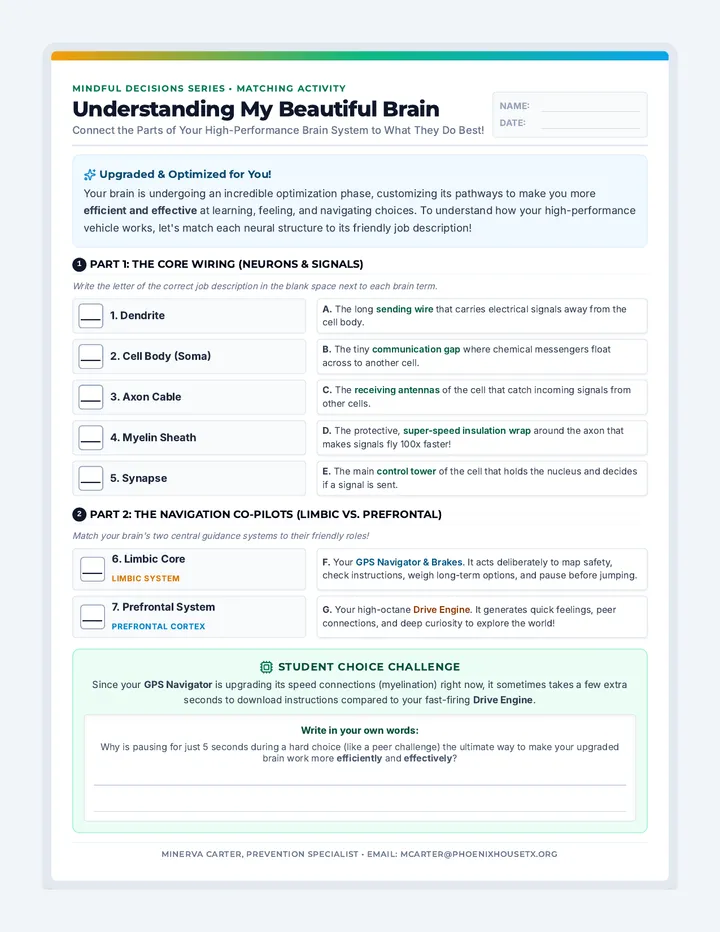
Beautiful Brain Worksheet Mindful Decisions Series • Matching Activity
Understanding My Beautiful Brain
Connect the Parts of Your High-Performance Brain System to What They Do Best!
Name:
Date:
Upgraded & Optimized for You! Your brain is undergoing an incredible optimization phase, customizing its pathways to make you more efficient and effective at learning, feeling, and navigating choices. To understand how your high-performance vehicle works, let's match each neural structure to its friendly job description!
1 Part 1: The Core Wiring (Neurons & Signals)
Write the letter of the correct job description in the blank space next to each brain term.
____
1. Dendrite
____
2. Cell Body (Soma)
____
3. Axon Cable
____
4. Myelin Sheath
____
5. Synapse
A. The long sending wire that carries electrical signals away from the cell body.
B. The tiny communication gap where chemical messengers float across to another cell.
C. The receiving antennas of the cell that catch incoming signals from other cells.
D. The protective, super-speed insulation wrap around the axon that makes signals fly 100x faster!
E. The main control tower of the cell that holds the nucleus and decides if a signal is sent.
2 Part 2: The Navigation Co-Pilots (Limbic vs. Prefrontal)
Match your brain's two central guidance systems to their friendly roles!
____
6. Limbic Core Limbic System
____
7. Prefrontal System Prefrontal Cortex
F. Your GPS Navigator & Brakes. It acts deliberately to map safety, check instructions, weigh long-term options, and pause before jumping.
G. Your high-octane Drive Engine. It generates quick feelings, peer connections, and deep curiosity to explore the world!
Student Choice Challenge
Since your GPS Navigator is upgrading its speed connections (myelination) right now, it sometimes takes a few extra seconds to download instructions compared to your fast-firing Drive Engine .
Write in your own words:
Why is pausing for just 5 seconds during a hard choice (like a peer challenge) the ultimate way to make your upgraded brain work more efficiently and effectively ?
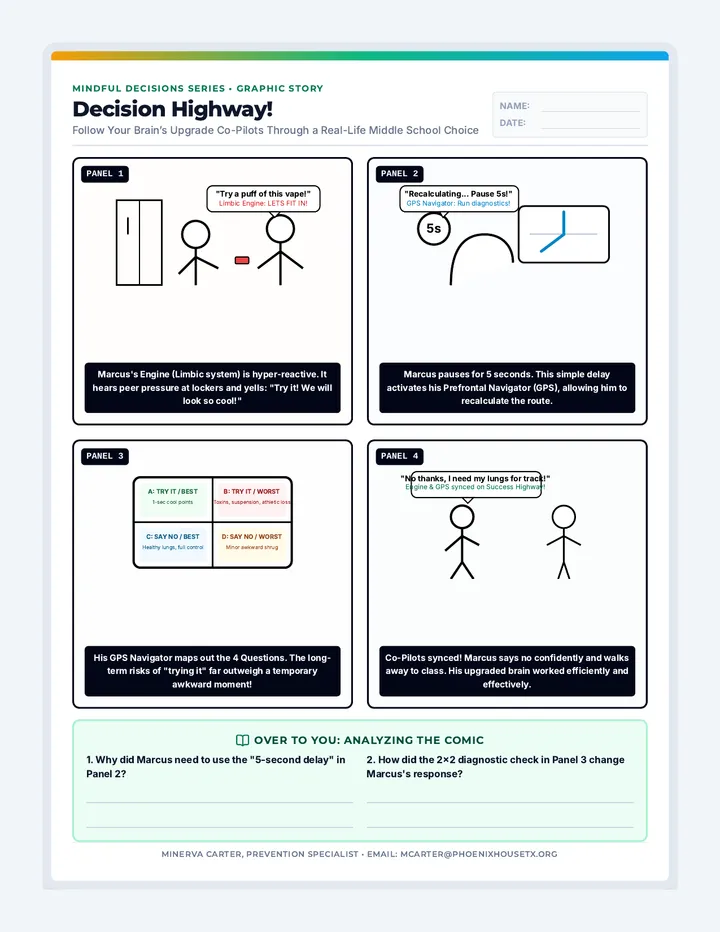
Decision Highway Comic Strip Mindful Decisions Series • Graphic Story
Decision Highway!
Follow Your Brain’s Upgrade Co-Pilots Through a Real-Life Middle School Choice
Name:
Date:
PANEL 1
"Try a puff of this vape!" Limbic Engine: LETS FIT IN!
Marcus's Engine (Limbic system) is hyper-reactive. It hears peer pressure at lockers and yells: "Try it! We will look so cool!"
PANEL 2
5s "Recalculating... Pause 5s!" GPS Navigator: Run diagnostics!
Marcus pauses for 5 seconds. This simple delay activates his Prefrontal Navigator (GPS), allowing him to recalculate the route.
PANEL 3
A: TRY IT / BEST 1-sec cool points B: TRY IT / WORST Toxins, suspension, athletic loss C: SAY NO / BEST Healthy lungs, full control D: SAY NO / WORST Minor awkward shrug
His GPS Navigator maps out the 4 Questions. The long-term risks of "trying it" far outweigh a temporary awkward moment!
PANEL 4
"No thanks, I need my lungs for track!" Engine & GPS synced on Success Highway!
Co-Pilots synced! Marcus says no confidently and walks away to class. His upgraded brain worked efficiently and effectively.
Over to You: Analyzing the Comic
1. Why did Marcus need to use the "5-second delay" in Panel 2?
2. How did the 2x2 diagnostic check in Panel 3 change Marcus's response?
Minerva Carter, Prevention Specialist • Email: mcarter@phoenixhousetx.org
Brain Wiring Answer Key Mindful Decisions Series • Teacher Resource
Brain Wiring Answer Key
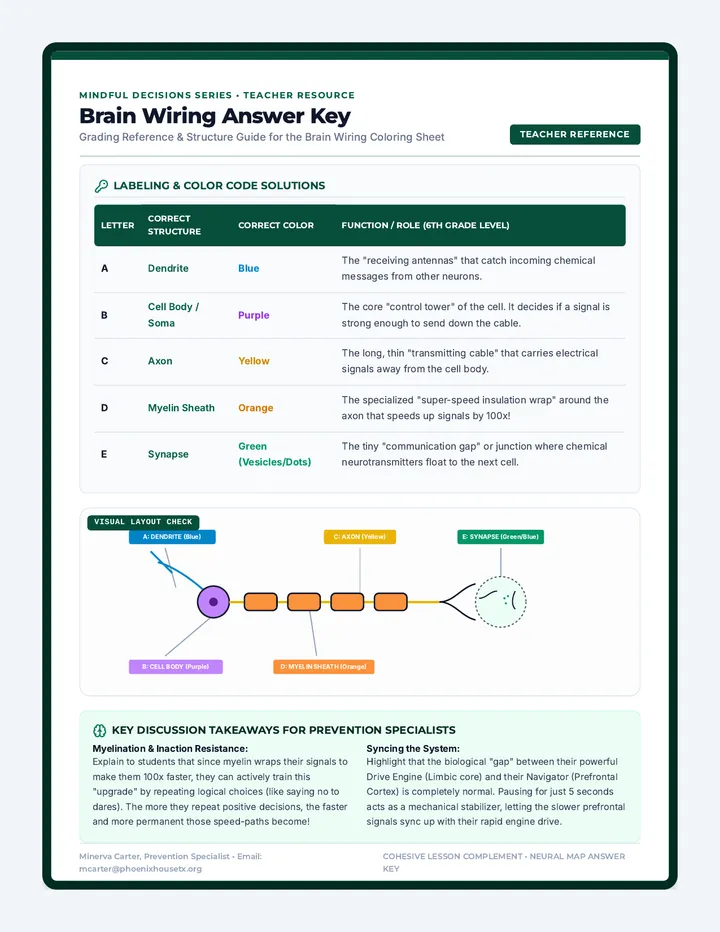
Grading Reference & Structure Guide for the Brain Wiring Coloring Sheet
Teacher Reference
Labeling & Color Code Solutions
Letter Correct Structure Correct Color Function / Role (6th Grade Level) A Dendrite Blue The "receiving antennas" that catch incoming chemical messages from other neurons. B Cell Body / Soma Purple The core "control tower" of the cell. It decides if a signal is strong enough to send down the cable. C Axon Yellow The long, thin "transmitting cable" that carries electrical signals away from the cell body. D Myelin Sheath Orange The specialized "super-speed insulation wrap" around the axon that speeds up signals by 100x! E Synapse Green (Vesicles/Dots) The tiny "communication gap" or junction where chemical neurotransmitters float to the next cell.
Visual Layout Check
A: DENDRITE (Blue) B: CELL BODY (Purple) C: AXON (Yellow) D: MYELIN SHEATH (Orange) E: SYNAPSE (Green/Blue)
Key Discussion Takeaways for Prevention Specialists
Myelination & Inaction Resistance: Explain to students that since myelin wraps their signals to make them 100x faster, they can actively train this "upgrade" by repeating logical choices (like saying no to dares). The more they repeat positive decisions, the faster and more permanent those speed-paths become!
Syncing the System: Highlight that the biological "gap" between their powerful Drive Engine (Limbic core) and their Navigator (Prefrontal Cortex) is completely normal. Pausing for just 5 seconds acts as a mechanical stabilizer, letting the slower prefrontal signals sync up with their rapid engine drive.
Minerva Carter, Prevention Specialist • Email: mcarter@phoenixhousetx.org COHESIVE LESSON COMPLEMENT • NEURAL MAP ANSWER KEY