Coping with Anxiety Lesson Plan
Coping with Anxiety
Instructional Lesson Plan
Audience
Grade 10
Duration
45 Minutes
Objective
Identify anxiety types & coping tools
Why it Matters
In this lesson, students will learn about the various types of anxiety and effective coping strategies. This equips students with practical tools to handle stress and emotional challenges common in high school and beyond.
Materials Needed
- Discussion Guide
- Reflection Worksheet
- Pens & Paper
- Calm background music
Facilitation Tip
Create a safe, non-judgmental space. Remind students that anxiety is a universal human experience and they are not alone.
Lesson Procedure
5m
Introduction
- Welcome students and introduce the topic of anxiety.
- Explain that the lesson covers recognizing types of anxiety and practical coping mechanisms.
10m
Understanding Anxiety
- Discuss common types: Generalized Anxiety Disorder (GAD), Social Anxiety, and Panic Attacks.
- Use real-life examples (e.g., test anxiety, social events) to illustrate.
- Open space for students to share thoughts or general experiences.
10m
Coping Strategies
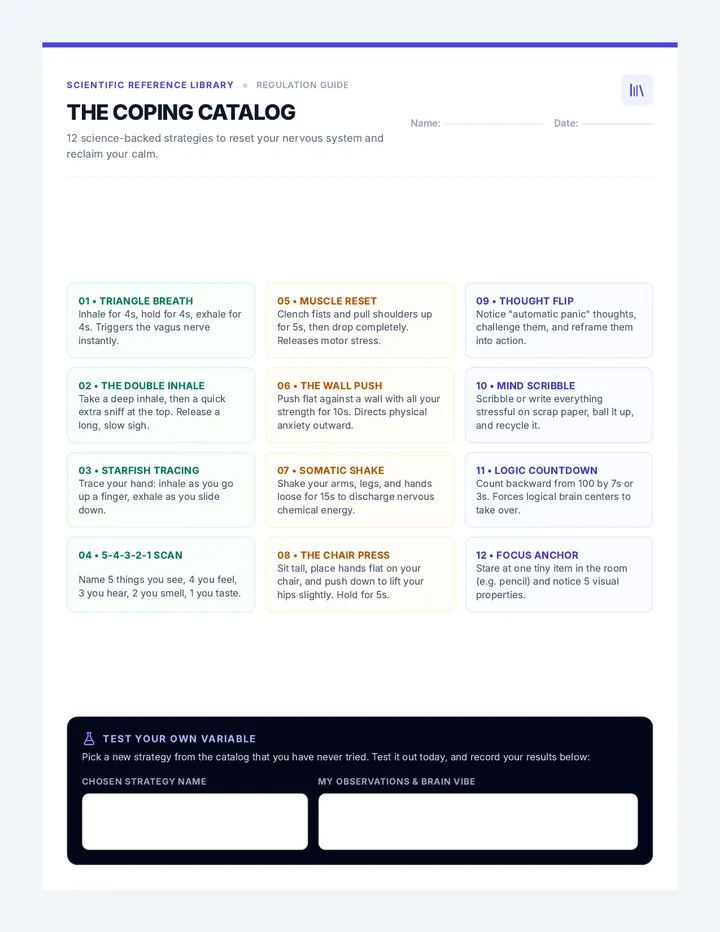
- Introduce strategies: deep breathing, mindfulness, physical exercise, and grounding techniques.
- Demonstrate: Lead a 4-7-8 deep breathing exercise or box breathing.
- Have students participate in a 3-minute guided relaxation practice.
10m
Group Discussion
- Break students into small groups (3-4 members).
- Distribute the **Discussion Guide** to each group.
- Allow groups to explore triggers and share effective supports.
10m
Summary & Wrap-up
- Summarize key takeaways and host a brief Q&A session.
- Hand out the **Coping Strategies Worksheet** for individual reflection.
- Collect worksheets and thank students for their participation.
Mindful Conversations Guide
Mindful Conversations
Group Discussion Guide
1
What are some common triggers for anxiety?
Facilitator Note: Encourage students to share personal experiences if they are comfortable. Discuss different triggers like social situations, academic pressure, family dynamics, or future uncertainties.
2
Which coping strategies do you think are most effective?
Facilitator Note: Discuss various methods (breathing, movement, journaling) and encourage students to share which ones they have tried or are willing to try.
3
How can we support friends and family members who experience anxiety?
Facilitator Note: Talk about the importance of empathy, active listening, and providing support without judgment. Emphasize that "fixing" the person isn't the goal—presence is.
Confidentiality and respect are the foundations of our discussion today.
Coping Strategies Worksheet
Coping Strategies
Reflect • Breathe • Respond
Name
Date
This worksheet is for your personal reflection. Use what you learned today about the types of anxiety and the relaxation exercises we practiced to complete the sections below.
1
Understanding the Types
List three types of anxiety discussed in class (e.g., general anxiety, social anxiety, panic attacks) and provide a brief description of each.
Type 1:
Type 2:
Type 3:
2
Finding Your Strategy
Describe a coping strategy that you find helpful or would like to try (e.g., deep breathing, mindfulness, exercise, music). How exactly would you practice it?
3
Future Resilience
Reflect on a time when you felt anxious. Looking back, which specific strategy from today's lesson could you use if a similar situation happens again?
Coping with Anxiety Slides
Coping with Anxiety
Building Resilience & Calm
Today's Journey
Understand
Identify the different types of anxiety and how they manifest.
Equip
Learn and practice evidence-based relaxation techniques.
Discuss
Share experiences and support strategies in a safe space.
Reflect
Create a personal plan for managing stress.
What is Anxiety?
The Natural Alarm
Anxiety is your body's natural response to stress. It's a feeling of fear or apprehension about what's to come.
When it lingers...
If these feelings are extreme, last for longer than six months, and interfere with your life, you may have an anxiety disorder.
"Anxiety is like a smoke alarm. Sometimes it goes off for a fire, and sometimes it goes off just because the toast is burnt."
Generalized Anxiety (GAD)
People with GAD feel excessive, persistent, and unrealistic worry about everyday things like health, money, family, or work.
Common Symptoms:
- Feeling restless or on edge
- Difficulty concentrating
- Muscle tension
"I worry about everything, even when I know there's no reason to. It feels like I can't turn my brain off."
Social Anxiety
"I’m constantly worried people are judging me or that I’ll say something stupid."
A intense, persistent fear of being watched and judged by others.
What it feels like:
- Avoiding eye contact
- Physical symptoms (blushing, sweating)
- Fear of being in a crowd
Panic Attacks
Sudden, intense episodes of fear that trigger severe physical reactions when there is no real danger or apparent cause.
Physical Signs:
- Racing heart
- Shortness of breath
- Chills or hot flashes
"It feels like I'm losing control or like I can't breathe. It comes out of nowhere."
The 4-7-8 Technique
4
Inhale
Quietly through the nose
7
Hold
Keep the breath in
8
Exhale
With a whoosh through mouth
Let's try it together three times.
The 5-4-3-2-1 Grounding Method
5 See