Conflict Conversations Blueprint Lesson Plan
Conflict Conversations Blueprint
Tier 1 Social-Emotional Learning • 4th Grade
Time
40 Minutes
Audience
4th Grade Class
Approach
Teach • Model • Practice
The "Why"
Equipping 4th graders with conflict-resolution tools builds empathy, reduces classroom tension, and fosters a supportive community where every voice is heard.
Learning Objective
"Students will learn and practice active listening and respectful dialogue skills to navigate disagreements, aiming to identify feelings, use 'I' statements, and collaborate on solutions."
Prep Work
- • Queue up the Steps to Respectful Dialogue slide deck.
- • Review Facilitator’s Conversation Prompts.
- • Prepare pairings and name tags for the Peer Listening Pairs Activity.
- • Review the Reflection Circle Guide for closure.
Materials
- Steps to Respectful Dialogue Slide Deck
- Facilitator’s Conversation Prompts Script
- Peer Listening Pairs Activity Sheet
- Reflection Circle Guide
Instructional Timeline
5m
Introduction & Hook
- Explain the objective: learning to talk through disagreements respectfully.
- Display a simple conflict scenario on the Steps to Respectful Dialogue slide deck.
- Ask students how they feel during disagreements and record responses on the board.
10m
Teaching Active Listening
- Define active listening: eye contact, nodding, paraphrasing.
- Use slides to illustrate examples.
- Invite two volunteers for a quick demo using the Facilitator’s Conversation Prompts.
- Emphasize asking clarifying questions ("Can you tell me more?").
10m
Modeling Respectful Dialogue
- Introduce the four steps: Describe, Feelings, Needs, Request.
- Facilitate a short role-play with student volunteers using the script.
- Debrief: Ask observers what went well and what could improve.
10m
Peer Listening Pairs Role-Play
- Pair students and assign each pair the Peer Listening Pairs Activity worksheet.
- Student A speaks while Student B practices active listening, then swap.
- Use the checklist on the worksheet to guide and assess each other.
- Circulate to offer feedback and support.
5m
Reflection Circle
- Arrange students in a circle and use questions from the Reflection Circle Guide.
- Ask: "What made you feel listened to today?"
- Encourage one-sentence shares and close with the positive affirmation.
Steps to Respectful Dialogue Slides
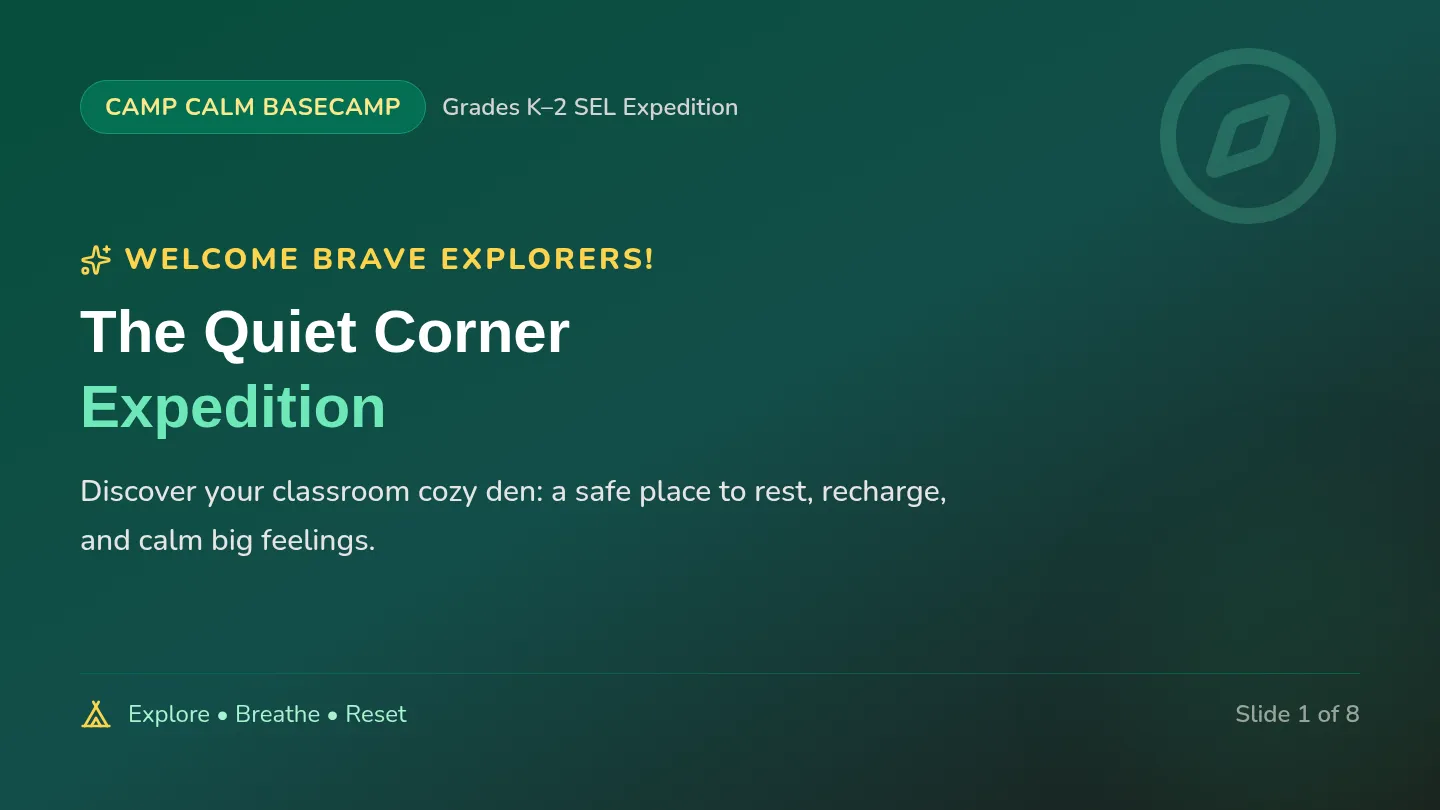
Steps to
Respectful Dialogue
Learning to talk through disagreements with kindness and clarity.
4th Grade SEL
Why Respectful Dialogue?
Helps everyone feel heard and valued.
Turns conflicts into solutions together.
Shows respect and care for our classroom.
Step One
Describe the Situation
- State what happened neutrally and stick to the facts.
- Avoid blaming words like "always" or "never."
Example
“When you grabbed my marker without asking...”
Step Two
Express Your Feelings
Example
“I feel upset and surprised...”
- Say “I feel...” followed by an emotion.
- Helps others understand how you were affected.
Step Three
State Your Needs
- Share what you need or value.
- Connect your feelings to your needs.
Example
“I need to know my things will be returned.”
Step Four
Make a Request
Example
“Can you please ask before borrowing my marker?”
- Ask for a solution or a change.
- Be polite, precise, and specific.
Active Listening Skills
Maintain eye contact
Nod or say “uh-huh”
Paraphrase: “So you feel...?”
Ask: “Tell me more?”
Quick Check
Which step helps you share what you need?
A
Step 1: Describe
B
Step 2: Express Feelings
C
Step 3: State Needs
D
Step 4: Make Request
Facilitator’s Conversation Prompts Script
Teacher Support Material
Facilitator’s Conversation Prompts
Guided scripts for modeling and coaching respectful dialogue.
1
Introduction & Hook (5 Minutes)
Teacher: “Good morning, everyone! Today we’re going to learn how to ‘talk it out’ when we have disagreements. By using simple steps, we can show respect, solve problems, and keep our friendships strong.”
Teacher: “I want you to think for a moment: How do you feel when someone doesn’t really listen to you?”
(Wait for a few hands.)
Teacher: “Who can share a quick example of a disagreement you’ve had, maybe with a friend or a sibling?”
Follow-up prompts:
- “That sounds frustrating—thank you for sharing!”
- “What did you wish had happened in that moment?”
2
Active Listening Demo (10 Minutes)
Teacher: “Active listening is one of our superpowers for good conversations. It means paying full attention with your eyes, your body, and your heart.”
Teacher: “Let’s look at the Active Listening Skills slide. Notice the actions: eye contact, nodding, paraphrasing, and asking questions like ‘Can you tell me more?’.”
Teacher: “I need two volunteers. One will share a short story, and the other will practice active listening. Who wants to try?”
(Call up Student A and Student B.)
Teacher: “Student A, please tell us a quick story about something that made you upset or excited today—just one or two sentences.”
(Listen to Student A's response.)
Teacher: “Great! Now, Student B, practice active listening: look at Student A, give a nod or say ‘uh-huh,’ then paraphrase what you heard. You can start with, ‘So you feel…’ and finish with, ‘…because…’ When you’re done, you can ask, ‘Can you tell me more about…?’”
COACHING TIP
If Student B struggles, prompt them: "Try starting with 'I heard you say...'"
3
Modeling Respectful Dialogue (10 Minutes)
Teacher: “Our next step is to use the four steps of respectful dialogue: Describe, Feelings, Needs, and Request. I’ll be Speaker 1, and [Student C] will be Speaker 2. Our scenario: borrowing a pencil case without asking.”
1. Describe: “When you opened my pencil case and took my colored pencils without asking…”
2. Feelings: “I feel upset and surprised…”
3. Needs: “I need to know that my supplies will be returned when I ask.”
4. Request: “Can you please ask me before borrowing my things?”
Teacher: “Thank you. Now, [Student C], you’re Speaker 2. Please use the same four steps to respond: describe what happened, express your feelings, share your needs, then make a request.”
Peer Listening Pairs Activity Worksheet
Peer Listening Pairs
Talking It Out Together
Student Name
How to Play
- 1 Find your partner and decide who is Speaker (A) and Listener (B).
- 2 Follow the tasks in your column to practice your skills.
- 3 Switch roles after 3–4 minutes with a new scenario!
Speaker Tasks
-
1
Describe the situation clearly and neutrally.
-
2
Say “I feel...” to share your emotion.
-
3
State your need: “I need...”
-
4
Make a clear request: “Can you...?”
Listener Tasks
-
1
Make eye contact and face the speaker.
-
2
Nod or say “uh-huh” to show you’re paying attention.
-
3
Paraphrase: “So you feel... because...”
-
4
Ask: “Can you tell me more about...?”
Pick Your Scenario
Your partner borrowed a book and returned it late without telling you.
Your friend switched teams in a game without asking you first.
Someone ate your snack from the lunch table when you weren't looking.
Your classmate drew on your homework without your permission.
Round 1 Debrief
One Positive Feedback
One Suggestion for Growth
Reflection Circle Guide Cool Down
Closing Activity
Reflection Circle Guide
Closing the session with connection and affirmation.
Setup
Arrange students in a circle so everyone can see one another. Explain that this is a time to share briefly and listen respectfully. Use a "talking piece" if your class is familiar with that routine.
Directions
- Read each prompt aloud slowly.
- Allow a "think time" pause after each prompt.
- Invite 2–3 volunteers for one-sentence responses.
- Focus on listening without interruptions.
Reflection Prompts
Prompt 1
“What made you feel listened to today?”
Prompt 2
“Which step of respectful dialogue was most helpful for you?”
Prompt 3
“When might you use these active listening skills outside of class?”
Prompt 4
“What is one new thing you learned about expressing your feelings or needs?”
Prompt 5
“What can our class do tomorrow to keep practicing respectful conversations?”
Closing Affirmation
“I listened well.”
“I spoke with kindness.”
“We solve problems together!”
Repeat three times, growing a little louder each time!