Boundary Bubble Lesson Plan SEL Lesson Plan Grade 3 • 45–50 Mins
The Boundary Bubble Blueprint
Empowering Students to Establish Respectful Space & Assertive Verbal Cues
CASEL: Relationship Skills
Focus: Assertive Communication
Learning Targets: (1) Identify personal space as an invisible arm's-length bubble. (2) Contrast passive, aggressive, and assertive responses. (3) Draft and speak an assertive 3-part blueprint statement (When you... I feel... Please... ) with calm eye contact and tall posture.
Materials Needed
Slide Deck, Boundary Blueprint Worksheets, Bubble Patrol Scenario Cards, 1 hula hoop (optional visual demo), pencils.
Core Vocabulary
Boundary: Personal invisible border. Assertive: Clear, calm, firm, and kind. Comfort Zone: Feeling safe and respected.
1
Hook & The Space Bubble Demo
8 Minutes
Activation Action: Invite all students to stand, extend their arms wide, and slowly rotate 360 degrees without touching desks or neighbors. Explain that this sphere is their Personal Space Bubble .
Teacher Talk Script: "Everyone has an invisible bubble that protects our peace, bodies, and belongings. Sometimes friends pop or squeeze our bubbles without realizing it. Today, you are architects drafting your very own Boundary Bubble Blueprint so you know exactly how to speak up!"
2
Direct Instruction: 3 Voices & The 3-Step Script
14 Minutes
🐢 The Turtle (Passive)
Whispering, looking down, hiding feelings, bubble gets popped.
🦁 The Tiger (Aggressive)
Yelling, pointing fingers, mean words, pops everyone else's bubble.
🦉 The Owl (Assertive) ⭐
Tall spine, calm voice, eye contact, clear & kind boundaries.
The 3-Step Blueprint Verbal Code:
Step 1: Notice
Step 2: Name Feeling
Step 3: Clear Request
Boundary Bubble Blueprint • Teacher Facilitation Guide Page 1 of 2
3
Guided Practice: Bubble Patrol Role-Play
15 Minutes
Protocol: Form student pairs (Architect A & Architect B). Hand out the Bubble Patrol Scenario Cards .
Round 1: Partner A acts as the "Bubble Squisher" (e.g., cutting in line, grabbing an eraser). Partner B stands tall, plants feet, holds up a gentle palm stop sign, and uses the 3-Step Script.Round 2: Switch roles with a new card. Partner B tests assertive body language while Partner A practices receiving the boundary gracefully ("Got it, sorry about that!").
Teacher Observation Look-For: Are students smiling nervously and whispering (passive) or shouting with clenched fists (aggressive)? Guide them to an even, conversational, yet resolute tone.
4
Independent Application: The Blueprint Worksheet
10 Minutes
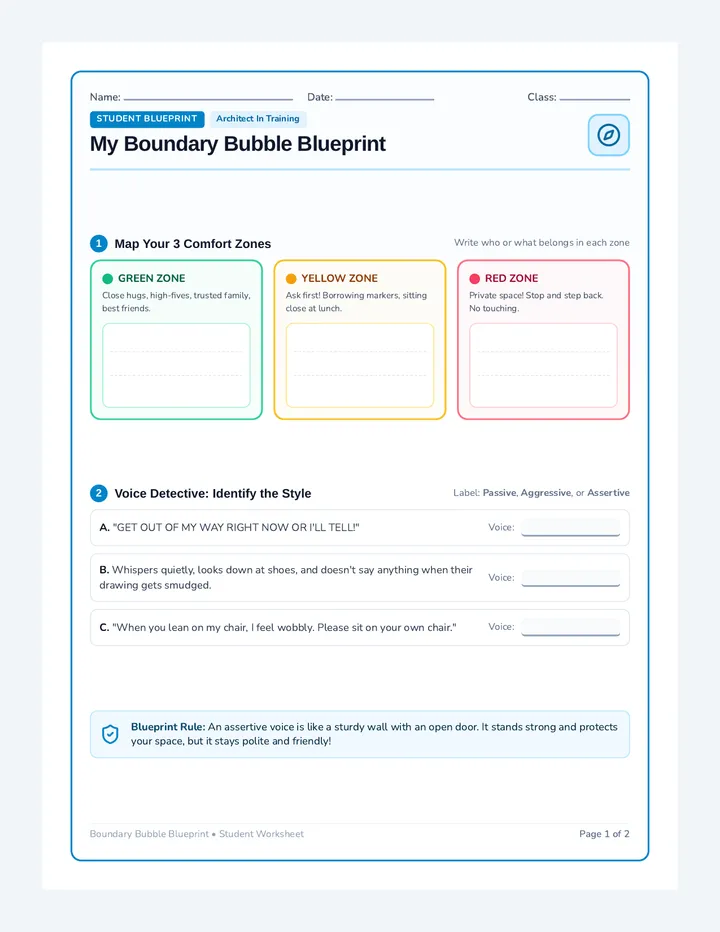
Distribute the Boundary Bubble Blueprint Worksheet . Students map their personal space zones (Green = Welcome, Yellow = Ask First, Red = Stop & Back Up) and compose two customized boundary defense scripts for their own school day.
Wrap-Up / Debrief (3 Mins): Whole-class choral affirmation: "My space is my space. Your space is your space. We speak up with respect!"
Differentiation & Scaffolds
Emergent Readers/ELL: Provide sentence stem strips with visual picture icons for feelings (crowded, startled, upset).Shy Students: Allow non-verbal hand stop gesture paired with short cue: "Please step back."Advanced: Challenge students to roleplay responding when someone ignores their first boundary statement.
Formative Assessment Check
Role-Play Rubric:
Body: Planted & Tall Tone: Firm & Calm Words: Clear Request
Blueprint Work: Student accurately completes 3-part script with appropriate respectful boundaries.
Key Coaching Tip: Boundaries are Not Punishments
Remind third graders that saying "No, thank you" or "Please give me space" is not being mean. It protects friendships because friends know how to keep each other comfortable and safe!
Boundary Bubble Blueprint • Teacher Facilitation Guide Page 2 of 2
Boundary Bubble Slides Grade 3 SEL Adventure
Respect • Space • Voice
The Boundary Bubble Blueprint
How to protect your personal space, respect others, and speak up with confidence!
1 Know Your Space
2 Choose Your Voice
3 Use the Script
Your Personal Space Bubble
Concept 01
An Invisible Shield
Your personal space bubble is an invisible sphere around your entire body—about an arm's length wide in every direction!
What It Protects
It keeps your body safe, your personal items secure, and your mind calm so you can learn and have fun.
Try the Arm's Length Test!
Reach your arms out straight. If you can touch someone, you might be in their bubble!
Everyone has their own bubble size. We must always ask before entering!
Three Ways to React
Concept 02
🐢
The Turtle
Passive Voice
• Whispers or stays quiet
• Looks at shoes
• Bubble gets popped!
"I guess it's okay..."
🦁
The Tiger
Aggressive Voice
• Yells or glares
• Points fingers
• Pops everyone's bubble!
"GET AWAY RIGHT NOW!"
🦉
The Wise Owl ⭐
Assertive Voice
• Calm & firm voice
• Looks in eyes & stands tall
• Protects bubbles kindly!
"Please take a step back."
Assertive means being clear and strong while still being respectful!
The 3-Step Blueprint Script
Formula
1
WHEN YOU...
State clearly what happened without blaming or calling names.
"When you stand really close behind me..."
2
I FEEL...
Name your true feeling honestly and calmly.
"...I feel crowded and distracted..."
3
PLEASE...
Tell them the exact action that will make things right.
"...please give me two steps of space."
Put it together: When you... I feel... Please...
Assertive Body Language
Checklist
Friendly Eye Contact
Look directly at the person's eyes or forehead without glaring.
Bubble Patrol Scenario Cards Partner Role-Play Activity Cut or Fold Along Dashes
Bubble Patrol Scenario Cards (Set A)
Rule of the Role-Play: Be calm, be kind, be clear!
1. Draw Card: Read situation aloud.
2. Act It Out: One invades, one stands tall.
3. Speak Script: "When you... I feel... Please..."
Card 01 • Classroom
The Desk Squeezer
During independent reading, your classmate leans their body all the way across your desk to see what book you are reading, bumping your arm while you write.
Assertive Prompt: "When you lean across my desk, I feel crowded. Please ask to see my book from your seat."
Card 02 • Line Space
The Heel Tapper
Walking to gym, the student behind you steps right on your sneaker heels twice and stands so close you can feel their breath on your neck.
Assertive Prompt: "When you stand on my heels, I feel uncomfortable and might trip. Please give me an arm's length of space."
Card 03 • Carpet Time
The Rug Roller
During morning meeting on the rug, someone keeps rolling over onto your carpet square and spreading their legs onto your lap.
Assertive Prompt: "When you roll onto my square, I feel squished. Please stay on your own carpet space."
Card 04 • Belongings
The Pencil Grabber
A friend reaches straight into your pencil box and takes your favorite neon eraser without asking your permission first.
Assertive Prompt: "When you take my eraser without asking, I feel upset. Please ask before touching my supplies."
Boundary Bubble Blueprint • Role-Play Activity Cards Page 1 of 2
Partner Role-Play Activity
Bubble Patrol Scenario Cards (Set B)
Practice Rounds 5–8
Card 05 • Playground
The Tag Tag-Along
At recess, someone grabs your jacket hood to tag you and pulls backward, tugging your collar roughly.
Assertive Prompt: "When you pull my jacket hood, I feel unsafe. Please tag with a gentle tap on my arm."
Card 06 • Bus / Cafeteria
The Bench Squeezer
On the cafeteria bench, a peer slides over so close their elbow constantly bumps into your lunch tray while you eat.
Assertive Prompt: "When you slide into my tray, I feel cramped. Please scoot over a little so we both have room."
Card 07 • Group Project
The Whisper In Your Ear
While working on science posters, a partner puts their mouth right next to your ear to whisper, making you jump.
Boundary Blueprint Worksheet Name: Date:
Class:
Student Blueprint Architect In Training
My Boundary Bubble Blueprint
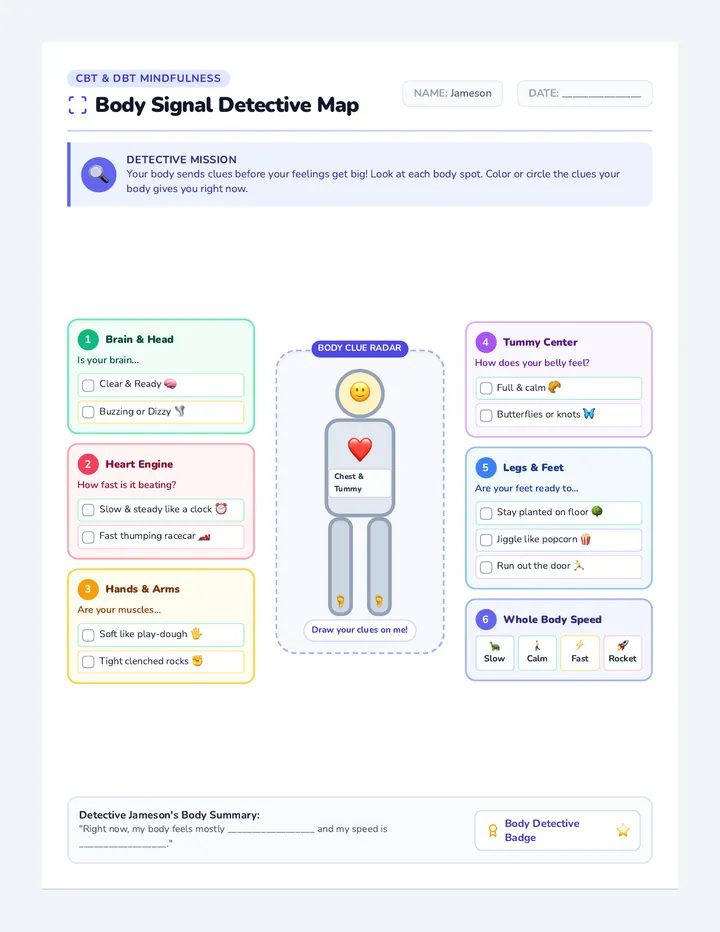
1 Map Your 3 Comfort Zones
Write who or what belongs in each zone
GREEN ZONE
Close hugs, high-fives, trusted family, best friends.
YELLOW ZONE
Ask first! Borrowing markers, sitting close at lunch.
RED ZONE
Private space! Stop and step back. No touching.
2 Voice Detective: Identify the Style
Label: Passive , Aggressive , or Assertive
A. "GET OUT OF MY WAY RIGHT NOW OR I'LL TELL!"
Voice:
B. Whispers quietly, looks down at shoes, and doesn't say anything when their drawing gets smudged.
Voice:
C. "When you lean on my chair, I feel wobbly. Please sit on your own chair."
Voice:
Blueprint Rule: An assertive voice is like a sturdy wall with an open door. It stands strong and protects your space, but it stays polite and friendly!
Boundary Bubble Blueprint • Student Worksheet Page 1 of 2
3
Build Your Assertive Blueprint Scripts
Action Plans
Use the 3-Step formula (When you... I feel... Please... ) to write your own responses for real school moments.
Blueprint 1: In the Classroom or Hallway Example: Someone grabbing supplies or standing on heels
1. When you: (What happened?)
2. I feel: (Your feeling)
3. Please: (Clear, polite request)
Blueprint 2: At Recess or in the Cafeteria Example: Rough tag, taking lunch seat, crowding game
1. When you: (What happened?)
2. I feel: (Your feeling)
3. Please: (Clear, polite request)
4 My Assertive Body Language Checklist (Check each one you can do!)
I plant both feet flat and stand tall. I look at the person's eyes calmly. I speak clearly without yelling. I step back when someone asks me to.
Official Boundary Architect Pledge
"I promise to defend my bubble with kindness and respect the bubbles of my classmates every day."
Architect Signature:
Boundary Bubble Blueprint • Student Worksheet Page 2 of 2