Active Ears Lesson Plan 5th Grade ELA / SEL 30 Minutes
Communication & Speaking Standards
Active Ears Challenge
Lesson Plan: Demonstrating 3 Core Active Listening Behaviors in Peer Interviews
Learning Objective
Students will demonstrate three active listening behaviors (eye contact/posture, verbal affirmations, and follow-up questioning) during a peer interview.
Key Concepts
Active Listening (mindful focus), Non-Verbal Cues (body language & nodding), and Deep Questioning (clarifying & extending).
Materials Needed
Listen Up Slides, Listening Bingo sheets, Listening Checklist (1 per student), Challenge Script & Partner cards, timers.
00-05m: Bingo Warm-Up
•
05-12m: Model Behaviors
•
12-24m: Peer Interviews
•
24-30m: Checklist Reflection
1
Warm-Up: Listening Bingo (5 Min)
Slides 1–2
Goal: Prime students to recognize daily listening habits vs. listening distractions in a fun, non-judgmental way.
Teacher Moves: Distribute the Listening Bingo card upon entry. Give students 3 minutes to mingle and sign boxes (e.g., "Find someone who listened without checking a screen", "Caught themselves daydreaming while a friend spoke").
Transition Hook: Call for attention with a two-clap signal. "Today, hearing sound is automatic, but active listening is an intentional superpower. Let's inspect the evidence!"
2
Direct Instruction & Modeling: The 3 Core Behaviors (7 Min)
Slides 3–5
Behavior 1: Body Radar
Torso faces speaker, gentle eye contact, open hands, relaxed posture.
Behavior 2: Verbal Bridges
Rhythmic nodding, small verbal affirmations ("Oh wow", "Got it", "Interesting").
Behavior 3: The Deep Hook
Asking at least one follow-up question that builds directly on what was said.
Demonstration (Challenge Script Part 1): Invite a confident student volunteer. Perform a 30-second "Bad Listener" demo (fidgeting, looking at watch, interrupting) followed by a 30-second "Active Ear" demo (showing all 3 behaviors). Have students call out what shifted.
Active Ears Challenge • 5th Grade Lesson Plan Page 1 of 2
Active Ears Challenge: Practice & Assessment
Peer Interviews, Reflection Protocol, & Instructional Supports
Part 2 of Lesson
3
Guided Practice: Peer Interviews (12 Min)
Slides 6–7
Setup: Pair students into Partner A and Partner B. Hand out the Listening Checklist . Each student acts as the Listener once and the Speaker once.
Round 1 (5 Minutes):
Partner A is the Speaker (shares prompt from script card).
Partner B is the Active Listener (practices 3 behaviors).
Final 1 min: Partner A rates Partner B on the checklist.
Round 2 (5 Minutes):
Switch roles: Partner B speaks, Partner A actively listens.
Partner A asks a clarifying/extending follow-up question.
Final 1 min: Partner B provides feedback and ratings.
Teacher Circulating Note: Carry sticky notes to jot down exemplary follow-up questions overheard around the room to shout out during debrief.
4
Checklist Reflection & Debrief (6 Min)
Slide 8
Self-Reflection (2 min): Students complete the bottom section of their checklist: "Which behavior felt most natural? Which behavior required conscious effort?"
Whole-Group Wrap-Up (4 min): Ask: "How did it feel when your partner asked a genuine follow-up question instead of immediately talking about themselves?" Collect checklists as formative exit assessment.
Differentiation & Accommodations
• English Learners: Sentence stems provided on checklist ("Tell me more about...", "Why was that important to you?" ).
• Neurodivergent / Shy Students: Accept "soft focus" or looking toward the speaker's shoulder rather than forced direct eye contact.
• Extension: Challenge advanced students to summarize their partner's answer in one sentence before asking their question.
Common Student Misconceptions
• "Waiting to speak" vs. Listening: Students often plan their response instead of processing their partner's words.
• Interrogating vs. Questioning: Clarify that follow-up questions should show curiosity, not put the speaker on trial.
• The Staring Freeze: Remind students that active listening is natural and warm, not robotic or rigid.
Formative Assessment Look-Fors (Success Criteria)
1. Non-Verbal: Partner angled towards speaker at least 80% of speaking time; visible nodding.
2. Affirmations: At least 2 verbal acknowledgments without talking over the speaker.
3. Follow-Up: Produced a relevant question linked to specific details shared by partner.
Active Ears Challenge • 5th Grade Lesson Plan Page 2 of 2
Listen Up Slides Grade 5 Communication Lab 30-Minute Challenge
Sound Lab Edition
Active Ears Challenge
Hearing is automatic. Active listening is a deliberate superpower.
Mission: Master 3 core behaviors in today's peer interview Tap in & get ready →
Warm-Up • 5 Min
Listening Bingo Mission
Your Goal
Mingle respectfully around the room. Find classmates who match the listening habits on your card and collect signatures!
Rule: One signature per classmate!
Look For Habits Like:
• Nodded while someone was talking
• Put away a screen to look at a friend
• Caught themselves daydreaming
When the countdown bell rings, return immediately to your launch seat! Ready? Go!
Big Idea
Hearing vs. Active Listening
Passive Hearing
Automatic & Unfocused
Sound waves hit your ears, but your mind is wandering, planning what you want to say next, or distracted by surroundings.
"Yeah, yeah, cool... anyway, about my game..."
Active Listening
Intentional & Full-Body
You lock in with your eyes, posture, and brain. You focus completely on understanding their message before reacting.
"That makes sense. Why did you choose that option?"
Today we unlock the 3 Core Behaviors of active listening!
Core Skills
The Big 3 Listening Behaviors
1
Body Radar
Non-Verbal Cues
Turn your chest toward the speaker. Keep gentle eye contact and open posture.
Sign: "I am locked in with you."
2
Verbal Bridges
Mini-Confirmations
Nod along and use quick verbal signals like "Right," "Got it," or "Oh wow."
Sign: "I am tracking every word."
3
The Deep Hook
Follow-Up Question
Don't change the subject! Ask a question that digs deeper into what they just shared.
Sign: "Tell me more about that."
You will be evaluated on these exact 3 behaviors in the peer interview!
Live Demo
Spot the Difference Challenge
Round A: Watch Closely
Watch the teacher listen to our student volunteer. What red flags do you see in the body language, sounds, or reactions?
• What signal does this send to the speaker?
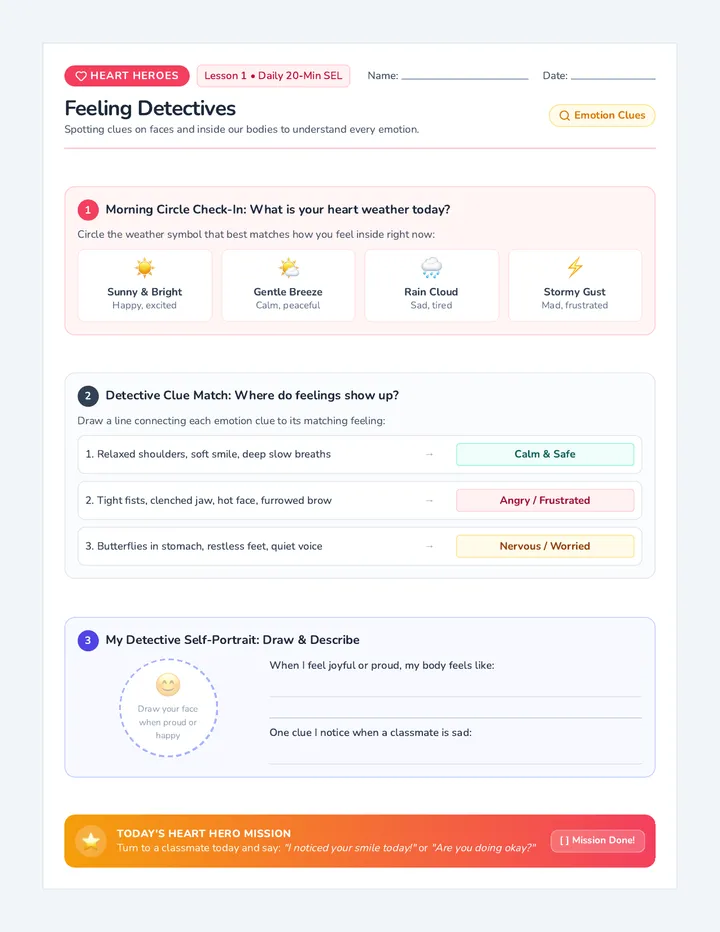
Listening Bingo Worksheet Warm-Up Activity Active Ears Challenge
Name: Date:
Listening Bingo
Find classmates who match each listening habit. Collect their signature in the box!
Time: 5 Minutes
Rules: Each classmate may sign your board only once ! Try for 4 in a row, four corners, or blackout!
4 × 4 Grid
#1
Put away a screen or device when a friend started speaking
Sign:
#2
Nodded their head to encourage someone to keep talking
Sign:
#3
Asked "What happened next?" to learn more about a story
Sign:
#4
Caught themselves daydreaming while someone talked
Sign:
#5
Waited patiently for a speaker to finish without cutting in
Sign:
#6
Used verbal bridges like "Uh-huh," "Right," or "Oh wow"
Sign:
FREE SPACE
Ready to unlock Active Ears today!
Superpower Activated
#8
Kept calm, respectful eye contact for a whole conversation
Sign:
#9
Politely asked: "Could you say that again? I want to make sure I heard."
Sign:
#10
Accidentally interrupted someone because they got too excited
Sign:
#11
Felt genuinely happy because a classmate really listened to them
Sign:
#12
Turned their whole body to face a speaker in a noisy room
Sign:
#13
Remembered a small detail a classmate shared last week
Sign:
#14
Pretended to listen while secretly thinking about lunch
Sign:
#15
Summarized someone's idea: "So what you're saying is..."
Sign:
#16
Noticed a friend's voice sounded nervous or excited
Sign:
Quick Mingle Check (Answer on your own):
1. Which habit was most common in our class today?
2. One active habit I will focus on during the interview:
Active Ears Challenge • Listening Bingo Warm-Up Phase (00–05m)
Listening Checklist Worksheet Peer Assessment & Reflection Active Ears Challenge
My Name: Partner:
Listening Checklist
Track and score your partner's 3 active listening behaviors, then reflect on your own skills.
My First Role: Speaker Listener
A Peer Observation: How My Partner Listened to Me
Fill this out after your partner finishes listening to your story
Behavior 1: Body Radar (Non-Verbal)
Faced chest toward me • Kept comfortable eye contact • Calm body
Rock Solid (3) Got Distracted (2) Turned Away (1)
Evidence I saw:
Behavior 2: Verbal Bridges (Mini-Affirmations)
Nodded along • Said encouraging signals ("Whoa," "Got it," "Right," "Cool" )
Multiple times (3) Once or twice (2) Completely silent (1)
Bridge words/reactions my partner used:
Behavior 3: The Deep Hook (Follow-Up Question)
Asked a question connected directly to my story instead of talking about themselves
Deep hook! (3) Basic question (2) Hijacked topic (1)
Write the exact question your partner asked you:
Partner Shout-Out: What did your partner do that made you feel most respected?
B Self-Reflection: My Personal Active Listening Growth
Individual Reflection
1. Which of the 3 behaviors felt most natural to you?
Body Radar Verbal Bridges Deep Hook
Why was this one easiest?
2. Which behavior required the most conscious effort?
Body Radar Verbal Bridges Deep Hook
What made it tricky?
3. My Active Listening Goal for the rest of this week:
Active Ears Challenge • Listening Checklist Turn in to teacher at end of lesson
Active Ears Challenge Script Teacher Instructional Script Active Ears Challenge
Duration: 7 Min Demo
Active Ears Challenge Script
Verbatim Modeling Dialogues, Non-Verbal Action Cues, and Class Discussion Prompts
Setup: Select one confident student volunteer before class or at the start of Phase 2. Instruct them to share a simple 30-second story (e.g., "What I did this past Saturday" ). You will play the listener twice.
Demo 1 • 60 Sec
The Distracted Ear (What NOT to Do)
Call out the red flags
Student: "So this weekend, my older brother and I built this giant obstacle course in our backyard for our puppy..."
Teacher Moves: [Turn torso 45 degrees away. Tap foot. Look up at the ceiling or check imaginary watch. Slump shoulders.]
Student: "...and we set up cardboard tunnels and a jump rope, but every time the puppy tried to jump..."
Teacher (Interrupting): "Oh yeah, dogs are cool. My aunt has a golden retriever. Anyway, what was I saying? Oh right, homework is due Friday."
Debrief Ask: "Class, what message did my body send to our speaker? How did that feel for the speaker?"
Demo 2 • 60 Sec
The Active Ear (The 3 Behaviors in Action)
Watch for the 3 skills
Student: "So as I was saying, every time our puppy ran through the cardboard tunnel, he kept grabbing the sides and shaking them..."
Teacher Moves (Behavior 1 - Body Radar): [Square shoulders toward student. Warm, steady eye contact. Lean in slightly.]
Teacher (Behavior 2 - Verbal Bridge): [Nodding rhythmically] "Oh no, really? Haha!"
Student: "...and the whole tunnel collapsed on him, but his tail was wagging the entire time!"
Teacher (Behavior 3 - The Deep Hook): "That's hilarious! How did you and your brother fix the tunnel so he could finish the course?"
Debrief Ask: "Notice how my question wasn't about MY dog? It hooked directly onto THEIR story. That is active listening."
Classroom Transition Call (Launching Phase 3):
"Active Ears sound-check! In three seconds, Partner A turns their Body Radar directly to Partner B. In Round 1, Partner B is the listener. Remember: Body Radar, Verbal Bridges, Deep Hook. Timer starts in 3... 2... 1... Listen up!"
Active Ears Challenge • Modeling Script Page 1 of 2