Tool Name: ________________
Tool Idea Bank (Ideas you can pick for your toolbox):
🌈 Rainbow Breathing
🐢 Turtle Shell Tuck
🧱 Wall Push / Desk Press
💧 Drink of Cold Water
🧸 Hug a Stuffed Animal
🖐️ Count to 5 on Fingers
My Navigator Promise:
"When I feel in the Yellow or Red zone, I can pause and try my favorite tool!"
Signed:
Zone Navigators • Part 2 Coping Toolbox Activity • Page 2 of 2
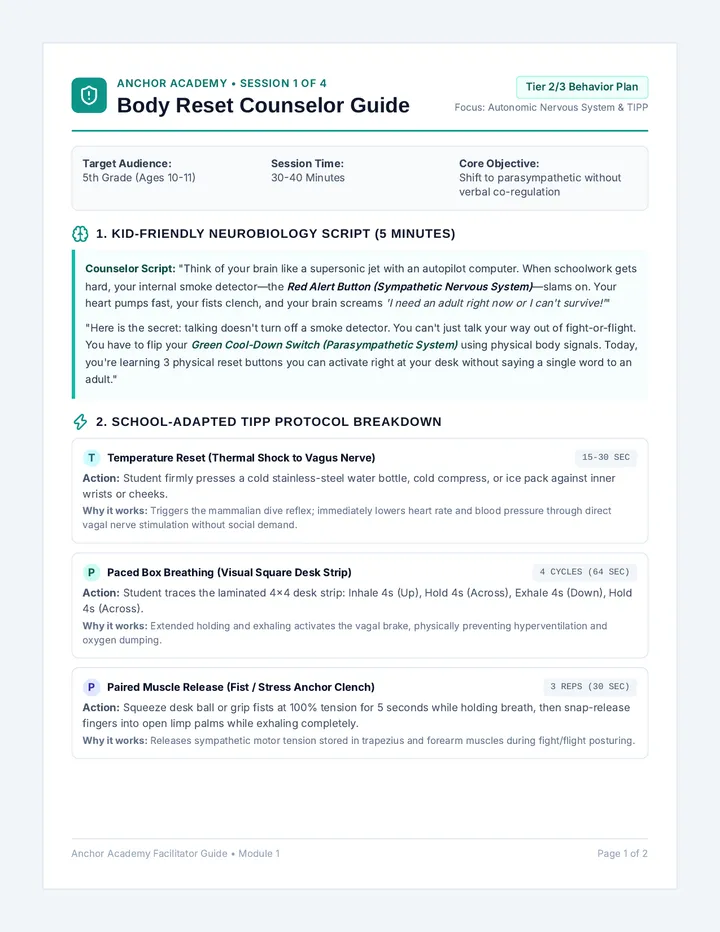
⏱️ Session 2: 30 Minutes
Focus: Coping Toolbox in Action
🧰
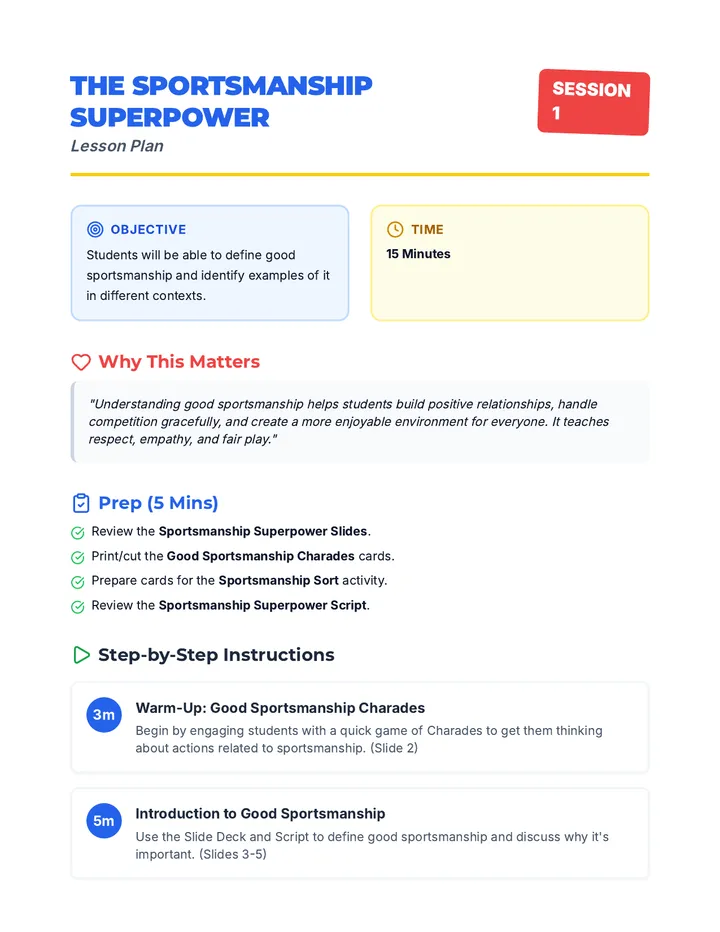
Core Purpose: Move from awareness to actionable emotion regulation. Teach students four explicit physical/sensory coping tools and have them assemble a personalized "Calm Toolbox" to keep at their desk or the classroom calm corner.
Session 2 Instructional Flow (30 Minutes)
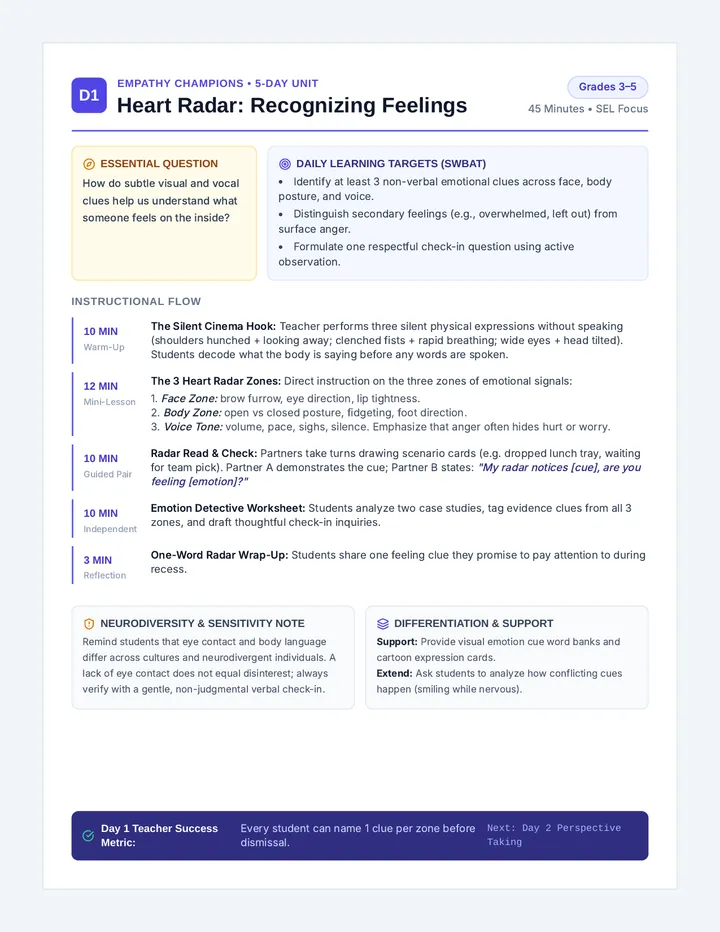
1. Engine Check & Tool Concept (5 Mins) — Slide 4 0:00 - 0:05
Introduce the concept of a Coping Tool: "Just like a car mechanic has tools to fix an engine running too fast or too hot, we have tools to help our body engine find its safe Green Zone!"
2. Active Modeling: The Four Power Tools (10 Mins) — Slide 5 0:05 - 0:15
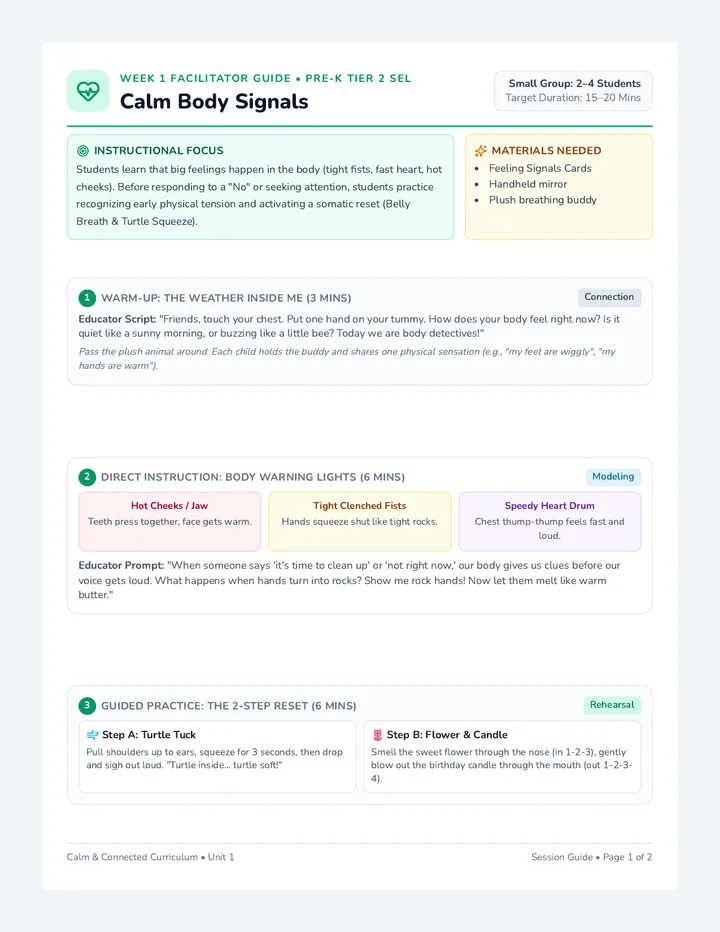
• Rainbow Breath: Sweep arms up inhaling deeply through nose; exhale slowly swooping arms down into an arch. Repeat 3 times.
• Turtle Tuck: Tuck chin gently to chest, fold arms across chest, count 1-2-3 softly inside the shell.
• Wall Push / Palm Press: Push flat hands into desk or wall with 70% effort for 5 seconds to discharge restless nervous energy.
• Cool Sip & Happy Thought: Model sipping water slowly and closing eyes to recall a favorite calming memory.
3. Building the Personal Toolbox Activity (10 Mins) — Page 2 0:15 - 0:25
Distribute Page 2 of the activity. Students choose their 4 favorite go-to tools from the Tool Bank (or invent their own) and draw/write them into their personalized toolbox. Circulate to prompt: "When you feel frustrated during math, which tool will you open?"
4. Group Pledge & Calm Station Anchor (5 Mins) — Slide 6 0:25 - 0:30
Chant the Zone Navigator Pledge together. Point to your classroom Calm Corner or Peace Station and announce that these exact tools are available whenever their body needs to reset!
Daily Routines & Home Carryover
Morning Check-In: Place 4 colored baskets or magnets near the door where students drop their name card to show their starting zone.
Family Note: Send home the completed Page 2 Toolbox so caregivers can use shared vocabulary ("Let's do a rainbow breath together").
Primary Zone Navigators • Educator Guide • Part 2 of 2
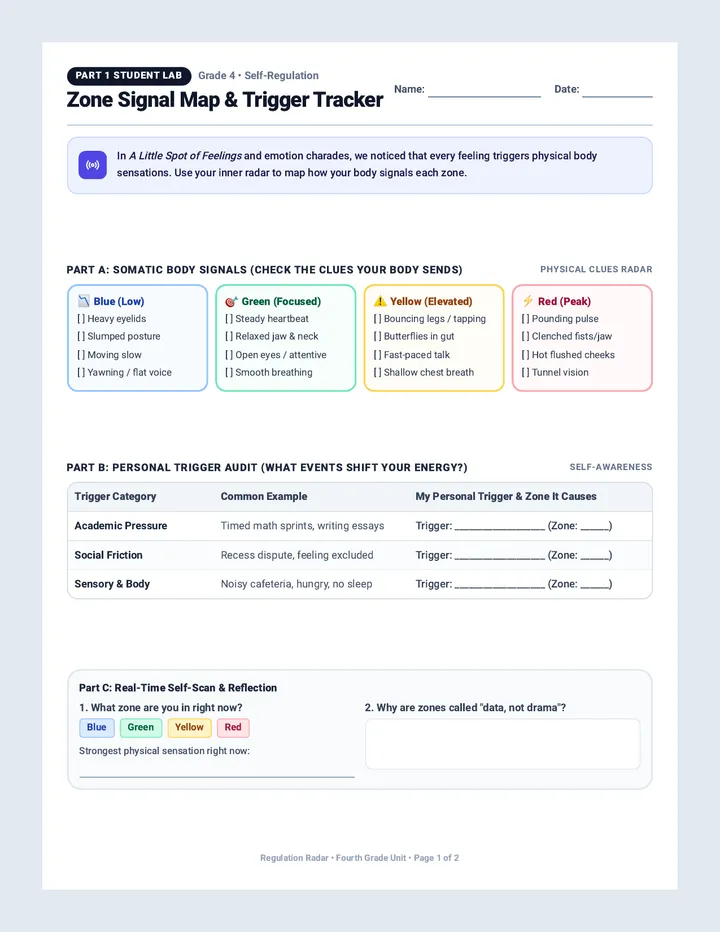
Zone Shift: Green ➔ Yellow
⚽ 🗣️
Zone Shift: Yellow ➔ Red
🔊 🥱
Zone Shift: Green ➔ Blue / Yellow
🎯 When you know your triggers in advance, you can prepare your coping strategy!
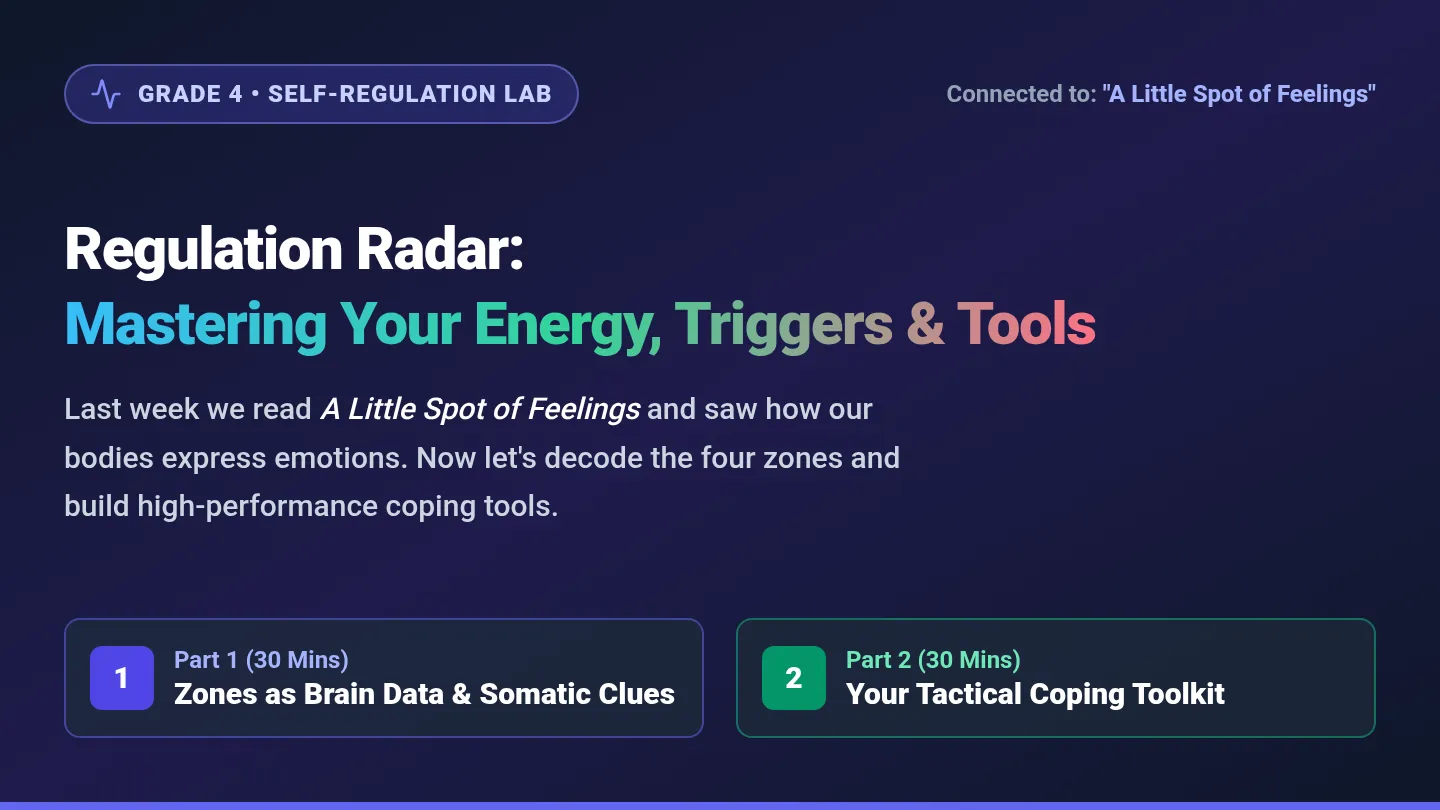
Part 2 • Tactical Coping
Tested Science Tools
🫁 ⏹️
Box Breathing 4×4: Inhale 4s, Hold 4s, Exhale 4s, Hold 4s.
Isometric Clench: Squeeze fists 5s, exhale release completely.
Calms heart & vagus nerve
🧠 🔄
Reality Check: "Is this a glitch or an emergency?"
Growth Self-Talk: "My brain is just feeling rushed; I can take one step."
Engages the prefrontal cortex
👁️ 👂
5-4-3-2-1 Scan: 5 things you see, 4 feel, 3 hear, 2 smell, 1 taste.
Cold Water Shock: Sip ice water or splash wrists to ground.
Pulls mind back to the present
Rehearsal: Let's do one cycle of Box Breathing right now: 4... 4... 4... 4!
Part 2 • Tactical Application
Choose Your Response
Scenario 1: Four-Square
Someone yells "You're out!" on a line ball you thought was safe. Your fists ball up and heat rushes to your face.
Tool: Step back 3 paces + 5-sec palm press + calmly say "Let's replay it."
Scenario 2: Math Exam
Question 5 looks impossible. The timer shows 10 minutes left. Your heart begins thumping and you freeze.
Tool: Put pencil down + Box breath + Self-talk: "I will skip and come back."
Scenario 3: Post-Lunch Crash
It is 1:30 PM. Your eyelids feel like lead during silent reading and you can't absorb any words on the page.
Tool: Wall push stretch + cold water drink + 2 rolling shoulder shrugs.
🚀 Mastery is not never feeling angry or tired; mastery is knowing what tool to use!
When in GREEN (Focused): Goal: Sustain
My Tool: _________________________________________
Ideas: Goal-setting • Helping a partner • Organizing desk • Active focus
When in YELLOW (Elevated): Goal: Downshift
My Tool: _________________________________________
Ideas: Box breathing (4×4) • 5-4-3-2-1 scan • Reality check • Squeeze ball
When in RED (Overload): Goal: Stop & Protect
My Tool: _________________________________________
Ideas: Take 5 paces back • Turtle tuck • Hand signal to teacher • Safe space
Part B: Cognitive Reframe Formula (Changing the script in your head) Prefrontal Cortex Tool
Unhelpful Alarm Thought:
"I'm going to fail this test and everyone is watching me!"
Calm Grounded Reframe:
"This is hard, but I can breathe and tackle one question at a time."
Part C: Tactical Problem Solving (Apply your plan)
Scenario 1: You are working on a group poster. A classmate draws over your section without asking. You feel hot heat surging up your neck (Yellow turning Red).
Somatic Tool I will use immediately: ___________________________________
Words I will say to regulate: "________________________________________________"
Scenario 2: During independent math, you get completely stuck on problem #3. You notice you are tapping your eraser hard, breathing quickly, and feeling anxious.
Somatic Tool I will use immediately: ___________________________________
My cognitive reframe thought: "________________________________________________"
Zone Navigators • Fourth Grade Coping Playbook
Student Commitment Signature: __________________________
⚙️
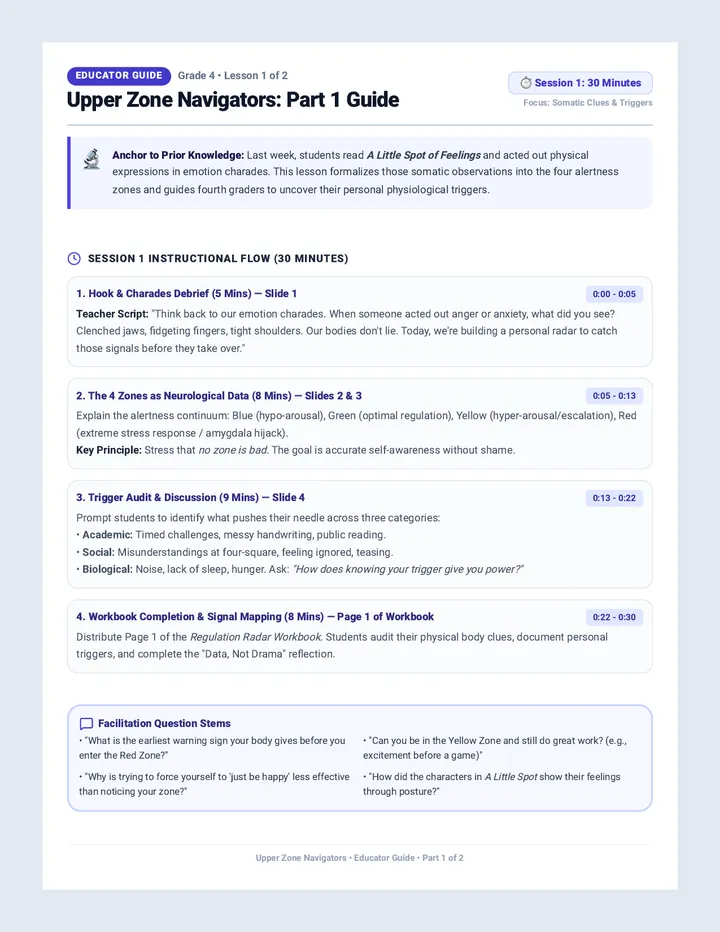
Action Objective: Transition students from theoretical zone awareness to practical self-regulation execution. Explicitly instruct, coach, and rehearse somatic resets, cognitive reframing, and scenario problem-solving.
Session 2 Instructional Flow (30 Minutes)
1. Radar Check & Tool Introduction (4 Mins) — Slide 4 0:00 - 0:04
Rapid pulse check: Have 3 volunteers share their current zone. Explain: "An athlete doesn't just hope they don't get tired; they have tactical drills. Today you are training your nervous system's tactical drills."
2. Somatic Drill Coaching (9 Mins) — Slide 5 0:04 - 0:13
• Box Breathing (4×4): Lead class through 2 full cycles: Inhale (4s), Hold (4s), Exhale (4s), Hold (4s). Explain how this signals the vagus nerve to slow heart rate.
• Isometric Muscle Release: Have students squeeze their fists and pull shoulders to ears for 5 seconds, then drop and exhale. Contrast the feeling of tension vs relaxation.
• Cognitive Reframe: Introduce the formula: "Acknowledge feeling + State the real fact + Choose one action."
3. Real-World Scenario Lab (10 Mins) — Slide 6 & Page 2 Part C 0:13 - 0:23
Have students partner up. Partner A reads Scenario 1 (group project conflict). Partner B demonstrates the somatic pause and speaks the cognitive reframe response aloud. Switch roles for Scenario 2 (math test freeze).
4. Playbook Completion & Self-Advocacy Protocol (7 Mins) 0:23 - 0:30
Students write their personal strategy matrix and sign the commitment. Introduce the classroom "Yellow Zone Signal" (two fingers tapped on desk) which allows a student to take a 2-minute water break or reset without interrupting instruction.
Observational Success Indicators (Formative Assessment)
1. Accurate Identification: Names own zone using somatic clues rather than vague emotional words ("My shoulders are tense; I'm in Yellow").
2. Tool Selection: Chooses an appropriate tool matched to energy level (e.g., activates in Blue, downshifts in Yellow).
3. Proactive Recovery: Uses strategies independently or with discreet prompt before reaching Red Zone escalation.
Upper Zone Navigators • Educator Guide • Part 2 of 2