You Are Enough Lesson Plan You Are Enough
Tier 3 Individual Intervention Plan
Purpose
This intervention is crucial for students navigating social challenges and academic pressures. It equips them with tools to challenge negative self-perceptions, build resilience against peer influence, and feel more comfortable and engaged in their school environment.
Pacing
Frequency: 6 weeks (1 session/week)Duration: 30 minutes per sessionTotal Time: 3 hours
Preparation (20 mins/week)
Review the session materials and teaching scripts.
Print relevant worksheets and activity cards (e.g., My Strengths Worksheet).
Prepare whiteboard or chart paper for discussion prompts.
Ensure journal and writing materials are ready for the student.
Review the specific scripts and discussion guides for the week.
Material Checklist
Whiteboard & Markers
Positive Self-Talk Script
My Strengths Worksheet
Student Journal & Pens
Coping Strategy Cards
Boundaries Guide & Activity
Session Roadmap
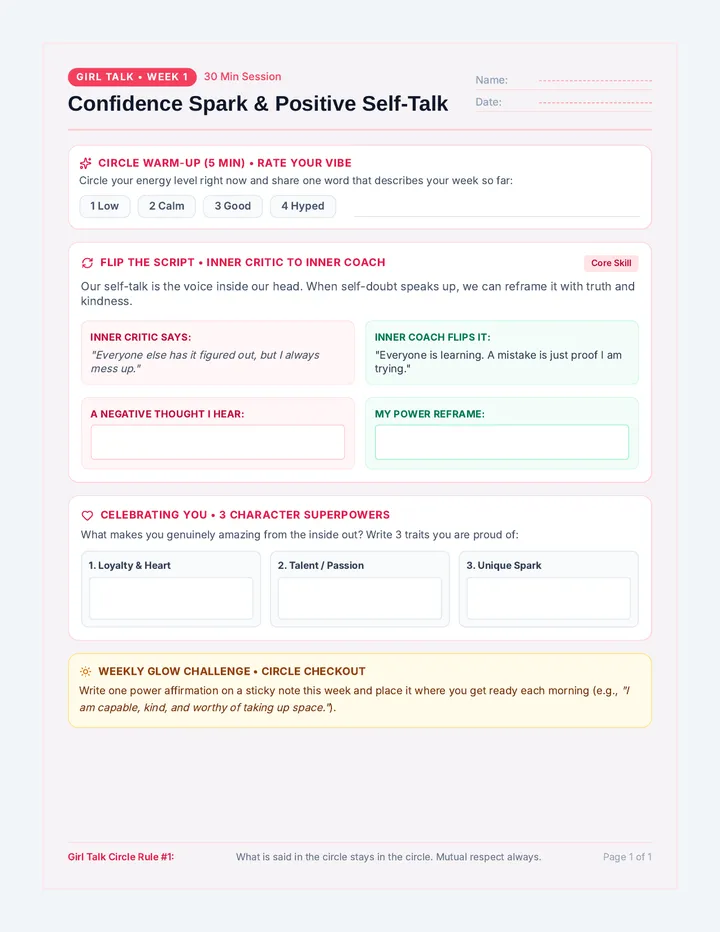
Week 1: Inner Voice & Self-Talk
Discuss the "Inner Critic" vs. "Inner Coach." Practice reframing negative thoughts into affirmations.
5m Warm-up 10m Discussion 10m Activity 5m Cool-down
Week 2: Identifying Strengths
Explore personal attributes, talents, and accomplishments that build a sense of worth.
5m Review 10m Strengths Discussion 10m Worksheet 5m Share
Week 3: Challenging Assumptions
Introduce cognitive distortions (mind-reading). Analyze scenarios for evidence vs. assumptions.
5m Case Study 10m "Detective" Lesson 10m Scenario Work 5m Pause Strategy
Week 4: Developing Coping Tools
Brainstorm healthy mechanisms for stress. Select and practice personal favorite strategies.
5m Intro 10m Brainstorming 10m Card Selection 5m Practice
Week 5: Setting Boundaries
Understand emotional personal space. Role-play setting limits with peers respectfully.
5m Warm-up 10m Concept Intro 10m Role-play 5m Commitment
Week 6: Celebrating Growth
Reflect on the 6-week journey. Finalize a "Booster Kit" for long-term resilience.
5m Review 10m Reflection 10m Kit Creation 5m Takeaway
You Are Enough Slides You Are Enough
Building Your Inner Confidence
Session 1 Intro
1
Your Inner Voice
Key Concepts
What is self-esteem?
Inner Critic vs. Inner Coach
Changing the script
"When did you feel good about yourself recently?"
Our Goal: Turning up the volume on your Inner Coach!
2
Discovering Your Strengths
What makes you, YOU?
Let's look at the amazing things that make you a unique person. Your strengths are your superpowers.
Talents
Qualities
Interests
Successes
Today's Focus
Recognizing internal strengths
Seeing your worth
Identifying accomplishments
3
Challenging Assumptions
Is That Really True?
Mind-Reading:
Thinking you know what someone else is thinking about you.
Catastrophizing:
Thinking the worst possible thing is happening.
"Wait! What is the real evidence for this thought?"
4
Your Coping Toolbox
Handling Tough Feelings
We all get overwhelmed. The secret is having a "toolbox" of healthy ways to feel better.
Reflect:
What do you do right now when school feels like "too much"?
Deep Breathing
Listen to Music
Journaling
Taking a Walk
5
Setting Your Boundaries
Protecting Your Peace
Boundaries are like a "social fence" that keeps you safe and respected. They tell people what is okay and what isn't.
Personal Space Saying "No"
"Please stop, that makes me uncomfortable."
"I'm going to walk away now."
6
Your Power Plan
You Are Ready!
Reflection
Look at how far you've come.
Booster Kit
Tools for the future.
Next Steps
Moving forward with strength.
Inner Voice Teacher Script Facilitator Script
You Are Enough: 6-Week Intervention
Facilitation Notes
Safe Space: Reiterate that this is a private, supportive environment.Pacing: Keep discussions to 10-15 minutes to allow for activity time.Validation: Use "active listening" — repeat back what the student says to ensure they feel heard.
Week 1: Understanding Emotions & Self-Talk
Warm-up (5 min)
"Hi [Student's Name], thanks for coming today. We're going to spend the next few weeks talking about how you see yourself and how to feel more confident. Let's start with a quick warm-up. Can you tell me about a time when you felt really good about yourself? What was happening?"
Discussion (10 min)
"Have you ever noticed a voice in your head that says negative things? Maybe it says, 'You're not good enough.' We call that your Inner Critic . On the other hand, there's your Inner Coach — the voice that encourages you. Which one feels louder lately?"
Notes on Student Response
Week 2: Identifying Strengths
Review (5 min)
"Last week we chose a positive affirmation. How did that go for you this past week? Were you able to remember it?"
Discussion (10 min)
"Today, we're focusing on all the amazing things about you. What are some things you are good at? It could be anything — sports, math, being a good listener. Nothing is too small."
Notes on Student Strengths
Week 3: Challenging Negative Assumptions
Concept Intro (10 min)
"Sometimes our brains jump to conclusions. It’s like 'mind-reading' — thinking we know what others are saying even when we haven't seen proof. If you see someone whispering, you might assume they're talking about you. Does that sound familiar?"
Activity Prompt
"Let's be detectives. What's the actual *evidence* that they were talking about you? What else could have been happening?"
Week 4: Developing Coping Strategies
Discussion (10 min)
"Coping strategies are like tools in a toolbox. They help you calm down when things feel like 'too much.' What are some things you already do to feel better? Let's look at some new ones together."
Week 5: Setting Healthy Boundaries
Introduction (10 min)
"Boundaries are invisible fences that protect your personal space. They tell people what is okay and what is not okay. Why do you think it might be important to have these rules for yourself?"
Role-Play Prep
Good Vibes Check Warm Up Good Vibes Check
Session 1 Warm-Up
NAME:
DATE:
"Think back to a time when you felt truly good about yourself. It could be big or small, recent or a while ago. What was happening? How did it make you feel?"
Take your time to write or draw your reflection above.
Inner Coach Activity Sheet Inner Coach Practice
Positive Self-Talk Script
NAME:
This script helps you practice turning negative thoughts into positive, more realistic, and kinder thoughts. Remember, your thoughts are powerful!
The Inner Critic says...
"He's always talking about me. Everyone is probably looking at me and judging me because of him. School is impossible with this going on."
Your Inner Coach says...
"I can't control what others say or think, but I can control how I react. I will focus on my own work and friends who support me. I am capable of handling school even with challenges."
The Inner Critic says...
"My friends probably think I'm weird or boring because I'm so quiet now. They might not want to hang out with me anymore."
Your Inner Coach says...
"My friends care about me for who I am. It's okay to feel quiet sometimes, and true friends understand. I will try to engage when I feel ready."
The Inner Critic says...
"This homework is too hard. I'm never going to understand this. I'm going to fail."
Your Inner Coach says...
"This is challenging, but I can ask for help or break it down into smaller steps. I've learned hard things before, and I can do it again."
Your Turn
A negative thought I often have:
My Detective Question (Is it true?):
What my Inner Coach would say instead:
One Positive Thought Cool Down My Power Phrase
Session 1 Cool-Down
"Before we finish today, choose one positive affirmation or kind thought about yourself that you will try to remember and use this week. Write it down here."
Keep this phrase in your mind like a shield this week.
My Strengths Worksheet My Strengths
Week 2 Spotlight
NAME:
"It's easy to forget all the amazing things that make you, YOU! Let's take some time to celebrate your unique strengths, talents, and positive qualities. These are the things that make you strong and valuable."
Part 1: What Am I Good At?
Think about things you enjoy doing, things you do well, or things that come easily to you. (Drawing, sports, math, music, listening, writing...)
Part 2: What Positive Qualities Do I Have?
Words that describe your personality. (Kind, brave, funny, creative, curious, determined, thoughtful, honest...)
Part 3: What Am I Proud Of?
Moments, big or small, where you felt pride. (Finished a task, helped someone, tried something new...)
Reflection
How do these make me "enough"?
Look at all the incredible things you've written! How do these remind you that you are a valuable person, no matter what anyone else says or implies?
Challenging Assumptions Activity Assumption Detectives
Week 3: Evidence Check
"Sometimes our brains jump to conclusions without proof. This is called making an assumption . It's like our brain tries to 'mind-read' others. This activity helps you find the real evidence!"
What happened?
Describe just the facts—what you saw or heard objectively.
Example: I saw the boy whisper something and his friends looked in my direction.
What was your assumption?
What did your brain tell you was happening?
Example: They were definitely making fun of me. Everyone thinks I'm weird.
The Investigation
Evidence FOR
What proof do you have that it's true?
Evidence AGAINST
Could there be another explanation?
The Balanced Verdict
How likely is the assumption now?
Very Likely Somewhat Likely Unlikely Very Unlikely
A more balanced thought to have:
Coping Strategies Activity Cards My Coping Toolbox
Select the tools that work for you
Belly Breathing
Place one hand on your belly. Breathe in slowly through your nose, feeling your belly rise. Exhale slowly through your mouth. Repeat 3-5 times.
Short Walk
Step away for a few minutes. Walk around the room, down the hall, or just stand up and stretch. Movement releases tension.
Read a Bit
Dive into a story or an interesting article for a few minutes. It helps shift your focus away from current worries.
Engage Senses
Notice 5 things you see, 4 you hear, 3 you feel, 2 you smell, and 1 you taste. This grounds you in the present.
Journaling
Write about how you're feeling. Don't worry about grammar, just let the words flow. Get those feelings out of your head.
Doodle It
Express your feelings through art or sketching. A creative outlet can help process strong emotions without words.
Talk to an Adult
Share what you're going through with a teacher, counselor, or parent. Another perspective can be very helpful.
Music Break
Put on some calming or uplifting music. Music has the power to shift your mood and focus instantly.
My Selection
Choose 2-3 strategies you want to try practicing this week:
Setting Boundaries Discussion Guide Boundary Guide
Facilitator Discussion Prompts
What are Boundaries?
"Think of boundaries as invisible lines or rules you set for yourself. Just like a fence around a yard, they protect your personal space—both physical and emotional. What do you think 'emotional personal space' means?"
Notes on Student Definition
Why are they important?
"Why do you think having these rules is important? How might they help you feel safer or more respected, especially when you feel self-conscious?"
Key Talking Points:
Control over your own feelings
Building healthier friendships
Boosting self-esteem by knowing your worth
How to Communicate
"Setting a boundary doesn't have to be mean. It's just clear communication. What are some ways you could tell someone that something they are saying is bothering you?"
BE DIRECT: "Please stop, I don't like that."
ASK FOR SPACE: "I need a moment to myself."
WALK AWAY: If words don't work.
TELL AN ADULT: If you feel unsafe.
What if they don't respect it?
Discuss repeating the boundary, walking away, or seeking help. Emphasize that the student's well-being comes first.
Setting Boundaries Role-Play Activity Setting Boundaries
Role-Play Practice
"Practicing what to say and do can make it easier to set boundaries in real life. Your teacher will play the other person. You practice responding by setting a boundary."
1
Scenario: The Hurtful Comment
The Other Person Says:
"Look at that..." (muttering and laughing as you pass)
Your Practice Response
2
Scenario: Group Gossip
The Other Person Says:
"Did you see what they were wearing today? So weird!"
Your Practice Response
3
Scenario: Feeling Overwhelmed
The Other Person Says:
"Can you help me after school with this big project? It'll take hours!"
Your Practice Response
Post-Practice Thoughts
How did it feel to actually say those words?
What was the hardest part? What felt easiest?
Self-Esteem Booster Kit Activity My Booster Kit
Week 6: Ready for the Future
"You've learned so many strategies! This kit is a collection of your favorite tools and reminders that you can use anytime you need a lift. You are enough!"
POWER AFFIRMATIONS
TOP STRENGTHS
GO-TO COPING TOOLS
BOUNDARY PHRASE
Assumption Check
"Wait! What is the real evidence for this thought?"
I AM CAPABLE. I AM STRONG. I AM ENOUGH.
Reflection Journal Prompts Reflection Journal
Growth & Resilience
"Take some time to reflect on your journey over the past six weeks. Use these prompts to help you think about your growth and what you've learned."
1. What was the most challenging part of these sessions, and how did you work through it?
2. What is one new thing you learned about yourself during this program?
3. How have your feelings about school, or about peer comments, changed since we started?
4. Which strategy or technique do you think you will use most often going forward?
A Letter to Your Future Self
Write a short note reminding yourself of your strengths and all the tools you now have to feel confident and resilient.