Survival Brain Atlas Worksheet Survival Brain Atlas
Lesson 1: Anatomy of the Survival Brain
Student Name
Date
Part 1: The Triune Brain Model
The brain evolved in layers. While we think of it as one organ, different parts specialize in different tasks. Read the descriptions below and label the corresponding areas on the diagram.
A. Neocortex (The Human Brain)
Responsible for logic, language, and abstract thought. It helps us plan and make rational decisions.
B. Limbic System (The Mammal Brain)
The emotional center. Houses the Amygdala and Hippocampus. Manages memory and "big feelings."
C. Brainstem (The Reptilian Brain)
The survival center. Controls breathing, heart rate, and temperature. It is purely reactive.
1. ________ 2. ________ 3. ________
Part 2: The Amygdala & Prefrontal Cortex
The Amygdala (The Guard)
The Amygdala scans the environment for danger. When it senses a threat, it "pulls the fire alarm," sending signals to the rest of the body to react instantly .
"React first, think later!"
The PFC (The Professor)
The Prefrontal Cortex is where logical reasoning happens. It evaluates if a threat is real or just a false alarm (like a loud car backfiring).
"Let's look at the facts before we panic."
Analysis: The "Downstairs" Brain Takeover
Imagine you are walking in the woods and see a curved shape in the grass. Before you even realize it's a stick, you jump back. Explain what happened in your brain using the roles of the Amygdala and the Prefrontal Cortex .
Part 3: The Simulation
Class Simulation: The "Processing Jam"
During the teacher-led simulation, record your observations. When the "alarm" (stimulus) was triggered, what happened to your ability to solve complex problems?
Condition Mental State Physical Sensation Baseline (Calm)
|
| Alarm (Stress) |
|
|
Synthesis Question
Why is it biologically difficult to "think your way out" of a panic attack once the Amygdala has taken control?
Survival Brain Slides Survival Systems
The Neurobiology of Stress & Trauma
Wait... What Was That?
Think about the last time you were startled. Maybe a door slammed or someone jumped out at you.
"Your heart starts pounding before your brain even knows why."
Reaction vs. Reflection
Evolution favors speed over accuracy when your life is on the line.
The Triune Brain Model
Level 3
The Neocortex
Rational, logical, language-based thinking.
"THE PROFESSOR"
Level 2
Limbic System
Emotions, memory, and threat scanning.
"THE ALARM"
Level 1
Brainstem
Automatic survival (breathing, heart rate).
"THE ENGINE"
The Amygdala
Your Brain's Security Guard
Scans every 1/10th of a second for danger.
Can override your "logical brain" in milliseconds.
Doesn't speak English—it speaks in feelings and impulses .
Flipping Your Lid
Dr. Dan Siegel’s Hand Model of the Brain:
1
Thumb tucked: The Limbic System is active and communicating with the PFC.
2
Fingers lift ("Flip your lid"): The PFC disconnects. Logic is gone. The Amygdala is now in control.
Survival Simulation Teacher Guide Simulation Facilitation Guide
Lesson 1: Anatomy of the Survival Brain
Teacher Resource
Objective
To demonstrate how a sudden physiological "alarm" (stress response) impairs complex cognitive processing (Prefrontal Cortex) and shifts focus to survival mechanisms (Amygdala).
Phase 1: The Baseline (The Hook)
Setup:
Ask students to stand and find a partner.
One partner holds their hand out like they are holding a glass; the other partner holds a ruler (or just their hand) 2 inches above.
Without warning, the top partner drops the object. The bottom partner must catch it.
Discussion Prompt:
"Did you have to think about moving your hand, or did it just happen? This is your brainstem and amygdala working together before your cortex can even name the object."
Phase 2: The "Processing Jam" Simulation
Round 1: Baseline Logic
Give students a simple logic puzzle or math problem (e.g., "If you have 15 apples and give 3 to 4 friends, how many are left?"). Record how quickly they answer.
Round 2: The Stress Shift
Introduce a "stressor" (loud rhythmic clapping, a 10-second countdown timer, or a surprise loud noise). While this is happening, give a puzzle of equal difficulty.
Key Insights to Facilitate:
1
The Disconnection: Explain that when the amygdala senses the "alarm" (the loud noise/timer), it sends a signal that inhibits the Prefrontal Cortex. We literally become less smart in the moment of danger.
2
Physiological Spillover: Ask students to check their pulse or breathing. Stress is a whole-body event, not just a thought.
Implementation Notes
Trauma Sensitivity
Be mindful of students with known trauma histories. Avoid physical contact and give a clear "opt-out" option if the loud noises or time pressure feel too intense.
The "Why"
Emphasize that this is a protection mechanism. The brain isn't broken; it's doing its job to keep you safe from a perceived threat.
The Four Fs Slides The Four Fs
How Your Brain Chooses to Defend You
Fight • Flight • Freeze • Fawn
Survival is Step One
Your brain’s #1 job isn't to be happy or successful—it's to keep you alive .
Every defense mechanism was designed by evolution to solve a specific problem in the wild.
Active
Overpower or Escape
Passive
Wait or Appease
Active Responses: Fight & Flight
Fight
Defeating the threat through power or aggression.
Modern Signs:
Anger / Irritability
Need to control others
Clenched jaw/fists
Flight
Escaping the threat to find safety elsewhere.
Modern Signs:
Anxiety / Panic
Perfectionism (running from failure)
"Busy-ness" / Inability to sit still
Passive Responses: Freeze & Fawn
Freeze
Becoming still or "numb" when you can't fight or flee.
Modern Signs:
Feeling "stuck" or paralyzed
Zoning out / Dissociation
Procrastination / Hiding
Fawn
Appeasing the threat to prevent conflict.
Modern Signs:
People-pleasing
Lack of boundaries
Over-apologizing
There is no "wrong" response.
Your brain picks the strategy it thinks has the best chance of helping you survive in that specific moment .
Next we will look at how these show up in the animal kingdom vs. your own life.
Defense Detectives Worksheet Defense Detectives
Lesson 2: Analyzing the Four Fs
Student Name
The Mission
Below are several scenarios describing animal and human behaviors in response to a threat. Identify which of the Four Fs (Fight, Flight, Freeze, Fawn) is being demonstrated and explain the "survival logic" behind it.
Case #1: The Opossum
When an opossum is confronted by a predator like a dog, it may suddenly collapse, its body becoming limp and its breathing slowing to almost nothing. It remains motionless for hours, even if the predator nudges or bites it.
Response Type:
Survival Logic:
Case #2: The Over-Apologizer
Jordan is in a group project. A teammate starts raising their voice and getting angry about the workload. Jordan immediately starts saying "I'm so sorry, it's my fault, let me do your part of the work too. What can I do to make it better?"
Response Type:
Survival Logic:
Case #3: The Gazelle
A gazelle grazing in the savanna hears the snap of a twig 50 yards away. Within a fraction of a second, its heart rate triples, its muscles flood with oxygen, and it leaps away at 60 mph toward the horizon.
Response Type:
Survival Logic:
Case #4: The Defiant Student
Maya feels embarrassed when a teacher corrects her in front of the class. Instead of feeling sad, she feels a surge of heat in her chest, stands up, and shouts, "This class is stupid and you're just picking on me!" before slamming her book shut.
Response Type:
Survival Logic:
Reflective Thinking:
Why might humans use "Fawn" (appeasing) in a modern social situation like a disagreement with a boss or a bully, even though it wasn't a choice for most wild animals?
Defense Response Field Guide Defense Response Field Guide
Quick Reference: The Four Fs
Response Evolutionary Goal Mental State Modern Manifestation Fight To overpower the threat and remove the danger physically. Aggressive, Controlling, Hyper-focused Explosive anger, yelling, clenched muscles, feeling "righteous" or blaming others. Flight To create distance between self and the threat as fast as possible. Anxious, Restless, Panicked Running away from conflict, chronic "busy-ness," perfectionism, or avoidance. Freeze To hide in plain sight or "play dead" when fighting/fleeing isn't an option. Numb, Detached, Paralyzed Zoning out, "brain fog," feeling stuck, sleeping excessively, or dissociation. Fawn To appease the threat or find a "friend" in the predator to survive. Submissive, Eager, Self-Sacrificing People-pleasing, inability to say "no," taking the blame, or ignoring own needs to keep peace.
Survival Logic
Why do we "Flip our Lid"?
When your Amygdala triggers one of these 4 responses, it disconnects the Prefrontal Cortex (your thinking brain). This happens because thinking takes too long. In a survival situation, the body values speed over logic .
Understanding your response is the first step toward regaining control.
Physiological Mapping Slides The Body Speaks
Mapping the Physical Language of Stress
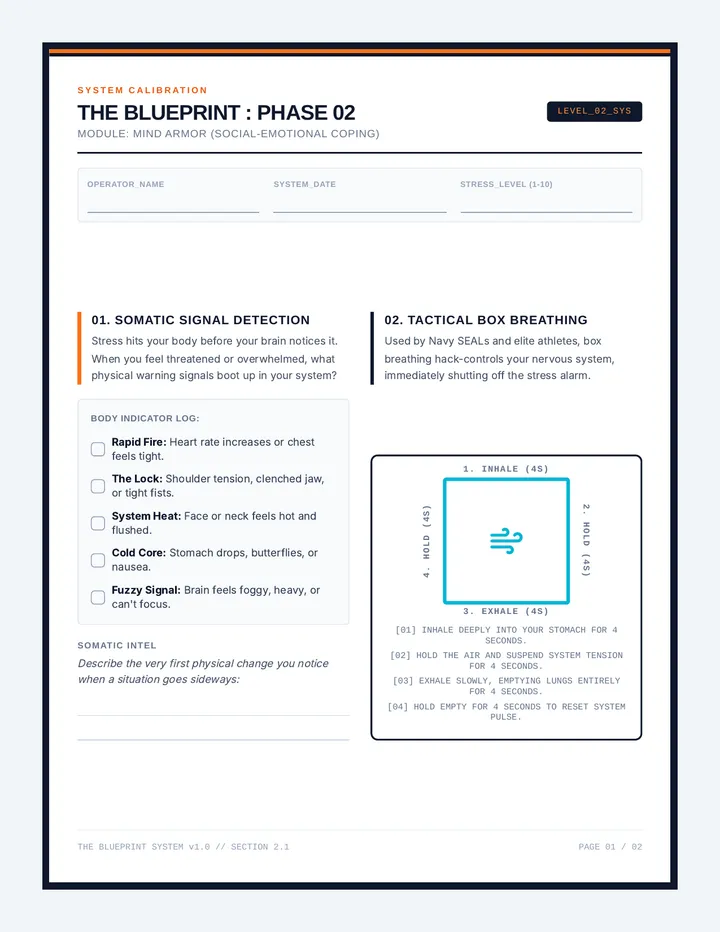
Somatic Awareness
"Soma" means Body.
Before your brain can put a feeling into words , your body puts that feeling into sensations .
The Body Keeps Score.
Heart Rate
Pumping blood to large muscle groups.
Breathing
Shallow, fast breaths for quick oxygen.
Muscle Tension
Arming the body for impact or action.
Your Internal Control Panel
Sympathetic
THE GAS PEDAL
Mobilizes energy. High alertness. Ready for Fight or Flight.
"ACTIVATE!"
Parasympathetic
THE BRAKE
Conserves energy. Promotes digestion and rest. The "Calm Down" system.
"REST & DIGEST"
Where do you feel it?
The Chest
Tightness, pounding heart, feeling like you can't get enough air.
The Gut
"Butterflies," nausea, knots, or a sinking feeling.
The Extremities
Tingling in fingers, cold hands, restless legs, or heavy limbs.
The Head/Neck
Clenched jaw, tension headache, "fuzziness," or heat in the face.
Activity: Somatic Mapping
We are going to activate our survival systems and then use a map to visualize where that energy lives in our bodies.
Get Ready to Move
Somatic Mapping Worksheet The Somatic Map
Lesson 3: Visualizing Your Survival Senses
Student Name
Step 1: The Activation
After the teacher-led "High Energy" exercise, sit quietly. Close your eyes and scan your body from head to toe. Don't judge the feelings—just notice them.
Step 2: The Key
Choose different colors to represent different sensations. For example: Red = Heat, Blue = Cold, Zig-Zags = Tension, Dots = Tingling.
Your Sensation Key
___________________
___________________
___________________
___________________
Quick Reflection
Which sensation felt the strongest? Where in your body do you usually feel stress first?
Connecting Brain to Body:
During a stress response, why does the body send blood away from your stomach (digestion) and toward your arms and legs?
Somatic Scan Script Teacher Resource Somatic Scan Script
Lesson 3: Physiological Mapping
Teacher Resource
Preparation
Ensure students have enough space to stand and move.
Have the "Somatic Mapping Worksheet" ready for immediately after.
Clear the "opt-out" procedure for students with physical limitations or sensory sensitivities.
The Goal
The goal is to safely induce a mild sympathetic nervous system response (arousal) so students can accurately observe their own physical "stress markers" while in a controlled environment.
Part 1: The "High Energy" Hook (3-5 Mins)
Script/Facilitation:
"Everyone, please stand up. We are going to do 60 seconds of high-intensity movement to wake up our survival systems. I want you to run in place, high knees, as fast as you can. On my mark... GO!"
(During the minute, offer encouragement. At the 60-second mark:)
"Stop! Sit down immediately. No talking. Close your eyes if you feel comfortable, or just soften your gaze at the floor. Put your hands on your lap. Do not try to change anything. Just listen to what your body is doing right now."
Part 2: The Somatic Scan (5-7 Mins)
Read slowly, with pauses between instructions:
1. Breath: "Notice your breathing. Is it deep or shallow? Is it coming from your chest or your belly? Don't change it. Just notice."
2. Heart: "Shift your attention to your chest. Can you feel your heartbeat? Where do you feel it most—in your neck, your chest, or maybe your fingertips?"
3. Temperature: "Scan your face and hands. Do they feel hot? Cold? Sweaty? Just notice the temperature."
4. Tension: "Scan your jaw, your shoulders, and your stomach. Are you holding any tightness there? Does it feel like a knot, or a vibration?"
"Now, gently open your eyes. Grab your 'Somatic Map' worksheet and use the next few minutes to color-code exactly what you just felt."
Part 3: The Brain-Body Connection
Connecting the Amygdala
Explain that the physical sensations they felt (pounding heart, fast breath) are the Amygdala ordering the Sympathetic Nervous System to prepare for action. Even though there was no "predator," the body responded as if there was one.
The Purpose of Awareness
Why do we map this? Because if we can recognize the physical signs of stress early, we can use our Prefrontal Cortex to intervene before we "flip our lid."
Neuroplasticity Slides The Plastic Brain
How Experience Shapes Your Biology
What is Neuroplasticity?
Your brain is not a computer chip—it's more like a muscle .
"Neurons that fire together, wire together."
The brain strengthens the pathways you use the most, and weakens the ones you don't.
Plasticity
Malleable • Adaptive • Changing
The "Path Through the Grass" Analogy
1
Walk through a field once, and the grass barely bends.
2
Walk it every day for a year, and you create a permanent, dirt path.
3
Soon, you walk that path automatically , even if you weren't trying to go that way.
Trauma and chronic stress act like a heavy truck driving down the "Survival Path" every single day.
Sensitization: The Super-Sensitive Alarm
Normal Alarm
A smoke detector that goes off when there is an actual fire. It works correctly to keep you safe.
Sensitized Alarm
After chronic stress, the alarm becomes "sensitized." Now it goes off if you just burn a piece of toast or if the room gets a little too warm.
TRIVIAL INPUT = MASSIVE RESPONSE
Practice Makes Permanent
If we practice Survival Brain (Amygdala) everyday, those pathways get thick and fast. Our Thinking Brain (PFC) gets weaker from lack of use.
The Good News:
Plasticity works both ways.
We can "unlearn" survival paths and build "safety" paths.
Mapping the Paths Worksheet Mapping the Paths
Lesson 4: Neuroplasticity & Habit Formation
Student Name
Part 1: The Grass Analogy
Recall the "Path through the Grass" analogy from the slides. In your own words, explain what happens to a neural pathway (a connection between brain cells) when it is used over and over again for survival.
Part 2: Sensitization Analysis
Sensitization
Becoming MORE responsive to a stimulus.
Example: A student who has been bullied in the past jumps when they hear someone laugh, even if the laugh isn't about them.
Habituation
Becoming LESS responsive to a stimulus.
Example: A student who lives near a train track eventually stops noticing the sound of the train at night.
Case Study Analysis:
Scenario: "The False Alarm"
Alex grew up in a very loud, chaotic home where yelling meant something bad was about to happen. Now, Alex is in a calm classroom. The teacher accidentally drops a stack of books, and Alex falls out of their chair, their heart racing and face turning red. Other students just chuckle and keep working.
Is this Sensitization or Habituation?
Why did Alex's brain react this way?
The "Bottom-Up" Brain
When we are in chronic stress, our brain becomes Bottom-Heavy . The "Survival Brain" (Amygdala/Brainstem) is much stronger and more active than the "Thinking Brain" (Prefrontal Cortex).
Critical Thinking Question:
How can we start to "re-walk" the paths to the Prefrontal Cortex? What are some things we might do to strengthen our "Thinking Brain"?
Acute vs Chronic Slides The Long Game
Acute Response vs. Chronic Systems
1. Acute Stress
Acute stress is short-term . It is an immediate response to a specific event.
"The Alarm goes off, you solve the problem, and the Alarm turns off."
Proportional to the threat.
Body returns to "Baseline" quickly.
Helpful for survival (e.g., slamming the brakes).
2. Chronic Stress
Chronic stress is long-term . It happens when the body stays in survival mode for weeks, months, or years.
"The Alarm gets stuck in the ON position."
Cumulative (adds up over time).
Body forgets how to return to "Baseline."
Harmful to long-term health.
Toxic Stress
Biological Wear & Tear
When cortisol and adrenaline are constantly in your system, they start to damage tissues, weaken the immune system, and shrink the hippocampus (memory center).
Chronic stress turns a survival system into a sensitized system .
Hyper-vigilance (Always scanning)
Sleep disturbance
Memory and Focus issues
Summary
Your brain is a survival machine. It's designed to protect you, but sometimes it needs help knowing when the danger is actually over .
Awareness
Grounding
Support
Stress Scenario Sort Worksheet Stress Scenario Sort
Lesson 5: Differentiating Stress Responses
Student Name
Acute vs. Chronic
Read each scenario. Determine if it describes an Acute (short-term) or Chronic (long-term) stressor. Then, explain the likely impact on the person's nervous system.
Scenario A: The Dog Park
Case Study #1
While at the park, an unleashed dog suddenly barks and runs toward Sam. Sam's heart races, they jump onto a bench, and the owner quickly grabs the dog. Five minutes later, Sam is back to walking calmly and feels relaxed again.
Type of Stress:
Acute
Chronic
Biological Impact:
Scenario B: The Unstable Home
Case Study #2
Casey lives in an environment where there is constant arguing and unpredictable yelling. Casey never knows when a conflict will start. As a result, Casey is always "on edge," has trouble sleeping, and gets a stomachache before coming home from school every day.
Type of Stress:
Acute
Chronic
Biological Impact:
Scenario C: The Big Exam
Case Study #3
Liam has been studying for the SAT for six months. He feels intense pressure from his parents to get a perfect score. Even after the test is over, Liam finds that he cannot stop worrying about other tests, and he has started losing his hair in small patches.
Type of Stress:
Acute
Chronic
Biological Impact:
The Conclusion:
Which of the scenarios above is most likely to lead to sensitization (a super-sensitive alarm)? Explain why based on what we learned about neuroplasticity.
Survival Systems Summative Quiz Survival Systems Quiz
Unit Summative Assessment
Student Name
Score
Section 1: Brain Anatomy
Match the brain region to its primary function.
1
Amygdala
2
Prefrontal Cortex
3
Brainstem
____ A. Logic, reasoning, and rational thought.
____ B. Automatic functions (breathing, heart rate).
____ C. Scanning for danger and triggering the alarm.
Section 2: The Four Fs
4. Which defense response involves "people-pleasing" or appeasing a threat to stay safe?
A. Fight
B. Flight
C. Freeze
D. Fawn
5. "Flipping your lid" refers to which biological event?
A. The Brainstem taking over for the Amygdala.
B. The Prefrontal Cortex disconnecting from the Limbic System.
C. The Heart Rate slowing down during a panic attack.
D. The Hippocampus creating a new long-term memory.
Section 3: Concepts
6. Define "Somatic Awareness" and explain why it is helpful during stress.
7. Using the "Path Through the Grass" analogy, explain why someone who has experienced chronic stress might have a "sensitized" alarm system.
8. Identify if the following is Acute or Chronic stress:
A. Slamming your brakes to avoid a cat: __________
B. Living in a neighborhood with high violence: __________
Section 4: Application
9. What is the "Good News" about neuroplasticity, even for a brain that has been through a lot of trauma?