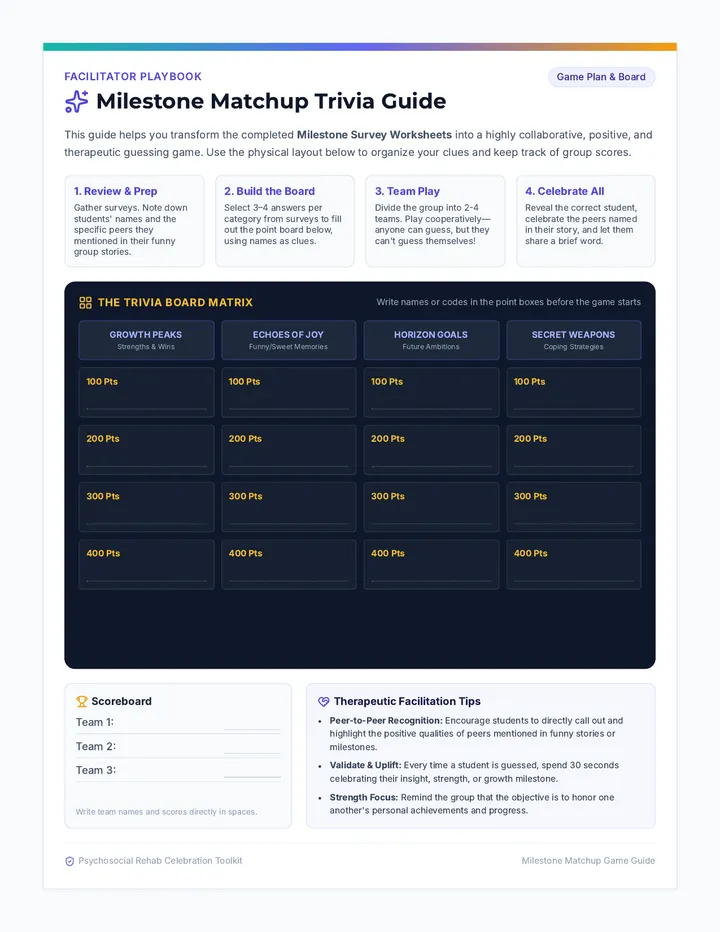
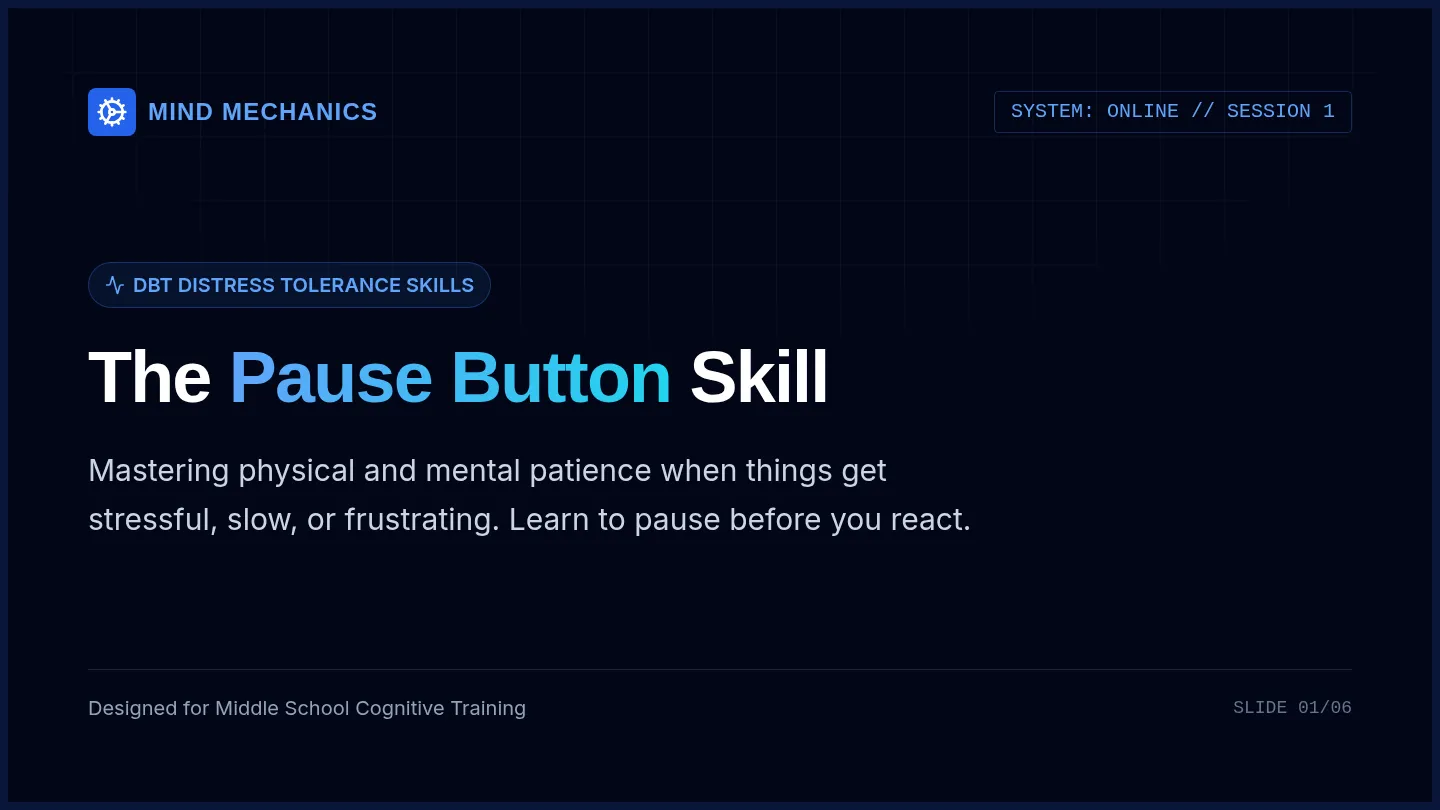
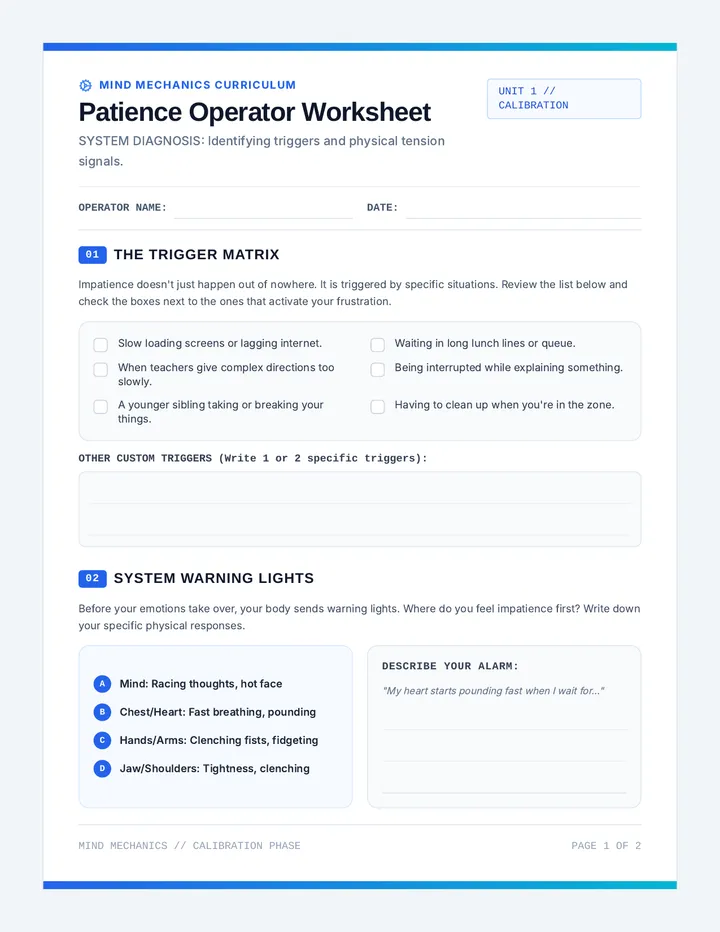
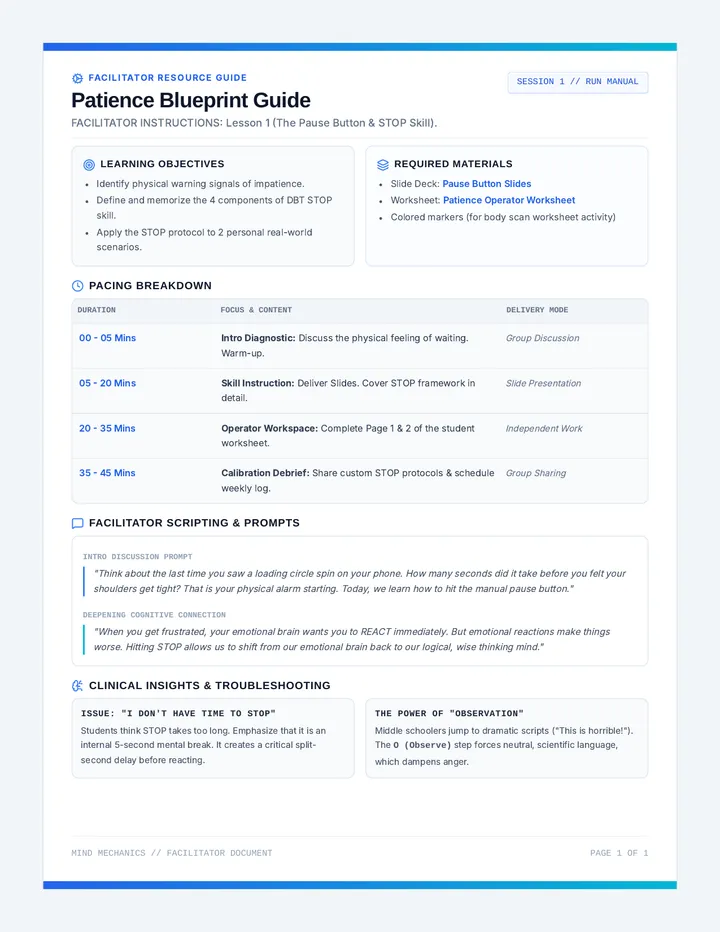
Brake Pedal Slides The Brake Pedal
Inner Calm Lab: Module 01
Mastering the science of slowing down using your body's built-in cooling system.
The Balloon Effect
Fast & Shallow
Like blowing up a balloon with short, jerky puffs. It's erratic, shaky, and creates tension.
Slow & Deep
Like a steady, controlled stream of air. The balloon fills smoothly and remains stable.
How does your body feel when you breathe fast versus slow?
The Gas vs. The Brake
Sympathetic System
"The Gas Pedal"
Fight, Flight, or Freeze
Heart rate speeds up
Shallow breathing
Focuses on threats
Parasympathetic
"The Brake Pedal"
Rest and Digest
Heart rate slows down
Deep, steady breathing
Body feels safe
Box Breathing
4-4-4-4
INHALE (4s)
HOLD (4s)
EXHALE (4s)
HOLD (4s)
Used by Navy SEALs
This technique helps maintain focus and calm in high-pressure situations. It "resets" your nervous system.
"Focus on the corners of the box as you move through each step."
The 4-7-8 Breath
Deep Relax
4
INHALE
Quietly through the nose
7
HOLD
Keep the breath in comfortably
8
EXHALE
Forcefully through the mouth with a 'whoosh'
The long exhale acts as a chemical signal to your brain to SHUT OFF stress.
The Biofeedback Lab
Step 1: Baseline
Find your pulse. Count beats for 60 seconds. This is your "Normal State".
Step 2: Activation
Practice 3 rounds of Box Breathing or 4-7-8 Breathing.
Step 3: Comparison
Count your pulse again. What changed? Record it on your Lab Tracker.
Your heart is your data source.
Prove to yourself that you have the power to change your biology.
Pulse Tracker Worksheet Pulse Tracker Lab
Biofeedback Investigation: The Brake Pedal
Scientist:
Date:
Objective
In this lab, we are testing the effectiveness of "Brake Pedal" techniques (Box Breathing and 4-7-8 Breathing). Our hypothesis is that these somatic techniques will physically lower your Heart Rate (BPM) by activating the parasympathetic nervous system.
Lab Procedure
01. BASELINE
Find your pulse. Count the beats for 60 seconds while sitting normally.
02. ACTIVATION
Choose ONE technique (Box or 4-7-8) and practice it for 3-5 full rounds.
03. DATA COLLECTION
Immediately recount your pulse for 60 seconds. Record the change.
Results
Measurement Phase Heart Rate (BPM) Physical Sensation (How you felt) Initial Baseline Post-Breathing Trial
Total Change in Heart Rate:
BPM
Lab Analysis
1. Describe the difference in your body before and after using the "Brake Pedal":
2. Which technique worked best for you?
Box Breathing
4-7-8 Breathing
3. When would this lab tool be most useful?
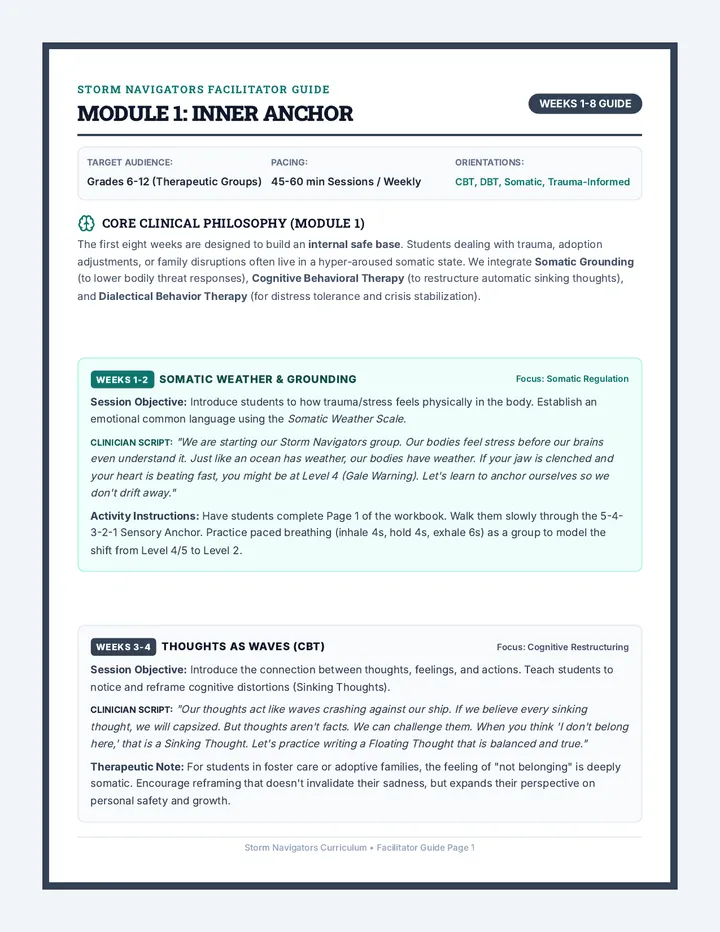
Brake Pedal Teacher Guide Facilitator Guide
Lesson 1: The Brake Pedal
6th Grade Psychology
Duration
45-50 Minutes
Key Skill
Somatic Regulation
Materials
Brake Pedal Slides
Pulse Tracker Worksheets
1 Round Balloon
Stopwatch/Timer
Instructional Sequence
1
The Balloon Hook (5 mins)
Use the balloon to demonstrate somatic states.
"Watch what happens when I blow short, fast breaths into this balloon. It's jerky and hard to control. Now watch the slow, steady fill. Which one feels more like 'being in control'?"
2
The Gas vs. The Brake (15 mins)
Use the Slide Deck to explain the Autonomic Nervous System.
Define Sympathetic (Gas) and Parasympathetic (Brake).
Model Box Breathing (4-4-4-4).
Model 4-7-8 Breathing (Deep signal to the brain).
3
The Pulse Lab (20 mins)
Students use the Pulse Tracker Worksheet.
Pro-Tip: Model how to find a pulse (wrist or neck) before starting. Use a 60-second timer on the board for the Baseline measurement so everyone is in sync.
4
Reflection & Wrap-Up (5 mins)
Discuss findings. Does everyone's heart rate drop? (Usually yes, but explain that 'practicing' makes it more effective over time).
Common Misconceptions
"I can't find my pulse!"
Have students try the carotid artery (neck) if the radial (wrist) is difficult. If all else fails, have them put a hand on their chest and count heartbeats.
"This feels weird/funny."
Acknowledge that deep breathing can cause slight lightheadedness for beginners. Remind them they are in control and can stop if needed.
Anchor Point Slides INNER CALM LAB
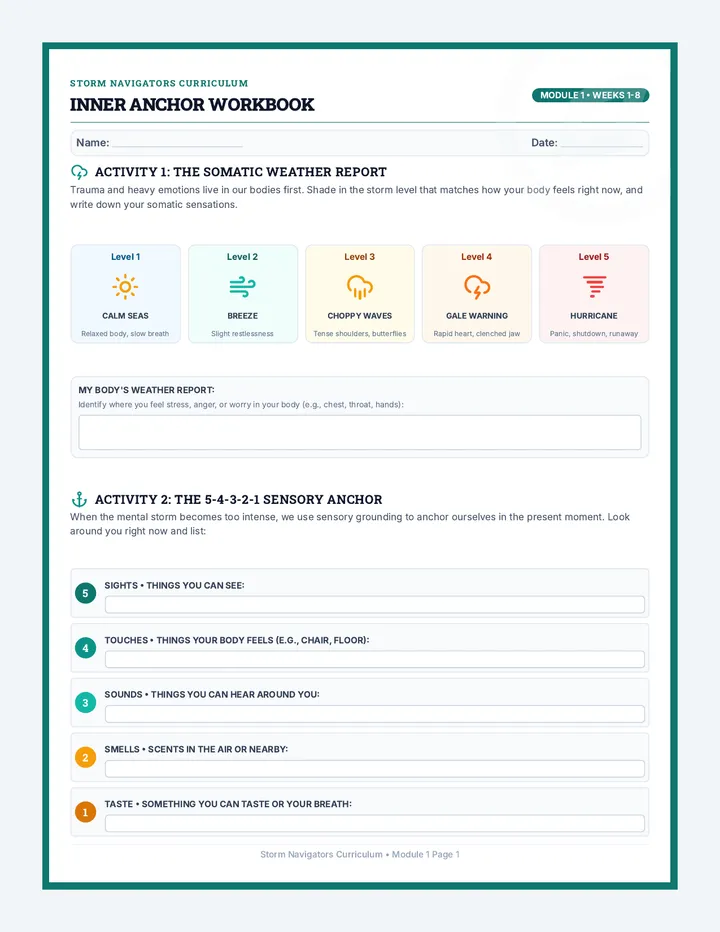
Anchor Points
Module 02: Sensory Grounding & Present-Moment Awareness
SEE HEAR TOUCH SMELL TASTE
The Mental Spiral
Stress often feels like being pulled into a stormy sea of "What Ifs."
"What if I fail the test?"
"What if they're mad at me?"
"What if I mess up?"
Your mind is in the future. Your body is in the past. Your attention is GONE.
Drop the Anchor
Grounding
A strategy to pull your focus out of your head and back into the present moment using your 5 senses.
If you can feel your feet on the floor, you aren't in the "What If." You are HERE.
Safety Signal to Brain
Focus Redirection
Breaks the Stress Cycle
The 5-4-3-2-1 Countdown
5
THINGS YOU SEE
4
THINGS YOU FEEL
3
THINGS YOU HEAR
2
THINGS YOU SMELL
1
THING YOU TASTE
Notice small details. The texture of your sleeve. The hum of the AC. The color of a pencil.
The Ice Cube Challenge
Can you hold an ice cube while reciting the alphabet backwards?
Why it works:
Intense physical sensation (cold) demands attention. It forces your brain out of the spiral and into the "Right Now."
Sensation
Intense but safe
Brain Power
Cognitive load
PRESENCE ACHIEVED
Grounding Quest
Ready to test your sensory anchors?
1
Pick a "Quest Card" from the deck.
2
Move to the environment listed on the card.
3
Complete the 5-4-3-2-1 check-in for that space.
Find an anchor in every room.
Grounding Quest Cards Grounding Quest Cards
Sensory Training Activity: Finding Anchors Anywhere
01
The Cafeteria Chaos
Scenario: It's loud, crowded, and smells like mystery meat. You feel a sensory overload starting.
Quest Checklist:
5 distinct colors in the room
4 different textures of food/trays
3 specific voices or sounds
2 unique smells (good or bad!)
1 taste (your drink or food)
02
The Outdoor Escape
Scenario: You're outside for recess, but your mind is still stuck on that argument you had earlier.
Quest Checklist:
5 shapes in the clouds or trees
4 textures (grass, bark, concrete)
3 nature sounds (wind, birds, cars)
2 scents (fresh cut grass, rain)
1 taste (fresh air/mint)
03
The Silent Exam
Scenario: The classroom is silent. You're staring at a question you don't know and your chest feels tight.
Quest Checklist:
5 square objects in sight
4 sensations (feet on floor, chair back)
3 tiny sounds (pencil scratching)
2 smells (old books, eraser)
1 taste (water/chapstick)
04
The Night Spiral
Scenario: You're in bed trying to sleep, but your brain is replaying everything you did wrong today.
Quest Checklist:
5 shapes in the shadows
4 textures (blanket, pillow, skin)
3 sounds (breathing, ticking clock)
2 scents (laundry, night air)
1 taste (toothpaste)
INSTRUCTIONS: Cut out these cards. Whenever you feel your mind "spiraling," pull one out and complete the quest to find your anchor.
Anchor Point Teacher Guide Facilitator Guide
Lesson 2: Anchor Points
6th Grade Psychology
Duration
45-50 Minutes
Key Skill
Sensory Grounding
Materials
Anchor Point Slides
Grounding Quest Cards
Small Ice Cubes (Optional)
Paper Towels
Instructional Sequence
1
The Ice Cube Challenge (10 mins)
A high-impact sensory demonstration.
"I'm giving everyone an ice cube. Your challenge is to hold it in your hand while trying to say the alphabet backwards. Notice how your brain starts ignoring your 'worries' and focuses entirely on your hand."
*Ensure students have paper towels. If ice isn't feasible, use a very heavy object or a very sour candy.
2
Why Grounding Works (10 mins)
Use Slides to explain the "Mental Spiral."
Explain that stress pulls us into the future or past.
Define Grounding as the "anchor" that holds us in the present.
Practice the 5-4-3-2-1 Technique as a whole class in the current room.
3
Grounding Quest (20 mins)
Simulation practice using Quest Cards.
Divide students into small groups. Give each group one "Quest Card." They must "imagine" being in that scenario and find specific anchors in the classroom that *could* represent what they see/feel/hear in that moment.
Teacher Tip: Encourage them to be specific. Instead of "I see a chair," say "I see the silver metal legs of the chair reflecting the light."
4
Debrief (5 mins)
Which sense was easiest to find? Which was hardest? (Usually smell/taste are hardest in a classroom). Remind them that they don't *need* all 5; just 1 or 2 can be enough to "drop the anchor."
Facilitation Notes
Managing Resistance
Some students may find mindfulness "boring." Reframe it as "hacking your attention" or "mental training" for athletes/performers who need to stay in the zone.
Sensory Issues
Be aware of students with sensory sensitivities. If a student is overwhelmed by the 5-4-3-2-1 process, allow them to focus on just ONE sense (like "Find 5 things that are Blue").
Thought Detective Slides CLASSIFIED: INNER CALM LAB
THOUGHT DETECTIVE
Investigating Automatic Negative Thoughts (ANTs)
Case Study: The Glass
Is the glass half-full or half-empty?
"The facts are the same: there is 50% water. The story you tell yourself about the facts is what creates your stress."
Cognitive restructuring is about changing the story.
The Suspects: ANTs
Automatic Negative Thoughts
A
AUTOMATIC
They pop in without you asking.
N
NEGATIVE
They make you feel bad, anxious, or angry.
T
THOUGHTS
They are ideas, not necessarily facts.
"Don't believe everything you think."
Common Distortions
Catastrophizing
"Making a mountain out of a molehill."
Imagining the absolute worst-case scenario will happen.
All-or-Nothing
"Black and white thinking."
Seeing things as either perfect or a total failure. No middle ground.
Fortune Telling
"Predicting the future."
Deciding you know exactly how things will turn out (badly) before they happen.
Mind Reading
"Assuming others' thoughts."
Assuming you know what people are thinking about you without any proof.
The Interrogation
1. CATCH IT
Notice the bad feeling and identify the ANT.
2. CHECK IT
Is this 100% true? Is there evidence?
3. CHANGE IT
Rewrite the thought to be balanced and fair.
Detective's Evidence Check:
Original Thought (ANT):
"I failed this one homework. I'm going to fail 6th grade."
Balanced Thought (Reframed):
"I missed this one, but I've done well on others. I can ask for help."
CRACK THE CASE
Open your "ANT Exterminator" worksheet. Your mission is to find the distortions and rewrite the story.
NO THOUGHT GOES UNINVESTIGATED.
ANT Exterminator Worksheet Official Case File
ANT Exterminator Log
Detective Name:
Badge No:
Catastrophizing
"Everything is a disaster."
All-or-Nothing
"If it's not perfect, it's trash."
Fortune Telling
"I know it's going to fail."
Mind Reading
"Everyone thinks I'm weird."
#001
Subject Thought (The Suspect):
"I missed one goal in soccer. My whole team hates me now and I should just quit."
Primary Distortion:
All-or-Nothing
Catastrophizing
Mind Reading
Reframed Evidence (New Story):
#002
Subject Thought (The Suspect):
"The teacher looked at me funny. They must think I'm cheating on this test."
Primary Distortion:
Mind Reading
Fortune Telling
Catastrophizing
Reframed Evidence (New Story):
Your Case
Write your own ANT Suspect:
Identify the Crime:
The Balanced Truth:
Property of Inner Calm Lab Intelligence Division
Thought Detective Teacher Guide Facilitator Guide
Lesson 3: Thought Detective
6th Grade Psychology
Duration
50 Minutes
Key Skill
Cognitive Reframing
Materials
Thought Detective Slides
ANT Exterminator Worksheet
Caution Tape (Optional decor)
The Investigation Procedure
The Glass Debate (5 mins)
Use Slide 2 to spark a debate.
Key Point:
"The facts don't change, but the feeling changes based on which story we choose. Stress is often a result of a 'False Story' our brain is telling us."
Defining ANTs (10 mins)
Introduce Automatic Negative Thoughts. Emphasize that these are not "choices"—they happen to everyone. The choice is whether we *believe* them.
Identifying Distortions (15 mins)
Review the four primary suspects: Catastrophizing, All-or-Nothing, Fortune Telling, and Mind Reading.
PRACTICE TIP:
Ask students for examples of things they've thought today. Can they categorize them? "I'm going to be late, and I'll get detention forever" = Fortune Telling + Catastrophizing.
Case Work (20 mins)
Students complete the "ANT Exterminator" worksheet. Walk around and help them with the "Reframing" step—this is the hardest part. A good reframe is 100% true and balanced.
Closing Discussion
The "Friend Test":
"If your best friend had this ANT, would you tell them it was true? Why are we meaner to ourselves than we are to our friends?"
The "Evidence" Rule:
"As a detective, you can't convict without proof. Where is the physical proof for your ANT? If there's no proof, we must release the thought."
Growth Gear Slides GROWTH GEAR
Switching Mindsets Under Pressure
V. 4.0
Coping Mechanism
System Failure?
When a puzzle is "too hard," what does your brain say?
"I'm just not a puzzle person."
This is a Fixed Gear. It's stuck.
What if failure was just DATA for your next attempt?
INPUTTING NEW STRATEGY...
Fixed Mindset
Mistakes are proof that I'm bad at this.
Challenges are threats to my ego.
Effort is for people who lack talent.
"STRESS LEVEL: HIGH"
Growth Mindset
Mistakes are data showing me what to fix.
Challenges are opportunities to level up.
Effort is how I grow my brain.
"STRESS LEVEL: MANAGEABLE"
The Cheat Code
...YET
This tiny word changes a dead end into a work in progress.
"I don't know how to do this."
"I don't know how to do this YET."
Mechanical Reframing
Frustration Gear:
"This is too hard. I'll never get it."
Curiosity Gear:
"This is a challenge. What part of my strategy isn't working yet?"
Frustration Gear:
"I'm so dumb for making that mistake."
Curiosity Gear:
"Mistakes are data. What can I learn from this specific error?"
Frustration Gear:
"They are so much better at this than me."
Curiosity Gear:
"What strategy are they using that I could try for myself?"
Operation: FLIPBOOK
You are building a "Mechanical Reframe Guide."
1
Identify 3 common stress statements you hear (or say).
2
Engineer a "Growth Gear" response for each.
3
Add the "Cheat Code" (YET) to every single page.
Your brain is the hardware. Your mindset is the software.
Upgrade your system.
Mindset Flip Log Mindset Flip-Log
SCHEMATIC REF: MODULE_04_GEARS
Engineer:
Date:
Instructions: Complete the schematics below. Identify common academic or social stresses (The Fixed Gear) and engineer a "Growth Gear" response using the power of YET.
Input: Fixed Gear (Stuck)
"I'm just not good at math."
Internal Software: Failure is permanent.
Output: Growth Gear (Upgrade)
Internal Software: Failure is Data.
Input: Fixed Gear (Stuck)
"I made a fool of myself in the hall."
Internal Software: Everyone is judging.
Output: Growth Gear (Upgrade)
Internal Software: Everyone is learning.
Engineer Your Own Scenario (Fixed):
Growth Engineering Solution:
"Your brain is a muscle. Training is required."
GEAR_LOCK: OFF
POTENTIAL: UNLIMITED
Growth Gear Teacher Guide Facilitator Guide
Lesson 4: Growth Gear
6th Grade Psychology
Duration
50 Minutes
Key Skill
Growth Mindset
Materials
Growth Gear Slides
Mindset Flip-Log Sheets
1 Challenging Puzzle/Task
System Upgrade Protocol
The Impossible Puzzle (10 mins)
Give students a difficult puzzle (e.g., a complex riddle or a tricky logic problem). Let them struggle for 3 minutes.
The Reveal:
"Notice the stress. Notice if you wanted to quit. That's the Fixed Gear. Now, I'm giving you a 'Cheat Code' (a hint or strategy). How does your stress change when you have a path forward?"
Fixed vs. Growth (10 mins)
Use Slides 3-4. Explain that intelligence isn't a "fixed amount" you're born with, but a "muscle" that grows with effort. Stress is the feeling of that muscle being challenged.
The Power of YET (10 mins)
Model how to add "Yet" to any statement of frustration.
Script Idea:
"I'm bad at biology." -> "I'm not comfortable with biology YET." The first is a dead end; the second is a request for a strategy.
Mindset Engineering (20 mins)
Students work on the "Mindset Flip-Log." Encourage them to think of specific times this week they felt "stuck" (Fixed Gear) and how they can "engineer" a way out next time.
Strategy Bank
Growth Mindset is NOT:
It's not just "trying hard." It's about changing strategies. If a student is trying hard but failing, they don't need "more effort," they need a "new gear" (new approach).
Stress Reframe:
Teach students that the physical feeling of stress during a hard task is actually their brain forming new connections. It's not a sign of failure; it's the feeling of growth.
Menu Mastery Slides Menu Mastery
Inner Calm Lab: Final Synthesis
Right Tool, Right Time
Why don't we order Soup for dessert?
"Because it doesn't fit the situation. Coping is the same way. Using Box Breathing for a minor annoyance is like using a sledgehammer to hang a picture."
Today, we categorize our skills so we always know what to "order."
High Stress
Medium Stress
Low Stress
Mastery
Appetizers
Minor Annoyances & Daily Stress
The "Mindset Mini"
Ingredients: 1 "Yet", 2 Curiosity Statements
Perfect for when you're frustrated with a math problem or a messy locker.
Sensory Snack
Ingredients: 5-4-3 Sight, Touch, & Sound
Good for when you feel "scatter-brained" or distracted between classes.
Main Courses
High Pressure & Big Feelings
The Brake Pedal Platter
Ingredients: Box Breathing, 4-7-8 Breath, Pulse Check
The heavy hitters for when your heart is racing and you feel like "exploding."
The Detective Special
Ingredients: ANT ID, Evidence Search, Reframe
Best for "spiraling" thoughts or when you're convinced everyone is mad at you.
Desserts
After-Care & Resilience
NEW!
The "Post-Game" Reflection
Once the stress has passed, we use our "dessert" skills to reward our brain and learn from the experience.
"What worked this time? What will I order next time?"
Your Coping Menu
Synthesis Mission: Combine everything you've learned into a Personalized Reference Guide.
Step 1
CATEGORIZE
Step 2
CUSTOMIZE
Step 3
FINALIZE
KITCHEN'S OPEN
Coping Menu Project Inner Calm Lab
A Personalized Coping Menu
Somatic • Cognitive • Resilience
Chef:
Date:
Appetizers
For Low Stress & Daily Frustrations
The "Mindset Mini"
...YET
Describe how you will use "Yet" and curiosity to handle a minor annoyance this week:
Sensory Amuse-Bouche
5-4-3
Pick 3 senses you'll use for a quick "grounding snack" during class transitions:
Main Courses
For High Stress & Big Feelings
The Brake Pedal Platter
When your heart is racing, what breathing technique is your "specialty"? Describe how you will perform it:
The Detective's Catch
When your thoughts are spiraling, what is your go-to "Evidence Check"? Write a reframe for your most common ANT:
Desserts
Resilience & Brain Training
The "Power Gear" Sundae
What is one "dessert" reward or reflection you will give yourself after managing a stressful situation successfully?
Keep this menu in your binder for daily service.
Menu Mastery Teacher Guide Facilitator Guide
Lesson 5: Menu Mastery
6th Grade Psychology
Duration
50-60 Minutes
Key Skill
Synthesis & Meta-cognition
Materials
Menu Mastery Slides
Coping Menu Project Sheets
1 Sample Restaurant Menu
The Service Sequence
1
The Restaurant Analogy (10 mins)
Use Slide 2 and a physical restaurant menu.
"If you go to a restaurant, you don't just order 'food.' You pick a dish that fits your hunger and the time of day. Stress management is the same. We need to know which 'dish' (skill) fits our 'appetite' (stress level)."
2
Skill Recap (10 mins)
Briefly review the major skills learned in Lessons 1-4. Have students shout out the names of the techniques (Box Breathing, 5-4-3-2-1, ANT identification, etc.).
SOMATIC: Body-based
COGNITIVE: Mind-based
3
The Coping Menu (25 mins)
Students complete the "Coping Menu Project." This is a synthesis task where they must match their favorite skills to the appropriate stress categories (Appetizers, Mains, Desserts).
Encourage them to decorate their menus to make them personal. These should be kept in the front of their student binders for easy reference throughout the year.
4
Kitchen Close (5 mins)
End with a final reflection: "What is one skill you've learned in the Inner Calm Lab that you think you'll still be using in 8th grade?"
Mastery Checklist
Successful Synthesis:
The student has correctly categorized at least ONE somatic (breathing/grounding) and ONE cognitive (mindset/reframing) skill in their menu.
Self-Advocacy:
The student's descriptions are personal and specific to their own life (e.g., mentioning specific classes or social situations where they feel stress).