Alert System Facilitator Guide Facilitator Guide
Week 1: The Alert System
Emotion Engineers
Objective
Students will identify the physiological "alert signals" their bodies send before a "system overload" (anger/frustration).
Time
45 - 50 Minutes
Materials
Alert System Slides
Trigger Map Worksheet
Drawing supplies
1. Group Launch: Meet the Engineers (10 min)
Welcome: Introduce the group as "Emotion Engineers." Explain that engineers study how systems work and fix them when they break down.
"Engineers use specialized tools to keep machines running smoothly. Sometimes our 'internal engines' get too hot or overloaded with big feelings. Over the next 4 weeks, we're building our regulation skills."
Icebreaker: High-Low-Check: Share one "high" point of the week, one "low" point, and a "status check" (how you're feeling right now 1-10).
2. System Diagnostics: Identifying Triggers (15 min)
The Metaphor: Explain that "Triggers" are like inputs that cause the system to spike. Use the Slides to show examples (someone cutting in line, a hard math problem, being told 'no').
Discussion Prompts:
What is one thing that reliably makes your engine start to 'overheat'?
Does everyone have the same triggers? Why or why not?
3. Internal Sensors: Body Signals (15 min)
Activity: Distribute the "Trigger Map Worksheet." Have students draw their "Alert Signals" (sweaty palms, fast heart, clenched jaw) on the blueprint diagram.
Key Point: We have to catch the signal BEFORE the system crashes. Our bodies are the best early-warning system.
4. Shutdown & Summary (5 min)
Reflection: What was one body signal you learned about today that you didn't notice before?
Take-Home: Hand out the "Body Signals Home Brief" to share with families.
Facilitator Tips
Managing the Group
Keep the engineering theme consistent. Use terms like "status update," "system check," and "debugging" to normalize talking about emotions as problems to be solved rather than character flaws.
Differentiation
For younger students, use simpler body signal words (e.g., "fast heart" instead of "increased heart rate"). For older students, discuss how triggers can be internal (negative thoughts) as well as external.
Alert System Slides Emotion Engineers
Phase 1: The Alert System
System Diagnostics & Warning Signals
System Log: Engineers
They Observe
Engineers watch how things work to find the "bugs" or problems.
They Map
They create blueprints to understand how parts fit together.
They Build
They use tools to fix systems that are broken or overheating.
"Our emotions are like complex machines. Sometimes they work great, and sometimes they need maintenance!"
The Power Grid: Triggers
The Ignored Trigger
When you feel like nobody is listening or you're being left out.
The Frustration Trigger
When a task is too hard or things aren't going your way.
The Unfair Trigger
When someone breaks a rule or you get blamed for something.
What is YOUR #1 System Trigger?
Alert Signals
System Warning
Your body sends signals BEFORE you explode. Can you feel them?
Fast Heartbeat
Hot Face/Ears
Clenched Fists
Short Breaths
Stomach Knots
Loud Voice
Blueprint Time
It's time to map your own signals. Grab your Trigger Map Worksheet and let's get to work!
Step 1
Identify your Triggers
Step 2
Locate your Warning Signals
Trigger Map Worksheet Confidential Blueprint
Trigger Map
Subject Diagnostic Report
Name:
Date:
System Inputs (Triggers)
What situations cause your system to overheat? List your top 3 triggers:
1
2
3
Early Warning System
When a trigger hits, your body is the first to know. Engineers call this "Telemetric Data." Learning to read your body data can save your system from a total meltdown!
Alert Signal Mapping
Label where you feel anger in your body.
Brain
Face / Ears
Heart
Hands
Stomach
My Top Warning Signal Is:
Division of Emotional Engineering
Project Code: ALPHA-ALERT
Form Rev: 01.E (Leader Line Fix)
Body Signals Home Brief Home Connection
Week 1 Report
EMOTION ENGINEERS
This week, your student joined the Emotion Engineers group. We are learning how to manage big feelings like anger and frustration using an engineering metaphor.
The Alert System
We focused on identifying Triggers (things that upset us) and Alert Signals (physical signs our body sends when we are getting angry). Identifying these early is the key to staying in control.
Ask Your Engineer:
"What is one physical 'Alert Signal' you noticed this week? (e.g., hot face, fast heart, clenched fists)"
"What are one or two things that act as 'System Triggers' for you at school or at home?"
Next Phase: Building the Toolkit
Next week, we will begin building a toolkit of strategies to "cool down" the system when an alert is triggered.
Engineering Emotional Success Together
Diagnostic System Check System Health Check
Emotional Diagnostic Test
Mode: Circle One: PRE / POST
Engineer Name:
1. Alert Signals
When I start to get angry or frustrated, what happens in my body? (Check all that apply)
Hot Face
Fast Heart
Tight Fists
Stomach Ache
Loud Voice
Short Breaths
2. System Triggers
Circle how much each situation "overheats" your system (1 = Low, 5 = High):
Losing a game or challenge
1 2 3 4 5
Being told "No" by an adult
1 2 3 4 5
Someone being mean to a friend
1 2 3 4 5
3. Toolkit Maintenance
My Favorite Cooling Tool is:
Can you "Pause" for 3 seconds?
Never
Sometimes
Usually
Diagnostic Protocol 101.C
Emotion Engineers Lab
Cool Down Facilitator Guide Facilitator Guide
Week 2: The Cool Down Toolkit
Emotion Engineers
Objective
Students will explore and select "cooling strategies" to add to their personal emotional regulation toolkit.
Time
45 - 50 Minutes
Materials
Cool Down Slides
Toolkit Parts Sheet
Scissors and glue
1. System Status Check (5 min)
Review: Quickly recap Week 1. Ask: "Who noticed an alert signal in their body this week?"
Status Check: Use a 1-10 scale (1 = cool engine, 10 = critical overload) for how students are feeling right now.
2. Cooling Systems: Strategy Exploration (15 min)
The Concept: Just like a computer needs a fan or a car needs coolant, we need strategies to bring our emotional temperature down.
Demonstration: Use the slides to introduce four categories of strategies:
Breathing/Physical: Deep breaths, counting, muscle relaxation.Sensory: Cold water, fidgets, listening to music.Cognitive: Positive self-talk ("I can handle this"), safe place visualization.Relational: Talking to a trusted adult, taking a break with a friend.
3. Fabrication: Toolkit Building (20 min)
Activity: Distribute the "Toolkit Parts Sheet." Students will cut out the strategies that they think will work best for them and paste them into their "Toolkit" on the second page of the sheet.
Encourage students to pick at least one from each category to ensure a "balanced system."
4. Quality Control Check (5 min)
Reflection: Which strategy are you most likely to use in the classroom? Which one is better for home?
Technical Support
Personalization
Remind students that not every tool works for every engine. If 'deep breathing' feels annoying to them, that's okay—encourage them to find a different 'part' for their kit.
Practice
Try to model one of the breathing techniques as a group. Physical practice builds "muscle memory" for when the system actually starts to overheat.
Cool Down Slides Emotion Engineers
Phase 2: Cool Down Toolkit
Installing Emotional Coolants
System Warning: Overheating
When an engine gets too hot, it seizes up or breaks.
When our emotions get too big, we lose our ability to think clearly.
The Goal:
"Bring the temperature down so the logic center of our brain can restart."
The Tool Categories
Physical Coolants
Strategies that change how your body feels (Breathing, Stretching, Movement).
Software Updates
Strategies that change your thinking (Positive self-talk, Mental distraction).
Sensory Filters
Strategies using your 5 senses (Fidgets, Cold water, Music, Calm scents).
Support Links
Connecting with others (Talking to a friend, Asking a teacher for help).
Featured Tool: Square Breathing
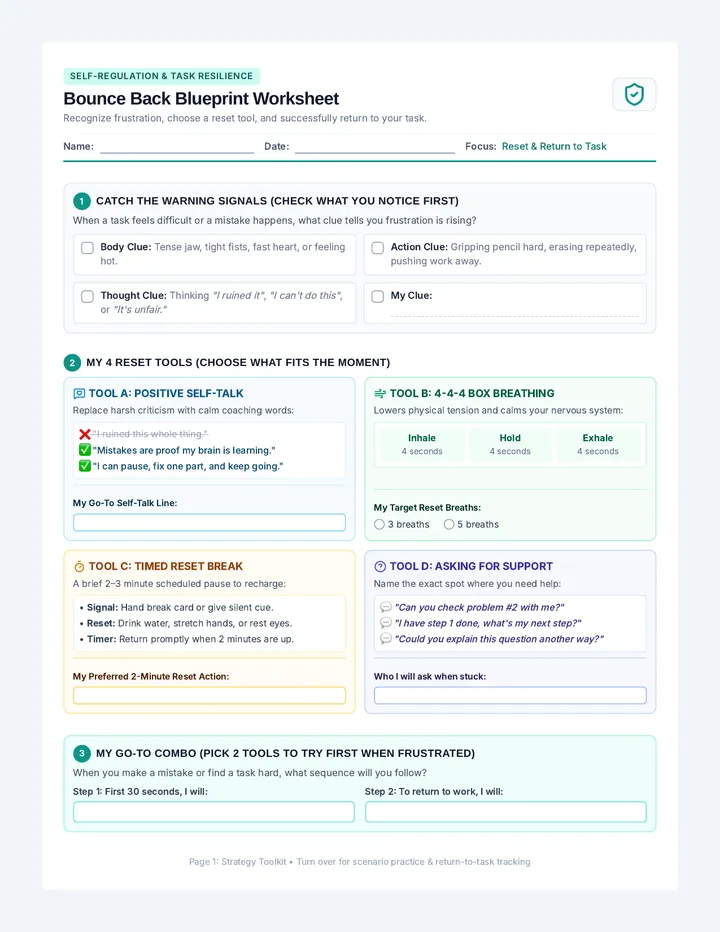
INHALE (4 sec)
HOLD (4 sec)
EXHALE (4 sec)
HOLD (4 sec)
Let's try it 3 times as a group!
Toolkit Assembly
Engineers don't use every tool for every job. Pick the 4 BEST TOOLS that work for YOUR brain.
Open your Toolkit Parts Sheet now
Toolkit Parts Sheet Personal Toolkit
Component Fabrication & Assembly Blueprint
Cut & Glue Unit
ENGINEER: ___________
Toolkit Parts
Deep Breathing
Muscle Squeeze
Wall Push
Self-Talk
Counting
Safe Place
Cold Water
Fidget Tool
Calm Music
Ask for Help
"Pick your 4 best tools. Cut them out and glue them onto the blueprint!"
Assembly Slots
01
Paste Here
02
Paste Here
03
Paste Here
04
Paste Here
Component Fabrication Unit
Rev: 02.C (Optimized Single Page)
Cooling System Home Brief Home Connection
Week 2 Report
EMOTION ENGINEERS
This week, our engineers focused on building their Cool Down Toolkits. We explored different ways to lower our "emotional temperature" before our systems overheat.
The Cooling System
Your student selected several strategies that work best for them. These might include deep breathing, positive self-talk, sensory tools, or taking a short break. Ask them to show you their "Blueprint" from today's session!
Try this together:
Square Breathing
Inhale for 4 seconds, hold for 4, exhale for 4, hold for 4. Practice this when things are calm so it's easier to use when things get stressful.
Identify the Tools
Ask your student: "Which tool in your kit would be best to use if you feel frustrated with your homework?"
Next Phase: The Big Freeze
Next week, we will focus on impulse control and the "Power of the Pause."
Engineering Emotional Success Together
Big Freeze Facilitator Guide Facilitator Guide
Week 3: The Big Freeze
Emotion Engineers
Objective
Students will practice the "Power of the Pause"—stopping their automatic reaction to allow their "Cool Down Toolkit" to activate.
Time
45 - 50 Minutes
Materials
Big Freeze Slides
Freeze-Frame Game Cards (Separate Printable)
Buzzer or Bell (optional)
1. System Boot-Up (5 min)
Recap: Remind students of their "Toolkit Parts." Ask: "Has anyone used a cooling tool this week?"
The Challenge: "Sometimes we forget to use our tools because our bodies react too fast. Today we are installing a 'Pause Button' in our system."
2. The Big Freeze: Stopping Impulse (15 min)
Metaphor: Use the slides to explain the "Buffer" or "Freeze" state. When we feel a trigger, we have about 3 seconds to choose our reaction before our "autopilot" takes over.
Modeling: Demonstrate a scenario (someone knocks over your pencils). Model the "Impulse" (yelling) vs. the "Pause" (closing eyes, counting to 3, then asking for help).
3. Field Test: Freeze-Frame Game (20 min)
The Game: Use the separate printable "Freeze-Frame Game Cards." Read a scenario. When you say "FREEZE!", students must hold perfectly still and think of a tool from their kit they would use in that situation.
Additional Scenarios for verbal use:
Someone calls you a mean name.
You are the last one chosen for a team.
A teacher gives you a grade you think is unfair.
4. System Update Summary (5 min)
Reflection: Why is it harder to 'pause' when we are at recess vs. in the classroom?
Take-Home: Distribute the "Pause Power Home Brief."
Engineering Impulse Control
Wait Time
Impulse control is physically demanding for children's brains. Be patient with the 'Pause'—it's a muscle that needs heavy lifting practice.
In-The-Moment
If a conflict arises during the group, use it as a "Live System Test." Call for a group "Pause" to evaluate the triggers and body signals together.
Notes & Observations Big Freeze Slides Emotion Engineers
Phase 3: The Big Freeze
Installing the System Pause Button
The Reaction Cycle
Immediate Reaction
Without a pause, TRIGGERS lead directly to BLASTS.
The Power of the Pause
The PAUSE is a tiny bit of space between a feeling and an action.
1
Freeze your body
2
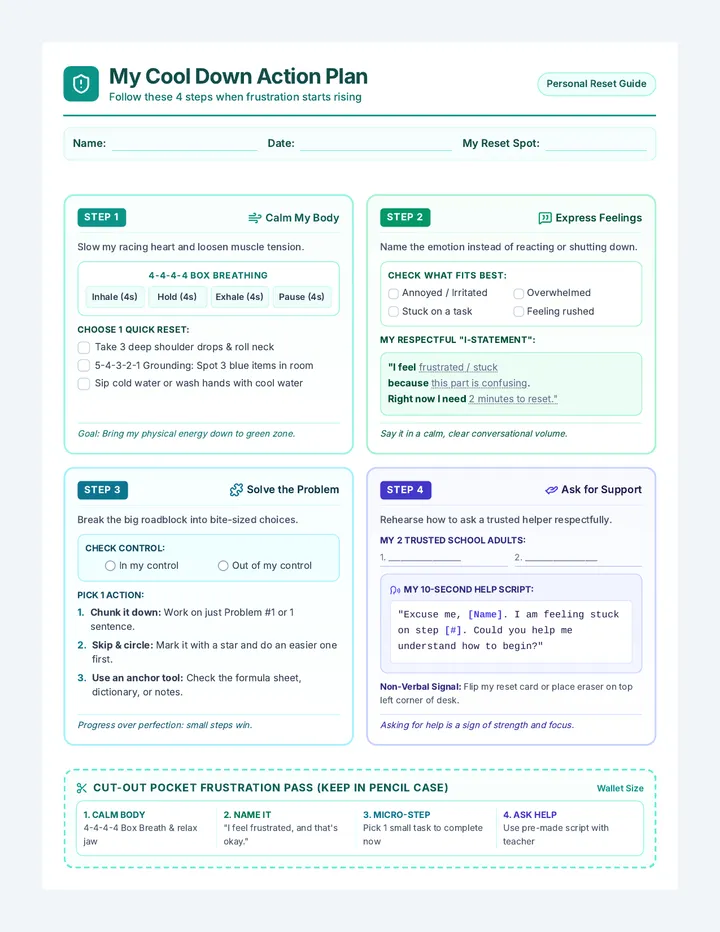
Label the feeling ("I am frustrated")
3
Pick a tool from your kit
PAUSE
Simulation: Freeze Frame
How to Play
Listen to the "System Trigger"
When you hear FREEZE! you must stop all movement.
Visualize yourself hitting the "Pause Button."
Share which tool you'd use.
Stand Up & Prepare For Field Tests
Your Weekly Mission
"Can you catch one 'Impulse' this week and freeze it for 3 seconds before you react?"
Pause Power: Activated
Freeze Frame Game Cards Freeze Frame
System Stress Simulations
Instructions: Cut cards. Leader reads trigger, students "Freeze," then share a strategy.
Sim #01
The Playground Push
Someone pushes you while you're taking a basketball shot.
Freeze!
Sim #02
The Math Glitch
You realize you did a whole math page wrong and have to erase.
Freeze!
Sim #03
The Tablet Time
Your parent takes your device in the middle of a winning level.
Freeze!
Sim #04
The Rumor Virus
You walk into lunch and see a group whispering about you.
Freeze!
Sim #05
The Marker Grab
Someone grabs your favorite marker while you're still using it.
Freeze!
Sim #06
The No-Prize Rule
The teacher says you don't get a prize because of a rule.
Freeze!
Sim #07
The Line Cutter
You've been waiting for a drink and someone cuts in front.
Freeze!
Sim #08
The Game Loser
You lose a game and the other player brags about it.
Freeze!
Cut along solid lines
Field Testing Protocol v3.4
Pause Power Home Brief Home Connection
Week 3 Report
EMOTION ENGINEERS
This week, we focused on the most important part of emotional regulation: The Power of the Pause. We are learning to stop our automatic reactions before they become outbursts.
The Pause Button
In group, we discussed how there is a small window of time (about 3 seconds) after a trigger where we can choose how to react. We call this "hitting the pause button." Once we pause, we can use the tools in our toolkit.
Support The Pause:
The "Freeze" Cue
If you see your student getting frustrated, try calmly saying, "Let's take a 3-second freeze." This gives them permission to stop and think.
Model the Pause
When you are frustrated (like in traffic or with chores), say out loud: "I'm feeling frustrated, so I'm going to hit my pause button for a second before I speak."
Final Phase: Team Resilience
Next week is our final session! We will focus on social problem solving and celebrate our graduation as certified Emotion Engineers.
Engineering Emotional Success Together
Team Resilience Facilitator Guide Facilitator Guide
Week 4: Team Resilience
Emotion Engineers
Objective
Students will apply their regulation skills to conflict resolution and celebrate their growth as a team.
Time
45 - 50 Minutes
Materials
Team Resilience Slides
Blueprint for Peace Worksheet
Diplomas
Snacks/Treats (optional)
1. Master Engineer Review (5 min)
Recap: Review the 3 steps learned so far: Detect signals, Pause the system, and use a Cooling Tool.
The Final Step: "Engineers don't just fix machines; they fix systems where people work together. Today is about resolving conflicts peacefully."
2. System Maintenance: Conflict Resolution (15 min)
The Blueprint: Use the slides to introduce the "I-Statement" as a technical tool for communication.
"I feel [emotion] when [trigger], I need [request]."
Practice: Distribute the "Blueprint for Peace" worksheet. Have students draft I-statements for common scenarios.
3. Certification Ceremony (20 min)
Reflection: Go around the circle. Each student shares one "system update" they've made over the last 4 weeks (e.g., "I'm better at catching my hot face signal").
Presentation: Call each student up individually. Present them with their "Emotion Engineer Diploma." Allow the group to clap for each graduate.
4. Final System Logout (5 min)
Encouragement: "The group is ending, but you carry your toolkit with you everywhere. Stay regulated, Engineers!"
Final Maintenance
Ongoing Support
Make sure teachers know which students graduated. Provide them with a copy of the "Toolkit" terminology so they can use the same language in the classroom.
Follow Up
Schedule a 1-on-1 "System Check" in two weeks with any students who might need extra reinforcement of these skills.
Team Resilience Slides Emotion Engineers
Phase 4: Team Resilience
Final System Integration & Graduation
Social Maintenance
Sometimes, our systems clash with other people's systems. This is called Conflict.
To fix a conflict, we need a special communication tool: the I-Statement.
"Blaming others is like trying to fix a machine by hitting it with a hammer. It just breaks more things!"
The I-Statement Component
I FEEL...
[Name your emotion]
WHEN...
[Describe the trigger situation]
I NEED...
[State a clear, respectful request]
"Example: I feel frustrated when you take my pencil without asking. I need you to ask first."
Graduation Ceremony
You have successfully completed all 4 levels of training. You are now an officially certified EMOTION ENGINEER.
Alert Signals
Cooling Kit
Pause Power
Peace Tools
Blueprint for Peace Worksheet Final Phase Blueprint
Blueprint for Peace
Conflict Resolution Schematic
Name:
Date:
Conflict is a system glitch. Use your I-Statement tool to fix the problem without breaking the relationship!
The I-Statement Assembly Line
I FEEL
WHEN
I NEED
Field Test A:
Someone is kicking the back of your chair in class and won't stop.
Field Test B:
Your friend promised to play with you, but they started playing with someone else.
Office of Social-Emotional Learning
Project Code: BRAVO-PEACE
Form Rev: 04.B (One-Page Fix)
Emotion Engineer Diploma Certificate Certification of Achievement
Emotion Engineer
This certifies that
has successfully completed all 4 phases of emotional systems training, mastering body signals, cooling tools, impulse control, and conflict resolution.
Chief Facilitator
Date of Certification