Stress Signal Slides Anatomy of Panic
Identifying the physical signals of a crisis before the emotional wave takes over.
Crisis Survival Sequence: Lesson 1
🌡️
🫁
The Essential Question
"How can we train our bodies to automatically default to effective coping strategies under pressure?"
The Goal
Build muscle memory so you don't have to "think" when your brain is offline.
The Metric
Reduce reaction time between the trigger and the TIPP skill.
What is TIPP?
T
Temperature
Cold water or ice to trigger the Dive Reflex.
I
Intense Exercise
Burn off stored physical energy fast.
P
Paced Breathing
Slow down the exhale to calm the system.
P
Paired Muscle Relaxation
Tense and release to communicate "Safety."
The Crisis Arc
Most people wait until they are at 100% Distress to use skills.
!
By then, the logical brain has shut down.
✓
The goal is to spot the Physical Signals at 40-60%.
100: PEAK
75: THE WAVE
50: SIGNALS START
25: BASELINE
Distress Level
Freeze Frame
In a moment, we will begin a role-play. When I shout FREEZE, your only job is to scan your body for the physical signals of stress.
The Script
"You just found out you have a presentation... in 5 minutes."
The Script
"A friend just sent a text that sounds very angry with you."
The Script
"You are stuck in heavy traffic and are already late for a job interview."
Signal Recognition
Chest & Heart
Racing beat, tightness, shallow breaths.
Hands & Limbs
Shaking, cold palms, tensed shoulders.
Head & Face
Clenched jaw, buzzing ears, tunnel vision.
Temperature
Feeling "hot" in the face, sweating.
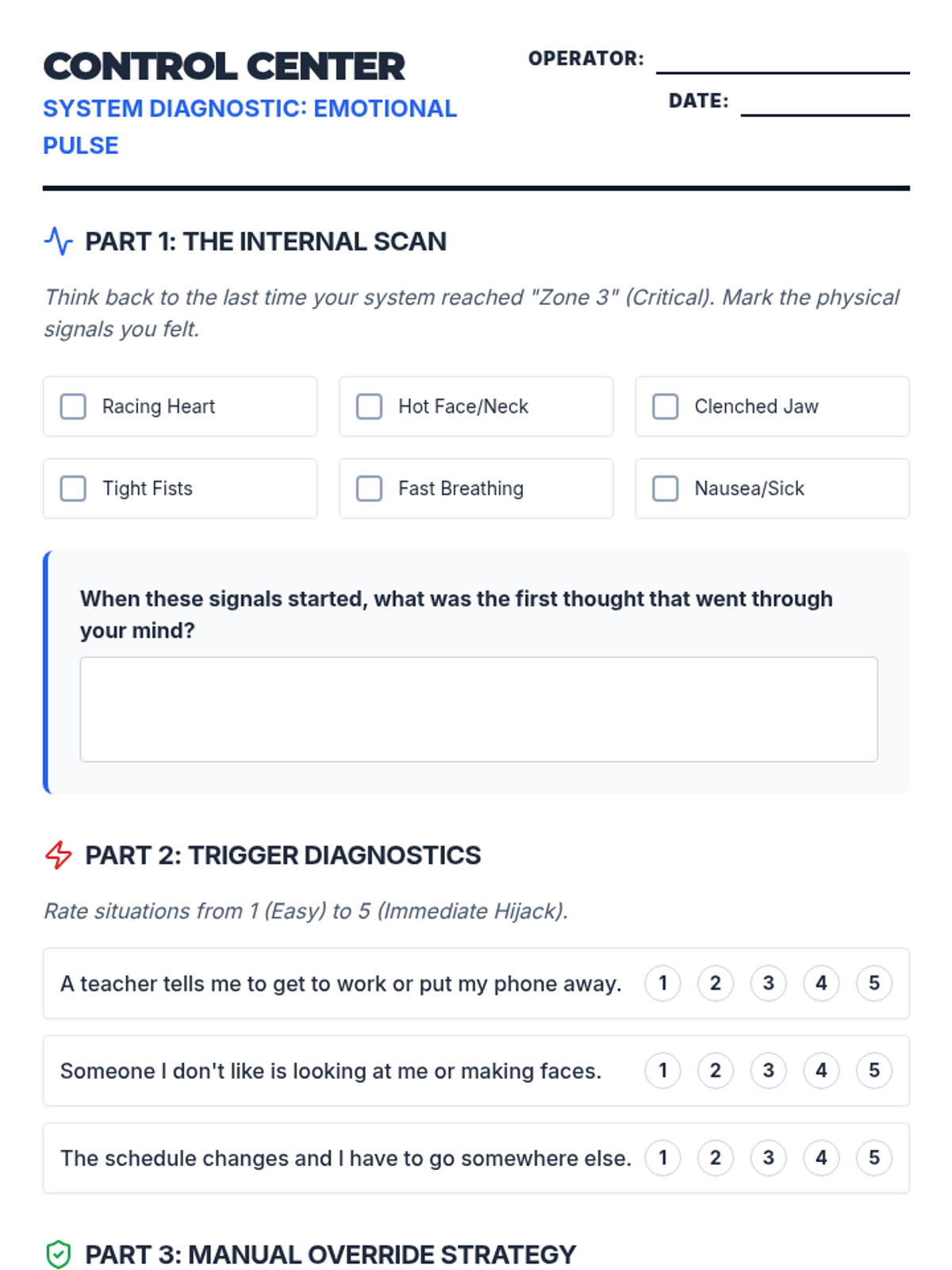
Panic Mapping Worksheet Stress Signal Map
Crisis Survival Lab // Lesson 01
Name: __________________________
Date: ___________________________
The Goal
A crisis doesn't start in your head; it starts in your body. To survive a crisis, you must learn to read your body's "Early Warning System." Use this sheet during our role-plays to map where you feel stress and which TIPP skill targets that specific feeling.
Tense Shoulders?
Jaw Clenched?
Shaking Hands?
1. The Physical Trigger
What was the role-play scenario?
2. Somatic Inventory
Mark the sensations you felt (circle all that apply):
Heart Racing
Hot Face
Shallow Breath
Nausea
Leg Jitter
Tensed Neck
3. The TIPP Selection
Based on these sensations, which skill feels most relevant?
TEMP
EXERCISE
BREATH
MUSCLE
Signal Threshold Analysis
At what point on a scale of 1-10 (10 being a total meltdown) did you first notice your body changing during the role-play? Explain the sensation.
1: Calm 5: Alert 10: Crisis
Freeze Frame Guide Freeze Frame: Facilitation Guide
Teacher Resource // Lesson 01 Facilitation
Objective
Students will move from intellectualizing stress to feeling it in a controlled environment, identifying their unique somatic "early warning" signals.
Key Term
Somatic Awareness: The ability to perceive and interpret signals from within the body.
1
The Setup (5 mins)
Ask students to stand and find a "stage partner." Explain that they aren't trying to "solve" the stress in these scenes—they are just trying to *inhabit* it.
Teacher Tip: Keep the energy high. Don't let the scenes go on too long (30-60 seconds max before the freeze).
2
The Scenarios (15 mins)
Scene A: The Mistake
"You just accidentally sent a very mean text about your partner... TO your partner. They are looking at their phone right now."
Scene B: The Cold Call
"You are in a college interview for your dream school. The interviewer asks you a question in a language you don't speak, expecting you to know it."
3
The "Freeze" Instruction (20 mins)
When you shout "FREEZE" , give these specific prompts:
"Without moving a muscle, scan from your toes to your head."
"Where is the heat? Where is the tension?"
"How is your stomach behaving? What about your jaw?"
"Hold that sensation. Now, look at your partner. Can you see their signals?"
4
Debrief Questions (10 mins)
"Which signal was the loudest? The racing heart or the tensed muscles?"
"Did anyone feel the 'brain fog'? Describe what that felt like physically."
"If we ignored these signals, what would happen in 5 minutes? 10 minutes?"
Lab Protocol Slides Authorized Personnel Only
Simulation Lab
Mastering Temperature & Intense Exercise
Temperature
Intense Exercise
The Mammalian Dive Reflex
When we are in Peak Distress (Level 8-10), words don't work. We need to "hack" the nervous system directly.
The Bio-Hack
Cold water triggers the brain to think you are underwater. It forces your heart rate to drop instantly.
120 BPM
Normal Distress
Station 1
Temperature
🧊
The Protocol:
1
Submerge eyes/nose in cold water (bowl) OR use an ice pack on cheeks.
2
Hold breath for 15–30 seconds .
3
Safety Note: Keep water temp around 50°F (10°C). Not for those with heart conditions.
Station 2
Intense Exercise
🏃
The Protocol:
1
60 Seconds of maximum output.
2
Wall sits, burpees, sprinting in place, or star jumps.
3
Exhaust the physical energy so the Emotional Wave has nowhere to go.
Emergency Deployment
When the siren sounds, you have 5 SECONDS to begin your assigned station protocol.
"Thinking is the enemy of survival. Moving is the ally of survival."
Simulation Lab Report T & I Simulation Lab Report
SUBJECT RESPONSE LOG // SESSION 02
LOG ID: TIPP-S2-LAB
NAME: __________________________
STATION A: TEMPERATURE
DATE: ___________________________
STATION B: INTENSE EXERCISE
T
Station 1: Temperature Challenge
Subject Physical State (Pre-Skill)
Method Used
Ice Pack
Cold Water
Other
Immediate Physiological Response
I
Station 2: Intense Exercise Burst
Exercise Selected
Duration (Secs)
Sensory Observation (Post-Skill)
Describe the feeling in the chest, limbs, and head after the burst.
Overcoming Inertia
During a real crisis, why is it harder to move your body to a sink or start doing jumping jacks than it was in this classroom today?
Strategy for "The Real World":
Lab Setup Guide The "Fire Drill" Facilitator
Teacher Resource // Lesson 02 Implementation
Active Learning
Station 1: The Cold Reset
• Materials: 4-5 plastic bowls, cold water, ice cubes, paper towels, OR multiple reusable ice packs kept in a cooler.
• Safety: Ensure floor stays dry. Provide a "Splash Zone" boundary.
• Alternative: Using cold metal objects or frozen water bottles on the face.
Station 2: The Energy Burn
• Space: Clear desks to the periphery. Ensure 4ft of space per student.
• Materials: A visible timer (projected) or a loud whistle/siren sound effect.
• Accessibility: Offer "Seated Star Jumps" or "Wall Pushes" for varying physical needs.
Core Activity: The Drill
Phase 1: Controlled Application
Students rotate through stations. Spend 5 minutes at each station where they practice the skill in a calm state. This builds the procedural memory of *how* to do the skill correctly.
Phase 2: The "Crisis" Siren
Once students are back at their desks (or in between rotations), play a loud siren sound or shout "CRISIS PROTOCOL ACTIVATED!" .
"Students must immediately—within 5 seconds—drop whatever they are doing and perform their assigned T or I skill for exactly 60 seconds without hesitation or question."
Debriefing the Inertia
Prompt 1: The Resistance
"Who felt like they wanted to laugh or stop because it felt 'silly'? That feeling is the first wall you'll hit in a real crisis. How did you push through it?"
Prompt 2: The Aftermath
"Right now, focus on your hands. Are they tensing or relaxing? Is your head 'quieter'? That quietness is the goal of T and I."
[ ] WATER REFILLS [ ] TOWEL SUPPLY [ ] SAFETY CLEARANCE
TIPP SEQUENCE // LESSON 02
Co-regulation Slides De-escalation Dyads
Mastering Paced Breathing & Paired Muscle Relaxation
Teamwork
Co-Regulation
The Power of the Dyad
In a crisis, we often lose the ability to self-coach. We need another person to serve as our External Prefrontal Cortex.
Co-Regulation
The process by which one person’s nervous system calms another person’s nervous system.
"Mirror Neurons" mean my calm can become your calm.
External voice = Internal direction.
P1
Paced Breathing
The 4-6 Ratio
• Inhale: 4 Seconds
• Exhale: 6 Seconds
"The long exhale signals the Vagus Nerve to slow the heart."
Exhale
Focus
P2
Paired Muscle Relaxation
Tense & Release
• Tense: 5-10 Seconds (Tight!)
• Relax: 20-30 Seconds (Heavy...)
"Notice the difference between tension and relaxation."
Step 1: Fists and Arms
Step 2: Face and Jaw
Step 3: Shoulders and Back
Co-Pilot Mode
One student will be the "Distressed Navigator" (feeling 6/10 stress).
The other will be the "Grounding Anchor" .
SYNCHRONIZE SYSTEMS
Anchor Practice Guide The Anchor Guide
Co-Regulation Protocol // Lesson 03
Dyad Practice
"Be the calm you want to see."
Role A: The Navigator
Instructions:
Close your eyes and imagine a stressful social situation. Focus on the physical signals (tight chest, heat). Your job is to follow the instructions of your partner without trying to "do it right."
Role B: The Anchor
Instructions:
Your job is to guide your partner using the scripts below. Speak in a low, steady, and rhythmic voice. Match your own breathing to what you want them to do.
Skill: Paced Breathing Ratio: 4-in, 6-out
"I want you to place one hand on your belly. Breathe into my hand... 1... 2... 3... 4. Good. Now, slowly exhale... push the air out... 1... 2... 3... 4... 5... 6. Keep that pace. With every exhale, feel your shoulders drop away from your ears."
Observation Log (Navigator)
How did the 6-second exhale feel compared to normal breathing?
Skill: Paired Muscle Relaxation Focus: Tense-Release
"Tighten your fists. Squeeze them as hard as you can. Hold it... feel the tension in your forearms... 3... 2... 1... and RELAX. Let them go totally limp. Notice the feeling of blood flowing back into your hands. Let that heaviness spread up your arms."
Observation Log (Anchor)
Did your partner actually relax their muscles? How could you tell?
Post-Mission Debrief
To be discussed and answered together:
WHAT WAS THE HARDEST PART OF GUIDING SOMEONE ELSE?
WHAT WAS THE MOST EFFECTIVE CUE THE ANCHOR GAVE?
Dyad Coaching Scripts Teacher Resource Co-Regulation Dyad Scripts
Teacher Resource // Lesson 03 Coaching
Why Dyads?
"When we teach others, we learn twice." By requiring students to vocalize the TIPP instructions, they are internalizing the pacing and logic of the skills. This turns a passive exercise into an active leadership skill.
1. Coaching "The Anchor" on Paced Breathing
Encourage students to use these specific modifiers:
TONE OF VOICE
"Anchor, your voice should be like a heavy blanket. Don't rush. If they are breathing too fast, slow down your own count."
THE 4-6 RATIO
"Remind them that the exhale is the 'Brake Pedal' for the heart. Make sure they are counting for the full 6 seconds."
2. Coaching "The Anchor" on Muscle Relaxation
Direct students to focus on the 'Transition' moments:
SENSORY CUES
"Tell your partner exactly what to feel. Use words like: Heavy. Warm. Melting. Loose. Floppy. Stilled."
THE CONTRAST
"Ensure they stay in the 'tense' phase for long enough to feel the discomfort, so the 'release' phase feels like a massive relief."
Managing the "Switch"
The most critical part of this lesson is when students swap roles. Many will feel embarrassed or "done" after the first round.
Protocol:
Signal the end of Round 1 with a low chime (not a loud alarm).
Give 60 seconds of "Silent Transition" (No talking, just switching positions).
Reset the room with a collective deep breath before Round 2.
[ CO-REGULATION // DYAD SCRIPTS // 10TH GRADE TIPP SEQUENCE ]
Real World TIPP Slides Environment Readiness
The Obstacle
Course
Adapting TIPP skills for the messy, public, and inconvenient Real World .
Fantasy vs. Reality
The Fantasy
"You are in a quiet room with pillows, dim lights, and an ice pack ready."
Easy Practice
The Reality
"You are on a crowded bus, in the middle of a test, or at a family dinner."
Survival Mode
Top 3 Barriers to TIPP
Visibility
"People will think I'm weird if I start doing burpees in the cafeteria."
Resources
"I don't have a bowl of ice water in my pocket."
Brain Fog
"I am so upset that I can't even remember what TIPP stands for."
The "Adaptation" Playbook
Temperature
Splash face in a restroom or press a cold soda can against your temples.
Exercise
Climb stairs rapidly or do "isometric pushes" against your own desk.
Breathing
Trace the edges of your phone (Box Breath) or focus on the feeling of your feet on the floor.
Relaxation
Grip the edges of your chair and release, or tense your toes inside your shoes.
Draw Your Barrier
"In a moment, you will receive a scenario where TIPP feels impossible. You have 2 minutes to design a 'Stealth Mode' version of that skill."
Stealth Mode Activated
Barrier Buster Worksheet Barrier Buster Cards
Obstacle Course Adaptation // Lesson 04
The Mission:
Skills are only useful if they work when you are miserable. Below are four common barriers. For each one, brainstorm a "Stealth Mode" or "Resource-Light" version of a TIPP skill.
Barrier 01: The Fishbowl
Scenario:
"You are in a crowded cafeteria and feeling 8/10 distress. You don't want anyone to notice you are using a skill."
Your "Stealth" Adaptation:
Barrier 02: The Lock-In
Scenario:
"You are in the middle of a 2-hour final exam. You cannot leave your seat. Your brain has gone completely blank from anxiety."
Your "Stationary" Adaptation:
Barrier 03: The Desert
Scenario:
"You are outside, away from home, and have no access to ice, water, or a private room. You need 'Temperature' now."
Your "Resourceful" Hack:
Barrier 04: The Crossfire
Scenario:
"You are in a heated argument with your family. Everyone is yelling. You feel the urge to explode or run away."
Your "In-The-Moment" Skill:
NAME: ___________________________
DATE: ___________________________
Obstacle Course Facilitation Guide Obstacle Course Facilitation
Teacher Resource // Lesson 04 Facilitation
The Objective
"Survival is about adaptability." In this lesson, we move from the clinical practice of the skills to the messy implementation. Students must defend their choices of adaptation to their peers.
1
Case Study Deep-Dive (15 mins)
Present the Barrier Cards. Ask students: "Why would doing a cold-water splash in Barrier 01 be difficult socially?"
Example Adaptation: "For Barrier 01, instead of a full sink splash, I could go to the bathroom and hold a wet paper towel against my face for 30 seconds."
2
The "Stealth Mode" Challenge (20 mins)
Challenge students to demonstrate a TIPP skill while walking across the room or talking to a partner, without the other person knowing they are using it.
Paced Breathing: Do it while nodding and listening to a story.
Paired Muscle Relaxation: Focus only on the toes and calves during a conversation.
Intense Exercise: Clench every muscle in the core and hold while sitting at a desk.
3
The Reality Check (10 mins)
Debrief Questions:
"Is a 50% effective TIPP skill better than a 0% skill?" (Yes—perfection is the enemy of survival).
"What is one 'Stealth TIPP' you could commit to using this week?"
LESSON 04 Facilitation Guide TIPP CRISIS SEQUENCE
Crisis Arc Capstone Slides Mission Briefing
The Crisis Arc
Final Capstone Simulation: Prove you can survive the wave.
Mastery Level
The Simulation Anatomy
01: The Trigger
The stressor is introduced. The arc begins. Watch for your physical signals.
1
02: The Peak
Maximum distress (Level 8-10). Total system overload. Deploy T and I skills immediately.
2
03: The Baseline
De-escalation begins. Use P and P to anchor back into reality and safety.
3
Choose Your Adventure
Option A: The Performance
"You are backstage. The lights go up in 30 seconds. You have forgotten every word of your speech. Your heart is an engine."
Option B: The Confrontation
"You just walked into a room and heard your best friend saying something devastating about you. They see you. The room goes silent."
The class will vote on the "Path" in real-time.
Rules of Engagement
1
Authenticity: Commit to the physical state of the scenario.
2
Responsiveness: You have 5 seconds to act when the peak hits.
3
Sequencing: Use T/I first, then P/P. Order matters.
Survival Complete
"The crisis is over. You are at baseline. You did not explode. You did not shut down. You survived the arc."
Next: Final Peer Evaluation
Crisis Arc Survival Log Crisis Arc Survival Log
CAPSTONE ASSESSMENT // FINAL MASTERY MISSION
STATUS: ACTIVE
SURVIVOR: __________________________
CHOSEN SCENARIO: ___________________
1
Phase 01: The Trigger Detection
Describe the very first physical sensation you felt when the "Crisis" was introduced.
2
Phase 02: Peak Survival (8-10 Distress)
Skill Deployed:
Temperature
Exercise
Why was this the correct choice for this peak?
Latency (Reaction Time):
______ SECS
3
Phase 03: Return to Baseline
Identify the Paced Breathing or Muscle Relaxation cue that finally "anchored" you back.
Mission Mastery Reflection
THE BARRIER ENCOUNTERED:
What unexpected difficulty happened during the role-play?
THE MUSCLE MEMORY VERDICT:
How much did you have to "think" versus just "act"?
Capstone Evaluation Rubric Teacher Guide Capstone Evaluation Rubric
Teacher Resource // Lesson 05 Assessment
Mastery Level
Criteria Developing (1-2) Proficient (3-4) Mastery (5) Signal Recognition Misses the trigger; waits for peak to acknowledge distress. Identifies somatic signals but hesitates to name them. Instantly identifies and vocalizes specific body changes at the trigger. Skill Deployment Requires multiple prompts to choose a skill; execution is disjointed. Deploys T or I skill within 10-15 seconds of peak. Proper form. Zero-hesitation deployment of T or I within 5 seconds of peak. Clear muscle memory. Sequencing (T/I to P/P) Attempts breathing while still in peak crisis; order is reversed. Transitions to P or P once heart rate begins to stabilize. Perfect transition: Bio-hack (T/I) followed immediately by grounding (P/P). Barrier Adaptation Becomes "stuck" when a barrier is introduced; stops skill. Adjusts skill to fit barrier after brief pause or reflection. Fluid adaptation. Uses "Stealth Mode" or resource hack without breaking focus.
Simulation Master Control
THE TRIGGER INJECT:
"While Subject A is role-playing, walk up and whisper: 'Wait, I just checked the schedule... the presentation is actually RIGHT NOW. The teacher is calling your name.'"
THE PEAK ESCALATION:
"Slam your hand on a desk or play a loud 'Phone Ringing' sound. Shout: 'THE WAVE IS HERE! LEVEL 10!'"
THE BARRIER TWIST:
"As they start their skill, announce: 'Wait, the principal just walked in! You have to hide what you are doing!'"
TOTAL SCORE: ________ / 20
10TH GRADE TIPP SEQUENCE // CAPSTONE