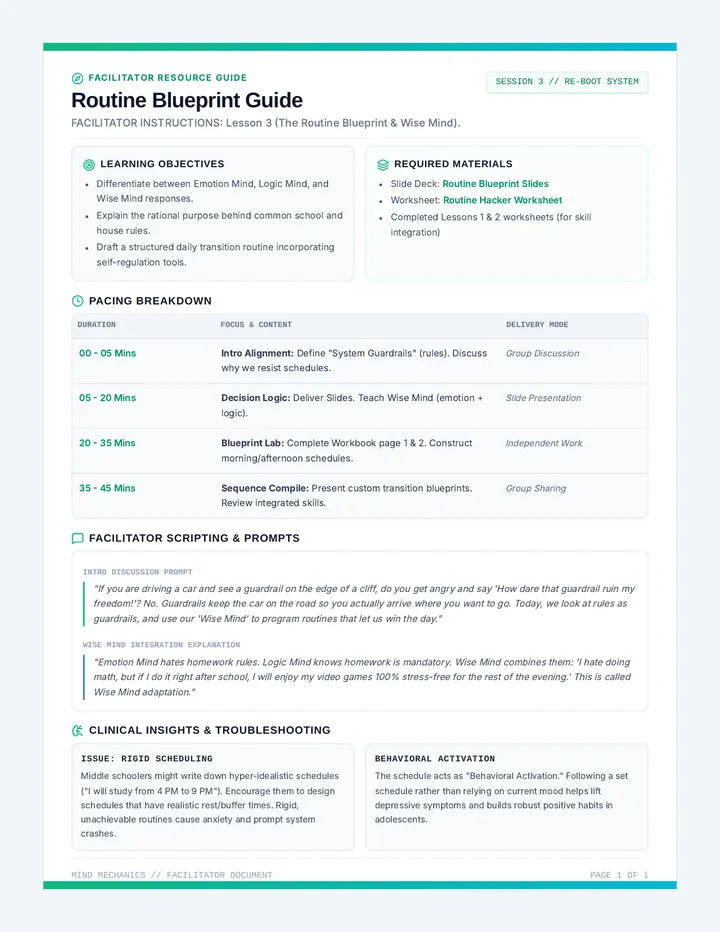
The Hiring Filter Slides The Hiring Filter
Lesson 1: The Manager's Lens
The 6-Second Reality
On average, a recruiter spends 6 to 7 seconds on an initial screen of a resume and cover letter.
"We aren't reading for details yet. We are looking for a reason to keep reading—or a reason to stop."
75%
Percentage of applications rejected by ATS or initial screen before reaching a human hiring manager.
The Decision Matrix: Three Piles
The "Toss"
Typos or formatting gore
Generic "To Whom it May Concern"
Clearly unresearched
The "Maybe"
Qualifications match, but unremarkable
Passive tone
Repetitive of the resume
The "Interview"
Tailored value proposition
Cultural/Mission alignment
Narrative flow & clarity
Activity: The 6-Second Sift
1
Take the role of a Senior Project Manager at a high-stakes tech firm.
2
You have 5 sample letters. You will see each for exactly 6 seconds.
3
Decide: Toss or Keep.
"What stood out? What felt like a red flag? Don't think—react."
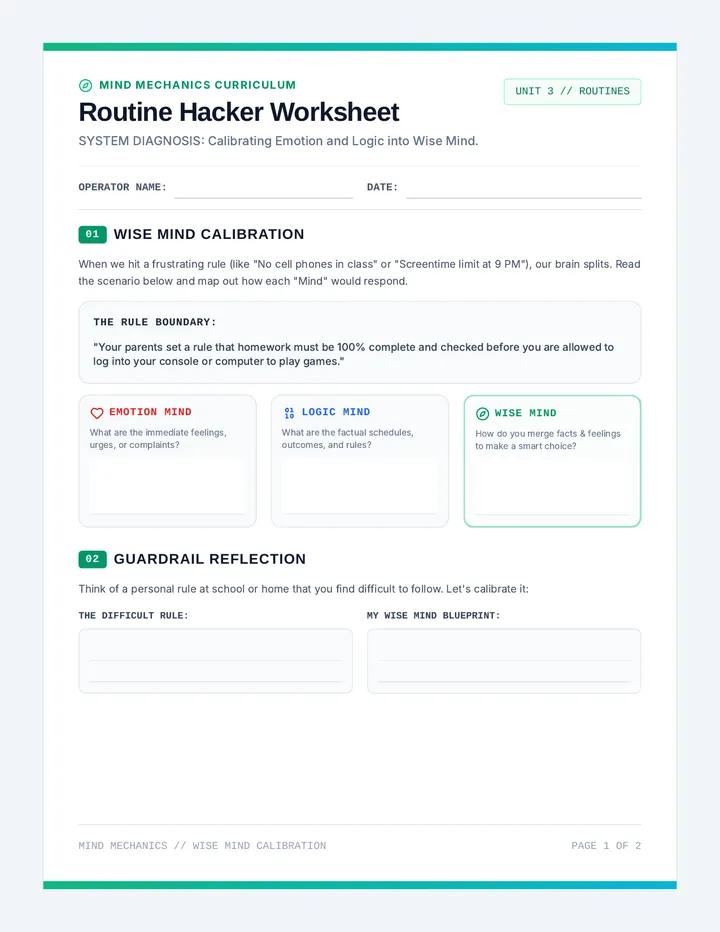
Six Second Sift Worksheet The 6-Second Sift
Graduate Career Workshop // Simulation Sheet
NAME:
DATE:
MISSION BRIEFING
You are the Hiring Manager for Nexus Strategic Consulting . You are hiring for a high-level Project Lead role. You have 200 applications and 15 minutes before your next meeting. You will review each sample for 6 seconds . Mark your gut reaction immediately.
Sample # Decision Primary Reason (Quick Note) Sample 01 KEEP TOSS
| |
| Sample 02 |
KEEP TOSS
| |
| Sample 03 |
KEEP TOSS
| |
| Sample 04 |
KEEP TOSS
| |
| Sample 05 |
KEEP TOSS
| |
The Aftermath Reflection
What was the absolute first thing your eyes landed on in the "Keep" pile?
Identify one "Instant Dealbreaker" you noticed today.
The Professional Filter: Your Internal Rubric
Based on your experience as a manager, define what standard a cover letter must meet to move to the 'Interview' pile.
Category: Structural Integrity
Visual appeal, formatting, flow
Reject (1)
Maybe (3)
Interview (5)
Category: Strategic Value
Tailoring, evidence of impact
Reject (1)
Maybe (3)
Interview (5)
Category: Tone & Professionalism
Vocabulary, confidence, etiquette
Reject (1)
Maybe (3)
Interview (5)
"The quality of your feedback to yourself is limited by the clarity of your standards."
Big Picture Logic Slides Big Picture Logic
Lesson 2: Macro-Editing & Flow
The Skeleton of Persuasion
Macro-editing isn't about commas. It's about architecture.
1
Narrative Arc: Does it move from 'Who I am' to 'What I bring' to 'Why it matters'?
2
Point Efficiency: Does every paragraph have exactly one main thesis?
3
Connective Tissue: Are the transitions between paragraphs logical or forced?
Structural Block A
Structural Block B
Structural Block C
Reverse Outlining: A Stress Test
The goal is to strip the draft down to its bare arguments to see if it still makes sense.
The 1-Sentence Test
"If I remove the fluff, what is the single, unique argument this paragraph is making?"
The Protocol:
Number every paragraph in your current draft.
On a blank sheet, write one sentence summarizing the core claim of that paragraph.
Evaluate the list: Do the points build on each other? Any repetition?
The Paragraph Puzzle
In pairs, you will receive a shuffled cover letter. Your goal is to reassemble it in the most persuasive order.
Watch for:
Signposting (Transition words)
Logical dependencies
Escalating impact
Paragraph 4?
Paragraph 1?
Paragraph 3?
Structural Stress Test Worksheet The Structural Stress Test
Macro-Editing // Reverse Outlining Worksheet
NAME:
Phase 1: The Distillation
Read your current draft. For each paragraph, write one single sentence that captures the primary argument or purpose of that block of text. No fluff, no "I believe," just the core claim.
P1
Core Claim / Narrative Purpose
P2
Core Claim / Narrative Purpose
P3
Core Claim / Narrative Purpose
P4
Core Claim / Narrative Purpose
P5
Core Claim / Narrative Purpose
Phase 2: The Logic Audit
Review your list above. Does this sequence of claims create a compelling, non-repetitive case for your candidacy?
Redundancy Check
Are any two paragraphs basically making the same argument? If so, combine or cut.
The "So What?" Check
Does every claim directly connect back to a specific requirement in the Job Description?
Transitions Check
Do I have clear "pivot" sentences between paragraphs to guide the reader?
Hierarchy Check
Is the most important argument (your "biggest win") buried at the bottom?
The Structural Pivot
"Based on this audit, I will re-order my draft by move paragraph _______ to _______ and removing paragraph _______ because..."
Paragraph Puzzle Cards
Instructor Prep: Print and Cut these blocks for Lesson 2 Activity
Block A
"Beyond my technical proficiency, my approach is rooted in the same collaborative values outlined in your company’s mission statement. During my tenure at [Organization], I spearheaded a cross-functional initiative that bridged the gap between engineering and marketing, resulting in a 15% increase in project velocity. I am eager to bring this same integrative mindset to the Senior Project Lead role at Nexus."
Block B
"Dear Hiring Committee, I am writing to formally express my interest in the Senior Project Lead position at Nexus Strategic Consulting. Having followed your firm’s recent work on the urban infrastructure initiative in Chicago, I am inspired by your commitment to sustainable development and believe my background in scalable logistics makes me an ideal fit for your team."
Block C
"Thank you for your time and consideration of my application. I have attached my resume for your review and look forward to the possibility of discussing how my experience aligns with the strategic goals of Nexus Strategic Consulting in an interview. Please feel free to contact me at your convenience."
Precision Prose Slides worked on helped responsible for things good at maybe passionate really very assisted worked on helped responsible for things good at maybe passionate really very assisted
Precision Prose
Lesson 3: Tone, Diction & Power Verbs
Action & Impact
Passive / Weak
"I was responsible for managing a team of five people and we worked on marketing."
Active / Impactful
"Directed a cross-functional team of five to execute high-impact marketing campaigns."
The "Power Verb" Formula:
[Action Verb] [Specific Task] [Quantifiable Result]
Example: "Orchestrated a data migration project that reduced system latency by 22%."
The Word Funeral
Burying the clichés of mediocrity
"Helped"
Too vague. Did you assist? Lead? Support? Co-author?
Replace with:
Facilitated, Supported, Collaborated on, Expedited
"Passionate"
Overused. Show, don't tell. Let your achievements prove it.
Replace with:
Dedicated to, Focused on, Aligned with, Committed to
"Hard-working"
Subjective and generic. Everyone says this.
Replace with:
Diligent, Tenacious, Systematic, Detail-oriented
Calibration of Tone
The Confidence Gap
"I feel that I would be a good fit..."
↓
"My background in X makes me uniquely qualified to..."
Eliminate Hedging Language (e.g., "I believe," "I think," "I feel," "I might"). Speak with authority about your expertise.
The Expert Voice
Position yourself as a peer or a solution-provider, not just an applicant seeking a favor.
Word Funeral Worksheet The Word Funeral
Micro-Editing // Vocabulary & Tone Activity
NAME:
1. The Cemetery of Clichés
Find these "walking dead" words in your current draft. Circle them. Then, choose a powerful replacement from the list or your own brain to bring your sentence back to life.
Bury: "Worked on"
Upgrade to:
Spearheaded Orchestrated Executed Engineered
Bury: "Responsible for"
Upgrade to:
Directed Managed Administered Supervised
Bury: "Think / Believe"
Upgrade to:
Possess Command Maintain Offer
Bury: "Good at"
Upgrade to:
Expert in Proficient in Mastered Adept at
2. Tone Translation Lab
Translate the following "hedging" sentences into confident, expert-level statements.
"I feel like my graduate studies have helped me learn about project management."
"I was hoping to potentially apply my skills at your company."
"I think I’m a hard worker who is very passionate about this mission."
3. The Power Formula Challenge
Action Verb + Specific Context + Quantifiable Result
Draft your strongest "Impact Sentence" below:
Meticulous Polish Slides Meticulous Polish
Lesson 4: Proofreading & Technical Precision
The Spellcheck Blindspot
Algorithms catch misspellings, but they miss context.
The "Fatal Flaws"
Homophones: Their / There / They're
Correct but Wrong: From / Form, Manager / Manger
Proper Nouns: Misspelling the company name.
Hiring Manager Truth:
"One typo in a cover letter is a mistake. Two typos are a pattern. Three typos and I stop reading. If you aren't careful with your own future, why would you be careful with our clients?"
Hacking the Brain: The Backward Review
Your brain is too good at reading. It "auto-corrects" errors because it knows what you meant to write.
The Technique:
Start with the last sentence.
Read it in isolation. Check for grammar.
Move to the second-to-last sentence.
Repeat until you reach the header.
Breaks Narrative Flow
Forces focus on technicality over meaning.
The Final Technical Sweep
Visual consistency
Are all fonts the same size/style?
Are margins uniform?
Is the date correct?
Contact Accuracy
Is the Recruiter’s name spelled correctly?
Is your phone number right?
Is the email address hyperlinked?
Output Check
File named correctly? (FirstName_LastName_CL)
PDF format (never .docx!)
Working links?
Proofreading Protocol Checklist Technical Proofreading Protocol
Final Polish // Technical Accuracy Checklist
CANDIDATE:
The Rule of Three
Studies show that reading your own work results in missing up to 60% of technical errors. To reach professional grade, you must use at least three distinct proofreading "modes."
Target Precision
100% Zero-Error
01
Mode: The Backward Review (Sentence-Level)
Read the letter from bottom to top, sentence by sentence.
Check: Does every sentence have a clear subject and verb?
Check: Are there any unintentional run-ons or fragments?
02
Mode: The Audio Check (Flow-Level)
Read the letter aloud at a slow pace (or use Text-to-Speech).
Check: Do any sentences feel "clunky" or require a second breath?
Check: Is the tone consistent from start to finish?
03
Mode: The Technical Audit (Data-Level)
Recruiter Name spelled right
Company Name spelled right
Email & Phone are current
Today's Date is accurate
Consistent Font (Size/Face)
Margins (Standard 1")
Peer Review Sign-off
Reviewer Signature:
"I have reviewed this document using the Protocol above and confirm it is free of technical errors."
Certified Polish
Strategic Pitch Slides The Strategic Pitch
Lesson 5: Presentation & Rhetorical Defense
Defending Your Strategy
It's not enough to write a good letter. You must understand why it works.
The Master's Perspective:
"Rhetorical choices are tactical decisions. Every word, every structural move, every tone shift should be a calculated response to the job description."
Your Task:
Present the Target Job (Key challenges/needs).
Present your Cover Letter (The tailored solution).
Explain the Bridge (How your letter directly solves their problems).
The 60-Second Defense Script
The Template
"I tailored this letter for [Company] because they explicitly asked for [Specific Skill/Trait]. My strategic hook in the first paragraph focused on [Achievement] to demonstrate my immediate value. I chose a [Professional/Bold/Collaborative] tone because their culture is [X]. Finally, I structured my evidence around [Specific Problem] to prove I can hit the ground running."
Time Limit: 60 Seconds
Feedback Focus: Strategy Over Content
Mastery Achieved
You have moved from a draft to a professional-grade asset. Revision is not a chore; it is the engine of professional distinction.
0%
Error Rate
100%
Strategic Tailoring
1
New Interview
Rhetorical Defense Form The Rhetorical Defense
Strategic Pitch // Justification Form
NAME:
The Pitch Premise
"Every choice in a cover letter should be a response to a specific need in the job description. In your pitch, you are not just reading your letter; you are explaining your strategy."
01
The Hook Strategy
What is the specific achievement or value proposition used in your opening, and why will it grab this specific manager's attention?
02
Structural Logic
Explain the order of your body paragraphs. Why does the reader need to see [Point A] before they see [Point B]?
03
Tonal Calibration
How did you adjust your vocabulary to match the company culture (e.g., academic, corporate, startup, creative)?
04
The "Ask"
Describe the call-to-action in your conclusion. How does it project confidence without sounding entitled?
Pitch Evaluation Rubric
Peer & Instructor Assessment Tool
Criterion Standard for Excellence Score (1-5) Strategic Alignment Candidate clearly linked their rhetorical choices to 3+ specific needs in the Job Description. Verbal Defense Defense was delivered with confidence, authority, and within the 60-second limit.
|
| Document Polish | The finalized document is 100% free of technical, tonal, or structural flaws. |
|
Final Facilitator Feedback