Zero Budget Case Guide
Personal Finance • Budgeting Case Study
Zero Budget Case Guide
Topic Reference Pay Yourself First
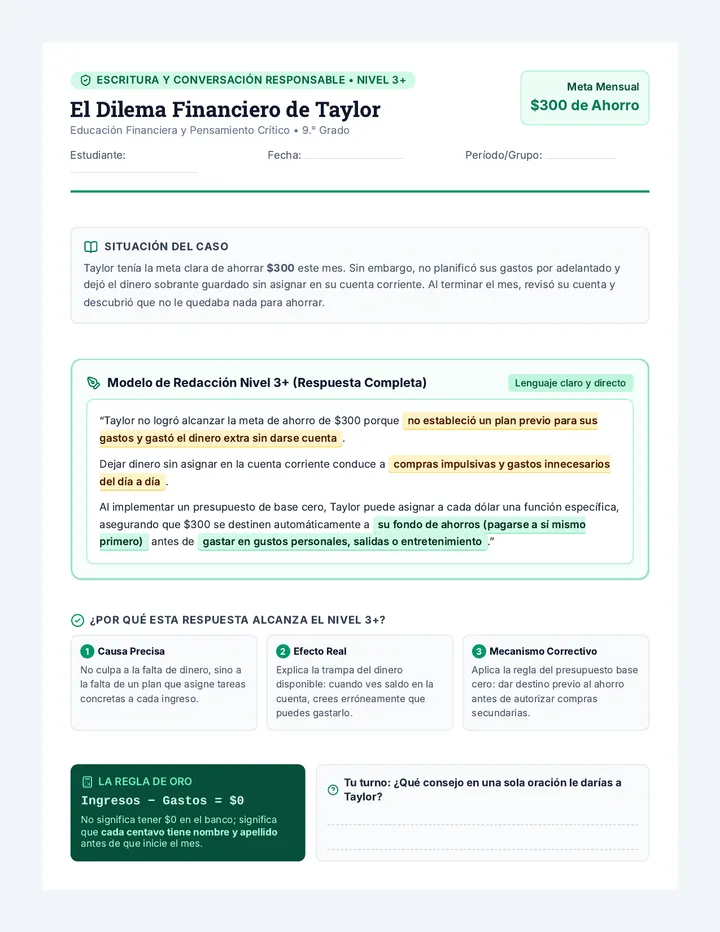
Completed Case Statement
“Taylor failed to achieve the $300 savings goal because untracked impulse spending drained leftover funds . Leaving unassigned money in checking leads to mindless overspending and lifestyle leak . By implementing a Zero-Based Budget, Taylor can give every dollar a specific job, ensuring that $300 is automatically directed to a dedicated savings account before discretionary spending begins .”
Blank 1 Why Taylor Failed: Relying on leftover cash / unplanned spending
Blank 2 The Checking Trap: Frictional spending / lifestyle creep
Blank 3 Destination: High-yield savings / emergency fund
Blank 4 Timing: Before variable non-essential purchases occur
Three Foundational Principles in Action
Give Every Dollar a Job
Income minus all expenses, savings, and investments equals exactly $0. No dollar is left idle in the account.
Pay Yourself First
Savings is treated as a non-negotiable bill due on payday, not an afterthought funded by leftover crumbs.
Friction & Separation
Moving target savings out of checking prevents the psychological illusion that unassigned funds are free to spend.
Cash Flow Strategy: Before vs. After
Taylor's Initial Mistake Reactive
1. Monthly Take-Home Pay $2,400
2. Fixed Expenses Paid -$1,400
3. Unassigned Buffer Left in Checking $1,000
4. Mindless Discretionary Leaks -$1,000
Final Realized Savings: $0
Zero-Based Budget Fix Proactive
1. Monthly Take-Home Pay $2,400
2. Priority 1: Automated Savings -$300
3. Priority 2: Fixed Living Costs -$1,400
4. Priority 3: Allocated Discretionary -$700
Unallocated Checking Balance: $0 (Goal Met)
Behavioral Insight: Parkinson's Law of Money
Spending expands to consume all available liquid cash visible in a checking account. By moving savings immediately into a separate account on payday, Taylor enforces synthetic scarcity—protecting long-term financial goals from day-to-day emotional spending.