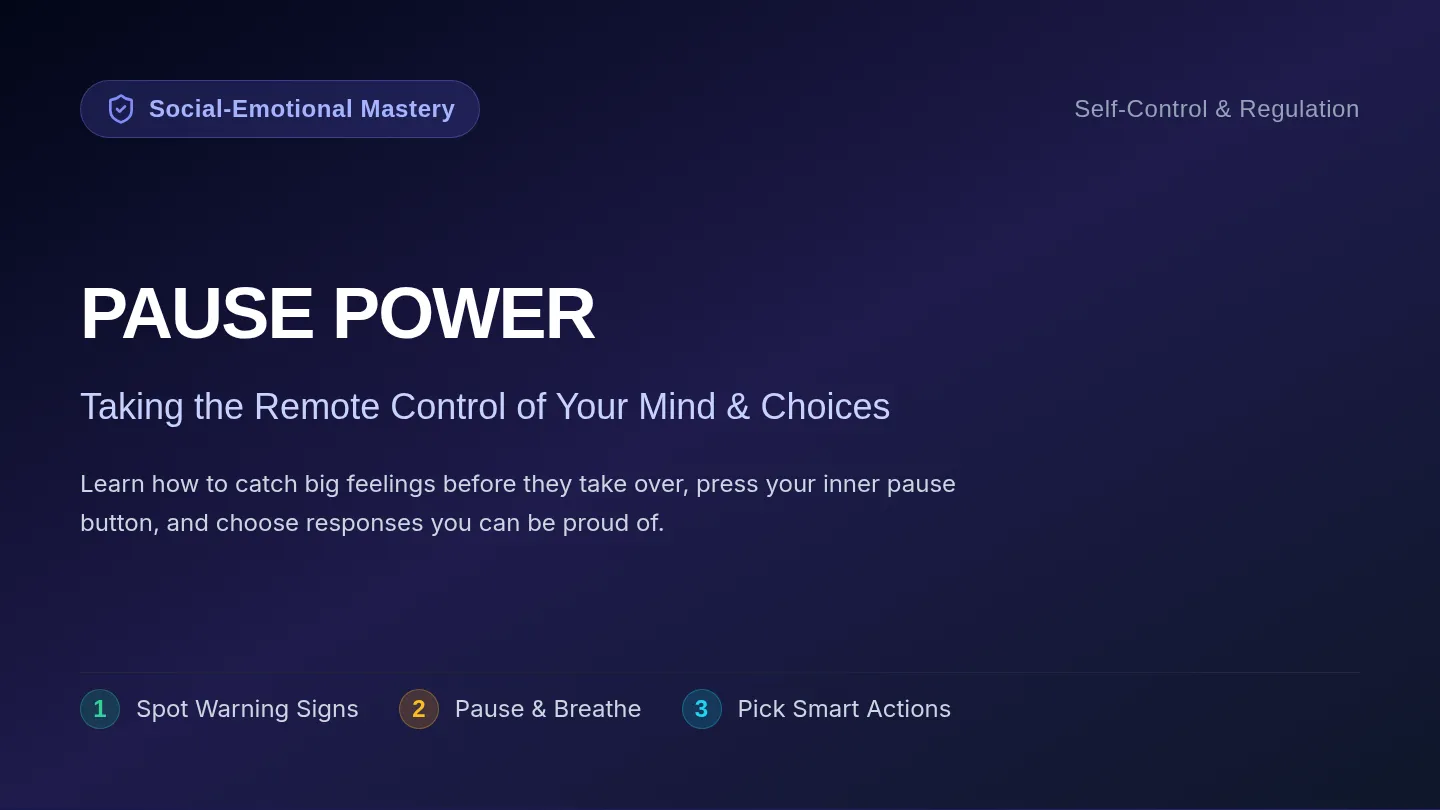
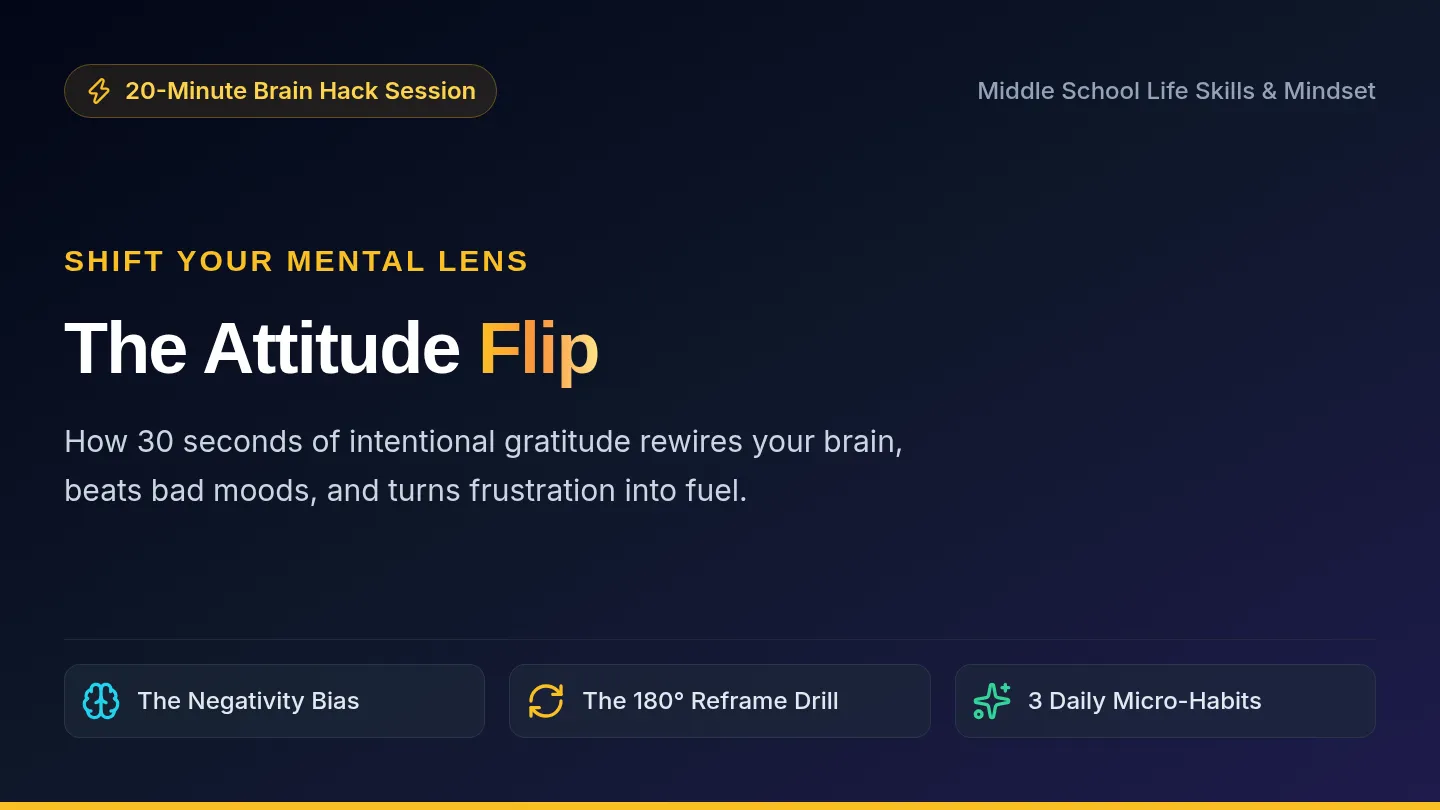
Emotion Decoder Slides
TELEHEALTH PSYCHOEDUCATION
Middle School SEL Series • Grades 6–8
Self-Regulation & Communication Toolkit
Decoding Your Emotions
Learn how your brain and body communicate, track emotional intensity, and master real-world tools to express what you feel.
1. Emotion Anatomy
2. Intensity Thermometer
3. Healthy Expression
4. Somatic Coping
The Golden Rule: Emotions Are Data
Part 1 • Mind Basics
Emotions Are Signals
- Internal messengers alerting you to boundaries, needs, or safety.
- Chemical waves that rise, peak, and naturally fade.
- 100% valid: There are no "bad" or "wrong" feelings.
💡 Anger defends boundaries; anxiety prepares you for the unknown.
Emotions Are Not Orders
- Feeling angry does not force you to yell, slam doors, or insult.
- Feeling anxious does not mean real danger is certain.
- Emotions are passengers, but you are always the driver.
⚖️ You cannot stop a feeling, but you always control your actions.
LIVE PROMPT "What emotion showed up most often for you this past week?"
The Anatomy of an Emotion: 3-Part Circuit
Part 1 • Dissecting Reactions
Step 1
Trigger & Story
An event happens and your brain instantly creates an automatic thought.
Example: Friend doesn't wave → "They're ignoring me!"
Fires in milliseconds
Step 2
Body Reaction
Your nervous system releases hormones creating physical body signals.
Sensations: Knot in stomach, tight throat, pounding heart.
Your body's alarm bell
Step 3
Action Urge
The impulse to react (fight, flee, lash out, or shut down completely).
Your Choice: Pause & respond skillfully vs. reacting on auto-pilot.
Where your power lives
Key Takeaway: You cannot block Step 1 or 2, but you can always master Step 3. Space Between Trigger & Action
Body Clues: Where Does It Live?
Part 1 • Body Awareness
Head & Jaw
Anger & Overwhelm
- • Clenched teeth
- • Forehead tension
- • Racing thoughts
Signal: "Too much input!"
Chest & Lungs
Anxiety & Fear
- • Pounding heart
- • Shallow breathing
- • Tight chest
Signal: "Fight-or-flight alert"
Stomach & Gut
Nervousness & Dread
- • Butterflies
- • Cramped / knot
- • Sinking feeling
Signal: "Uncertainty ahead"
Hands & Limbs
Frustration & Restless
- • Clenched fists
- • Sweaty palms
- • Shoulders raised
Signal: "Trapped energy"
Self-Check: Where do you feel stress first? Head, Chest, Stomach, or Hands?
Interactive Check
The Emotion Thermometer: 1 to 10 Scale
Part 2 • Intensity Scaling
LEVELS 1–3 Green Zone
Mild & Manageable
Slightly annoyed, distracted, nervous before a quiz. Thinking brain (prefrontal cortex) is online.
Best Tool: Name the feeling, drink water, take 2 deep breaths, stretch.
⭐ Golden Window
LEVELS 4–7 Yellow Zone
Moderate / Escalating
Voice gets sharp, muscles tense, urge to snap or storm off. Defense mode begins.
Best Tool: Call a timeout, somatic grounding (5-4-3-2-1), use an "I-Statement".
LEVELS 8–10 Red Zone
Red Alert / Overload
Logic is offline. Screaming, panic attacks, crying uncontrollably, or complete shutdown.
Best Tool: Pure safety & sensory reset. Cold splash, silence, zero debates.
Rule of Thumb: Don't try to solve arguments at Level 8+. First bring your body back to Level 4! Regulate First → Reason Second
Healthy Expression: The "I-Statement" Formula
Part 3 • Communication Tools
The 4-Piece Communication Puzzle:
PART 1: FEELING "I feel..."
Name the emotion clearly.
PART 2: FACT "When you..."
Neutral event without blaming.
PART 3: IMPACT "Because..."
Explain why it matters to you.
PART 4: REQUEST "I need / want..."
Clear, doable next step.
The Reactive Trap ("You" Attack)
"You always ignore me and you're the worst friend!"
→ Triggers defensive arguments and counter-attacks.
The Skilled "I-Statement"
"I feel left out when plans happen without me. Could you invite me next time?"
→ Focuses on problem-solving without blame.
Pro-Tip: Say "I feel [emotion]", NOT "I feel like you are annoying" (that's an accusation!). Real Feelings Only
Scenario Scripts: Peer Dynamics
Part 3 • Telehealth Practice
SCENARIO A School & Teamwork
Group Project Frustration
Your partner is on their phone and left all remaining slides for you to finish.
Ready-to-Use Script:
"I'm feeling stressed because we have three slides left and the deadline is tomorrow. I need us to split the remaining work right now."
Direct, clear, stays calm
SCENARIO B Social Media & Friends
The Group Chat Exclusion
Friends are talking about an inside joke or hangout you weren't invited to.
Ready-to-Use Script:
"Hey, I feel a bit left out when weekend plans get brought up here. I really enjoy hanging out with you guys and would love to join next time."
Honest, avoids passive-aggressive comments
Telehealth Challenge: Pick Scenario A or B to read out loud together!
Live Practice
Somatic Resets: Calming Your Nervous System
Part 4 • Self-Regulation Tools
5-4-3-2-1 Sensory
Grounds your brain in the immediate room:
- 👀 5 things you can see
- ✋ 4 things you can feel
- 👂 3 things you hear
- 👃 2 things you smell
- 👅 1 thing you taste
Fastest brain de-escalator
4x4 Box Breath
Signals vagus nerve to slow heart rate:
Inhale nose: 4s
Hold full: 4s
Exhale mouth: 4s
Hold empty: 4s
Repeat 3–4 cycles anywhere
Cold & Tension Drop
Breaks biological fight-or-flight loop:
- 🧊 Cold Water: Splash face or hold ice cube.
- 💪 Progressive Squeeze: Clench fists for 5s, then release.
- 🚶 Brisk Walk: Burns excess adrenaline.
Ideal for anger & intense spikes
Live Practice: Let's do one cycle of Box Breathing together right now! Inhale • Hold • Exhale • Hold
The Emotion Cycle: Release vs. Suppress
Part 4 • Emotional Health
The "Soda Bottle" Trap
Stuffing feelings down and ignoring body signals:
1. Bottle Up: "I'm fine, it doesn't matter."
2. Pressure Builds: Tension, irritability, headache.
3. Sudden Explosion: Snapping over something small.
Result: Damaged friendships, guilt, and lingering stress.
Constructive Release Valves
Letting the emotional wave complete its cycle safely:
✍️ Raw Writing: Write uncensored, then rip it up.
🏃 Kinetic Output: Sprints, hoops, drumming.
🎨 Creative Outlet: Doodling, playlist curation.
🗣️ Safe Debrief: Venting to a trusted confidant.
Result: Clear thinking and physical tension release.
Healthy Rule: If you don't talk it out, your body will act it out. Release > Suppress
Your Personal Emotion Action Plan
Session Debrief & Goals
1
My #1 Early Clue
What is your earliest physical body warning sign when reaching Level 4?
"My shoulders tense up and my voice gets loud."
2
My Go-To Reset
Which somatic regulation tool will you test out the next time you feel stressed?
"Box breathing or the 5-4-3-2-1 sensory scan."
3
My Expression Goal
Who is one person you can practice using an "I-Statement" with this week?
"Talking to my sibling or teammate calmly."
Remember:
You are not your emotions; you are the one observing and directing them.
Session Complete!