Cart Smarts Slides
Financial Life Skills
|
Consumer Math & Budgeting
Cart Smarts
Mastering Grocery Budgeting, Unit Pricing & Smart Spending
Comparing Choices
Brands, sizes & sales
Unit Pricing
True cost per ounce/item
Staying On Budget
Fixed limits & trade-offs
Foundation
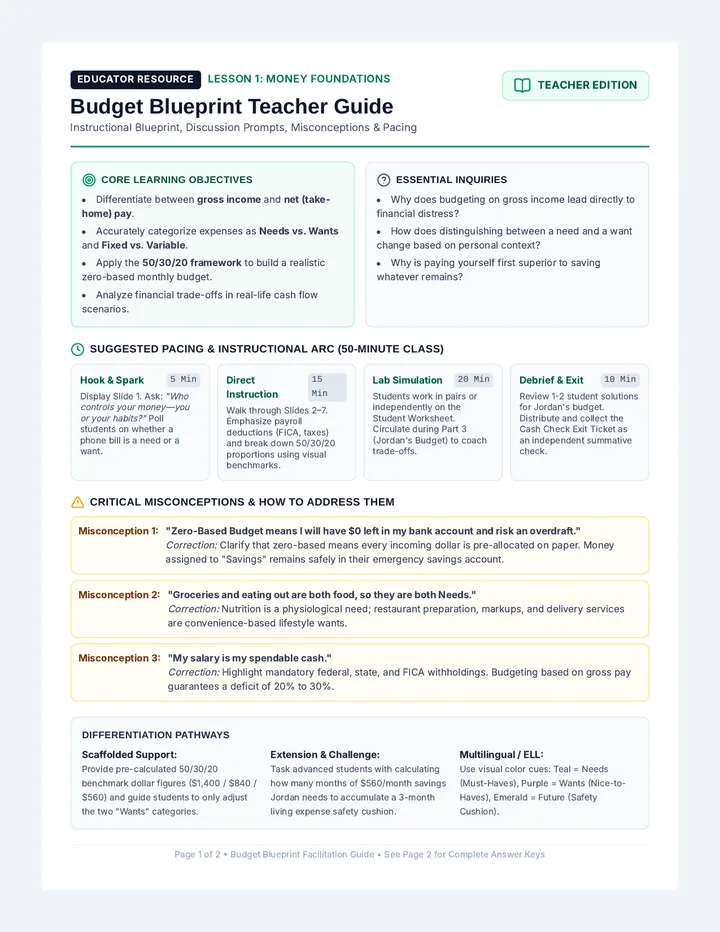
The Two Grocery Superpowers
Strategy First
1. Compare Before You Cart
Never look at the total sticker price alone. Marketing tricks make expensive packages look cheaper. Compare unit prices, brands, and package volume.
Ask: "Which option gives me the most value per dollar?"
2. Respect the Spending Limit
A budget is a hard boundary, not a suggestion. Impulse buys add up silently. If you add an extra item to your cart, you must remove or swap something else.
Ask: "Is this on the list, and does it fit my cap?"
Smart shoppers save an average of 25% to 40% per trip with these two habits.
Skill 1: Comparing Choices
Name Brand vs. Store Brand
Same Food, New Box
National Brand $5.49
Crunchy O's Cereal (18 oz)
- High price pays for TV commercials & celebrity ads
- Eye-level shelf placement fee built into price
- Familiar box and catchy mascot
Unit Cost: $0.31 per ounce
Store Brand / Generic $2.99
Market Choice Oat O's (18 oz)
- Often manufactured in the exact same facility
- Near-identical nutrition facts and ingredient list
- Zero ad spending means direct consumer savings
Unit Cost: $0.17 per ounce (Save $2.50 / box!)
Store brands save an average of 30% on staples like oats, pasta, milk, and flour.
Rule: Try generic once!
The Mathematical Equalizer
Understanding the Unit Price
The Great Comparison Tool
Total Sticker Price
$4.80
÷
Total Quantity (oz, lbs, count)
16 oz
=
Unit Price
$0.30 / oz
Where to look on the shelf tag
Stores are legally required to print the unit price. It is usually printed in a smaller orange or yellow box in the corner of the shelf label!
Watch the units!
Always ensure both items use the same unit (e.g., both per ounce, per pound, or per 100 count). If one is per quart and one is per ounce, convert first!
Unit price cuts through all marketing confusion and reveals the true value.
Skill 1: Comparing Choices
The Size Trap: Is Bulk Always Better?
Myth Buster
Regular Jar $3.00
Peanut Butter (15 oz)
Unit Price: $3.00 ÷ 15 oz = $0.20 / oz
Fits weekly budget easily
Will be eaten completely before expiration
"Giant" Value Tub $8.40
Peanut Butter (35 oz)
Unit Price: $8.40 ÷ 35 oz = $0.24 / oz
Surprise: 20% MORE expensive per ounce!
Takes $5.40 extra out of this week's budget
Before buying bulk, ask these 3 questions:
1. Is the unit price truly lower?
2. Will it spoil before we finish?
3. Does it break this week's limit?
Skill 1: Comparing Choices
Decoding Sales & Promotions
Marketing Traps
"Buy 2, Get 1 Free"
Item costs $6.00 each
You spend $12.00 to get 3 items ($4.00 each). Great deal—IF you actually needed 3 of them!
⚠️ If you only needed one, you just overspent by $6.00!
"10 for $10" Sale
Do you have to buy 10?
In most stores, no! You can buy just 1 item for $1.00. The sign is designed to make you grab ten items.
✅ Buy only what you need unless fine print requires 10.
"Manager's Special"
30%–50% Markdown
Often placed on meat, bakery items, or produce nearing "sell-by" dates. Excellent savings if cooked today or frozen!
❄️ Freeze immediately to preserve the discount!
Golden Rule: It is not "on sale" if you were not planning to buy it!
Unused sales = Wasted cash
Skill 2: Staying On Budget
4 Steps to Beat the Spending Limit
Execution Plan
1
Lock the Limit
Set an exact dollar number before leaving home (e.g., "$45.00 strict maximum").
No vague limits
2
Shop the Pantry
Check what you already have. Never buy duplicates of rice, spices, or canned beans.
Zero double-buying
3
Categorize Needs
Divide your list: Non-negotiable essentials at top; optional treats at the bottom.
Rank priority
4
Running Tally
Round prices up to nearest dollar on your phone calculator while placing in the cart.
No checkout shocks
Pro Tip: Round every price up ($3.49 → $4.00). That builds a built-in safety cushion for sales tax!
Modeling Practice
The $50 Cart Blueprint
Budget: $50.00 Limit
Item & Choice Strategy Category Actual Cost
Eggs (18 count) Store brand ($0.19 / egg)
Protein $3.49
Brown Rice (3 lb bag) Bulk value price
Grain $3.29
Boneless Chicken Thighs (3 lbs) Sale: $2.49/lb
Protein $7.47
Bananas (6) & Broccoli Crowns Fresh produce staples
Produce $5.80
Milk & Whole Wheat Bread Store brand basics
Dairy/Bread $5.75
Tally Check
Running Total
Essentials Total: $25.80
Remaining Buffer: +$24.20
On Track!
Over half the budget remains for remaining dinner recipes and planned snacks.
Notice how store brands and bulk grains keep the core meals under $26.00!
Skill 2: Staying On Budget
The Trade-Off: You Are $6.00 Over!
Decision Time
Cart Total: $56.00. Your limit is $50.00. You cannot check out until you fix this.
Over by +$6.00
Strategy A
The "Swap"
Swap brand-name sparkling water ($6.49) for store-brand lemon seltzer ($2.49).
Saved: $4.00 (Almost there!)
Strategy B
The "Cut"
Cut the gourmet bakery cookies ($6.50). They are a pure want, not on the dinner plan.
Saved: $6.50 (Back in budget!)
Strategy C
The "Size Down"
Change large family pack of snack bars ($8.99) to a 6-pack box ($3.49).
Saved: $5.50 (Need 50¢ more)
Key Mindset: Swapping and cutting wants preserves your essential meals!
Classroom Action
Your Turn: The Smart Shopper Checklist
Ready to Shop
1. Calculate Unit Price
Always divide price by ounces or count before assuming bigger packages or sales are better deals.
2. Embrace Generic
Store brands give you identical nutrition and ingredients without the heavy brand advertising markups.
3. Defend the Limit
Keep a running tally. When over budget, execute a swap or cut immediately before reaching the register.
Next Activity: Build your own 5-item cart staying strictly under your assigned budget limit!
Let's Shop Smart! 🛒