Career Pathway Slides
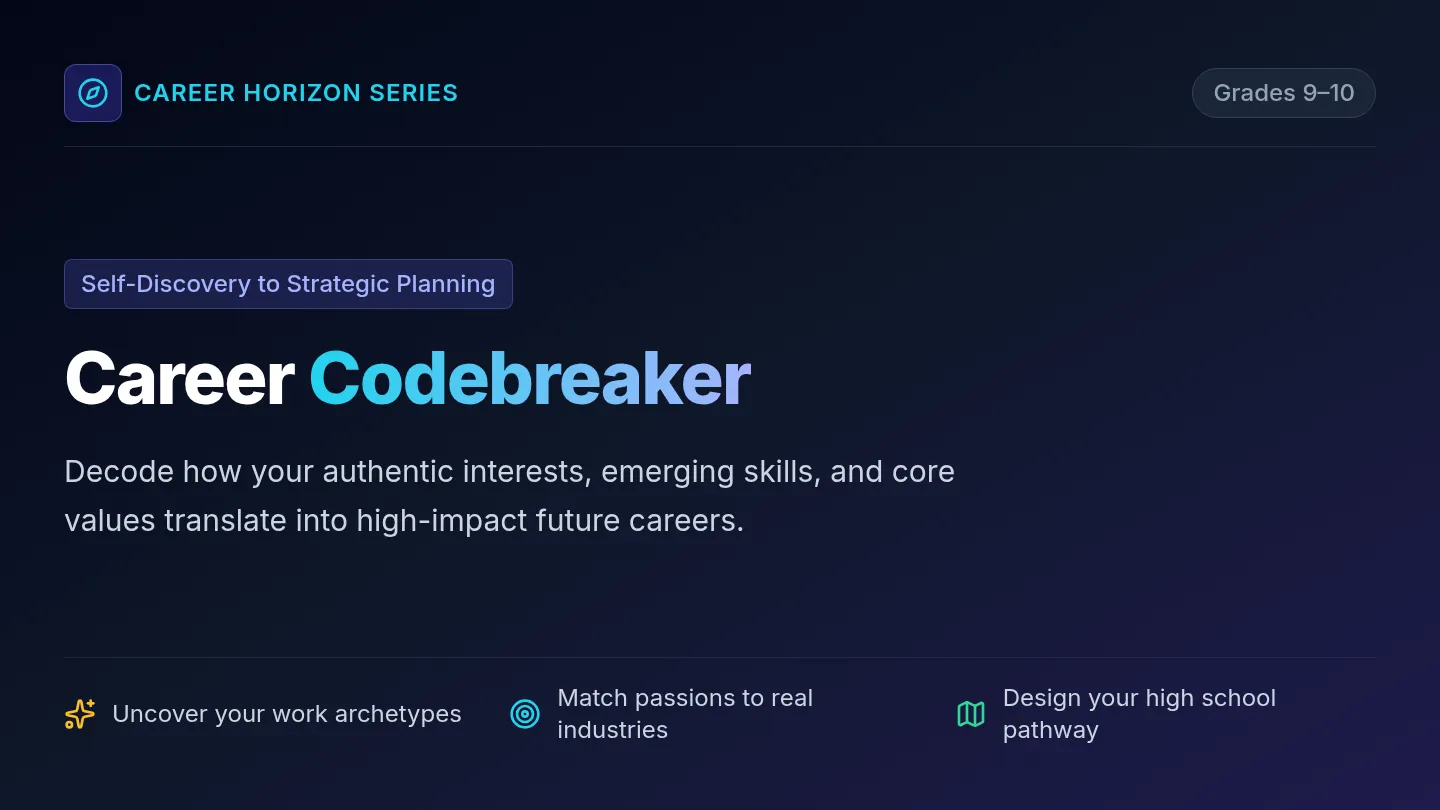
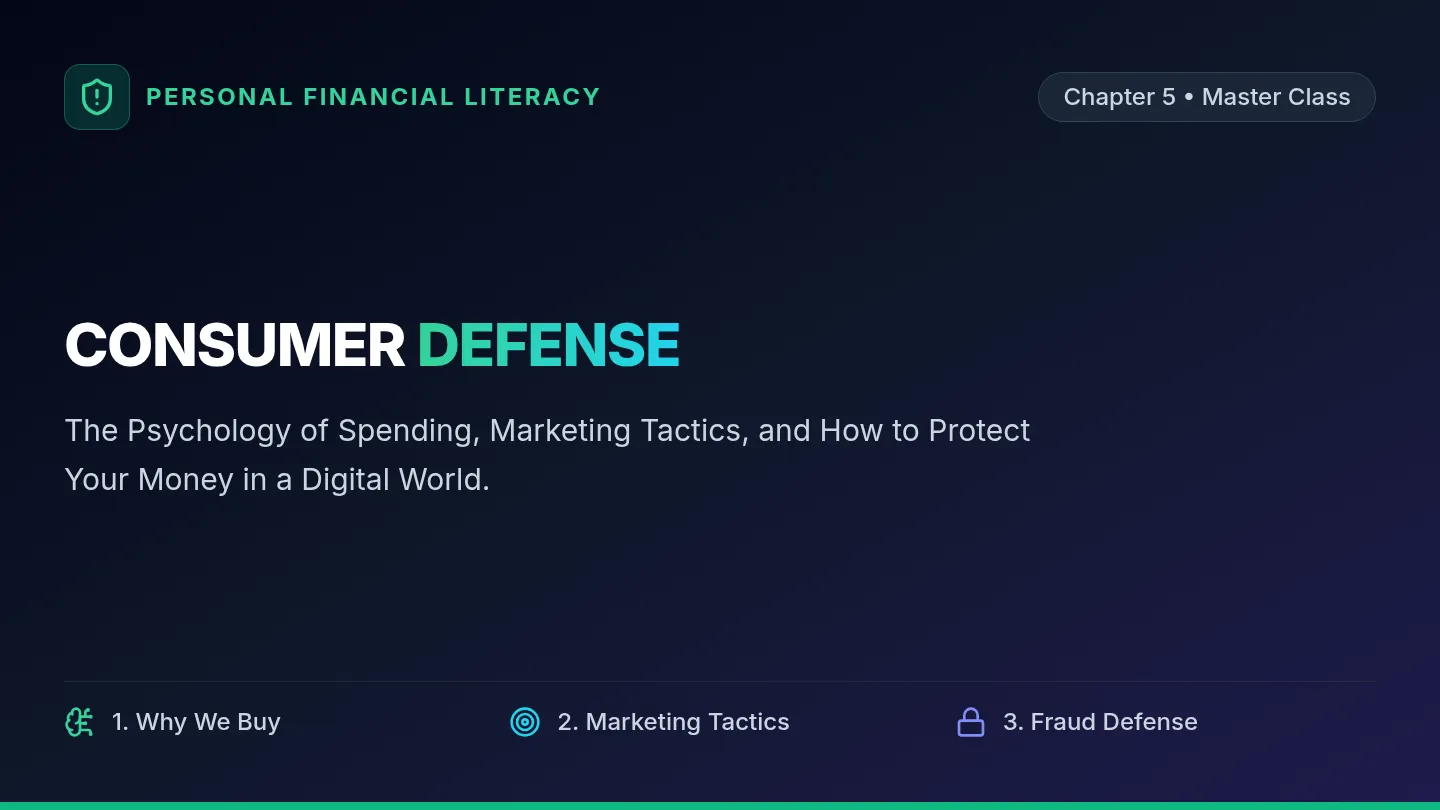
Grades 9–10 Career Readiness
Discovery Series
Connecting Interests
to Real-World Careers
Turn what you naturally enjoy into a career roadmap. Explore the RIASEC model, identify high-value skills, and build your high school strategy.
Pre- & Post-Test Included Interactive Partner Activities
Slide 1 / 14
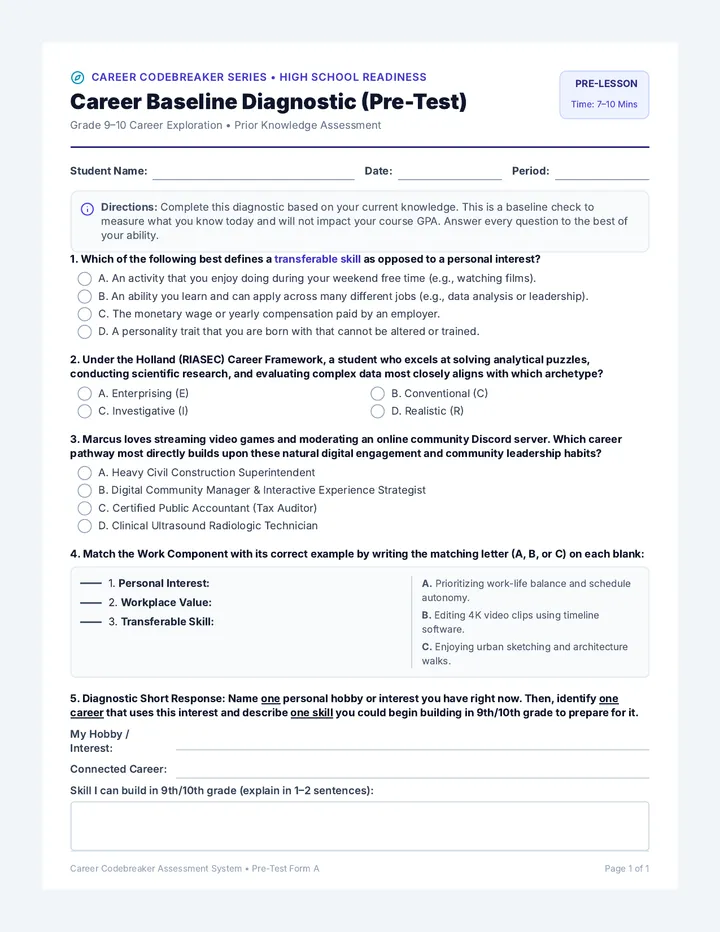
Pre-Assessment • Question 1 of 2
Slide 2 / 14
Question 1: What is the primary benefit of aligning your career with your personal interests?
A
You are guaranteed to earn the highest starting salary available in your state.
B
Higher long-term job satisfaction, sustained motivation, and lower risk of burnout.
C
You will never need to acquire new skills or complete advanced training.
Record your answer silently on your response slip or show finger signals (1, 2, or 3).
Pre-Assessment • Question 2 of 2
Slide 3 / 14
Question 2: Which statement best defines a "transferable skill"?
A
A specialized ability used only in one specific job (e.g., repairing one jet engine model).
B
A broad competency (like communication or problem-solving) applicable across many careers.
C
A certification that is automatically granted to every high school graduate.
We will return to these exact concepts at the end to measure your learning growth.
Warm-Up Hook
Slide 4 / 14
"What Do You Actually Love Doing When Nobody Is Grading You?"
Creating & Styling
Editing videos, sketching, producing music, writing stories, fashion, designing spaces.
Tinkering & Analyzing
Troubleshooting code, building hardware, analyzing sports stats, gaming strategies.
Connecting & Guiding
Coaching teammates, planning club events, resolving friend conflicts, mentoring.
Key Takeaway: Careers aren’t just job titles—they are daily routines built on the verbs you enjoy.
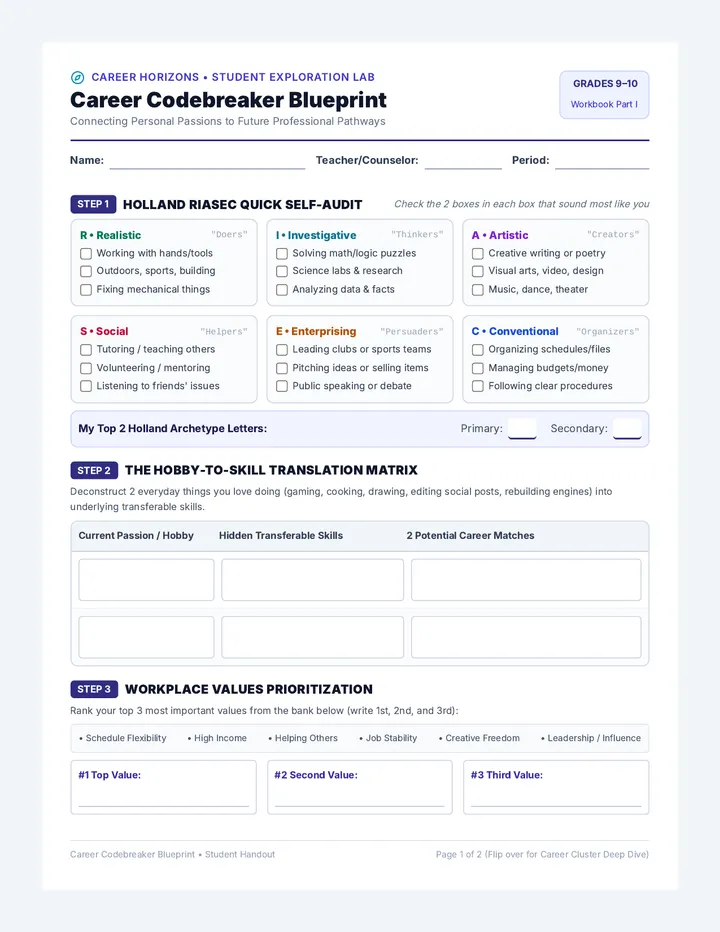
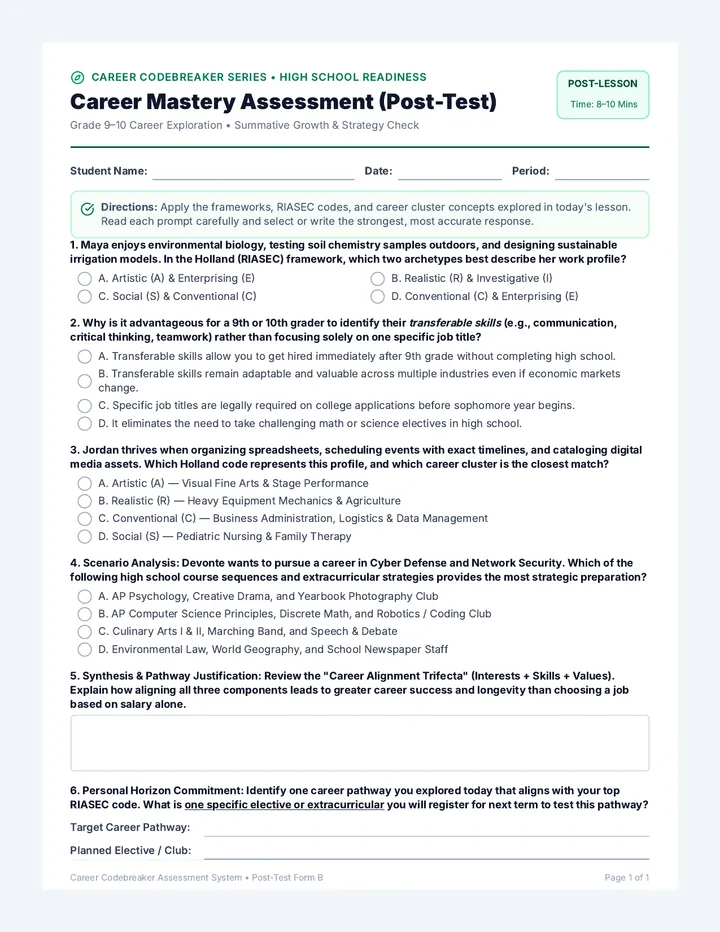
Core Framework • The Holland Codes (RIASEC)
Slide 5 / 14
Six Pathways of Work Personality
R • Realistic
The Doers
Hands-on, machines, tools, athletic, outdoors, engineering.
I • Investigative
The Thinkers
Research, scientific inquiry, math logic, data analysis.
A • Artistic
The Creators
Original design, writing, fine arts, drama, creative media.
S • Social
The Helpers
Teaching, nursing, counseling, mentoring, human services.
E • Enterprising
The Persuaders
Leadership, business pitches, sales, public speaking, politics.
C • Conventional
The Organizers
Systems, records, data organization, finance, details.
Most people are a combination of 2 or 3 letters (e.g., "A-S" or "I-R").
Activity 1 • Self-Inventory (3 Minutes)
Slide 6 / 14
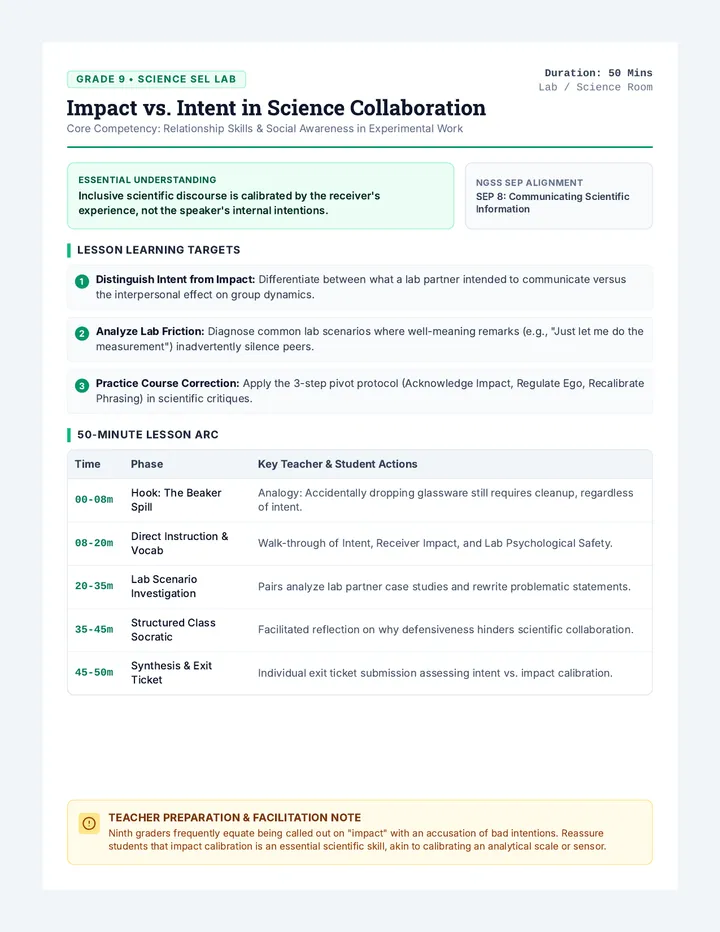
Pinpoint Your Top Two Letters
1
Select Your Primary Letter
Which category matches what you naturally pick when you have free time? Write down that letter (R, I, A, S, E, or C).
2
Select Your Supporting Letter
What is your second strongest area? If you love designing (A) and coding (I), you might be an A-I combo!
Turn & Share With Your Desk Partner:
"My top two letters are [ _ & _ ] because outside of school I spend time..."
Be prepared to share out 2 interesting combinations with the whole class.
Career Strategy
Slide 7 / 14
The Career Sweet Spot: Where 3 Circles Overlap
CIRCLE 1
What You Enjoy
Your passions, curiosities, and personal energy drivers. Keeps you engaged across decades.
CIRCLE 2
What You Practice
Your developed talents and technical skills. You don't start as an expert—you train.
CIRCLE 3
What People Need
Growing market demand, viable compensation, and real-world societal problems to solve.
Only interest without skill is a hobby. Only skill without interest leads to burnout.
Aim For The Overlap
High school is your testing ground to build skills around the things you already enjoy.
Real-World Translation
Slide 8 / 14
How Everyday Hobbies Become High-Growth Jobs
If you enjoy:
Video Games & World-Building
Explore:
3D Environment Artist • UX Designer • Game Physics Coder
If you enjoy:
Social Media, Memes & Trends
Explore:
Digital Brand Strategist • Data Analyst • PR Campaign Director
If you enjoy:
Fixing Cars, Bikes, or Gear
Explore:
Robotics Technician • Biomedical Equipment Repair • EV Engineer
Notice how one single hobby opens doors in tech, business, and creative fields!
Activity 2 • Scenario Solver
Slide 9 / 14
Case Study: Career Coaching for Jordan (10th Grade)
Jordan's Profile
- • Enjoys: Biology lab experiments & drawing graphic comics
- • Personality: Social (S) + Artistic (A) + Investigative (I)
- • Frustration: "I don’t want to be a doctor, but I love science."
Your Team's Challenge
Name two distinct careers that bridge Jordan's love for scientific discovery and creative visual art.
Hint: Think healthcare communication, publishing, or digital tech.
Possible matches: Medical Illustrator, Prosthetics Designer, Science Documentary Producer!
Group discussion: 2 minutes to generate ideas with your team.
Future-Proofing Your Career
Slide 10 / 14
Transferable Skills: The Superpowers Employers Crave
Communication
Explaining complex concepts clearly, pitching ideas, and active listening in diverse teams.
Problem Solving
Diagnosing why something failed, analyzing facts, and testing innovative solutions.
Adaptability
Learning new software quickly, embracing feedback, and pivoting when situations shift.
Even if AI changes specific software tools, strong transferable skills keep you in demand.
Action Plan • Grades 9 & 10
Slide 11 / 14
How to Test-Drive Careers Before You Graduate
1
Choose Strategic Electives & CTE Courses
Take graphic design, intro to robotics, business marketing, or psychology to test your real interest.
2
Join Clubs, Sports, & Student Leadership
Robotics team, DECA, mock trial, school newspaper, or student council build actual leadership evidence.
3
Conduct a 15-Minute Informational Interview
Ask a family friend or local professional: "What does your typical Tuesday look like?"
You don't need to commit to a 40-year career today—you only need to take your next experiment.
Post-Assessment • Question 1 of 2
Slide 12 / 14
Question 1: In the Holland RIASEC model, a student who loves persuasion, pitching ideas, and leading teams falls under:
A
Enterprising (E)
B
Investigative (I)
C
Conventional (C)
Correct Answer: A • Enterprising individuals thrive in entrepreneurship, management, law, and marketing.
Post-Assessment • Question 2 of 2
Slide 13 / 14
Question 2: Why are transferable skills (like problem-solving and communication) crucial for 9th and 10th graders to cultivate?
A
They allow you to adapt and succeed across multiple industries as careers evolve.
B
They guarantee that you will never need a resume or interview again.
C
They only matter for students planning to pursue 4-year university degrees.
Correct Answer: A • Transferable skills provide flexibility and career mobility throughout your life.
Exit Challenge • Your Next 7 Days
Slide 14 / 14
Build Your Career Hypothesis
Before next week's advisory, complete these three simple steps:
STEP 1
Log Your 2 Letters
Write down your top 2 RIASEC letters on your career folder.
STEP 2
Research 2 Jobs
Search O*NET Online or CareerOneStop for jobs matching your code.
STEP 3
Ask 1 Question
Ask your counselor or teacher about an elective aligned with your interest.
Great work today! Keep testing your curiosity.
End of Presentation