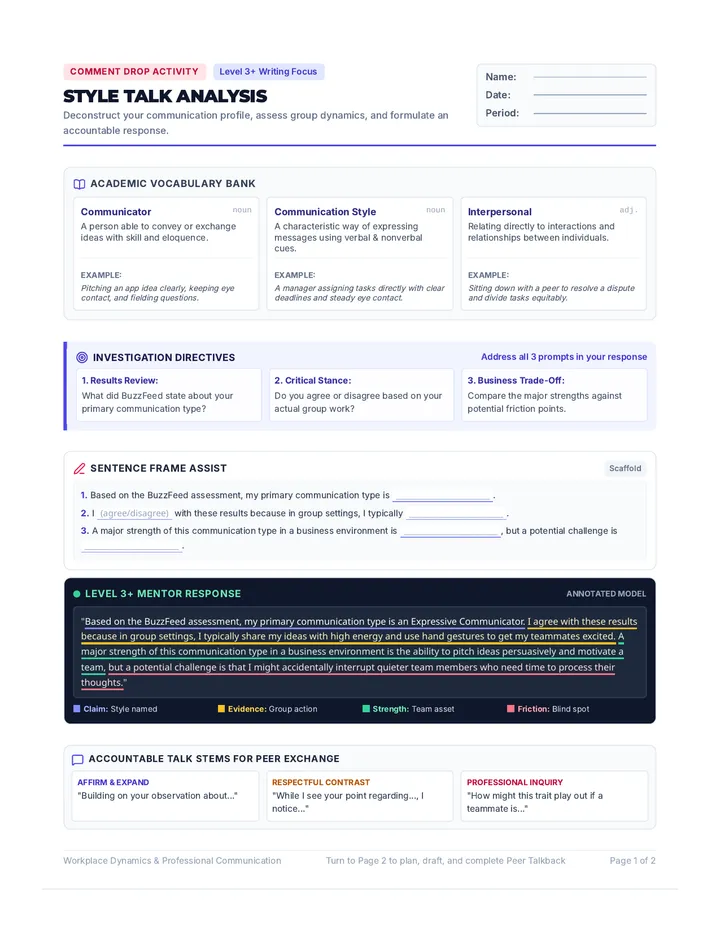
Communication Styles Study Guide
Executive & Team Dynamics Page 1 of 2 • Core Profiles
Communication Styles Reference Guide
A behavioral framework categorizing workplace communicators by pace, focus, debate posture, and decision-making preferences.
The Four Behavioral Quadrants
Communication styles reflect two underlying behavioral dimensions: Assertiveness (Direct vs. Indirect) and Focus (Task-Oriented vs. People-Oriented).
Director Communicator
Direct • Task
“Give me the bottom line—what is the end result?”
Decisive, goal-driven, and pragmatic. Prized for efficiency, rapid problem-solving, and cut-to-the-chase clarity.
Debate Style: Candid and assertive; comfortable debating ideas openly without taking friction personally.
Core Strengths: Fast execution, strong accountability, thrives in high-stakes environments.
Blind Spot: Can appear blunt, impatient, or dismissive of emotional nuances.
How to Connect: Be concise, focus on outcomes, and present clear options with tradeoffs.
Analytical Communicator
Indirect • Task
“Show me the data and the methodology behind this.”
Precise, systematic, and logical. Prioritizes empirical proof, structural integrity, and accuracy over rapid decisions.
Debate Style: Dissects assumptions using objective facts; avoids emotionally heated arguments.
Core Strengths: Thorough risk assessment, meticulous quality control, sound logic.
Blind Spot: Susceptible to analysis paralysis; may resist decisions under ambiguous conditions.
How to Connect: Provide documentation ahead of time, maintain logical consistency, and avoid hype.
Socializer Communicator
Direct • People
“Imagine what this could look like—let’s dream big!”
Expressive, spontaneous, and visionary. Rallies teams through enthusiasm, compelling storytelling, and creative inspiration.
Debate Style: Champions innovative ideas with emotional energy; dislikes dry, pedantic contention.
Core Strengths: Inspiring vision, creative brainstorming, high engagement, and team morale.
Blind Spot: Can overlook logistical details and may pivot rapidly between unfinished projects.
How to Connect: Acknowledge their creativity, engage in dialogue, and assist with tactical follow-through.
Personal Communicator
Indirect • People
“How will this change affect everyone on our team?”
Empathetic, relational, and diplomatic. Champions psychological safety, mutual trust, and the human dimension of work.
Debate Style: Seeks consensus and de-escalation; feels stressed by aggressive debate or sharp conflict.
Core Strengths: Active listening, conflict mediation, cultural cohesion, and deep empathy.
Blind Spot: Reluctant to voice dissent openly if it risks damaging relationships or team harmony.
How to Connect: Build genuine interpersonal trust, listen actively, and provide non-confrontational forums.
Framework: Merrill-Reid & Alessandra Behavioral Models Turn to Page 2 for Question Diagnostic & Matrix Analysis →
Diagnostic & Applications Page 2 of 2 • Assessment Analysis
Assessment Analysis & Team Dynamics
Detailed breakdown of the question scenario, behavioral matrix axes, and debate dynamics across communication styles.
Exam Question Diagnostic
Correct: C (Director Communicator)
“Which of the following communicator personality types is best described as someone who prefers honest, direct dialogue and is comfortable debating or challenging ideas in a group setting?”
Option A
Analytical Communicator (Incorrect): While analytical types value honesty and facts, they are indirect in pace, deliberate cautiously, and typically avoid public adversarial debates.
Option B
Socializer Communicator (Incorrect): Highly direct and expressive, but fundamentally people-focused; they prioritize positive engagement and creative rapport over rigorous intellectual confrontation.
Option C
Director Communicator (CORRECT): Combines high assertiveness with a task orientation. They view candid debate as an efficient path to the best solution, speak without sugar-coating, and relish intellectual challenges.
Option D
Personal Communicator (Incorrect): Values harmony and interpersonal relationships above all; prefers gentle diplomatic consensus and actively seeks to minimize friction or aggressive debating.
The Two Underlying Behavioral Axes
Pace (Assertiveness) vs. Priority (Responsiveness)
DIRECTOR Direct + Task
High assertiveness, low emotional display. Fast, candid, decisive. Debating ideas is seen as standard problem solving.
SOCIALIZER Direct + People
High assertiveness, high emotional display. Fast, energetic, spontaneous. Debating is focused on vision and inspiring engagement.
ANALYTICAL Indirect + Task
Low assertiveness, low emotional display. Deliberate, cautious, data-driven. Challenges logic through empirical proof rather than debate.
PERSONAL Indirect + People
Low assertiveness, high emotional display. Deliberate, relational, supportive. Avoids adversarial debate in favor of team unity.
Key Takeaway for Team Collaboration
When working with a Director, remember that blunt pushback is not an attack—it is an invitation to defend the logic of your idea. Present clear facts, stand your ground respectfully, and focus on end objectives.
Answer C
Director
Team Tension Resolution Worksheet
Team Communication Activity Page 1 of 2
Team Tension Resolution Worksheet
Learn how different work styles clash under stress, and write a simple plan to fix late work and calm team tension.
Name:
Date:
Period / Team:
The Team Problem: Late Presentation Slides
Deadline Today
Your group is making an important presentation. The manager warns you that the team is falling behind because some slides are not done. Stress starts rising fast. A Director teammate demands quick answers right now. A Personal teammate feels upset, ignored, and stops talking. The team is stuck.
Director Teammate
What they want: Quick action and finished slides.
Why they are stressed: They fear missing the deadline and sound blunt when pushing for results.
Personal Teammate
What they want: Respect, kindness, and time to speak.
Why they are stressed: They feel blamed in front of the group and shut down when rushed.
Key Words to Use in Your Writing
Active Listening Paying full attention and checking that you understand.
Clarification Asking simple questions so tasks are clear to everyone.
Feedback Helpful tips to make work better without being harsh.
Rationale The clear reason why you made a choice.
Tension Stress and bad feelings between people working together.
Communicator Style The way someone prefers to talk, listen, and share ideas.
Step 1: Quick Thinking Questions
1. What does the Director need right now, and what does the Personal communicator need?
2. How does asking questions (clarification) help both teammates at the same time?
Turn the page to write your response. Page 2: Sentence Frame & Writing Studio →
Writing Studio Page 2 of 2
Class Comment Drop: Your Team Fix
Complete the exact sentence frame to explain how you will calm tension, fix late work, and help the team succeed.
Checklist: What to Include Check off as you write
Name the Director and Personal styles
Explain why the group feels stressed
Use active listening and clarification
Give a clear reason why your plan works
Sentence Frame Assist (Exact Structure) Fill in each blank
“To reduce tension, I would first ____________. This helps because it balances the Director's need for ____________ with the Personal communicator's need for ____________. To stay on track, I would use strategies like ____________ and ____________. For example, I could ____________. In my opinion, addressing task delays early ensures ____________.”