Walk in Shoes Lesson Plan A Walk in Someone Else's Shoes
Internal Briefing: 2nd Grade Social-Emotional Learning
Detective Guide
TIME
30 Minutes
GOAL
Identify feelings & perspectives in others.
AUDIENCE
2nd Grade Students
Why This Lesson Matters
Understanding how others feel helps us be better friends and classmates, making our school a kinder and more supportive place for everyone. Perspective-taking is the foundation of empathy and conflict resolution.
Instructional Approach
Through collaborative scenarios and active role-playing, students will practice seeing situations from different viewpoints, moving from individual observation to empathetic action.
Detective Gear (Materials)
Whiteboard or Projector
Walk in Their Shoes Slides
Perspective Scenario Cards
Role-Playing Character Cards
Mission Prep
10 Minutes Before:
• Review the Walk in Their Shoes Slides and familiarize yourself with the content.
• Print and cut out the Scenario Cards and Role-Playing Cards (laminate if possible!).
• Ensure the projector is ready for the "Detective Briefing."
Mission Steps (Instructions)
5m
1. Detective Briefing (Warm-Up)
• Start by asking: "What does it mean to put yourself in someone else's shoes?" Listen for ideas about "thinking like them" or "feeling what they feel."
• Introduce Perspective-Taking : It's like being a detective for feelings. You have to look for clues to understand what someone else is going through.
10m
2. Learning the Clues (Introduction)
• Display Slides 2-4 .
• Explain the three types of clues: Words (what they say), Body Language (how they look/act), and The Situation (what just happened).
• Practice with Slide 4 (The Ice Cream Scenario). Ask: "What clues tell us how our friend feels?"
10m
3. Field Investigation (Group Activity)
• Divide students into groups of 3-4.
• Hand out one Scenario Card to each group. Have them discuss: How does each person feel? Why? How can we help?
• Hand out Role-Playing Cards . Let students act out the scenario, focusing on expressing the character's emotions through their clues.
5m
4. Sharing Discoveries (Wrap-Up)
• Bring the class together. Ask each group to share one discovery from their scenario.
• Reinforce the core message: Taking a walk in someone else's shoes helps us build stronger friendships and a kinder classroom.
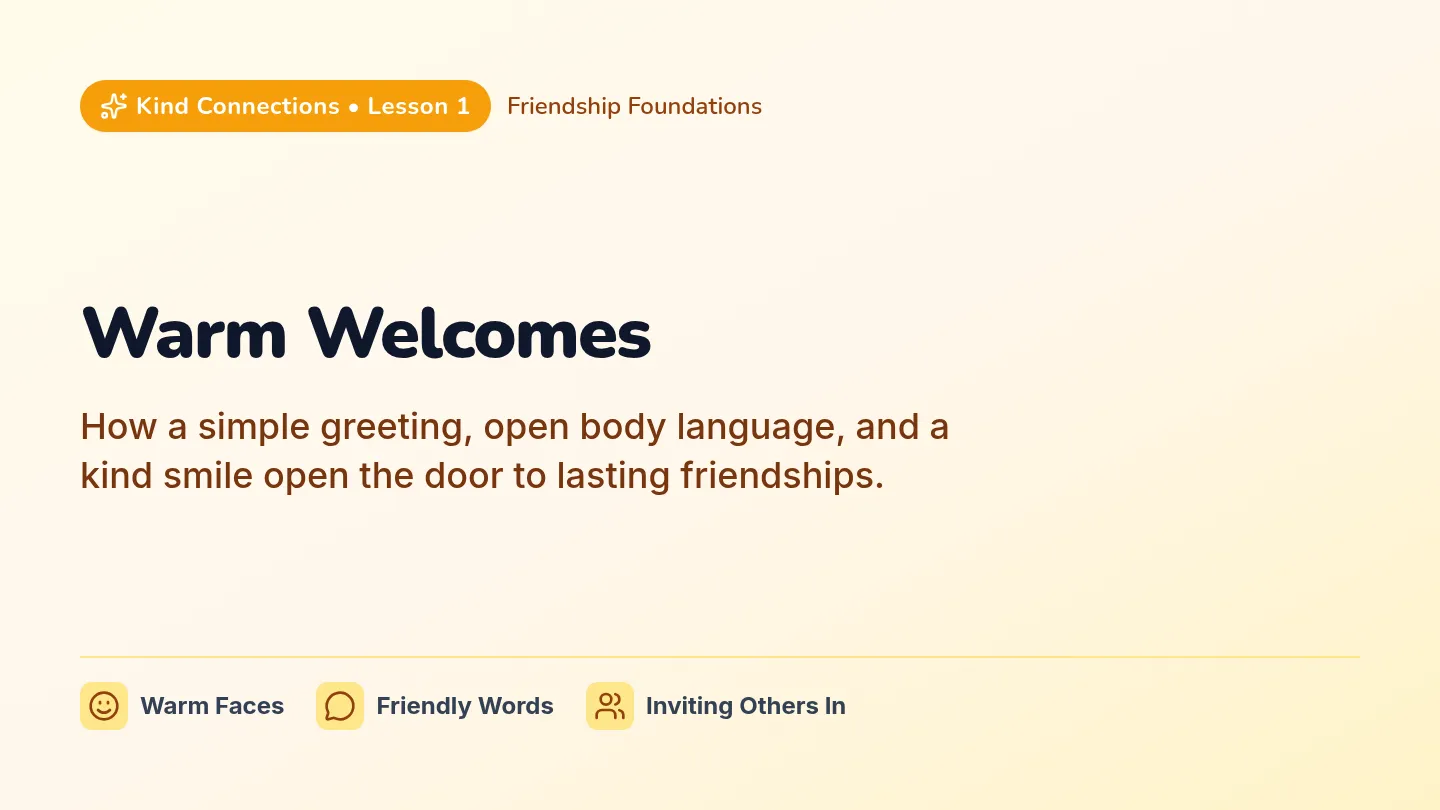
Walk in Their Shoes Slides A Walk in Someone Else's Shoes
What does it mean to put yourself in someone else's shoes?
Detective Training: Unit 1
Becoming a Feelings Detective
To understand how others feel, we become "feelings detectives"!
We look for clues.
Top Secret: Observation Skills
Our Detective Clues
Words
What someone is actually saying to you.
Body Language
How their face looks and how they stand.
The Situation
What is happening around them right now.
Let's Practice!
The Case:
Imagine your friend dropped their ice cream cone on the ground! 🍦
The Detective Questions:
How might your friend feel? Why?
What clues tell us how they feel?
Mission Briefing
Field Investigation Time!
Work in your small detective groups.
Read your Scenario Card and discuss.
Act it out! Use your role-play cards.
Case Closed: Our Discoveries
When we walk in someone else's shoes, we...
Understand different feelings
Learn how to be kind and helpful
Build stronger, happier friendships
Different Perspectives Scenarios Case Files: Different Perspectives
Mission: Identify the Feelings Clues
Name: __________________________
Date: __________________________
Detective Instructions:
Read each case file with your team. Use your detective skills to find clues about how everyone is feeling and why!
Case File #001: The Missing Toy
Lily brings her favorite new toy car to school for show-and-tell. During recess, she leaves it on the playground bench while she goes to get a drink. When she comes back, the toy car is gone. Her classmate, Ben, is playing with a very similar toy car a few feet away.
How might Lily be feeling? Why?
How might Ben be feeling? Is it possible he found a different car?
What could someone do to help Lily or Ben in this situation?
Case File #002: The New Game
Ms. Davis introduces a new board game to the class. It looks really fun! Maya is excited because she loves board games. However, David looks worried because he doesn't understand the rules and is scared he won't be good at it.
How might Maya be feeling? Why?
How might David be feeling? Why?
What could someone do to show empathy or help David in this situation?
Case File #003: Art Class Oops!
During art class, Leo is painting a beautiful picture. Suddenly, his elbow bumps his water cup, and it spills all over Sarah's drawing, which she was just finishing. Sarah looks very upset, and Leo feels terrible.
How might Sarah be feeling? Why?
How might Leo be feeling? Why?
What could someone do to help Sarah or Leo in this situation?
Case File #004: Sharing the Swing
At the playground, Mia has been on the swing for a long time. She loves swinging! Another student, Sam, has been waiting patiently for a turn for a while, and really wants to swing too.
How might Mia be feeling? Why?
How might Sam be feeling? Why?
What could someone do to help Mia and Sam resolve this kindly?
Role-Playing Cards Detective Role-Playing Cards
Acting Out the Clues!
How to Play:
Choose a card that matches your group's scenario. Pick roles and act out the situation! Use your Words, Body Language, and the Situation to show how you feel.
A
The Sad Friend
Characters:
Lily, Ben, Helpful Classmate
The Scene:
Lily is upset about her missing car. Ben has a similar car. The classmate helps.
Focus:
Show sadness and confusion. Practice talking to each other kindly to solve the mystery.
B
Worried Newbie
Characters:
Maya, David, Teacher/Friend
The Scene:
Maya is excited for the game. David is worried about the rules. A friend notices.
Focus:
Show BIG excitement vs. quiet worry. Practice offering help and explaining things.
C
Art Class Oops
Characters:
Leo, Sarah, Kind Classmate
The Scene:
Leo spills water on Sarah's painting. Sarah is upset. Leo feels terrible.
Focus:
Show a "terrible" feeling vs. being upset. Practice saying sorry and helping to clean up.
D
Swing Dilemma
Characters:
Mia, Sam, Mediator/Friend
The Scene:
Mia is swinging happily. Sam is waiting for a turn. A friend helps them share.
Focus:
Show enjoyment vs. impatience. Practice finding a fair way for everyone to have fun.
Detective Headquarters • Perspective-Taking Unit
Different Perspectives Answer Key Teacher Answer Key
Case Files: Different Perspectives
Confidential
Case #001: The Missing Toy
Lily's Perspective:
Lily likely feels sad, frustrated, or anxious because her favorite toy is gone. She might feel suspicious of Ben.
Ben's Perspective:
Ben might feel happy (if the car is his) or confused/guilty (if he found it and didn't realize it belonged to someone else).
Helpful Actions:
Ask Ben politely if that is his car; look for the car together; ask a teacher for help mediating the conversation.
Case #002: The New Game
Maya's Perspective:
Maya feels excited, energetic, and happy because she loves games and this one looks fun.
David's Perspective:
David feels worried, nervous, or overwhelmed because he doesn't understand the rules and fears failing.
Helpful Actions:
Maya could offer to explain the rules simply; the teacher could pair them up; Maya could reassure David that it's okay to learn as they go.
Case #003: Art Class Oops!
Sarah's Perspective:
Sarah feels upset, disappointed, or angry because her hard work was ruined right as she was finishing.
Leo's Perspective:
Leo feels terrible, guilty, and sorry. He didn't mean to do it, but he knows he caused a problem.
Helpful Actions:
Leo should apologize immediately; Leo and Sarah could try to fix the drawing together or Sarah could start a new one with Leo's help.
Case #004: Sharing the Swing
Mia's Perspective:
Mia feels joyful and focused on her own fun. She might not even notice Sam is waiting.
Sam's Perspective:
Sam feels impatient, sad, or left out. He has been waiting a long time and feels it's unfair.
Helpful Actions:
A friend could suggest a timer; Mia can offer Sam a turn after 10 more swings; they could agree on a specific "waiting spot" or turn order.
Perspective-Taking Lesson • Teacher Resource Only