Unlocking Inner Strength Lesson Plan Unlocking Inner Strength
Lesson Plan: The Self-Management Superpower
Duration 60 min
Why This Matters
Understanding and practicing self-management helps students navigate challenges, make informed decisions, and achieve their goals, both in school and in life. By mastering their internal "remote control," students move from reactive behavior to intentional action.
Learning Objective
Students will be able to define self-management and identify its core components, including impulse control and emotional regulation, and recognize their importance for personal effectiveness and academic achievement.
Audience & Approach
9th Grade Class
Interactive discussion, engaging reading, and self-reflection.
Teacher Preparation
Review slide deck and lesson materials.
Print "Stories of Self-Control" readings.
Prepare "Impulse vs. Impact" debate sheets.
Set up projection equipment for slides.
Print "Self-Management Check-In Quiz" copies.
Time check: ~15 mins total preparation.
Instructional Sequence
10m
Introduction: What is Your Superpower?
Begin with the Warm Up activity to gauge initial understanding. Introduce self-management as an essential life skill using Slides 1-3 . Facilitate a brief class discussion on why these skills matter in daily high school life.
20m
Exploring Impulse Control: The Debate
Transition to impulse control using Slides 4-6 to present scenarios. Divide students into small groups to engage in the Impulse vs. Impact Debate Discussion . Reconvene to share insights on how pausing changes the outcome.
15m
Understanding Emotional Regulation: Stories
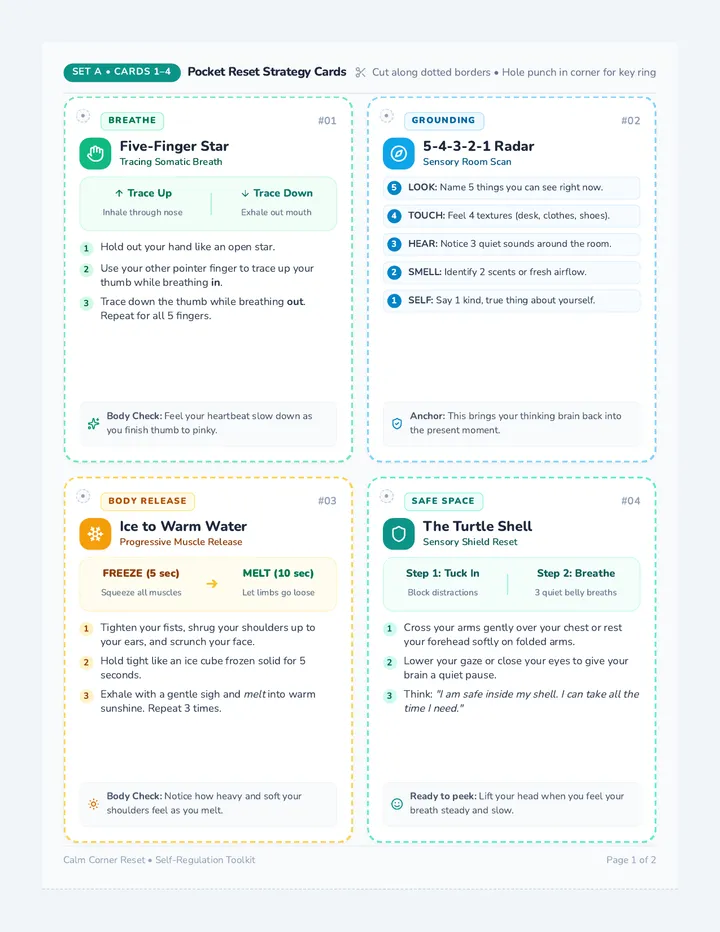
Introduce regulation using Slides 7-8 . Distribute Stories of Self-Control Reading . Have students read individually or in pairs. Lead a discussion on the specific strategies (breathing, grounding, reflection) used by the characters.
15m
Wrap-up & Assessment: Your Toolkit
Review key takeaways with Slides 9-10 . Administer the Self-Management Check-In Quiz . Conclude with the Cool Down reflection: identify one strategy to try this week.
Your Personal Superpower Slides Your Personal
Superpower
Unlocking Your Inner Strength for Success!
Self-Management Unit
Welcome students and introduce the topic of self-management as a powerful skill. Ask them what they think a 'superpower' is in real life. Connect it to inner strength.
What is Self-Management?
It's your ability to manage your thoughts, feelings, and actions.
It helps you reach your goals and be your best self!
Think About It
"What does it mean to
Explain that self-management isn't about controlling others, but controlling ourselves. Define it as managing thoughts, feelings, and actions to achieve goals. Provide simple examples.
Key Components
1
Impulse Control
Thinking before you act.
2
Emotional Regulation
Managing your feelings constructively.
Why are these important for YOU?
Highlight key components: impulse control and emotional regulation. Briefly explain each and why they are important for school and personal life.
Impulse Control: Think Before You Act!
Have you ever done something without thinking and regretted it later?
That's acting on impulse!
The Pause
Impulse control is pausing and considering the consequences before the reaction.
Introduce impulse control. Give a scenario where someone acts without thinking and the negative consequences. Ask students for similar experiences (without naming names).
Live Scenario
Group Project Frustration
"Your group project is due tomorrow, and one member hasn't done their part."
Your Impulse: YELL AT THEM!
The Impact?
What happens next if you follow that impulse?
Present a hypothetical scenario. Ask students to think about the 'impact' of yelling vs. taking a moment to think of a better approach.
Impulse vs. Impact: A Closer Look
The Pause
Instead of yelling, you take a deep breath.
The Choice
You calmly talk to your teammate, offer help, or speak to the teacher.
The Positive Impact:
A better outcome
A stronger team
Less stress for YOU
Show the alternative, where someone uses impulse control. Emphasize the positive outcomes.
Emotional Regulation:
Riding the Wave
Emotions are powerful! We all feel them. Regulation is about managing your feelings so they don't manage you.
The Golden Rule:
It's NOT about not feeling,
Introduce emotional regulation. Explain that emotions are normal, but how we respond to them matters. Give examples of healthy vs. unhealthy emotional responses.
Strategies for Calm
Deep Breaths
Simple, effective!
Talk it Out
Share with a friend.
Take a Break
Step away for a bit.
Reflect
Why do I feel this?
Provide simple strategies for emotional regulation. Mention deep breathing, talking to someone, taking a break.
Your Self-Management Toolkit
1. Impulse Control
Pause. Think. Act.
2. Regulation
Understand. Manage.
Summarize the two main components and reiterate their importance.
Practice Makes
Progress!
"What's one thing you will try to do differently this week to use your self-management superpower?"
Action Required
Encourage students to practice these skills. Prompt them to think about how they can apply what they learned today.
Self-Management Warm Up Worksheet Warm Up Activity
Topic: Your Inner Remote Control
Name:
Date:
Instruction
What's Your Remote Control?
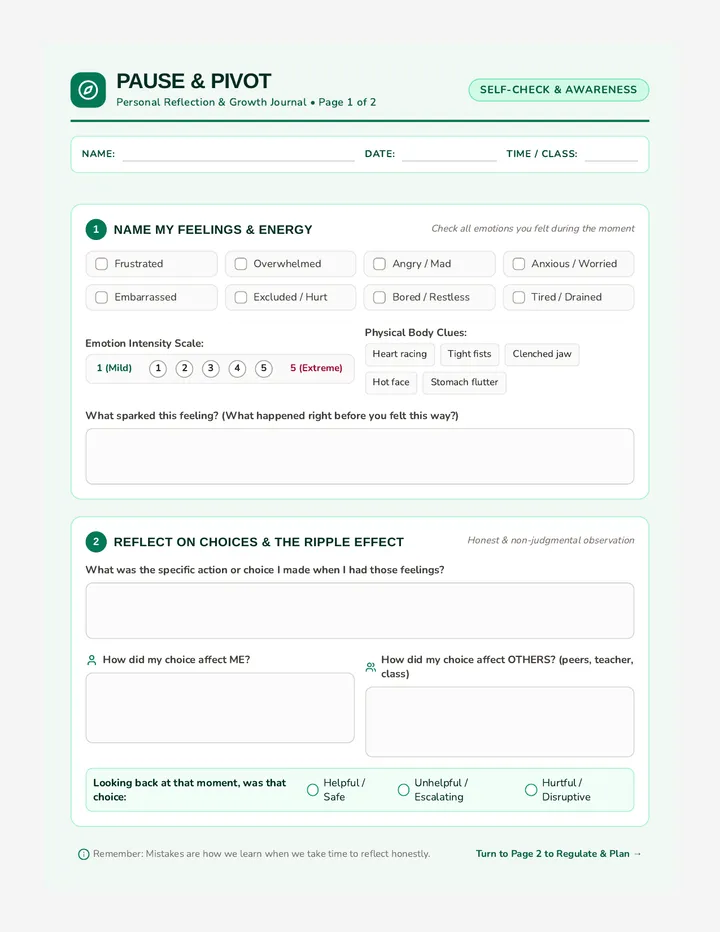
Think about a time when you really wanted something, but you had to wait or control yourself to get it. Or, a time when you felt a strong emotion (like anger, excitement, or frustration) and you managed to handle it in a way that you're proud of.
My Story:
Describe the situation and how you used your "inner remote control" to manage your actions or feelings.
Be prepared to share your thoughts with a partner or the class!
Stories of Self-Control Reading Reading Material
Stories of Self-Control:
Real-Life Regulation
Sometimes, the best way to understand self-management is to see it in action. These stories show how people use impulse control and emotional regulation to navigate challenges.
Story 1: The Frustrated Gamer
Jamal loved playing online games with his friends, but he had a problem: he often got incredibly frustrated when his team lost. One evening, after a particularly bad defeat, Jamal felt his face flush with anger. His immediate impulse was to shout at his teammates through his headset and then furiously quit the game. He knew from past experiences that this usually led to arguments and him feeling even worse later.
This time, however, Jamal remembered a conversation with his older sister about "taking a pause." Instead of reacting immediately, he took off his headset, stood up, and walked away from his computer. He took a few deep breaths, counting to ten slowly. He thought about why he was so angry and realized it wasn't really about his teammates, but his own disappointment in the loss.
After a few minutes, Jamal returned, feeling much calmer. He messaged his teammates, acknowledging the tough loss but thanking them for playing. His calm response prevented an argument and allowed him to enjoy the rest of his evening.
Self-Management in Action
Jamal demonstrated impulse control by pausing before reacting, and emotional regulation by using deep breathing to manage his frustration.
Story 2: The Online Comment Trap
Maria was scrolling through social media when she saw a post that made her blood boil. It was a comment from someone she knew making an unfair and hurtful statement about a topic she cared deeply about. Her first instinct was to type a long, angry reply, expressing her outrage. She started typing furiously.
Before hitting "send," Maria stopped. She considered what her angry comment would achieve. Would it change the person's mind? Or would it just escalate the conflict? She decided that a public argument wouldn't be productive.
Instead, Maria closed the app. She wrote a private message to a trusted friend who also cared about the issue, sharing her feelings and discussing ways they could positively advocate for their cause. By regulating her emotions, Maria turned a potentially negative interaction into a positive and empowering one.
Self-Management in Action
Maria showed impulse control by stopping herself from posting and emotional regulation by choosing a constructive way to process her feelings.
Story 3: The Big Test Anxiety
Impulse vs Impact Discussion Worksheet Impulse vs. Impact
Small Group Discussion Guide
Team Members
Welcome, future decision-makers! Today, we're diving into the heart of self-management: impulse control . In your groups, discuss these scenarios. Consider the immediate impulse versus the potential long-term impact of acting on that impulse versus taking a moment to exercise self-control.
1
The Frustrating Group Project
"You are working on a major project, and one teammate has consistently failed to contribute. The deadline is looming, and you feel a surge of anger."
Immediate Impulse:
Impact of Acting on Impulse:
Alternative Action (Controlled):
Impact of Alternative Action:
2
Social Media Reaction
"You see a post on social media that makes you incredibly angry. Your finger hovers over the keyboard, ready to type a harsh and immediate response."
Immediate Impulse:
Impact of Acting on Impulse:
Alternative Action (Controlled):
Impact of Alternative Action:
Group Reflection
1. Why is it often difficult to control an impulse in the heat of the moment?
2. What is one specific strategy your group can use to give yourselves "thinking time"?
Self-Management Check-In Quiz Summative Check-In
Self-Management Quiz
Name:
Date:
1
Which of the following best describes self-management?
Controlling others' actions and feelings.
Ignoring your feelings and impulses.
Effectively managing your own thoughts, feelings, and actions.
Letting your emotions guide all your decisions.
2
What is impulse control?
Acting immediately on your first thought.
Avoiding all difficult situations.
Thinking before you act and considering the consequences.
Suppressing all your feelings.
3
Which of these is an example of emotional regulation?
Yelling at someone when you're angry.
Ignoring your anger until it goes away.
Taking deep breaths and reflecting on why you're angry.
Letting your anger completely take over your actions.
4
Why is self-management considered a 'superpower' in real life? Provide at least two reasons.
5
How confident are you in applying self-management strategies in your daily life?
Not at all
Slightly
Moderately
Very
Extremely
Self-Management Quiz Answer Key Answer Key
Material: Self-Management Check-In Quiz
1
Which of the following best describes self-management?
Effectively managing your own thoughts, feelings, and actions.
2
What is impulse control?
Thinking before you act and considering the consequences.
3
Which of these is an example of emotional regulation?
Taking deep breaths and reflecting on why you're angry before responding.
4
Why is self-management considered a 'superpower' in real life?
Sample Answer:
It helps you make better decisions by avoiding impulsive mistakes.
It improves relationships by helping you handle conflict calmly.
It boosts academic performance by helping you stay focused under stress.
It makes you more reliable and resilient in the face of challenges.
5
Confidence Question
No correct answer. Use this to gauge student sentiment and identify who might need more support or practice opportunities.
Self-Management Cool Down Exit Ticket Exit Ticket
One Small Step
Your Personal Self-Management Goal
Choose Your Strategy
Think about one specific strategy you learned today (e.g., taking deep breaths, pausing before speaking, planning ahead, grounding, or identifying emotions).
My chosen strategy:
The Action Plan
Write down one small step you will try to take this week to practice that strategy in your own life.
Name: