Thanks That Stick Slides 30-Minute Social Skills Session • Grades 6–7
Thanks That Stick
How to go beyond a quick "thx" and give gratitude that actually lands.
1. Notice
2. Name
3. Share
Warm-Up • 5 Minutes Quick Check
Which one feels better to hear?
Option A • Generic
"Thanks."
Polite, quick, easy to forget.
Option B • Specific
"Thanks for saving me a seat at lunch today—I was having a rough morning and it really helped."
Personal, real, memorable.
Discuss: Why does Option B hit different than Option A?
Mini-Lesson • 5 Minutes
The 3-Part Thanks Formula
1
Notice
Name the exact thing the person did or said.
"Thank you for explaining that math problem..."
2
Name
Share how it helped you or made you feel.
"...because I finally got it without feeling embarrassed."
3
Share
Say it out loud, hand them a note, or send a text.
Real gratitude only works if it leaves your head!
Activity • 12 Minutes
Your Turn: Gratitude Radar
1
Scan Your Week
Jot down people who helped, included, or encouraged you at school, with friends, or at home.
2
Write 2 Shout-Out Cards
Use the 3-Part Formula (what they did + why it mattered) on Page 2 of your worksheet.
3
Keep It Real
Small moments count! Holding a door, sharing notes, or making you laugh all qualify.
Partner Share • 5 Minutes
Test Drive Your Thanks
Speaker
Read one of your Shout-Out Cards aloud to your partner (or share the idea of it).
Listener
Give quick feedback on two things:
• Did they name what happened?
• Did they say why it mattered?
Wrap-Up • 3 Minutes
The 24-Hour Ripple Challenge
Gratitude only builds connection when we actually share it.
Before tomorrow:
Deliver at least one specific thank-you—hand over a card, say it in the hallway, or send a quick message.
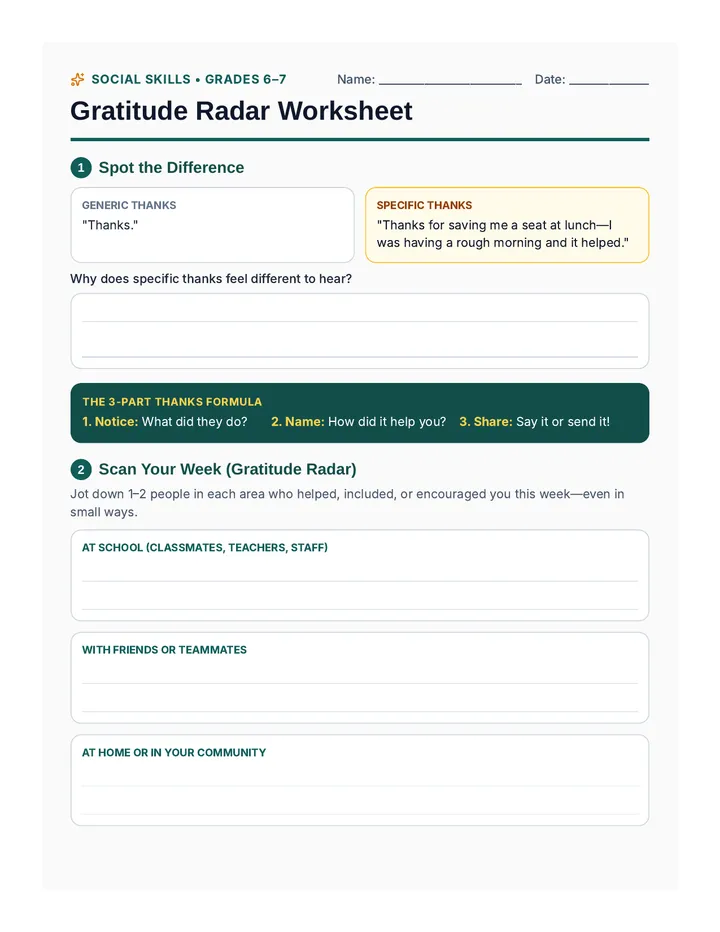
Gratitude Radar Worksheet Social Skills • Grades 6–7
Name: _________________________ Date: ______________
Gratitude Radar Worksheet
1 Spot the Difference
Generic Thanks
"Thanks."
Specific Thanks
"Thanks for saving me a seat at lunch—I was having a rough morning and it helped."
Why does specific thanks feel different to hear?
The 3-Part Thanks Formula
1. Notice: What did they do?
2. Name: How did it help you?
3. Share: Say it or send it!
2 Scan Your Week (Gratitude Radar)
Jot down 1–2 people in each area who helped, included, or encouraged you this week—even in small ways.
At School (classmates, teachers, staff)
With Friends or Teammates
At Home or in Your Community
3 Draft Your Shout-Out Cards
Cut & Share Optional
Pick two people from your radar. Use the 3-Part Formula: what they did + how it helped or mattered to you .
Card 1: For a Peer, Friend, or Classmate
To: ___________________________
From: _________________________
Thank you for... (what they did)
It mattered to me because... (the impact)
Card 2: For a Teacher, Coach, Staff Member, or Family Member
To: ___________________________
From: _________________________
Thank you for... (what they did)
It mattered to me because... (the impact)
4. 24-Hour Ripple Check-Out
Who will you deliver a thank-you to before tomorrow, and how (in person, note, or text)?
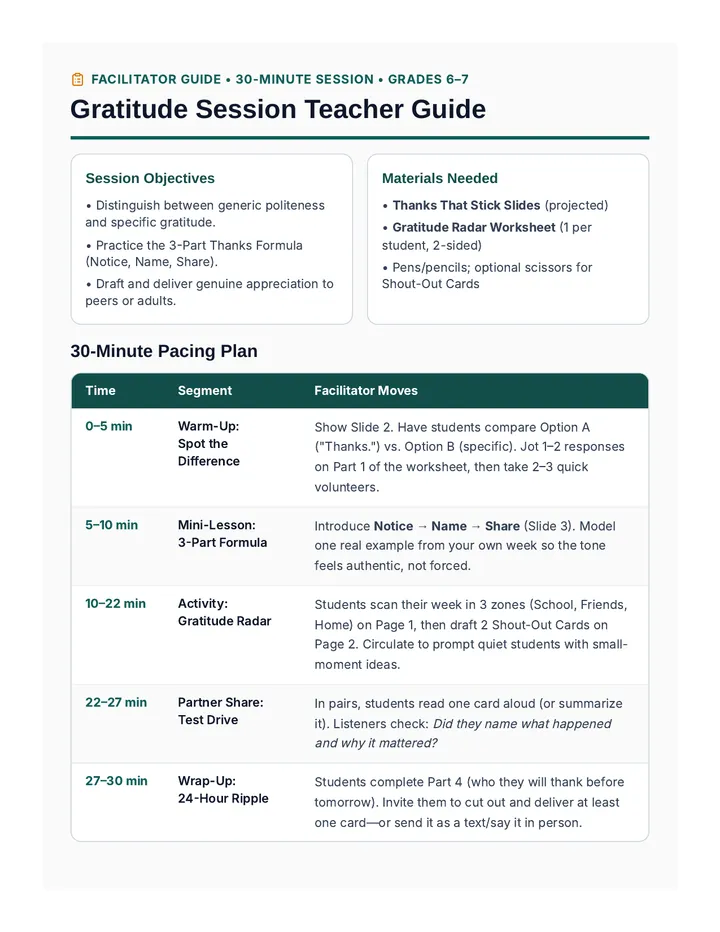
Gratitude Session Teacher Guide Facilitator Guide • 30-Minute Session • Grades 6–7
Gratitude Session Teacher Guide
Session Objectives
• Distinguish between generic politeness and specific gratitude.
• Practice the 3-Part Thanks Formula (Notice, Name, Share).
• Draft and deliver genuine appreciation to peers or adults.
Materials Needed
• Thanks That Stick Slides (projected)
• Gratitude Radar Worksheet (1 per student, 2-sided)
• Pens/pencils; optional scissors for Shout-Out Cards
30-Minute Pacing Plan
Time
Segment
Facilitator Moves
0–5 min
Warm-Up:
Spot the Difference
Show Slide 2. Have students compare Option A ("Thanks.") vs. Option B (specific). Jot 1–2 responses on Part 1 of the worksheet, then take 2–3 quick volunteers.
5–10 min
Mini-Lesson:
3-Part Formula
Introduce Notice → Name → Share (Slide 3). Model one real example from your own week so the tone feels authentic, not forced.
10–22 min
Activity:
Gratitude Radar
Students scan their week in 3 zones (School, Friends, Home) on Page 1, then draft 2 Shout-Out Cards on Page 2. Circulate to prompt quiet students with small-moment ideas.
22–27 min
Partner Share:
Test Drive
In pairs, students read one card aloud (or summarize it). Listeners check: Did they name what happened and why it mattered?
27–30 min
Wrap-Up:
24-Hour Ripple
Students complete Part 4 (who they will thank before tomorrow). Invite them to cut out and deliver at least one card—or send it as a text/say it in person.
Facilitation, Differentiation & Debrief
Keeping It Real for 6th & 7th Graders
Normalize small moments: Middle schoolers often think gratitude has to be big or dramatic. Remind them that sharing a charger, laughing at their joke, or holding the door counts.
Avoid forced positivity: Students don't have to feel grateful for hard things. Focus strictly on noticing when someone else made a moment a little easier or better.
Protect social safety: Never force students to read a personal note to the whole class; pair sharing keeps vulnerability low-stakes.
Differentiation & Support
Sentence Starters for Stuck Writers
• "I noticed when you..."
• "It really helped me because..."
• "I didn't say it at the time, but thanks for..."
Flexible Expression Options
• Allow bullet points instead of full sentences.
• Offer a comic-strip or doodle option inside the card.
• Let students thank a pet, coach, or online friend if home/school feels tricky.
Quick Debrief Questions (If Time Allows)
1. What was easier: thinking of someone to thank, or putting why it mattered into words?
2. How might someone's day change if they got one of these cards unexpectedly?
3. What is one way we can make specific thanks normal in this group or classroom?