Conflict Sparks Slides 7th Grade Health • Lesson 1
Conflict Sparks
Conflict isn't always a sign that something is broken. Sometimes, it's a signal pointing toward what matters most.
Essential Questions
Purpose • Power • Closure
Unit Compass
Three Questions That Guide Us
1. What good is this conflict doing to me?
2. What power does this conflict have over me?
3. How will I know when the conflict is over?
Core Concept
What Actually Is Conflict?
A Clash of Needs
Conflict happens whenever two people (or ideas) want different things, hold different values, or see the same moment differently.
Conflict is normal. Harm is optional.
Turn & Talk
Think of a small disagreement from this week (at school, home, or online). What did each person actually care about?
60 seconds with a partner
Essential Question 1
What good is this conflict doing to me?
Shows Boundaries
Tells you what feels unfair, uncomfortable, or important to protect.
Sparks Growth
Pushes you to listen, see another angle, and build stronger solutions.
Tests Trust
Working through tension honestly can make friendships more real.
Essential Question 2
What power does this conflict have over me?
When Conflict Drives You
• Replaying the argument in your head at night
• Losing focus in class or snapping at friends
• Checking your phone nonstop for a reply
• Avoiding places or people you usually like
Taking Back the Wheel
• Notice the physical clue (tight jaw, fast heart)
• Name what you can and cannot control
• Choose your next step instead of reacting
• Decide how much energy this deserves
Your Turn
Conflict Radar Check
On your Conflict Radar Worksheet, pick one real or realistic conflict and map out:
1 What good could come from facing it?
2 How much power does it have over your mood and choices?
3 What would "finished" actually look like?
Conflict Radar Worksheet Conflict Radar Worksheet
Lesson 1: Conflict Sparks • 7th Grade Health
Name: _________________________
Date: ______________
STEP 1
Describe the Conflict
Briefly describe a real disagreement (keep names private) or a common middle school conflict.
STEP 2
What good is this conflict doing to me?
What boundary, value, or lesson is this conflict showing you? How could working through it help you grow?
STEP 3
What power does this conflict have over me?
Circle your current stress level and explain how this conflict affects your mood, focus, or choices.
Power Meter: 1 (Barely bugs me) 2 3 (On my mind) 4 5 (Running my day)
STEP 4
How will I know when the conflict is over?
What specific action, agreement, or feeling will tell you this conflict is truly finished?
Reminder: You don't have to share private details out loud. Conflict Compass • Unit 1
Sparks Teacher Guide Lesson 1 Teacher Guide • 45 Minutes
Conflict Sparks: Introduction
Learning Objectives
• Define conflict as a normal clash of needs or perspectives.
• Identify positive outcomes that can emerge from healthy conflict.
• Recognize signs that a conflict holds emotional power over them.
Essential Questions
• What good is this conflict doing to me?
• What power does this conflict have over me?
• How will I know when the conflict is over?
Lesson Pacing & Facilitation
Time
Segment
Teacher Moves & Key Prompts
0–8 min
Hook & Questions (Slides 1–2)
Poll students: "Is conflict good, bad, or neutral?" Introduce the three essential questions as our unit compass.
8–18 min
What Is Conflict? (Slide 3)
Clarify that conflict ≠ violence or drama. Lead 60-second Turn & Talk on everyday clashes of needs.
18–28 min
Purpose & Power (Slides 4–5)
Ask: "When has a disagreement actually made a friendship or team better?" Contrast with signs conflict is driving your mood.
28–42 min
Conflict Radar (Slide 6)
Distribute Conflict Radar Worksheet . Remind students to keep names private. Circulate to support quiet reflection.
42–45 min
Quick Debrief
Ask 2–3 volunteers to share one positive thing conflict can reveal (without sharing personal details).
Differentiation
Support: Offer a sample scenario (e.g., "Two friends want different roles in a group project") for students who prefer not to write about a personal conflict.Extend: Ask students to identify whose perspective they haven't considered yet.
Watch Out For
Some 7th graders equate "conflict" with bullying or physical fights. Emphasize that bullying involves an imbalance of power, while everyday conflict happens between peers with shared stakes.
Conflict Compass • 7th Grade Health Materials: Slides, Conflict Radar Worksheet
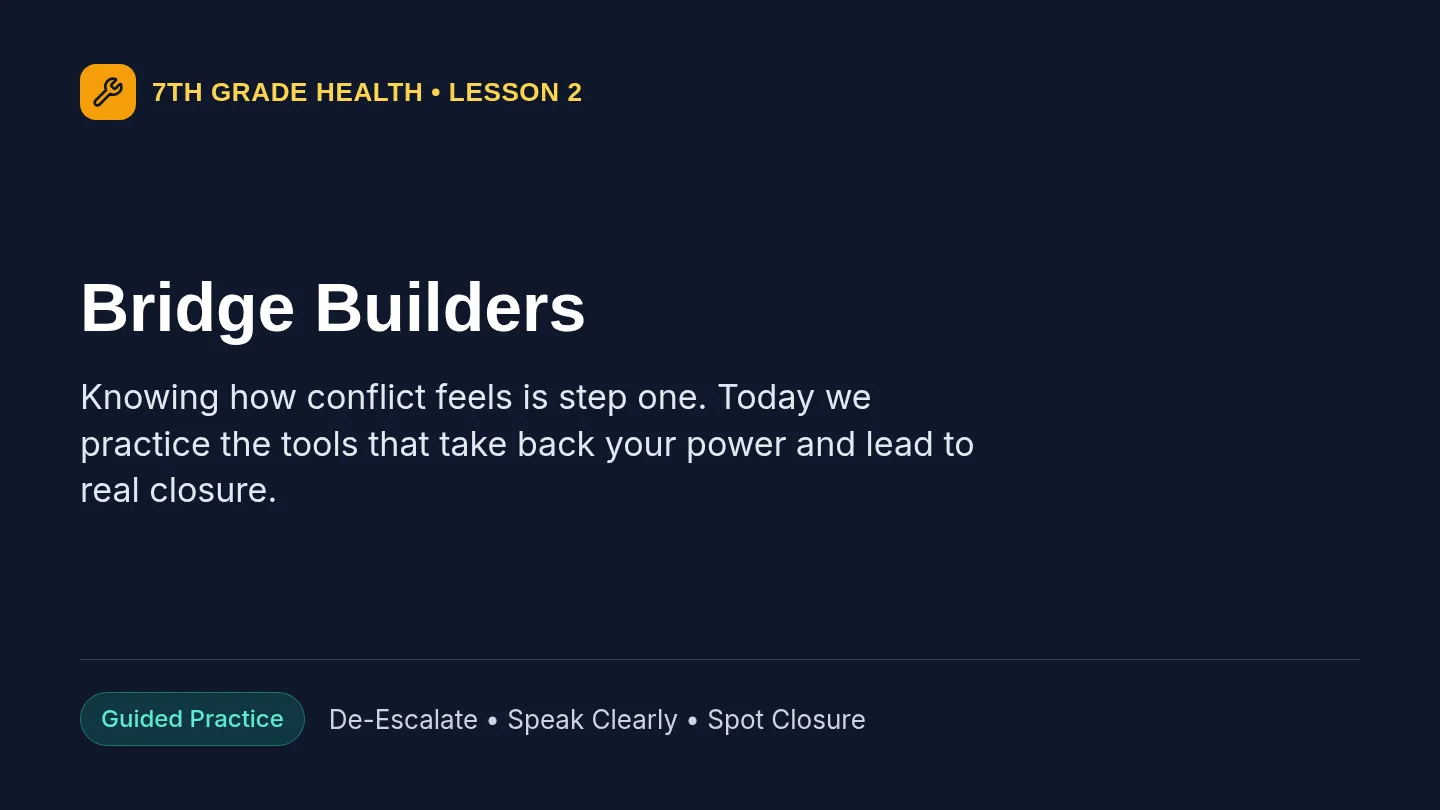
Bridge Builders Slides 7th Grade Health • Lesson 2
Bridge Builders
Knowing how conflict feels is step one. Today we practice the tools that take back your power and lead to real closure.
Guided Practice
De-Escalate • Speak Clearly • Spot Closure
Tool 1 • Lower the Heat
Before You Talk, Take Back Power
1. Hit Pause
Take 10 seconds or step away. Never type or yell at peak anger.
2. Check Tone
Drop your volume and uncross your arms. Calm body = calm brain.
3. Skip Traps
Avoid "You always..." or "You never..."—they lock people into defense.
Tool 2 • Speak Without Attacking
The 4-Part "I-Statement"
"I feel [emotion] when [specific action] because [impact]. What I need is [clear request]."
Example in Action
"I feel stressed when our slides aren't started the night before because I care about our grade. What I need is for us to split the last three slides right now."
Tool 3 • Find the Good
Listen to Understand, Not to Reload
Active Listening Moves
• Put screens away and face the person
• Let them finish without interrupting
• Mirror back: "So what I'm hearing is..."
• Ask: "Did I get that right?"
Why This Unlocks Growth
When you actually hear the other side, you discover what the conflict is really protecting—and that's how conflict does good.
Essential Question 3
How will I know when the conflict is over?
Fake Peace (Not Over)
• Saying "whatever" just to end the talk
• Giving the silent treatment or ghosting
• Venting to everyone else behind their back
Real Closure (Over)
• Both people agree on the next step or boundary
• You don't feel the urge to keep score
• The conflict loses its power over your mood
Guided Practice
Scenario Lab
With your partner, work through the Scenario Lab Worksheet. Practice:
1. Spot the Good & the Power
2. Draft a Calm I-Statement
3. Define Real Closure
Scenario Lab Worksheet Scenario Lab Worksheet
Lesson 2: Bridge Builders • 7th Grade Health
Name: _________________________
Date: ______________
I-Statement Formula: "I feel [emotion] when [specific action] because [impact] . What I need is [clear request] ."
Scenario A: The Group Project Overload
Partner Practice
You and Jordan are partners for a science poster due tomorrow. You finished your half three days ago, but Jordan keeps saying "I'll do it tonight" and still hasn't started. You feel frustrated and worried about your grade.
1. What good could this conflict do?
2. What power does it have right now?
3. Write a calm I-Statement to Jordan:
4. How will both of you know this conflict is over?
Scenario B: The Group Chat Screenshot
Partner Practice
You find out your friend Maya screenshotted a joke you sent in a private chat and shared it with another group. People are laughing about it at lunch, and you feel embarrassed and betrayed.
1. What boundary or value does this show?
2. How could you keep it from taking power?
3. Write a calm I-Statement to Maya:
4. What does real closure look like here (not fake peace)?
Conflict Compass • Lesson 2 Page 1 of 2
Role-Play Studio & Listening Check
Page 2
Scenario C: Your Choice (Hallway, Sports, or Home)
With your partner, invent a realistic 7th-grade conflict and plan how to talk it through.
The Situation:
Speaker's I-Statement:
Listener's Mirror-Back ("So what I'm hearing is..."):
Agreement / How Both Know It's Over:
Bridge Builder Quick Check (Check off after your role-play)
Used a calm, steady tone
Avoided "always" or "never"
Included all 4 parts of I-Statement
Mirrored back before replying
Conflict Compass • Lesson 2 Page 2 of 2
Builders Teacher Guide Lesson 2 Teacher Guide • 45 Minutes
Bridge Builders: Guided Practice
Lesson Pacing
Time
Segment
Teacher Moves
0–10 min
De-Escalation & I-Statements (Slides 1–3)
Model a bad "You-statement" vs. a calm 4-part I-statement. Have students point out the difference in tone.
10–18 min
Listening & Closure (Slides 4–5)
Discuss "fake peace" vs. "real closure." Ask: "How can you tell when someone says 'I'm fine' but the conflict isn't over?"
18–38 min
Scenario Lab (Slide 6)
Pairs complete Scenarios A & B, then role-play Scenario C. Coach pairs to use mirror-back listening.
38–45 min
Fishbowl Share
Invite 1–2 volunteer pairs to perform a 60-second role-play. Class identifies the I-statement and closure sign.
Scenario Lab Sample Key
Scenario A: Group Project Overload
Good: Clarifies shared expectations and responsibility. Power: Causes anxiety and resentment if unspoken.Sample I-Statement: "I feel stressed when your part isn't started yet because I want us both to get a good grade. What I need is a 20-minute work session together today."Closure: Both agree on a concrete deadline and check-in time.
Scenario B: Group Chat Screenshot
Good: Reveals an unspoken privacy boundary. Power: Can lead to rumination or retaliation if not addressed.Sample I-Statement: "I feel hurt when my private text gets shared without asking because I trust our group chat. What I need is for you to delete the screenshot and keep our chats private."Closure: Screenshot is deleted, boundary is acknowledged, and trust can begin rebuilding.
Role-Play Norms & Differentiation
Remind students to play the character , not escalate into real insults. For students anxious about acting, allow them to read their written I-statement aloud from their seat.
Conflict Compass • 7th Grade Health Materials: Slides, Scenario Lab Worksheet
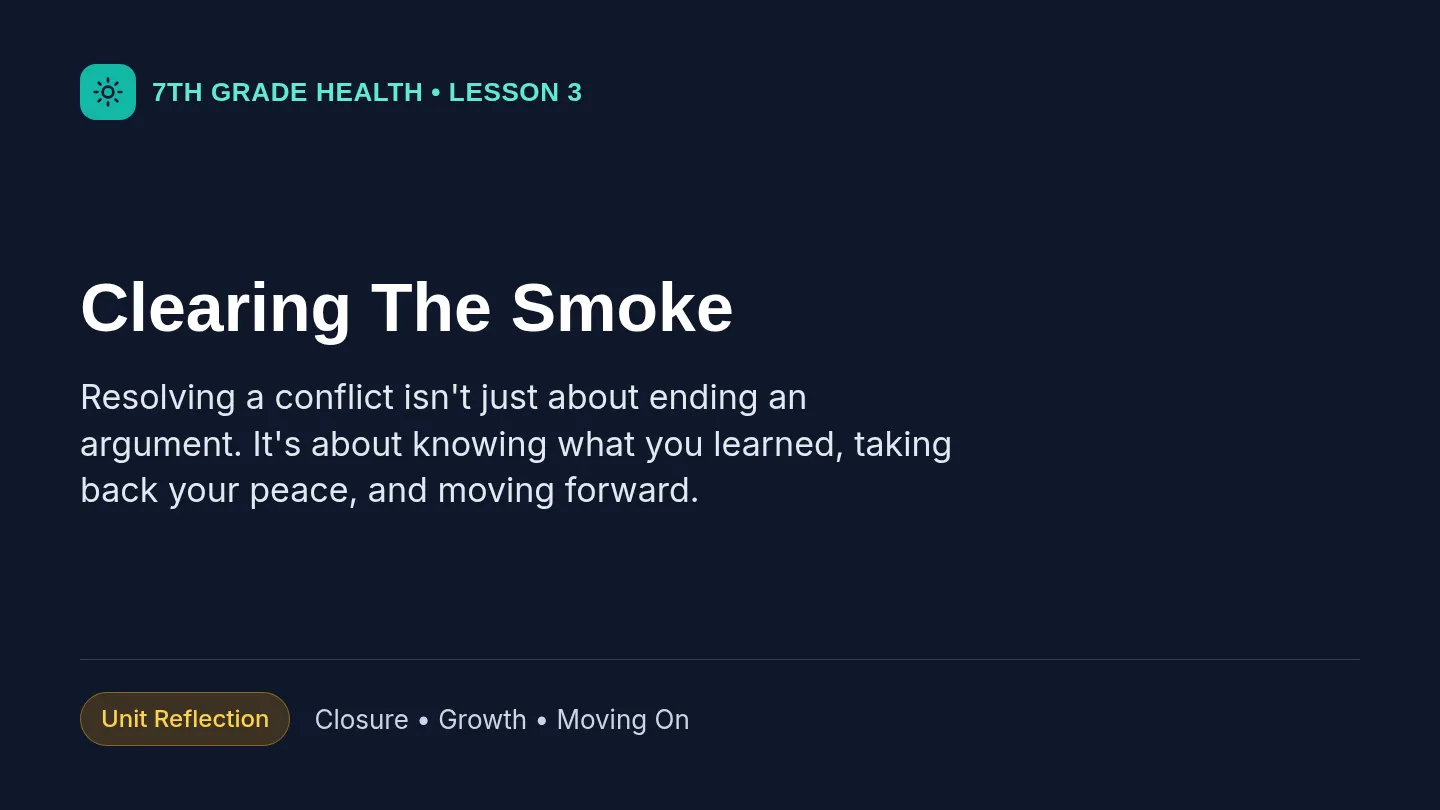
Clearing Smoke Slides 7th Grade Health • Lesson 3
Clearing The Smoke
Resolving a conflict isn't just about ending an argument. It's about knowing what you learned, taking back your peace, and moving forward.
Unit Reflection
Closure • Growth • Moving On
Looking Back
Our Three Questions Revisited
1. What good is this doing?
Conflict reveals your boundaries, values, and where trust needs repair.
2. What power does it have?
You notice when it steals your focus—and choose calm tools instead.
3. How do I know it's over?
Real closure means clarity, matched actions, and inner calm.
Closure Check
3 Signs a Conflict Is Truly Over
1
Clear Agreement or Boundary
Both people know what changes going forward—no guessing.
2
Actions Match Words
People follow through on what they promised, not just "my bad."
3
Your Mind Lets Go
You stop replaying it in your head and don't need to keep score.
Taking Back Control
What If They Won't Meet You Halfway?
Sometimes the other person won't apologize or change. You can still end the conflict's power over you.
• Set a firm boundary for your own peace
• Talk to a trusted adult if safety is an issue
• Focus your energy on friends who respect you
Final Step
Peace Check Reflection
Complete your Peace Check Reflection sheet to lock in your answers to all three essential questions.
Be honest with yourself: What is one conflict habit you're leaving behind, and one tool you're keeping?
Peace Check Reflection Peace Check Reflection
Lesson 3: Clearing The Smoke • 7th Grade Health
Name: _________________________
Date: ______________
1. Conflict Snapshot
Think of a conflict you resolved recently—or one you practiced in our Scenario Lab. Briefly name it:
2. What good did this conflict do to me?
What did it teach you about your boundaries, values, or how to communicate?
3. What power did it have—and how do I take my power back?
How did it affect your mood or focus, and what tool (pause, I-statement, boundary) helps you stay in control?
4. How will I know when a conflict is truly over?
Describe your personal signs of real closure (not fake peace):
My Conflict Compass Commitment
One communication habit I am leaving behind, and one skill I will use next time:
Conflict Compass • Unit 1 Wrap-Up 7th Grade Health
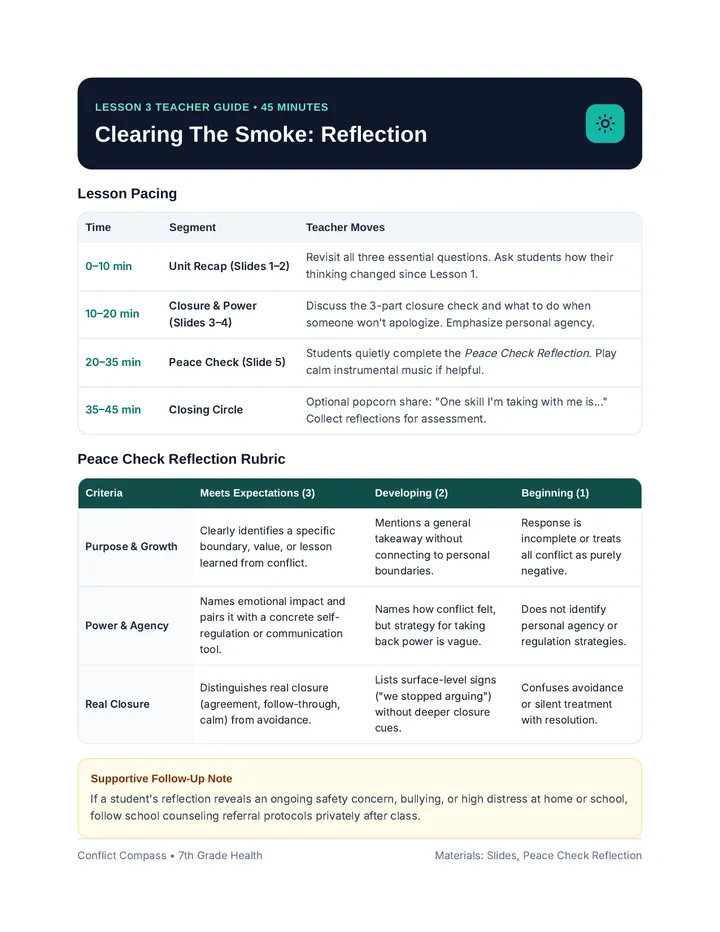
Reflection Teacher Guide Lesson 3 Teacher Guide • 45 Minutes
Clearing The Smoke: Reflection
Lesson Pacing
Time
Segment
Teacher Moves
0–10 min
Unit Recap (Slides 1–2)
Revisit all three essential questions. Ask students how their thinking changed since Lesson 1.
10–20 min
Closure & Power (Slides 3–4)
Discuss the 3-part closure check and what to do when someone won't apologize. Emphasize personal agency.
20–35 min
Peace Check (Slide 5)
Students quietly complete the Peace Check Reflection . Play calm instrumental music if helpful.
35–45 min
Closing Circle
Optional popcorn share: "One skill I'm taking with me is..." Collect reflections for assessment.
Peace Check Reflection Rubric
Criteria
Meets Expectations (3)
Developing (2)
Beginning (1)
Purpose & Growth
Clearly identifies a specific boundary, value, or lesson learned from conflict.
Mentions a general takeaway without connecting to personal boundaries.
Response is incomplete or treats all conflict as purely negative.
Power & Agency
Names emotional impact and pairs it with a concrete self-regulation or communication tool.
Names how conflict felt, but strategy for taking back power is vague.
Does not identify personal agency or regulation strategies.
Real Closure
Distinguishes real closure (agreement, follow-through, calm) from avoidance.
Lists surface-level signs ("we stopped arguing") without deeper closure cues.
Confuses avoidance or silent treatment with resolution.
Supportive Follow-Up Note
If a student's reflection reveals an ongoing safety concern, bullying, or high distress at home or school, follow school counseling referral protocols privately after class.
Conflict Compass • 7th Grade Health Materials: Slides, Peace Check Reflection