Bubble Crew Teacher Guide Kindergarten Small-Group Session • 25 Minutes
Personal Bubble Crew: Teacher Guide
Teaching personal space boundaries and how to ask for help with confidence.
🫧
Learning Goals
•Name what a "personal bubble" is and show where theirs is.
•Use kind, clear words to set a boundary ("Space, please").
•Identify trusted helpers and practice asking for help.
Quick Prep & Materials
•Bubble Buddies Slides projected or on a tablet
•My Bubble Activity Sheet (1 per student) + crayons
•Optional: 1 hula hoop or yarn loop to model a bubble
1. Warm-Up: 3 min
→
2. Short Lesson: 7 min
→
3. Guided Practice: 10 min
→
4. Reflection: 5 min
1. Welcome & Bubble Stretch (3 minutes)
Slides 1–2
Have students sit in a circle with room to stretch. Invite them to put their arms out wide and slowly spin in place without touching anyone.
Say: "Reach your arms out like airplane wings! That invisible circle around your body is your personal bubble . Today we'll learn how to protect our bubble and how to ask for help when we need it."
2. Short Lesson: Bubbles & Helpers (7 minutes)
Slides 3–5
A. What Is a Boundary? (3 min): Show Slide 3. Explain that a boundary is a rule that keeps our body and feelings safe. Different people have different-sized bubbles—sometimes we want a hug (ask first!), and sometimes we want space. Teach the hand-up "Bubble Stop" signal + calm words: "Space, please!"
B. Who Can Help & How to Ask (4 min): Show Slides 4–5. Brainstorm trusted helpers at school and home (teachers, counselors, parents, crossing guards, friends). Teach the 3-Step Ask:
1. LOOK
Face the helper
2. ASK
"Can you help me?"
3. LISTEN
Wait for the answer
Page 1 of 2
3. Guided Practice: Bubble Scenarios (10 minutes)
Slides 6–7
Read each short story aloud. Have pairs or volunteers act out the safe choice together, then have the whole group practice the words in unison.
Scenario 1: Too Close in Line
"Maya is standing in line, and her friend bumps right into her backpack."
Practice: Show a gentle hand-up stop sign and say, "Space, please! You're in my bubble."
Scenario 2: Ask Before Hugging
"Leo is super excited to see his friend Sam and wants to give a big hug."
Practice: Ask first: "Can I give you a hug?" Practice accepting both "Yes!" and "No thanks, high-five instead!"
Scenario 3: Stuck on a Zipper / Toy
"Noah's coat zipper is stuck and he feels frustrated. What can he do?"
Practice: Use the 3-Step Ask (Look, Ask, Listen) with a teacher: "Excuse me, can you help me with my zipper?"
Scenario 4: Someone Won't Leave Your Bubble
"A classmate keeps poking your arm even after you said 'Stop, please.'"
Practice: Walk to a trusted adult and say, "I asked for space and they didn't stop. Can you help me?"
4. Quick Reflection & Wrap-Up (5 minutes)
Slide 8 + Sheet
Hand out the My Bubble Activity Sheet . Students circle how their body feels when their bubble is safe, circle a trusted helper, and draw themselves inside their personal bubble.
Closing Circle Prompt: "Point to one person you can ask for help today, and whisper one kind word you can use to protect your bubble."
Kindergarten Support & Differentiation Tips
Non-Speaking / Shy Learners: Teach the hand-up "Bubble Stop" gesture and a "Help" picture card so students can set boundaries without words.
Movement Breaks: If energy rises during scenarios, do a 10-second "Shrink & Grow Your Bubble" stretch before sitting back down.
Page 2 of 2
Bubble Buddies Slides 🫧
Personal Bubble Crew
Keeping Our Bodies Safe & Asking for Help
🙆
Find Your Bubble!
1. Stretch your arms out wide like wings.
2. Spin slowly—make sure you don't touch a friend!
What Is a Boundary?
🫧
My Space
An invisible bubble around my body keeps me safe and comfy.
✋
My Words
Hold up a gentle hand and say:
Who Can Help Me?
👩🏫
Teachers
👨👩👧
Family
🤝
Friends
Asking for help is brave and smart!
How to Ask for Help
👀
1. Look
Face your helper.
🗣️
2. Ask
"Can you help me?"
👂
3. Listen
Wait for their answer.
Let's Practice!
Someone bumps into you in line or wants a hug you don't want.
✋ "Space, please!" or "High-five instead!"
Let's Practice!
Your zipper is stuck, or someone won't stop poking your bubble.
👀 Look → 🗣️ "Can you help me?" → 👂 Listen
🌟
Quick Reflection
How does my body feel when my bubble is safe?
😊 Calm 😄 Happy 🛡️ Safe
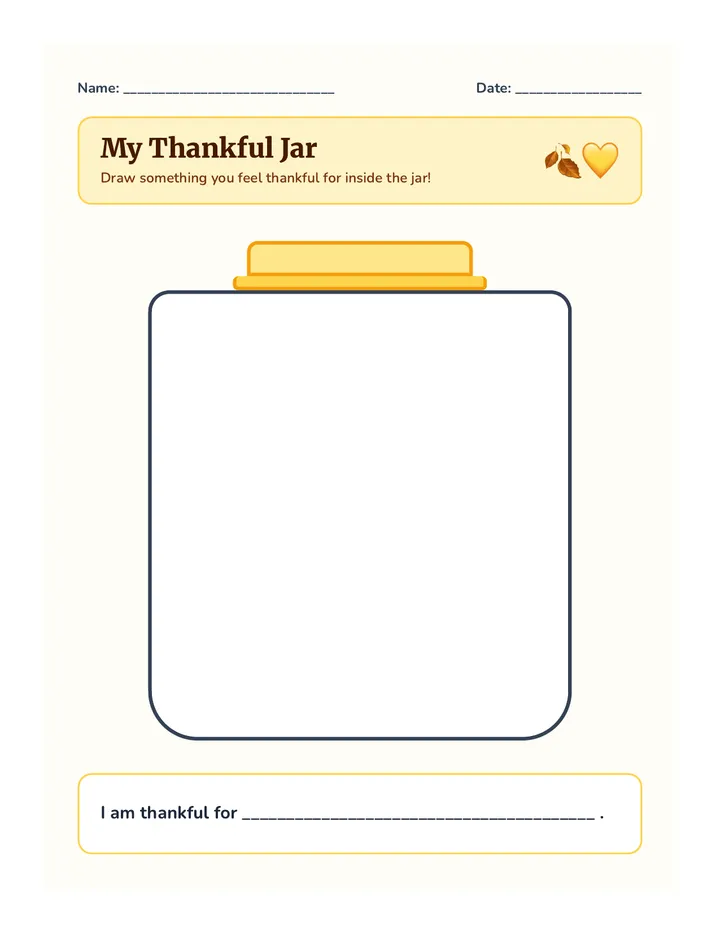
My Bubble Activity Sheet Name: ________________________
Date: ______________
My Bubble & My Helpers
Draw your safe space bubble and circle who can help you!
1. Draw yourself inside your personal bubble!
Remember: Your bubble keeps your body safe and comfy.
2. Circle 2 people you can ask for help:
👩🏫
Teacher
👨👩👧
Family
🤝
Friend
3. Quick Check-In: When my bubble is safe, I feel...
😊 Calm
😄 Happy
🛡️ Safe
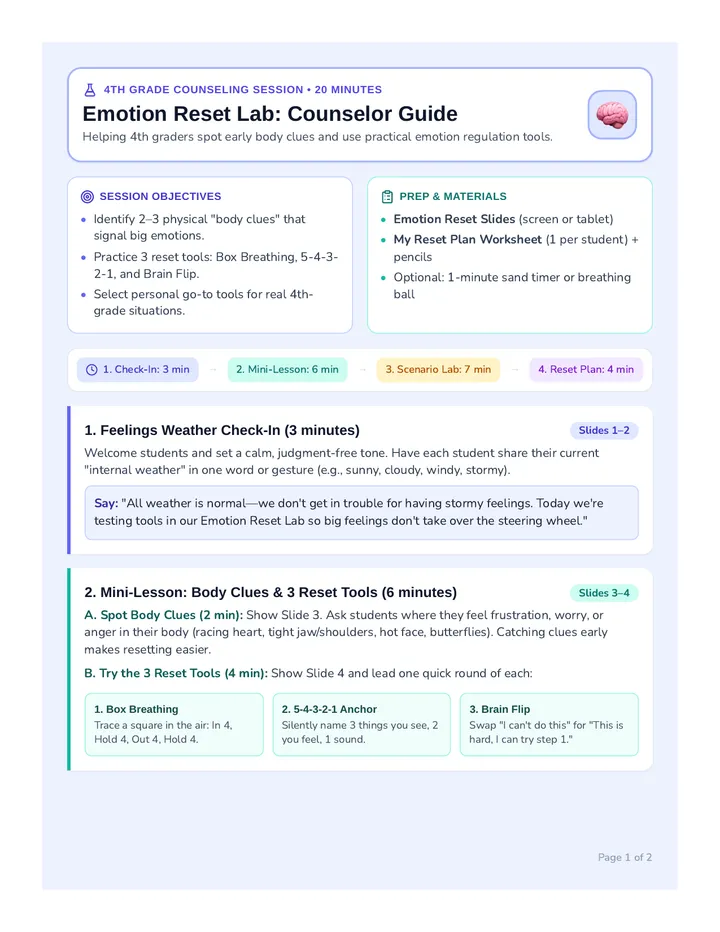
Emotion Reset Teacher Guide 4th Grade Counseling Session • 20 Minutes
Emotion Reset Lab: Counselor Guide
Helping 4th graders spot early body clues and use practical emotion regulation tools.
🧠
Session Objectives
•Identify 2–3 physical "body clues" that signal big emotions.
•Practice 3 reset tools: Box Breathing, 5-4-3-2-1, and Brain Flip.
•Select personal go-to tools for real 4th-grade situations.
Prep & Materials
•Emotion Reset Slides (screen or tablet)
•My Reset Plan Worksheet (1 per student) + pencils
•Optional: 1-minute sand timer or breathing ball
1. Check-In: 3 min
→
2. Mini-Lesson: 6 min
→
3. Scenario Lab: 7 min
→
4. Reset Plan: 4 min
1. Feelings Weather Check-In (3 minutes)
Slides 1–2
Welcome students and set a calm, judgment-free tone. Have each student share their current "internal weather" in one word or gesture (e.g., sunny, cloudy, windy, stormy).
Say: "All weather is normal—we don't get in trouble for having stormy feelings. Today we're testing tools in our Emotion Reset Lab so big feelings don't take over the steering wheel."
2. Mini-Lesson: Body Clues & 3 Reset Tools (6 minutes)
Slides 3–4
A. Spot Body Clues (2 min): Show Slide 3. Ask students where they feel frustration, worry, or anger in their body (racing heart, tight jaw/shoulders, hot face, butterflies). Catching clues early makes resetting easier.
B. Try the 3 Reset Tools (4 min): Show Slide 4 and lead one quick round of each:
1. Box Breathing
Trace a square in the air: In 4, Hold 4, Out 4, Hold 4.
2. 5-4-3-2-1 Anchor
Silently name 3 things you see, 2 you feel, 1 sound.
3. Brain Flip
Swap "I can't do this" for "This is hard, I can try step 1."
Page 1 of 2
3. Guided Practice: 4th-Grade Scenario Lab (7 minutes)
Slides 5–6
Read 2–3 scenarios below. For each one, ask: "What body clue might show up? Which Reset Tool would you test first?" Have the group practice the chosen tool together for 15 seconds.
Lab Case A: The Tough Math Quiz
"You flip over a math page and freeze on problem #1. Your stomach drops and your brain says, 'I'm going to fail.'"
Suggested Reset: 1 round of Box Breathing to calm the body + Brain Flip ("Skip #1 for now, start with one I know").
Lab Case B: Recess Argument
"Someone calls you 'out' in four-square when you know you were in. Your face gets hot and your fists clench."
Suggested Reset: Step back, do Box Breathing before speaking, or use 5-4-3-2-1 to cool down before asking a yard duty for help.
Lab Case C: Left Out at Lunch
"Your usual group is laughing at a table that looks full, and you feel a lump in your throat."
Suggested Reset: 5-4-3-2-1 Anchor to steady nerves + Brain Flip ("I can ask if there's room or sit with someone new today").
4. Personal Reset Plan & Closing (4 minutes)
Slide 7 + Sheet
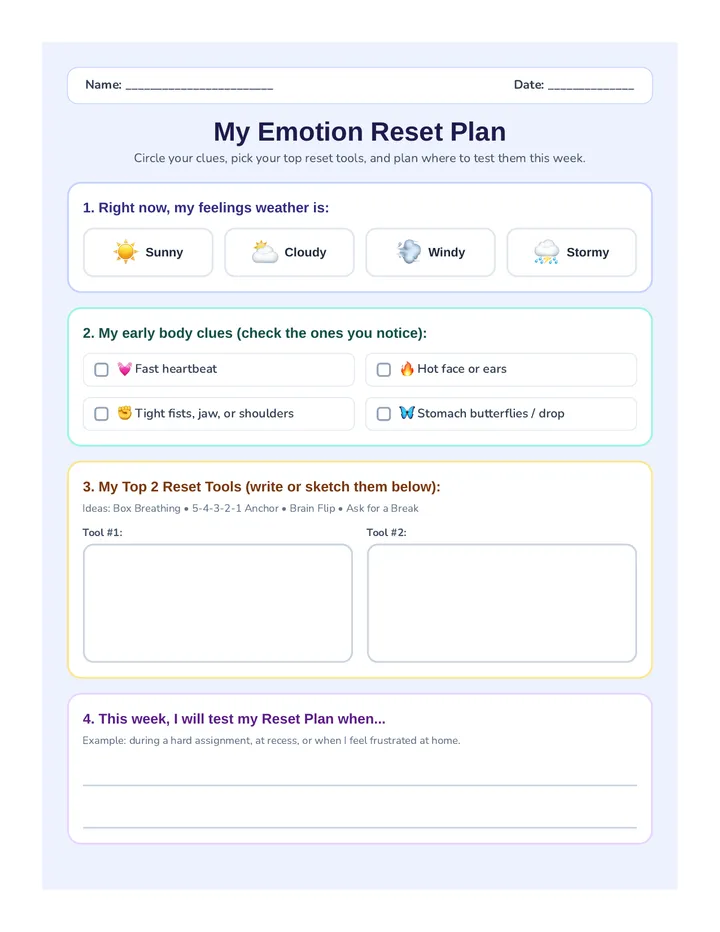
Distribute My Reset Plan Worksheet . Have students check off their top body clues, pick their favorite 2 Reset Tools, and jot down one place (class, recess, home) they'll test their plan this week.
Closing Whip-Around: "Share one tool you're keeping in your pocket this week—and pass if you'd rather just hold up 1, 2, or 3 fingers."
Counselor Facilitation & Differentiation Notes
Normalize & Validate: Remind 4th graders that regulation isn't about never getting mad—it's about choosing what we do next while feelings are big.
Low-Writing Option: Students who dislike writing can sketch icons or circle choices on their Reset Plan instead of writing full sentences.
Page 2 of 2
Emotion Reset Slides 🧠
Emotion Reset Lab
Spotting Body Clues & Choosing Your Reset Tools
Feelings Weather Check-In
☀️
Sunny
⛅
Cloudy
💨
Windy
⛈️
Stormy
All weather is normal. What is your weather right now?
Step 1: Spot Your Body Clues
💓
Fast Heartbeat
Body getting ready to react
🔥
Hot Face or Ears
Frustration or embarrassment
✊
Tight Fists or Jaw
Energy building up inside
🦋
Butterflies / Drop
Nervous or worried feeling
Step 2: Pick a Reset Tool
🟦
1. Box Breathing
In 4 • Hold 4
🖐️
2. 5-4-3-2-1
Notice 3 sights, 2 feels, 1 sound
🔄
3. Brain Flip
Swap "I can't" for "I can try step 1"
Scenario Lab #1
You flip over a tough math quiz and freeze on problem #1.
1. What body clue might show up?
2. Which Reset Tool will you test first?
Scenario Lab #2
Someone calls you "out" at recess when you know you were in.
1. What body clue might show up?
2. Which Reset Tool helps before you speak?
🧪
Build Your Reset Plan
On your worksheet, choose:
✓ Your top body clues • ✓ Your 2 go-to Reset Tools
My Reset Plan Worksheet Name: ________________________
Date: ______________
My Emotion Reset Plan
Circle your clues, pick your top reset tools, and plan where to test them this week.
1. Right now, my feelings weather is:
☀️ Sunny
⛅ Cloudy
💨 Windy
⛈️ Stormy
2. My early body clues (check the ones you notice):
💓 Fast heartbeat
🔥 Hot face or ears
✊ Tight fists, jaw, or shoulders
🦋 Stomach butterflies / drop
3. My Top 2 Reset Tools (write or sketch them below):
Ideas: Box Breathing • 5-4-3-2-1 Anchor • Brain Flip • Ask for a Break
Tool #1:
Tool #2:
4. This week, I will test my Reset Plan when...
Example: during a hard assignment, at recess, or when I feel frustrated at home.