Stay Steady Lesson Slides 3rd Grade SEL
Feelings Radar
Stay Safe, Stay Steady
How to notice big feelings, calm your body in our classroom, and ask a trusted adult for help.
1. Notice Clues
2. Calming Tools
3. Ask for Help
Today's 3 Big Goals
Notice Big Feelings
Spot body clues and tricky moments before feelings get too loud.
Use Calming Tools
Practice simple ways to reset your body right inside our classroom.
Ask for Help
Use your words or a signal to tell a trusted adult when you need a break.
Everyone has big feelings. Our goal is to stay safe and stay connected.
When Feelings Feel Like a Storm
Your Brain Says "RUN!"
When we feel frustrated, embarrassed, or overwhelmed, our brain can hit the alarm button. Sometimes our legs want to bolt out the door!
Why We Stay in the Room
Adults know where you are and can keep you safe.
You can get help or a break right away.
You stay part of our classroom team.
Running out feels like an escape, but staying gives you real power!
SKILL 1
Notice Big Feelings
Body Clues
• Heart beating fast
• Face feeling hot or red
• Tight fists or clenched jaw
• Butterflies or knots in tummy
• Feet wanting to bolt
Tricky Situations
• A math or reading task feels too hard
• The classroom gets too loud
• Feeling left out or corrected
• Making a mistake in front of others
• Losing a game or turn
Turn & Talk: What is ONE body clue you feel when you start getting upset?
SKILL 2
Use In-Class Calming Tools
4-4-4-4 Square Breath
Breathe in 4, hold 4, breathe out 4, rest 4.
Chair or Wall Push
Push down on your chair seat for 5 seconds, then release.
Squeeze & Melt
Squeeze your hands tight like lemons, then let them go limp.
Calm Spot Reset
Walk calmly to our classroom Calm Spot for 2 minutes.
All 4 tools keep your feet safe inside our classroom!
Let's Practice Right Now!
Practice 1 • 20 Seconds
Square Breathing
Trace a square in the air with your finger:Up: Breathe in 1-2-3-4Across: Hold 1-2-3-4Down: Breathe out 1-2-3-4Across: Rest 1-2-3-4
Practice 2 • 15 Seconds
Squeeze & Melt
1. Make tight fists and pull shoulders up to your ears.
Notice how your body feels after just 35 seconds of resetting!
SKILL 3
Ask a Trusted Adult for Help
WHEN WORK IS HARD
"I'm feeling stuck. Can you help me with the first step?"
WHEN YOU NEED A BREAK
"My feelings are getting big. May I take a 2-minute reset?"
WHEN WORDS FEEL HARD
Hold up your Break Pass or use our silent hand signal!
Asking for help is a strength, not a weakness. Trusted adults want to help!
Let's Act It Out!
SCENARIO 1
Frustrated with Math
Maya's face gets hot when she misses two problems. She wants to run out. What can she do instead?
SCENARIO 2
Too Loud in Group Work
Leo's table is loud and his tummy feels tight. How can he stay safe and ask for a reset?
SCENARIO 3
Bumped in Line
Sam gets bumped by accident and clenches his fists. What calming tool and words can he use?
For each one: 1. Name the body clue • 2. Pick a tool • 3. Say the help script!
Our Classroom Promise
When my feelings grow big...
I will notice my body clues.
I will stay inside our safe classroom.
I will use a calming tool or ask a trusted adult for help.
You are never alone in our classroom. We've got your back!
Feelings Radar Student Worksheet My Feelings Radar
Stay Safe, Stay Steady • 3rd Grade
Name: ______________________________
Date: ______________________________
PART 1
My Body Clues
Check the clues your body gives you when you start to feel upset or overwhelmed:
Heart beating fast
Face feels hot or red
Tight fists or clenched jaw
Knots or butterflies in tummy
Feet want to run out the door
Voice gets loud or frozen
Another body clue I notice is:
PART 2
My Tricky Moments at School
Circle any moments that make your feelings grow big:
Work feels too hard
Classroom gets too loud
Making a mistake
Feeling left out or corrected
Write or draw ONE tricky moment at school when you feel like leaving the room:
My Stay-Safe Plan
Page 2
PART 3
My In-Classroom Calming Tools
Check 3 tools you can use while keeping your feet safe inside our classroom:
4-4-4-4 Square Breathing
Chair or Wall Push-Ups
Squeeze & Melt Hands
2-Minute Calm Spot Reset
Quietly Count to 10
Use a Desk Fidget / Stress Ball
Draw or write about your #1 favorite calming tool:
PART 4
My Ask-for-Help Script
Practice what you can say to a trusted adult instead of leaving the room:
"Hi
, my body clue is
."
"I am feeling
. Can I please
?"
Who are 2 trusted adults at school you can ask for help?
I can stay safe, stay steady, and ask for help!
Sign: ____________________
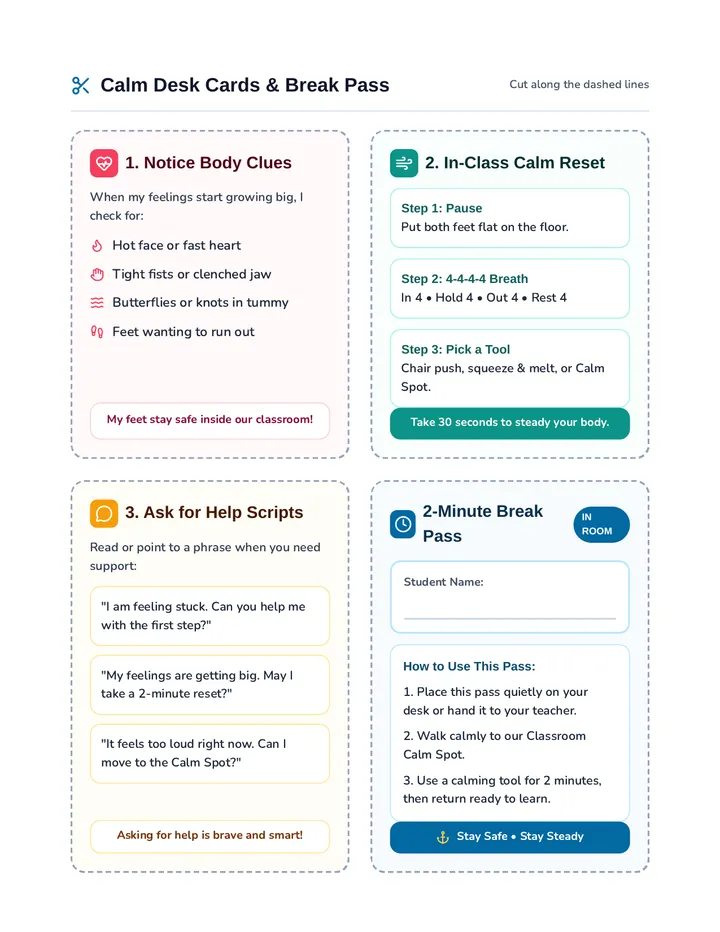
Calm Desk Reference Cards Calm Desk Cards & Break Pass
Cut along the dashed lines
1. Notice Body Clues
When my feelings start growing big, I check for:
Hot face or fast heart
Tight fists or clenched jaw
Butterflies or knots in tummy
Feet wanting to run out
My feet stay safe inside our classroom!
2. In-Class Calm Reset
Step 1: Pause
Put both feet flat on the floor.
Step 2: 4-4-4-4 Breath
In 4 • Hold 4 • Out 4 • Rest 4
Step 3: Pick a Tool
Chair push, squeeze & melt, or Calm Spot.
Take 30 seconds to steady your body.
3. Ask for Help Scripts
Read or point to a phrase when you need support:
"I am feeling stuck. Can you help me with the first step?"
"My feelings are getting big. May I take a 2-minute reset?"
"It feels too loud right now. Can I move to the Calm Spot?"
Asking for help is brave and smart!
2-Minute Break Pass
IN ROOM
Student Name:
How to Use This Pass:
1. Place this pass quietly on your desk or hand it to your teacher.
2. Walk calmly to our Classroom Calm Spot.
3. Use a calming tool for 2 minutes, then return ready to learn.
Stay Safe • Stay Steady
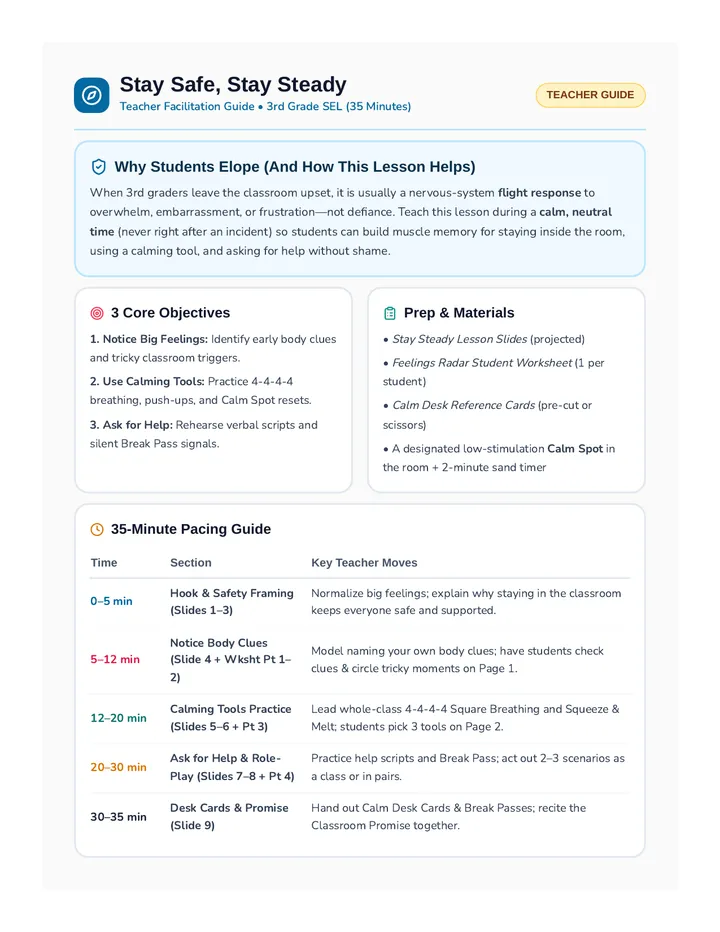
Stay Steady Teacher Guide Stay Safe, Stay Steady
Teacher Facilitation Guide • 3rd Grade SEL (35 Minutes)
TEACHER GUIDE
Why Students Elope (And How This Lesson Helps)
When 3rd graders leave the classroom upset, it is usually a nervous-system flight response to overwhelm, embarrassment, or frustration—not defiance. Teach this lesson during a calm, neutral time (never right after an incident) so students can build muscle memory for staying inside the room, using a calming tool, and asking for help without shame.
3 Core Objectives
1. Notice Big Feelings: Identify early body clues and tricky classroom triggers.2. Use Calming Tools: Practice 4-4-4-4 breathing, push-ups, and Calm Spot resets.3. Ask for Help: Rehearse verbal scripts and silent Break Pass signals.
Prep & Materials
• Stay Steady Lesson Slides (projected)
• Feelings Radar Student Worksheet (1 per student)
• Calm Desk Reference Cards (pre-cut or scissors)
• A designated low-stimulation Calm Spot in the room + 2-minute sand timer
35-Minute Pacing Guide
Time
Section
Key Teacher Moves
0–5 min
Hook & Safety Framing (Slides 1–3)
Normalize big feelings; explain why staying in the classroom keeps everyone safe and supported.
5–12 min
Notice Body Clues (Slide 4 + Wksht Pt 1–2)
Model naming your own body clues; have students check clues & circle tricky moments on Page 1.
12–20 min
Calming Tools Practice (Slides 5–6 + Pt 3)
Lead whole-class 4-4-4-4 Square Breathing and Squeeze & Melt; students pick 3 tools on Page 2.
20–30 min
Ask for Help & Role-Play (Slides 7–8 + Pt 4)
Practice help scripts and Break Pass; act out 2–3 scenarios as a class or in pairs.
30–35 min
Desk Cards & Promise (Slide 9)
Hand out Calm Desk Cards & Break Passes; recite the Classroom Promise together.
Facilitation Script & Support Plan
Page 2
Key Talking Points & Prompts
• Normalizing the Urge (Slide 3): "Have you ever felt so frustrated that your legs wanted to run right out the door? That's your brain's alarm system. Today we're practicing what to do inside our classroom so you stay safe and get what you need."
• Body Clues (Slide 4): "Feelings whisper before they shout. Notice your body clues—hot cheeks, tight fists, fast heart—so you can catch the wave early."
• Guided Practice (Slide 6): Physically demonstrate tracing a square in the air while counting 4-4-4-4 aloud. Follow immediately with Squeeze & Melt so students feel the contrast between tension and release.
• Role-Play Debrief (Slide 8): Keep role-plays upbeat! Have volunteers model both using words ("May I take a 2-minute reset?") and silently placing their Break Pass on their desk.
Classroom Setup: Preventing Elopement in the Moment
1. Create an In-Room Calm Spot: Place a quiet chair or cushion away from the doorway with a 2-minute timer, a copy of the Calm Desk Cards , and 1–2 quiet fidgets.2. Honor the Silent Break Pass: When a student holds up or places their Break Pass on their desk, nod calmly and point to the Calm Spot—no verbal lecturing or questioning in front of peers.3. Co-Regulate First, Problem-Solve Later: If a student is escalating near the door, lower your voice, keep your body calm, and offer a simple binary choice: "Calm Spot or chair push-ups?"
Differentiation & Individualized Support
For Students Who Elope Frequently
Pre-teach the Break Pass 1-on-1 before the whole-class lesson. Tape their Desk Card to the corner of their desk and schedule proactive 2-minute resets before known triggers (e.g., math block).
For Emerging Writers / ELLs
Allow students to draw their tricky moment and calming tool on the worksheet, and let them point to the 3 pre-written scripts on their Desk Card instead of speaking aloud when overwhelmed.