Harvest Heart Slides Thanksgiving Mini-Lesson
Harvest Heart Helpers
Practicing gratitude and calm coping strategies when holiday routines change.
Expressing Thanks
Managing Big Feelings
What Is Gratitude?
Gratitude means noticing the good things in our lives and letting others know we appreciate them.
People
Family, friends, teachers, or helpers who care for us.
Moments
Sharing a meal, playing a game, or laughing together.
Little Things
A warm coat, a cozy book, or a sunny fall afternoon.
The 3-Part Thank You
1. Who
Name the person
"Thank you, Aunt Maya..."
2. What
Name what they did
"...for baking the apple pie..."
3. Why
Share how it felt
"...it made dinner feel special!"
Try it out: Specific thank-yous help people feel truly seen and appreciated.
When Holidays Feel Tricky
Even fun holidays can bring stress, disappointment, or big feelings. That is completely normal!
Routine Changes
Different schedules, travel, or eating at a new time.
Crowded Spaces
Lots of noise, new people, or waiting for a turn.
Disappointment
A favorite dish runs out or plans change unexpectedly.
Feeling Tired
Long days can make small problems feel much bigger.
My Holiday Calm Toolkit
Leaf Breaths
Breathe in slowly for 4 counts, and blow out like a gentle autumn breeze.
Quiet Reset
Ask an adult for a 3-minute break in a calm spot to stretch or sip water.
Pivot Plan
Say: "Plan A changed, so I can choose Plan B!" Pick a backup activity.
Your Turn to Practice!
Step 1: Worksheet
Gratitude & Calm Plan
Write a 3-part thank you and choose your favorite calm-down strategies.
Step 2: Discussion Cards
Table Talk Practice
Take turns answering gratitude and problem-solving prompts with a partner.
Exit Reflection: What is one thing you are thankful for today, and one calm tool you can use this week?
Gratitude And Calm Worksheet Gratitude & Calm Worksheet
Harvest Heart Helpers • Page 1 of 2
Name: __________________________
Date: ___________________________
Part 1: My Gratitude Harvest
Gratitude means noticing the good things around us. Write or draw one thing you appreciate in each box below.
A Person Who Helps Me
A Favorite Moment
A Simple Everyday Thing
Part 2: Build a 3-Part Thank You
Choose someone you want to thank this week. Plan your message using all three parts, then write your full note below.
1. Who are you thanking?
2. What did they do or share with you?
3. Why did it matter or how did it make you feel?
Put it together! Write your full thank-you message here:
Skill Focus: Expressing Appreciation Tip: Specific thank-yous help others feel truly noticed!
Holiday Calm Toolkit
Harvest Heart Helpers • Page 2 of 2
Name: __________________________
Part 3: When Plans Change
Holidays can bring noise, waiting, or surprises. Circle any feelings you have noticed when a routine changes:
Excited
Overwhelmed
Disappointed
Tired
Frustrated
Worried
Part 4: Practice Your Calm Toolkit
Scenario: You were excited to play a game outside after dinner, but it starts raining and the living room is loud and crowded.
1. Check the coping tool you would try first:
Leaf Breaths
Quiet Reset
Pivot Plan
2. What is one respectful thing you could say or do next?
Part 5: Quick Reflection
One thing I am grateful for today:
One calm strategy I will keep in my toolkit this week:
Skill Focus: Managing Emotions & Routine Changes Remember: All feelings are okay, and we can choose calm actions.
Table Talk Discussion Cards Table Talk Discussion Cards
Set A: Gratitude & Kind Words
Gratitude #1
Helper Spotlight
Who is someone at school or home who helped you this week? What did they do, and how could you thank them?
Starter: "I appreciate _____ because _____."
Gratitude #2
Polite Pass
Imagine someone serves a food you are not sure you like. How can you respond respectfully while still showing appreciation?
Starter: "Thank you for making this! I will try a small bite."
Gratitude #3
Little Joy
What is one small, everyday thing (like a cozy sweater, a pencil, or a sunny walk) that you are thankful for today?
Starter: "One small thing I noticed today is _____."
Gratitude #4
Active Listener
Ask your partner what their favorite fall tradition is. Listen without interrupting, then repeat back one detail you heard!
Starter: "I heard you say you enjoy _____."
Gratitude #5
3-Part Thank You
Practice a 3-part thank you with your partner right now! Name who, what they did, and why it mattered.
Starter: "Thank you for _____, it helped me feel _____."
Gratitude #6
Include Everyone
You notice someone sitting quietly at the table or in class. What is a kind question you could ask to include them?
Starter: "Would you like to share _____?"
Cut along the dashed lines • Take turns reading a card and listening respectfully
Table Talk Discussion Cards
Set B: Calm & Flexible Thinking
Calm #1
Waiting for Dinner
Dinner is taking longer than expected and you are getting hungry and restless. What calm strategy can you use while you wait?
Starter: "While I wait, I can try _____."
Calm #2
Too Much Noise
Everyone is talking loudly and your brain feels overwhelmed. How can you politely ask an adult for a 3-minute quiet reset?
Starter: "Excuse me, may I take a quick break in _____?"
Calm #3
Plan B Pivot
You hoped to watch a parade or play outside, but plans changed. Name one feeling you might have and one Plan B idea!
Starter: "I feel _____, so my Plan B is _____."
Calm #4
Empty Pie Plate
Someone took the last slice of your favorite dessert! How can you handle that disappointment without snapping at anyone?
Starter: "I'm disappointed, so I will take a breath and _____."
Calm #5
Leaf Breaths Together
Practice two slow Leaf Breaths with your partner right now: breathe in for 4 counts, and blow out gently like an autumn breeze.
Check-in: "After breathing, my body feels _____."
Calm #6
Low Battery Check
At the end of a long holiday, your energy battery is low. What is one gentle way you can tell a family member you need rest?
Starter: "I had fun, and now I need a little quiet time to _____."
Cut along the dashed lines • Practice calm words and flexible thinking together
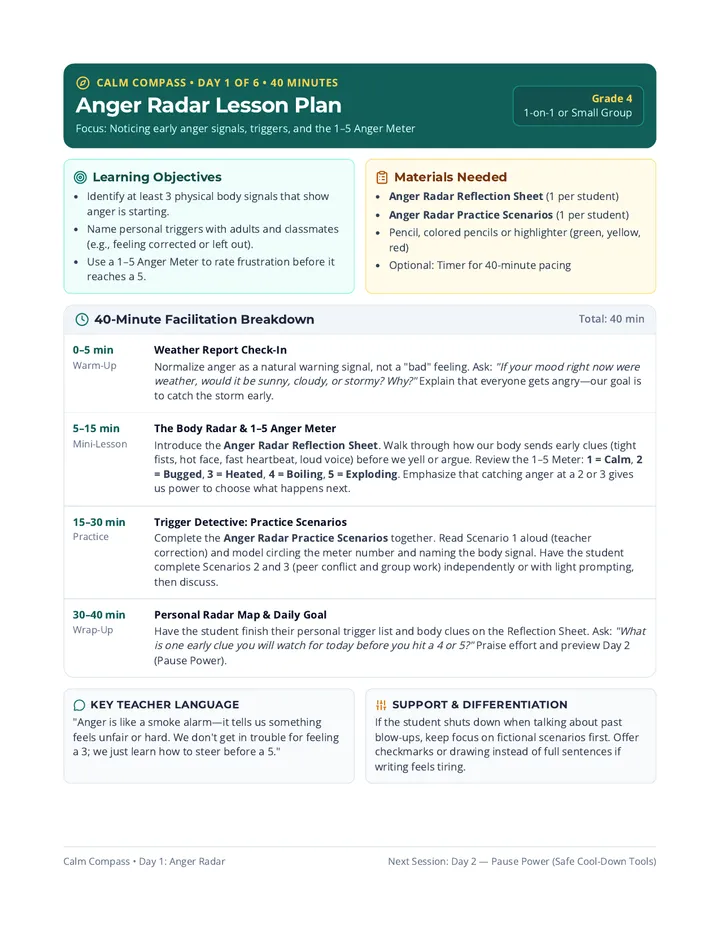
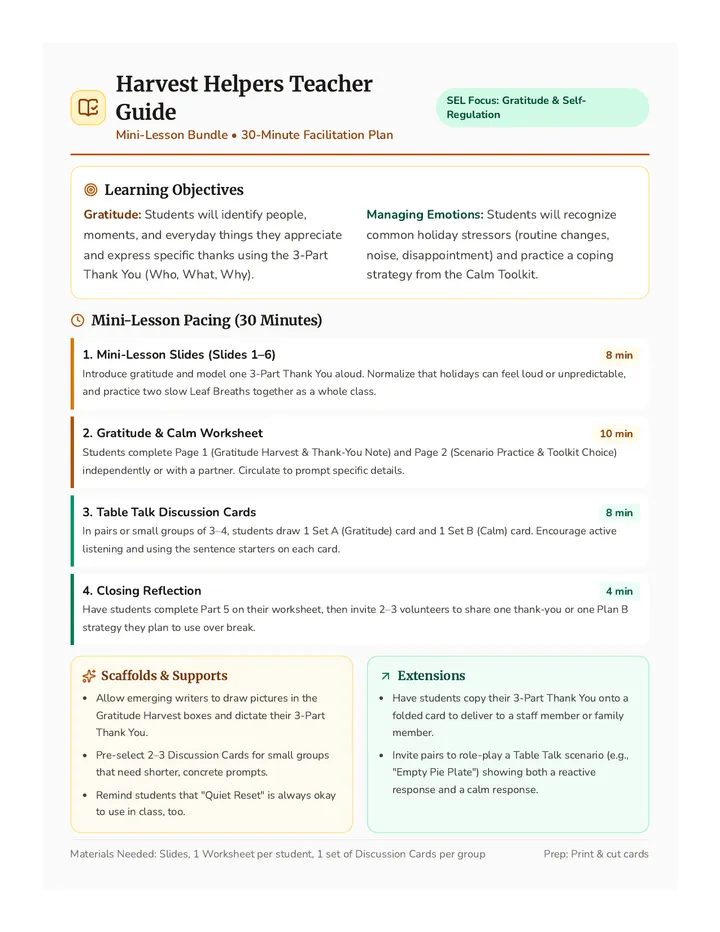
Harvest Helpers Teacher Guide Harvest Helpers Teacher Guide
Mini-Lesson Bundle • 30-Minute Facilitation Plan
SEL Focus: Gratitude & Self-Regulation
Learning Objectives
Gratitude: Students will identify people, moments, and everyday things they appreciate and express specific thanks using the 3-Part Thank You (Who, What, Why).
Managing Emotions: Students will recognize common holiday stressors (routine changes, noise, disappointment) and practice a coping strategy from the Calm Toolkit.
Mini-Lesson Pacing (30 Minutes)
1. Mini-Lesson Slides (Slides 1–6) 8 min
Introduce gratitude and model one 3-Part Thank You aloud. Normalize that holidays can feel loud or unpredictable, and practice two slow Leaf Breaths together as a whole class.
2. Gratitude & Calm Worksheet 10 min
Students complete Page 1 (Gratitude Harvest & Thank-You Note) and Page 2 (Scenario Practice & Toolkit Choice) independently or with a partner. Circulate to prompt specific details.
3. Table Talk Discussion Cards 8 min
In pairs or small groups of 3–4, students draw 1 Set A (Gratitude) card and 1 Set B (Calm) card. Encourage active listening and using the sentence starters on each card.
4. Closing Reflection 4 min
Have students complete Part 5 on their worksheet, then invite 2–3 volunteers to share one thank-you or one Plan B strategy they plan to use over break.
Scaffolds & Supports
Allow emerging writers to draw pictures in the Gratitude Harvest boxes and dictate their 3-Part Thank You.
Pre-select 2–3 Discussion Cards for small groups that need shorter, concrete prompts.
Remind students that "Quiet Reset" is always okay to use in class, too.
Extensions
Have students copy their 3-Part Thank You onto a folded card to deliver to a staff member or family member.
Invite pairs to role-play a Table Talk scenario (e.g., "Empty Pie Plate") showing both a reactive response and a calm response.
Materials Needed: Slides, 1 Worksheet per student, 1 set of Discussion Cards per group Prep: Print & cut cards