Anger Radar Lesson Plan Calm Compass • Day 1 of 6 • 40 Minutes
Anger Radar Lesson Plan
Focus: Noticing early anger signals, triggers, and the 1–5 Anger Meter
Grade 4
1-on-1 or Small Group
Learning Objectives
Identify at least 3 physical body signals that show anger is starting.
Name personal triggers with adults and classmates (e.g., feeling corrected or left out).
Use a 1–5 Anger Meter to rate frustration before it reaches a 5.
Materials Needed
Anger Radar Reflection Sheet (1 per student)Anger Radar Practice Scenarios (1 per student)Pencil, colored pencils or highlighter (green, yellow, red)
Optional: Timer for 40-minute pacing
40-Minute Facilitation Breakdown
Total: 40 min
0–5 min
Weather Report Check-In
Normalize anger as a natural warning signal, not a "bad" feeling. Ask: "If your mood right now were weather, would it be sunny, cloudy, or stormy? Why?" Explain that everyone gets angry—our goal is to catch the storm early.
5–15 min
The Body Radar & 1–5 Anger Meter
Introduce the Anger Radar Reflection Sheet . Walk through how our body sends early clues (tight fists, hot face, fast heartbeat, loud voice) before we yell or argue. Review the 1–5 Meter: 1 = Calm , 2 = Bugged , 3 = Heated , 4 = Boiling , 5 = Exploding . Emphasize that catching anger at a 2 or 3 gives us power to choose what happens next.
15–30 min
Trigger Detective: Practice Scenarios
Complete the Anger Radar Practice Scenarios together. Read Scenario 1 aloud (teacher correction) and model circling the meter number and naming the body signal. Have the student complete Scenarios 2 and 3 (peer conflict and group work) independently or with light prompting, then discuss.
30–40 min
Personal Radar Map & Daily Goal
Have the student finish their personal trigger list and body clues on the Reflection Sheet. Ask: "What is one early clue you will watch for today before you hit a 4 or 5?" Praise effort and preview Day 2 (Pause Power).
Key Teacher Language
"Anger is like a smoke alarm—it tells us something feels unfair or hard. We don't get in trouble for feeling a 3; we just learn how to steer before a 5."
Support & Differentiation
If the student shuts down when talking about past blow-ups, keep focus on fictional scenarios first. Offer checkmarks or drawing instead of full sentences if writing feels tiring.
Calm Compass • Day 1: Anger Radar Next Session: Day 2 — Pause Power (Safe Cool-Down Tools)
Anger Radar Reflection Sheet Anger Radar Reflection Sheet
DAY 1
Name:
Date:
1. My Body Warning Signals
Check the clues your body gives you when frustration starts to build:
Tight fists or jaw Hot face or ears Fast heartbeat Tight stomach Loud or sharp voice Wanting to stomp/throw
2. The 1–5 Anger Meter
Read each level. Circle the level where you usually first notice your anger:
1
Calm
Body relaxed, ready to learn
2
Bugged
Small sigh, slightly annoyed
3
Heated
Face warm, hard to focus
4
Boiling
Ready to argue or yell
5
Exploding
Out of control, unsafe
3. What Sparks My Anger?
With Classmates (ex: teasing, losing a game):
With Adults (ex: being corrected, hard work):
4. My Early Warning Goal
One body clue I will watch for today so I can catch my anger at a 2 or 3:
Calm Compass • Day 1 Student Reflection Notice Early • Stay Steady
Anger Radar Practice Scenarios Anger Radar Practice Scenarios
DAY 1
Name:
Date:
Read each 4th-grade situation. Circle the Anger Meter level, then write the body clues and why the moment feels frustrating.
Scenario 1: The Teacher Correction Anger Meter: 1 2 3 4 5
You are talking quietly to your desk partner while finishing a math problem. Your teacher says in front of the class, "Stop talking and get back to work." Other kids look at you, and you feel embarrassed.
Body clues you might notice:
What triggered the anger?
Scenario 2: Out at Four Square Anger Meter: 1 2 3 4 5
At recess, the ball hits the line. You think it was in, but two classmates yell, "You're out! Go to the back of the line!" You feel like they are ganging up on you.
Body clues you might notice:
What triggered the anger?
Scenario 3: Group Poster Trouble Anger Meter: 1 2 3 4 5
Your science group is making a poster. You spent 10 minutes drawing the title, and a classmate grabs the marker and scribbles over part of it to "fix" it.
Body clues you might notice:
What triggered the anger?
Calm Compass • Day 1 Practice Scenarios Spot the Signal Early
Pause Power Lesson Plan Calm Compass • Day 2 of 6 • 40 Minutes
Pause Power Lesson Plan
Focus: Choosing safe cool-down strategies to regain control
Grade 4
1-on-1 or Small Group
Learning Objectives
Practice 3 safe cool-down tools (Box Breathing, Wall Push/Stretch, Calm Self-Talk).
Select a personal "Top 3" cool-down menu for classroom and recess use.
Match a safe reset strategy to high-frustration scenarios.
Materials Needed
Pause Power Toolkit Sheet (1 per student)Pause Power Practice Scenarios (1 per student)Pencil or highlighter
Optional: Small index card for a desk "Reset Menu"
40-Minute Facilitation Breakdown
Total: 40 min
0–5 min
Radar Review & The Pause Button
Review Day 1: ask the student to name 1 body clue they noticed since yesterday. Introduce the idea of a mental Pause Button —a 10-second break between feeling mad and doing something we regret.
5–15 min
Test-Drive 3 Safe Cool-Down Tools
Practice each tool physically together using the Pause Power Toolkit Sheet : (1) 4-4-4 Breathing (inhale 4, hold 4, exhale 4), (2) Silent Muscle Reset (hands pressed together or wall push for 5 seconds, then release), and (3) Coach Self-Talk ("I can handle this," "Wait 10 seconds"). Have the student rate which felt best.
15–30 min
Pick the Reset: Practice Scenarios
Work through the Pause Power Practice Scenarios . For each scenario, contrast an unsafe reaction (yelling, throwing, storming off) with a safe Pause Power move . Role-play one scenario so the student practices using a calm voice and body reset in real time.
30–40 min
Build My Top 3 Toolkit
Have the student complete the bottom of the Toolkit Sheet by choosing their Top 3 strategies for class and recess. Agree on a discreet signal (e.g., tapping a desk card) they can use with the teacher when they need a 2-minute reset.
Key Teacher Language
"Taking a pause doesn't mean you're weak or giving up. It means you're the boss of your brain, not your anger."
Support & Differentiation
Some 4th graders feel embarrassed doing deep breathing in front of peers. Emphasize "stealth resets" (like pressing palms together under the desk or slow exhales) that nobody notices.
Calm Compass • Day 2: Pause Power Next Session: Day 3 — Steady With Adults
Pause Power Toolkit Sheet Pause Power Toolkit Sheet
DAY 2
Name:
Date:
1. Test-Drive Cool-Down Tools
Try each tool today. Circle whether it felt Helpful , Okay , or Not for Me .
4-4-4 Square Breathing
Breathe in 4 sec, hold 4 sec, breathe out slowly 4 sec.
Helpful | Okay | Not for Me
Stealth Palm Press
Press your palms together under your desk for 5 seconds, then relax.
Helpful | Okay | Not for Me
Water / Walk Reset
Ask for a quick sip of water or a 1-minute reset spot break.
Helpful | Okay | Not for Me
10-Second Count & Drop Shoulders
Drop your shoulders down and count backward from 10 in your head.
Helpful | Okay | Not for Me
2. My Calm Coach Phrase
Check one phrase—or write your own—to say in your head when you hit a Level 3:
"Pause first. I am in charge."
"This is annoying, not an emergency."
My own calm phrase:
3. My Top 3 Safe Reset Plan
Write the 3 safe moves you will try before yelling, arguing, or shutting down:
Move #1 (At my desk):
Move #2 (At recess):
Move #3 (When heated):
Calm Compass • Day 2 Toolkit Sheet Pause First • Choose Safe
Pause Power Practice Scenarios Pause Power Practice Scenarios
DAY 2
Name:
Date:
For each moment, write a safe Pause Power tool to use and a calm phrase to tell yourself.
Scenario 1: Hard Assignment & Loud Room
You are stuck on a 4th-grade writing prompt. Two kids behind you are tapping pencils. You feel like crumpling your paper and yelling, "Be quiet!"
Safe Pause Power move I can do:
Calm self-talk phrase:
Scenario 2: Line-Up Shove
Walking back from lunch, a classmate bumps into your shoulder and doesn't say sorry. Your fists clench and you want to shove them back.
Safe Pause Power move I can do:
Calm self-talk phrase:
Scenario 3: Lost Privilege
The recess monitor blows the whistle and says your whole table has to wait 2 minutes before going out because people were talking. You weren't talking, and your face feels hot.
Safe Pause Power move I can do:
Calm self-talk phrase:
Calm Compass • Day 2 Practice Scenarios Regain Control • Stay Safe
Steady With Adults Lesson Plan Calm Compass • Day 3 of 6 • 40 Minutes
Steady With Adults Lesson Plan
Focus: Handling corrections, following directions, and asking adults for help
Grade 4
1-on-1 or Small Group
Learning Objectives
Use the 3-Step Reset & Reply when an adult gives a correction or direction.
Separate "feeling embarrassed" from arguing back in the moment.
Ask an adult for help or a break using a respectful, steady voice.
Materials Needed
Steady With Adults Reflection Sheet (1 per student)Steady With Adults Practice Scenarios (1 per student)Pencil or highlighter
40-Minute Facilitation Breakdown
Total: 40 min
0–5 min
Why Corrections Sting
Validate that getting corrected by a teacher, lunch monitor, or parent can feel embarrassing or unfair. Ask: "What happens when you argue back right away? Does it make the problem smaller or bigger?"
5–15 min
The 3-Step "Accept & Ask" Routine
Introduce the Steady With Adults Reflection Sheet . Teach 3 steps for handling a direction: (1) Pause & Nod (keep body calm, no eye-rolling), (2) Follow First ("Okay," do the direction), and (3) Ask Respectfully Later ("Can I explain what happened?" or "May I have help?"). Practice asking for help scripts together.
15–30 min
Adult Talk Role-Play: Practice Scenarios
Complete the Steady With Adults Practice Scenarios . Have the student write a calm reply for each situation (teacher correction, substitute direction, asking for help on hard work). Then role-play 1–2 scenarios out loud, coaching tone of voice and body posture.
30–40 min
Personal Help-Seeking Script
Have the student fill in their go-to "Ask an Adult" script on the Reflection Sheet. Identify 1–2 trusted adults at school they can use this script with today.
Key Teacher Language
"Following a direction first doesn't mean you don't have a voice. It shows you're steady enough to be heard after the moment cools down."
Support & Differentiation
If verbal role-play feels intimidating, let the student be the "teacher" first while you model the calm student response, then switch roles.
Calm Compass • Day 3: Steady With Adults Next Session: Day 4 — Two Sides Story
Steady With Adults Reflection Sheet Steady With Adults Reflection Sheet
DAY 3
Name:
Date:
1. The 3-Step "Accept & Ask" Routine
When an adult gives a correction or direction, these 3 steps keep things from blowing up:
Step 1: Pause & Nod
Take 1 slow breath. Keep hands still and voice quiet.
Step 2: Follow First
Say "Okay" and follow the direction right away.
Step 3: Ask Later
Wait until calm, then ask to share your side or get help.
2. Check-In: Talking With Adults
Which adult moment feels hardest for you? (Check all that fit):
Being corrected in front of classmates Getting blamed when others were talking too Asking for help when work feels confusing Stopping a fun activity when told
Why is that moment hard? What do you wish adults knew?
3. My Respectful Ask-for-Help Scripts
Write a calm sentence you can say to an adult in each situation:
When I need help on classwork:
When I need a 2-minute cool-down break:
Two trusted adults at school I can talk to:
Calm Compass • Day 3 Reflection Sheet Steady Voice • Respectful Ask
Steady With Adults Practice Scenarios Steady With Adults Practice Scenarios
DAY 3
Name:
Date:
Read each moment with an adult. Write what you can do first and the calm words you can say.
Scenario 1: Moving Seats
During reading, your teacher whispers, "Please move to the quiet table so you can focus." You feel annoyed because your friend was the one talking.
What I can do first (Follow First):
Calm words I can say later:
Scenario 2: Stuck on Fractions
Everyone else seems to understand the math worksheet, and you don't get Problem #3. You feel like slamming your pencil down and saying, "This is stupid!"
How to get the teacher's attention calmly:
Respectful words to ask for help:
Scenario 3: Substitute Teacher Rule
A substitute teacher says, "No one can use the classroom library today." Your regular teacher usually lets you read there when you finish early.
How to stay steady (body & voice):
Respectful question or backup choice:
Calm Compass • Day 3 Practice Scenarios Pause • Follow • Ask Respectfully
Two Sides Story Lesson Plan Calm Compass • Day 4 of 6 • 40 Minutes
Two Sides Story Lesson Plan
Focus: Listening, perspective-taking, and I-statements with classmates
Grade 4
1-on-1 or Small Group
Learning Objectives
Describe both sides of a peer disagreement without name-calling or blaming.
Practice 2 active listening habits (eye contact/calm body, repeating back).
Build an I-Statement : "I feel ___ when ___ because ___. Next time, please ___."
Materials Needed
Two Sides Story Reflection Sheet (1 per student)Two Sides Story Practice Scenarios (1 per student)Pencil
40-Minute Facilitation Breakdown
Total: 40 min
0–5 min
The 6 vs. 9 Perspective Trick
Draw a large "6" on a piece of paper between you and the student. Ask what number you see (9) vs. what they see (6). Explain that conflicts often happen because two people are looking at the same moment from different sides.
5–15 min
Listening & I-Statements
Walk through the Two Sides Story Reflection Sheet . Teach "Listen to Understand" (no interrupting, repeat back: "So you felt mad because..." ). Then contrast "You-Blame" ("You always cheat!" ) with an I-Statement ("I feel frustrated when the rules change because I want it to be fair." ).
15–30 min
Both Sides Detective: Practice Scenarios
Complete the Two Sides Story Practice Scenarios . For each peer conflict, guide the student to guess what the other kid might be thinking or feeling, then write a calm I-Statement they could say.
30–40 min
Real-Life I-Statement Practice
Have the student finish the bottom of the Reflection Sheet by writing one I-Statement for a common peer annoyance (e.g., borrowing supplies without asking). Read it aloud in a steady voice.
Key Teacher Language
"Understanding someone else's side doesn't mean you agree with them. It just gives you clues so you can solve the problem instead of fighting."
Support & Differentiation
If the student insists "the other kid is just mean," offer two possible neutral reasons (e.g., "Maybe they didn't hear you" or "Maybe they were embarrassed too").
Calm Compass • Day 4: Two Sides Story Next Session: Day 5 — Fair Fix Steps
Two Sides Story Reflection Sheet Two Sides Story Reflection Sheet
DAY 4
Name:
Date:
1. Listen to Understand Checklist
Check the listening habits you want to practice when a classmate is talking:
Wait until they finish without interrupting Keep a calm face (no eye-rolling) Repeat back: "So you felt ___ because ___" Ask: "What did it look like from your side?"
2. See Both Sides
Think of a disagreement you had with a classmate recently (or a common one at school):
My Side (What I saw & felt):
Their Side (What they might have seen/felt):
3. Build an I-Statement
Formula: "I feel ________ when ________ because ________. Next time, please ________."
Write your own I-Statement for a classmate:
Calm Compass • Day 4 Reflection Sheet Listen First • Speak With "I"
Two Sides Story Practice Scenarios Two Sides Story Practice Scenarios
DAY 4
Name:
Date:
For each peer conflict, imagine the other classmate's point of view, then write a calm I-Statement .
Scenario 1: Borrowed Markers
You come back from the water fountain and see Maya using your favorite blue marker without asking. You feel like yelling, "Give that back, thief!"
What Maya might be thinking:
Calm I-Statement I can say:
Scenario 2: Kickball Captain
Leo picks his best friend to pitch instead of you, even though you asked first. You want to kick the ball away and quit the game.
What Leo might be thinking:
Calm I-Statement I can say:
Scenario 3: Laughing at Lunch
You drop your fork at lunch and two kids at the next table start laughing. You think they are laughing at you and want to tell them off.
Another reason they might be laughing:
Calm I-Statement (or check-in) I can say:
Calm Compass • Day 4 Practice Scenarios Two Sides • One Calm Voice
Fair Fix Steps Lesson Plan Calm Compass • Day 5 of 6 • 40 Minutes
Fair Fix Steps Lesson Plan
Focus: Step-by-step respectful problem-solving for disagreements
Grade 4
1-on-1 or Small Group
Learning Objectives
Follow the 4 Fair Fix Steps: Stop & Cool Down , Share Both Sides , Brainstorm 2+ Fixes , Agree on a Fair Plan .
Brainstorm win-win solutions instead of "my way or a fight."
Apply the steps to both classmate and adult disagreements.
Materials Needed
Fair Fix Steps Reflection Sheet (1 per student)Fair Fix Steps Practice Scenarios (1 per student)Pencil
40-Minute Facilitation Breakdown
Total: 40 min
0–5 min
The 1-Ball, 2-Players Puzzle
Pose a quick riddle: "Two kids want the same basketball at recess. What are 3 different ways to solve it without yelling?" Highlight that good problem-solvers think of more than one option.
5–15 min
The 4 Fair Fix Steps
Introduce the Fair Fix Steps Reflection Sheet . Walk through all 4 steps: (1) Stop & Cool Down (use Pause Power first), (2) Share & Listen (I-Statement + hear their side), (3) Brainstorm Fixes (come up with at least 2 ideas—take turns, trade, split, ask an adult), and (4) Agree & Try (pick one both people can live with).
15–30 min
Win-Win Lab: Practice Scenarios
Complete the Fair Fix Steps Practice Scenarios . Have the student generate 2 possible solutions for each conflict (seat/partner disagreement, Chromebook time, adult homework negotiation) and circle the fairest fix.
30–40 min
My Fair Fix Plan
Guide the student to map one real or recurring conflict onto the 4-step organizer on their Reflection Sheet. Celebrate how Day 1–4 skills all connect inside Step 1 and Step 2.
Key Teacher Language
"Fair doesn't always mean getting 100% of what you want. Fair means both people feel respected and the problem actually gets smaller."
Support & Differentiation
Keep a quick "Fix Menu" visible (Take Turns, Split It, Rock-Paper-Scissors, Ask for Help, Try Something Else) if the student gets stuck brainstorming.
Calm Compass • Day 5: Fair Fix Steps Next Session: Day 6 — Bridge Builders
Fair Fix Steps Reflection Sheet Fair Fix Steps Reflection Sheet
DAY 5
Name:
Date:
1. The 4 Fair Fix Steps
1. Stop
Cool down first so you can think clearly.
2. Share
Use an I-Statement and listen to their side.
3. Brainstorm
Think of at least 2 fair ideas together.
4. Agree
Pick one plan that works for both people.
2. Solve a Real Disagreement
Pick a disagreement you sometimes have at school or home and map out your Fair Fix:
What is the problem?
Step 1: How will I cool down first?
Step 2: What is my I-Statement?
Step 3: Two fair ideas we could try:
Step 4: Which plan is fairest & why?
Calm Compass • Day 5 Reflection Sheet Stop • Share • Brainstorm • Agree
Fair Fix Steps Practice Scenarios Fair Fix Steps Practice Scenarios
DAY 5
Name:
Date:
For each disagreement, brainstorm 2 fair ideas and then write the best agreement .
Scenario 1: One Chromebook, Two Partners
You and your partner are researching animals on one Chromebook. You want to type, and your partner also wants to type the whole time.
Brainstorm 2 fair ideas:
Best agreement to suggest:
Scenario 2: Recess Game Rules
Half the group wants to play tag and the other half wants to play soccer. People are starting to argue and waste recess time.
Brainstorm 2 fair ideas:
Best agreement to suggest:
Scenario 3: Homework & Screen Time
At home, you want to play video games right after school, but your parent/adult says homework must be done first. You feel tired and frustrated.
Brainstorm 2 respectful ideas to ask:
Calm agreement you can offer:
Calm Compass • Day 5 Practice Scenarios Win-Win Problem Solving
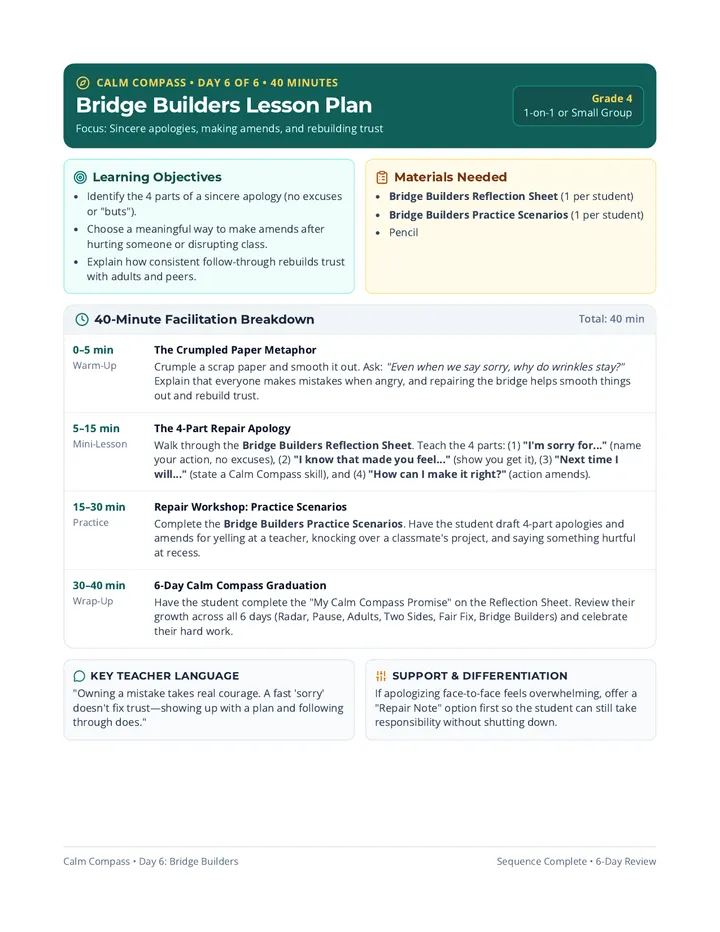
Bridge Builders Lesson Plan Calm Compass • Day 6 of 6 • 40 Minutes
Bridge Builders Lesson Plan
Focus: Sincere apologies, making amends, and rebuilding trust
Grade 4
1-on-1 or Small Group
Learning Objectives
Identify the 4 parts of a sincere apology (no excuses or "buts").
Choose a meaningful way to make amends after hurting someone or disrupting class.
Explain how consistent follow-through rebuilds trust with adults and peers.
Materials Needed
Bridge Builders Reflection Sheet (1 per student)Bridge Builders Practice Scenarios (1 per student)Pencil
40-Minute Facilitation Breakdown
Total: 40 min
0–5 min
The Crumpled Paper Metaphor
Crumple a scrap paper and smooth it out. Ask: "Even when we say sorry, why do wrinkles stay?" Explain that everyone makes mistakes when angry, and repairing the bridge helps smooth things out and rebuild trust.
5–15 min
The 4-Part Repair Apology
Walk through the Bridge Builders Reflection Sheet . Teach the 4 parts: (1) "I'm sorry for..." (name your action, no excuses), (2) "I know that made you feel..." (show you get it), (3) "Next time I will..." (state a Calm Compass skill), and (4) "How can I make it right?" (action amends).
15–30 min
Repair Workshop: Practice Scenarios
Complete the Bridge Builders Practice Scenarios . Have the student draft 4-part apologies and amends for yelling at a teacher, knocking over a classmate's project, and saying something hurtful at recess.
30–40 min
6-Day Calm Compass Graduation
Have the student complete the "My Calm Compass Promise" on the Reflection Sheet. Review their growth across all 6 days (Radar, Pause, Adults, Two Sides, Fair Fix, Bridge Builders) and celebrate their hard work.
Key Teacher Language
"Owning a mistake takes real courage. A fast 'sorry' doesn't fix trust—showing up with a plan and following through does."
Support & Differentiation
If apologizing face-to-face feels overwhelming, offer a "Repair Note" option first so the student can still take responsibility without shutting down.
Calm Compass • Day 6: Bridge Builders Sequence Complete • 6-Day Review
Bridge Builders Reflection Sheet Bridge Builders Reflection Sheet
DAY 6
Name:
Date:
1. The 4-Part Repair Apology
1. Own It: "I'm sorry for ______." (No excuses!)
2. Show Care: "I know that made you feel ______."
3. Next Time: "Next time I get mad, I will ______."
4. Make Amends: "How can I help fix this?"
2. Ways to Rebuild Trust
Check the repair actions you are willing to use after a conflict:
Fix or clean up what got messed up Write a sincere Repair Note Follow directions calmly the rest of the day Give the person space if they aren't ready yet
3. My Calm Compass Wrap-Up
My favorite skill from all 6 days (Anger Radar, Pause Power, Steady With Adults, Two Sides, Fair Fix, or Bridge Builders):
One promise I am making to myself for handling anger and conflicts:
Calm Compass • Day 6 Reflection Sheet Own It • Repair • Rebuild Trust
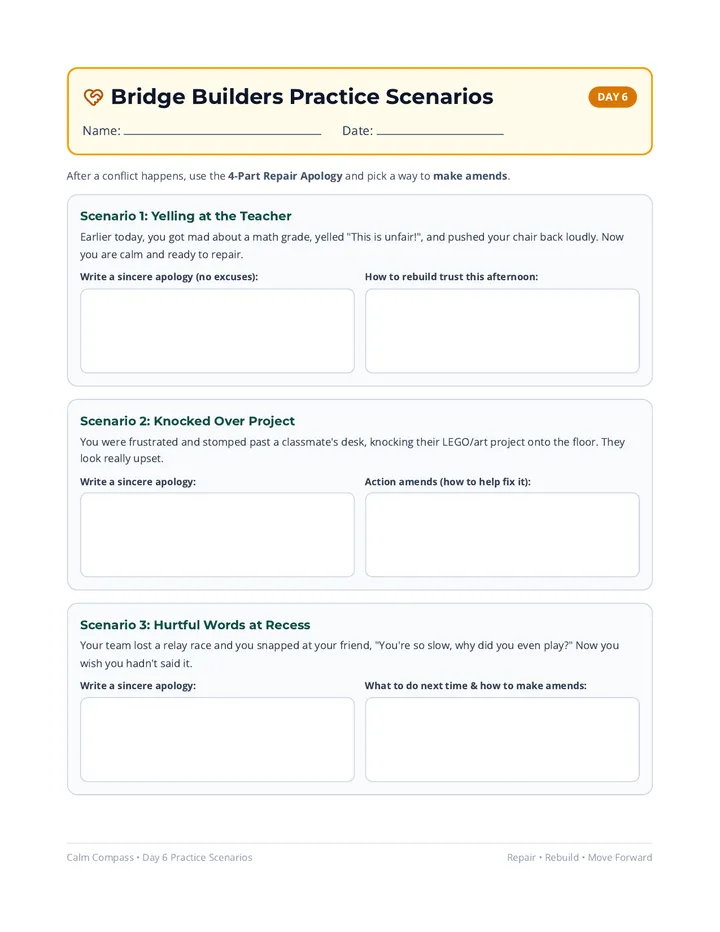
Bridge Builders Practice Scenarios Bridge Builders Practice Scenarios
DAY 6
Name:
Date:
After a conflict happens, use the 4-Part Repair Apology and pick a way to make amends .
Scenario 1: Yelling at the Teacher
Earlier today, you got mad about a math grade, yelled "This is unfair!", and pushed your chair back loudly. Now you are calm and ready to repair.
Write a sincere apology (no excuses):
How to rebuild trust this afternoon:
Scenario 2: Knocked Over Project
You were frustrated and stomped past a classmate's desk, knocking their LEGO/art project onto the floor. They look really upset.
Write a sincere apology:
Action amends (how to help fix it):
Scenario 3: Hurtful Words at Recess
Your team lost a relay race and you snapped at your friend, "You're so slow, why did you even play?" Now you wish you hadn't said it.
Write a sincere apology:
What to do next time & how to make amends:
Calm Compass • Day 6 Practice Scenarios Repair • Rebuild • Move Forward