Taming Test Anxiety Lesson Plan
Taming Test Anxiety
Group Lesson Plan • Tier 2 Intervention
30 Minutes
6th Grade Girls Group
Learning Objective
Students will understand test anxiety, identify its physiological and emotional symptoms, and learn practical coping strategies to manage anxiety during state testing.
Why It Matters
Helps students recognize and control feelings of anxiety to boost self-confidence and improve performance.
Preparation
- • Review the lesson flow and guiding questions.
- • Familiarize yourself with the worksheet and activity guide.
- • Prepare copies of the Worksheet and Activity Guide.
Materials Needed
- Taming Test Anxiety Worksheet
- Test Anxiety Coping Activity Guide
- Writing Utensils
Instructional Sequence
10 MIN
Introduction and Discussion
- Start with a brief discussion on what test anxiety is and ask students to share feelings they've experienced.
- Highlight common symptoms: racing heart, sweaty palms, racing thoughts.
- Emphasize that anxiety is a normal response that can be managed.
- Guiding Question: "What is one thing you notice about your body when you know a big test is coming up?"
10 MIN
Interactive Activity
- Introduce the Coping Activity Guide.
- Model and practice deep breathing (4-4-6 technique) as a group.
- Discuss positive self-talk: "I am prepared" vs "I can't do this."
- Briefly walk through the visualization technique.
10 MIN
Worksheet and Reflection
- Distribute the Worksheet for individual reflection.
- Prompt students to note personal anxiety triggers.
- Have students outline a personal plan using at least one strategy.
- Invite volunteers to share their plans for collective reinforcement.
Counselor Tip
Create a "safe space" atmosphere where students feel comfortable sharing their vulnerabilities. Remind them that many high achievers struggle with test anxiety and it isn't a reflection of their intelligence.
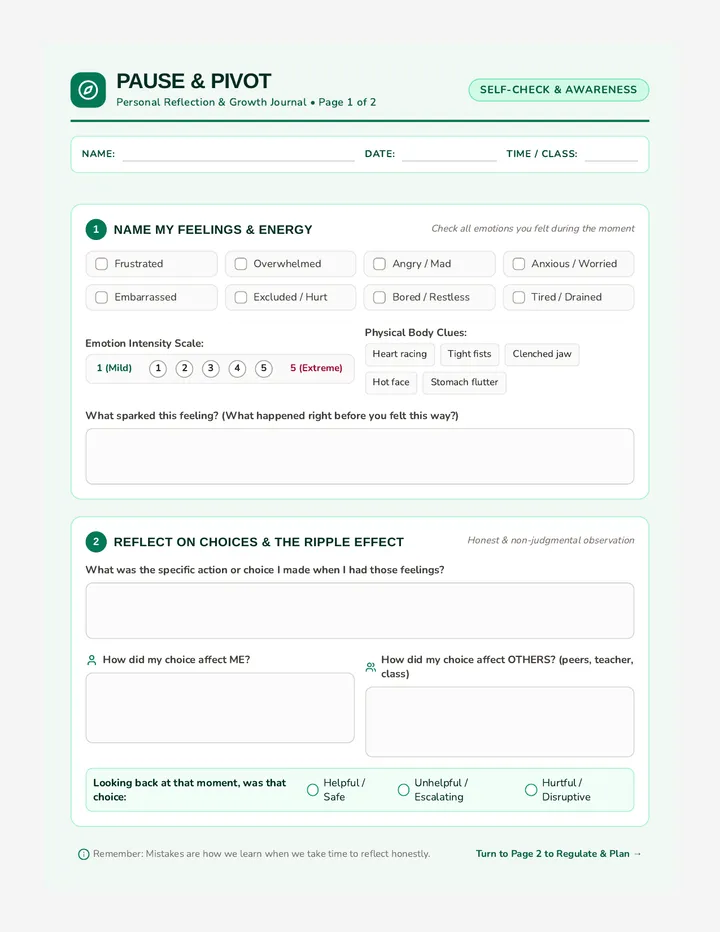
Taming Test Anxiety Worksheet
Taming Test Anxiety
Personal Reflection & Planning
Name:
Date:
1
Understanding Your Feelings
Think about times when you felt nervous or worried before a test. What words or feelings describe that experience?
2
Recognizing the Signs
Our bodies often give us clues. Check the signs you've noticed in yourself:
Feeling your heart race
Sweaty palms
Upset stomach
Racing thoughts
Other signs I've noticed:
3
Identifying Your Triggers
What makes you feel most anxious? Is it a certain subject, pressure to do well, or the "unknown"?
4
Planning Your Coping Strategies
Choose 1 or 2 techniques (like deep breathing or positive self-talk). Describe exactly how you will use them when anxiety starts to build:
5
Reflection
How do you think these steps will help you during a test?
Keep this worksheet close by. It’s a reminder that you have the power and the tools to manage your feelings and do your best!
Test Anxiety Coping Activity Guide
Test Anxiety Coping Guide
With practice, these strategies can become powerful tools to help you feel calm, confident, and completely in control.
Follow the steps below. Take your time with each exercise and notice how your body feels.
Technique 01
Deep Breathing Exercise
This exercise slows your heart rate and signals your brain to relax. It's like a "reset button" for your nervous system.
- 1 Sit comfortably with your back straight and feet on the floor.
- 2 Inhale slowly through your nose for a count of 4.
- 3 Hold your breath for a count of 4.
- 4 Exhale slowly through your mouth for a count of 6.
Technique 02
Positive Self-Talk
Turn your "inner critic" into your "inner coach." Words have power—use them to your advantage.
Negative Thought
"I'm going to fail this, I don't know anything."
Empowering Reframe
"I am prepared and capable. I can handle this."
Practice: When a worry pops up, catch it, challenge it, and change it!
Technique 03
The Calm Scene Visualization
Your brain doesn't always know the difference between a real event and a vividly imagined one. Use this to your benefit!
"Close your eyes. Imagine a place where you feel perfectly safe and peaceful—maybe a sunny beach, a quiet garden, or your cozy bedroom. Notice the soft colors, the gentle sounds, and the smell of the air. Feel the tension leave your shoulders as you stay in this place for a moment..."
Now, visualize yourself walking into your test feeling that exact same calm energy. You are ready.
Practice Makes Progress
You don't have to wait for a test to use these tools. Practice them during homework or whenever you feel a little stressed.
Be Kind
Be Strong
Be You