Talk The Talk Lesson Plan Talk The Talk
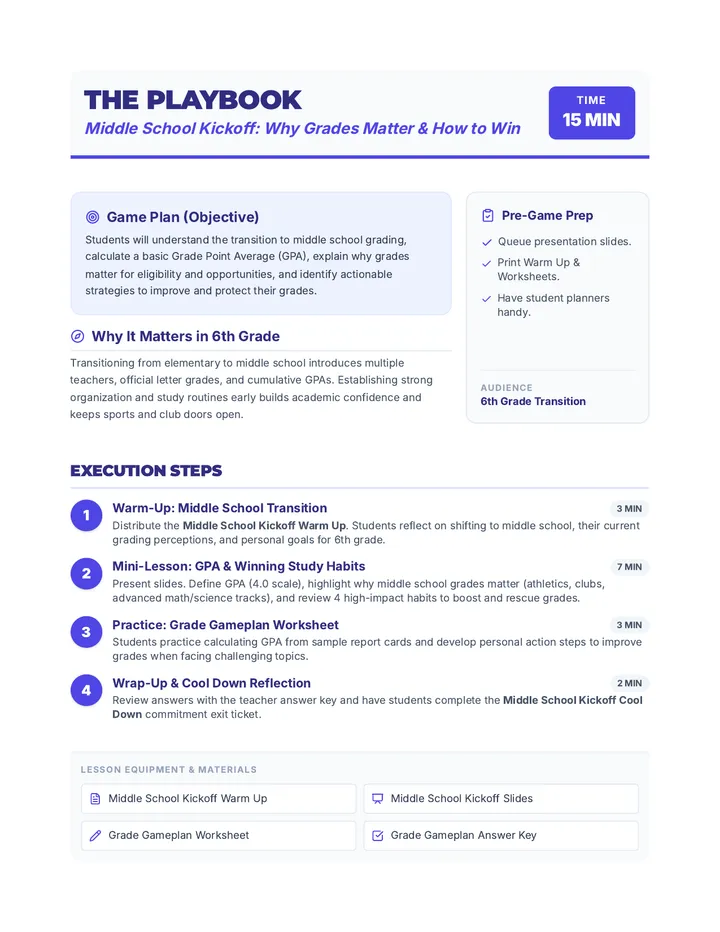
Lesson Plan • 6th Grade
15 Minutes
Objective
Students will be able to identify appropriate and inappropriate language in different social contexts and understand how the time of day can influence language choices.
Why This Matters
"Understanding how and when to use different types of language is essential for respectful communication, building positive relationships, and navigating various social and academic environments effectively."
Instructions
1
Warm-Up: What's the Vibe?
3 min
Begin by displaying the first slide of the Talk The Talk Slide Deck .
Ask students: "How does your language change depending on who you're talking to and where you are?" Allow a few students to share their initial thoughts.
Transition to discussing why this is important for effective communication.
2
Introducing Language Lenses
4 min
Use slides 2-4 to introduce the concepts of 'Appropriate' and 'Inappropriate' language, and 'Time of Day' considerations.
Provide clear examples for each, engaging students with questions like: "Why might this language be okay now, but not later?"
3
Scenario Showdown Activity
6 min
Distribute or display the Language Scenarios Activity .
Facilitate a whole-class discussion or small groups, presenting each scenario.
Ask students to identify if language is appropriate, explain why, and discuss how to adjust it.
4
Cool-Down: Reflect and Connect
2 min
Conclude with the Reflection Cool Down .
Ask students to share or write one new thing they learned.
Emphasize thinking before speaking and adapting for success.
Prep (5 min)
Review the Slide Deck to familiarize yourself with content.
Print or prepare to display the Scenarios Activity.
Review the Reflection Cool Down.
Materials
Smartboard or Projector
Talk The Talk Slide Deck
Language Scenarios Activity
Reflection Cool Down
Approach
Interactive discussion and scenario-based examples focused on social nuance and practical application.
Talk The Talk Slide Deck Talk The Talk
When and How We Speak
Ever notice how you talk differently around your friends versus your grandparents? Or in school versus at a sporting event? Today, we're going to explore why that is, and why it matters!
Communication Skills
What is 'Appropriate'?
Appropriate language means using words and a tone that are suitable for the situation you are in.
Why is it important?
"It shows respect and helps you communicate clearly."
Think about it:
• At school, talking to your teacher.
• At home, talking to your parents.
• Presenting a project to your class.
Teacher Note: Emphasize respect and clarity in different environments.
What is 'Inappropriate'?
Using words or a tone that are not suitable, or could even be offensive, for the situation.
Why avoid it?
"It can be misunderstood, cause offense, or make you seem less credible."
Think about it:
• Using slang or curse words during a formal presentation.
• Shouting loudly in a quiet library.
• Using disrespectful terms towards someone.
Teacher Note: 'Inappropriate' doesn't always mean 'bad' language, but simply 'not right for the situation.'
Timing Is Everything!
Sometimes, the time of day can also affect what language is appropriate.
Early Morning
Keeping voices down, using calm tones.
During Class
Focused language, on-topic discussions.
After School
More relaxed, casual conversations.
Different situations = Different expectations!
Language Scenarios Activity Scenario Showdown
Talk The Talk Activity
Name:
Date:
Instructions: Read each scenario below. Decide if the language used is appropriate or inappropriate for the situation and time of day. Explain why you think so, and suggest a better way to communicate if it was inappropriate.
Scenario 1: The School Assembly
MORNING
"During a very important school assembly about upcoming projects, a student in the back yells out, 'This is so boring! When can we leave?'"
Appropriate or Inappropriate?
Appropriate
Inappropriate
Why?
Better way to communicate?
Scenario 2: Lunch with Friends
NOON
"At lunchtime, sitting with your close friends, you use a lot of recent slang and talk about a funny video you saw online, using some informal language."
Appropriate or Inappropriate?
Appropriate
Inappropriate
Why?
Better way to communicate?
Scenario 3: Asking for Help After Class
3:30 PM
"It's 3:30 PM, after school hours, and you approach your teacher to ask for help on a homework problem. You say, 'Yo, teach! Can you hook me up with some answers for this math stuff? I'm totally lost.'"
Appropriate or Inappropriate?
Appropriate
Inappropriate
Why?
Better way to communicate?
Reflection Cool Down Reflection Cool Down
Talk The Talk: Mindful Communication
Name:
Date:
1
What is one new thing you learned or realized today about how you communicate?
2
Think about a situation coming up soon (e.g., family talk, group project, sports). How will you be more mindful of your language choices?
"Your words are powerful. Choosing the right ones for the right moment makes all the difference."
Language Scenarios Answer Key Answer Key
Language Scenarios Activity
Teacher Resource
1
The School Assembly
Classification: INAPPROPRIATE
Why:
Assemblies are formal school events. Shouting out is disruptive to the speakers and other students. Even if the content feels boring, the social expectation is to remain quiet and respectful. Yelling is aggressive and inappropriate for a shared listening space.
Better way to communicate:
If a student has feedback about the assembly, they could discuss it privately with a teacher later or write a respectful suggestion to the student council or administration.
2
Lunch with Friends
Classification: APPROPRIATE
Why:
Lunch is an informal social time. Using slang and discussing casual topics (like funny videos) with peers is a normal way to build relationships. The context is relaxed, and the language matches the casual environment of a cafeteria or lunchroom.
Better way to communicate:
No change needed, unless the volume is so loud it disrupts other tables or the language becomes offensive to others.
3
Asking for Help After Class
Classification: INAPPROPRIATE
Why:
Even though it is after school, the relationship between a student and teacher remains academic/professional. Terms like "Yo, teach" and "hook me up with some answers" are too casual and can be perceived as disrespectful. It assumes a level of familiarity that isn't suitable for an academic request.
Better way to communicate:
"Excuse me, [Teacher Name], do you have a minute? I'm having some trouble with this math problem and was wondering if you could help me understand how to solve it."
Discussion Tip
Remind students that "Inappropriate" doesn't mean the person is "bad"—it means the language doesn't match the goals or respect levels of the current situation. Encourage students to think about the "Power Dynamics" (who they are talking to) and "Environmental Rules" (where they are).