Strength Spotlights Slides Week 1 Brave Voices Group
20–30 Min Session
Discover Your Superpowers
Welcome to our safe circle! Here, every voice matters, mistakes are celebrated, and courage is our currency.
1
What stays here, stays here
2
Listen with full respect
3
Own your unique strengths
Concept Spotlight Building Real Confidence
True Strength Isn't Just Being the Loudest
Confidence grows when we know what we naturally bring to our school and friendships.
Heart Strengths
Kindness, empathy, making others feel included, loyal friendship.
"I care deeply"
Mind Strengths
Curiosity, creative ideas, problem solving, persistence when stuck.
"I figure things out"
Courage Strengths
Trying new things, bouncing back, standing up for fairness, honesty.
"I take brave steps"
Turn to your partner: Which strength bucket feels most natural to you today?
Weekly Action Step Practice in the Real World
Your Week 1 Brave Mission
Notice one moment this week where you used one of your strengths (Heart, Mind, or Courage). Jot it down in your workbook or keep it in mind for Week 2!
Checkout Question:
"One strength I appreciate about myself is..."
Group Cheer:
"We speak brave, we stand tall!"
See you next week for Week 2: Emotion Radar & Body Cues!
Strength Spotlights Worksheet Week 1
My Superpower Spotlight
Name:
Date:
Brave Voices Counseling Group • Discovering what makes you resilient, capable, and uniquely you.
Step 1: Check 2 Strengths in Each Category That Sound Like You
Heart Strengths
Good listener Kind to others Includes everyone Loyal friend
Mind Strengths
Creative thinker Solves hard puzzles Curious & asks why Doesn't give up
Courage Strengths
Tries new things Stands for fairness Tells the truth Bounces back fast
Step 2: My Personal Superpower Story
Pick your top strength from above. Describe a time you used it or how it helps someone:
My standout strength is:
Line 1 for written reflection
Line 2 for written reflection
Line 3 for written reflection
Step 3: Peer Strength Spotlight (Group Activity)
Turn to another group member. What is one positive strength you notice about them today?
Group Member's Name:
A strength I noticed in them:
My Week 1 Action Challenge
Self-Awareness
"One situation this week where I want to remember and trust my strength is..."
Write situation here
Write reflection here
Brave Voices • Small Group Counseling Series • Session 1 of 8
Emotion Radar Slides Week 2 Self-Awareness
20–30 Min Session
Tune Into Your Emotion Radar
Before you can manage a feeling, you have to name it. Your body always sends clues first!
Level 1–3
Calm, Focused, Ready
Level 4–6
Restless, Annoyed, Nervous
Level 7–10
Overwhelmed, Furious, Shut Down
Body Clues The Early Warning System
Where Does Your Body Sound the Alarm?
Emotions show up as physical sensations before our brain even realizes what's happening.
The Head
Racing thoughts, tension headache, dizziness, clenched jaw.
The Chest
Pounding heartbeat, shallow fast breathing, tightness.
The Stomach
Fluttering butterflies, knots, heavy sinking feeling, nausea.
The Hands/Legs
Shaky fingers, sweaty palms, tight fists, restless bouncing legs.
Group Reflection: "When I start feeling stressed, the first place I feel it is my..."
Weekly Mission Name It to Tame It
Your Week 2 Radar Mission
At least twice this week, pause and check your emotion radar: What is your number (1–10)? Where do you feel it in your body? Simply noticing it gives you back your power!
"If you can name it, you can tame it!"
Next week: Week 3: The Reset Button & Self-Management Toolkit!
Emotion Radar Worksheet Week 2
My Emotion Radar & Body Clues
Name:
Date:
Brave Voices Counseling Group • Identifying physical warning signals to catch big emotions early.
Step 1: The Feelings Thermometer (1 to 10)
Levels 1–3: Green Zone Calm
Relaxed, focused, safe, ready to learn or chat.
Levels 4–6: Yellow Zone Warning
Nervous, frustrated, restless, heart beats faster.
Levels 7–10: Red Zone Danger
Furious, panicked, frozen, ready to explode or hide.
Step 2: Map Your Personal Body Signals
Circle or mark the signals your body gives you when your emotions start climbing into the Yellow or Red zone:
Head & Face
Jaw tight or teeth grinding Hot or flushed cheeks Mind goes blank / racing thoughts
Chest & Breathing
Fast pounding heartbeat Short, shallow breaths Lump in my throat
Stomach
Nervous butterflies Heavy knot or cramp Loss of appetite / sick feeling
Hands & Muscles
Sweaty or icy cold hands Clenched fists or tense shoulders Shaking knees or restless feet
Step 3: Trigger & Radar Check
Think of a school situation that pushes you into Yellow or Red (e.g., pop quizzes, speaking in class, loud lunchroom):
My situation trigger:
My body signal that pops up first:
What number (1–10) does this usually feel like?
My Week 2 Radar Pledge
Self-Awareness
"When I feel my body signal this week, I will take one pause and say inside my mind: 'I notice my body is telling me something.'"
Student Signature: Goal Day(s): M • T • W • Th • F
Brave Voices • Small Group Counseling Series • Session 2 of 8
Reset Button Slides Week 3 Self-Management
20–30 Min Session
Hit the Reset Button
When your emotion radar goes off, you don't have to stay stuck in the storm. You have the tools to reset your nervous system!
1
Pause & Breathe
2
Ground Your Body
3
Choose Your Next Move
Reset Strategies Tools You Can Use Anywhere
Three Stealth Moves You Can Do Right at Your Desk
Nobody even has to know you are resetting your brain.
Box Breathing
Inhale for 4 seconds, hold for 4, exhale slow for 4, hold for 4. Slows your pulse instantly.
4-4-4-4 Rhythm
5-4-3-2-1 Grounding
Name 5 things you see, 4 you feel, 3 you hear, 2 you smell, 1 good thing about yourself.
Connect to Present
Palm Press & Release
Press your palms or feet firmly into the floor for 5 seconds, then let all muscles go loose.
Release Tension
Group Try-It: Let's do two cycles of 4-count breathing together right now!
Mission Check Self-Management in Action
Your Week 3 Reset Challenge
The next time you feel your emotion score reach a 5 or higher, press your mental reset button before saying or doing anything!
"Between the trigger and my reaction, there is a space. In that space is my power."
Next week: Week 4: Inner Coach vs. Inner Critic!
Reset Button Worksheet Week 3
My Personal Reset Toolkit
Name:
Date:
Brave Voices Counseling Group • Practical self-management tools to regain control when stress spikes.
Step 1: Build Your 3-Step Reset Plan
Select or write your preferred action for each step of the reset sequence:
1 Breathe (Calm Body)
4-count box breath Slow exhale sigh Hand-on-heart breath
2 Ground (Calm Mind)
Feet flat on floor 5-4-3-2-1 notice Palm squeeze & release
3 Choose (Next Action)
Take a sip of water Ask for help / pause Say a positive cue
Step 2: Quick Sensory Grounding In Our Group Right Now
Look around our counseling room and fill in your sensory anchors:
3 things I see right now:
2 textures I can feel:
1 supportive truth: "I am safe, and I can handle this."
Pocket Reset Card (Cut Out or Keep in Folder)
Carry this with you!
Emergency Reset Card Brave Voices
1. Breathe
In 4, hold 4, out 4
2. Ground
Feel feet on floor
3. Speak
"I can take a step."
My Go-To Calm Phrase:
Brave Voices • Small Group Counseling Series • Session 3 of 8
Inner Coach Slides Week 4 Mindset & Confidence
20–30 Min Session
Fire the Critic, Hire the Coach
The most important conversation you will ever have is the one happening inside your own mind. Who is doing the talking?
The Inner Critic
Harsh, blames you for errors, uses "always" & "never"
The Inner Coach
Realistic, encourages courage, adds the word "YET"
Cognitive Reframing Flipping the Script
How the Coach Rewires Your Thoughts
You don't have to believe everything your brain tells you when you're anxious.
Inner Critic Says:
"I completely bombed this math test. I'm just terrible at school."
Inner Coach Reframes:
"This test was hard, but a mistake is just data. I can ask for help."
Inner Critic Says:
"If I raise my hand, everyone will laugh at me."
Inner Coach Reframes:
"My voice matters. Other people probably have the exact same question."
The 3-Letter Secret Weapon: Change "I can't do this" to "I can't do this YET!"
Weekly Mission Coach On Duty
Your Week 4 Mindset Challenge
Catch your Inner Critic in the act this week! Whenever you notice a negative thought, stop and say: "What would my Inner Coach say to me right now?"
"Speak to yourself the way you would speak to a friend you really love."
Next week: Week 5: Assertive Voices & Confident Communication!
Inner Coach Worksheet Week 4
Flip the Script: Coach vs. Critic
Name:
Date:
Brave Voices Counseling Group • Transforming self-doubt into constructive, encouraging self-talk.
Step 1: Who Is Talking? (Critic or Coach)
Read each thought bubble and check who is doing the speaking:
"Everyone else gets this and I'm just slow." Critic
"I made a mistake, but I can ask for help." Coach
"I can't do this yet, but I'm getting better." Coach
"If I fail, I'll be totally humiliated." Critic
Step 2: Flip the Script Practice
Practice writing what the Inner Coach would say back to the Critic:
Critic: "You stumbled on your words during reading. Everyone thinks you're weird."
Coach Reframes:
Critic: "You won't be good at this new project, so don't even bother trying."
Coach Reframes:
Step 3: My Inner Coach Power Phrase
Self-Compassion
Choose or create one encouraging sentence you will whisper to yourself when things feel tough:
Write your power phrase in big letters:
Brave Voices • Small Group Counseling Series • Session 4 of 8
Assertive Voices Slides Week 5 Confidence & Communication
20–30 Min Session
Own Your Assertive Voice
How you speak matters just as much as what you say. Assertiveness means honoring your own needs while respecting others!
Passive (Doormat)
"My feelings don't matter, only yours do." Quiet voice, eyes down.
Aggressive (Bulldozer)
"Only my feelings matter, yours don't." Loud, blaming, glaring.
Assertive (Pillar)
"My feelings matter AND yours matter too." Calm, clear, eye contact.
The Brave Formula Body + Words
Clear Body Language & The "I-Statement"
Assertiveness isn't rude—it's honest and direct.
Confident Body Posture
Stand or sit tall with shoulders back
Keep steady, warm eye contact
Use a calm, steady volume (no mumbling)
Keep hands relaxed at your sides or on desk
The "I-Statement" Script
1. I feel [name your emotion]...
2. When [state the specific fact without blaming]...
3. I need / prefer [state what you want to happen]...
Group Practice: "I feel frustrated when I am interrupted. I need to finish my thought."
Weekly Mission Use Your Voice
Your Week 5 Assertive Mission
Use your Assertive Voice at least once this week! Speak up in class, state an opinion to a friend, or use an "I-Statement" calmly and clearly.
"Your thoughts and boundaries deserve to be heard."
Next week: Week 6: The Help Line & Asking for What You Need!
Assertive Voices Worksheet Week 5
Speaking Up: The Assertive Voice
Name:
Date:
Brave Voices Counseling Group • Balancing respect for ourselves and respect for others through assertive communication.
Step 1: Identify the Style (Passive, Aggressive, or Assertive)
Passive
Mumbles, looks down, says "It's fine" when it's not.
Hides Needs
Aggressive
Yells, points fingers, interrupts, demands their way.
Hurts Others
Assertive
Calm eye contact, clear words, firm posture, listens.
True Confidence
Step 2: Construct an "I-Statement"
Practice turning a frustrating situation into a calm, direct statement using the 3-step formula:
1. I feel... (Emotion)
2. When... (Action)
3. I need... (Request)
Practice Scenario: Someone cuts ahead of you in the lunch or water fountain line.
"I feel
when
I need you to "
Step 3: Confident Body Language Self-Rating
Check off the habits you practiced in group today:
Eye Contact: Looked directly at the person Posture: Shoulders back, spine straight
Voice: Clear and firm (not yelling or whispering) Hands: Still and relaxed by sides or on table
My Week 5 Assertive Action Goal
Self-Advocacy
"One person or situation where I will use my assertive posture or an I-statement this week is: "
Brave Voices • Small Group Counseling Series • Session 5 of 8
Help Line Slides Week 6 Self-Advocacy
20–30 Min Session
Activate Your Help Line
Asking for help isn't giving up—it is refusing to give up! Smart leaders advocate for what they need to succeed.
Myth:
"If I ask the teacher a question, they will think I wasn't listening or that I'm behind."
Reality:
"Teachers love students who advocate for themselves because it shows effort and care!"
Advocacy Script 4 Steps to Clear Help
The 4-Step "Ask With Confidence" Blueprint
Don't just say "I don't get it." Tell the teacher exactly where you are stuck.
1
Timing Check
Pick a good moment: during independent work, before/after class, or raise a steady hand.
2
Show Effort
"I tried step 1 and step 2, but..." Shows you actively gave it a shot first.
3
Specific Need
"Could you explain step 3 in a different way or show one example?"
4
Confirm & Thank
Repeat it back: "Got it, so I do this next. Thank you!"
The Script in Action: "Ms. Davis, I finished the reading, but I'm confused about question 4. Can you rephrase it?"
Weekly Mission Advocate at School
Your Week 6 Advocacy Challenge
Ask at least one teacher or adult for clarification, extra time, or assistance this week using your 4-step script. Note how it felt in your workbook!
"Advocating for yourself is the ultimate proof of self-respect."
Next week: Week 7: Boundary Builders & Saying No!
Help Line Worksheet Week 6
The Self-Advocacy Help Line
Name:
Date:
Brave Voices Counseling Group • Learning how to ask teachers and trusted adults for help with clarity and confidence.
Step 1: Overcome the Help Hesitation
Check the worry that most often stops you from asking for help:
"I don't want to look dumb."
Truth: Asking questions is how everyone actually learns!
"The teacher looks too busy."
Truth: You can write a note or ask: "When is a good time?"
"I don't even know what to ask."
Truth: Just say: "I'm stuck on step 2, can we review it?"
"Other kids will stare at me."
Truth: Most peers are relieved someone asked what they wondered!
Step 2: Draft Your Real-Life Advocacy Script
Pick a real class where you might need clarification or support:
Teacher / Class: Best time to ask:
1. Opening & Effort: "Excuse me [Teacher], I tried doing , but I'm getting stuck on..."
Line for detail
2. Specific Request: "Could you please explain it with an example / give me 5 more minutes?"
3. Polite Closing: "Thank you for explaining that to me!"
Step 3: My School Support Squad
Identify 3 trusted adults at school you feel safe advocating to:
1. Academic Helper:
2. Emotional / Safe Space:
3. Counselor / Coach:
My Week 6 Self-Advocacy Pledge
Self-Advocacy
"I will ask one question or request one piece of assistance this week using my clear, respectful script."
Brave Voices • Small Group Counseling Series • Session 6 of 8
Boundary Builders Slides Week 7 Boundaries & Self-Respect
20–30 Min Session
Build Your Boundary Shield
A boundary is an invisible line that protects your peace, energy, and values. Saying "no" to things that don't feel right is saying "yes" to yourself!
Physical
Personal space, items, belongings, physical touch.
Emotional
Respectful words, safe venting, not absorbing drama.
Time & Energy
Not overcommitting, resting when overwhelmed.
Refusal Menu 4 Ways to Say No With Grace
You Don't Need an Excuse to Set a Boundary
You can be completely polite and completely firm at the exact same time.
1. The Simple Direct No
"No thanks, that doesn't work for me."
Short, confident, leaves no room for debate.
2. The Alternative Offer
"I can't lend you my notebook, but we can study together for 10 minutes."
Protects your item while offering helpful collaboration.
3. The Delay & Check
"I need to check my schedule first. I'll let you know later."
Buys you time to think without feeling on the spot.
4. The Broken Record
"I hear you, but my answer is still no."
For peers who keep pushing or won't accept your first response.
Remember: "People who get angry at your boundaries were benefiting from you having none."
Weekly Mission Stand Your Ground
Your Week 7 Boundary Challenge
Set or maintain one healthy boundary this week. Say a calm, polite "no" or state your comfort limit without apologizing for having needs!
"Saying no to peer pressure is saying YES to yourself."
Next week: Week 8: Celebration, Progress & Future Launchpad!
Boundary Builders Worksheet Week 7
My Boundary Blueprint
Name:
Date:
Brave Voices Counseling Group • Protecting your physical, emotional, and social well-being with confident limits.
Step 1: Define Your 3 Boundary Zones
Write an example of what feels safe, what needs caution, and what is a hard stop for you:
Green: Safe & Welcome
Things that make me feel respected and happy:
Writing line 1
Writing line 2
Yellow: Slow Down
Things I need to think twice about / pause:
Writing line 1
Writing line 2
Red: Hard Limit / Stop
Things I will immediately say no to or report:
Writing line 1
Writing line 2
Step 2: Choose Your Response Strategy
Practice how you would respond to these two common peer boundary crossers:
Scenario A: A friend keeps grabbing your supplies or phone without asking first.
My Firm Response:
Scenario B: A classmate tries to copy your homework right before class starts.
My Firm Response:
Step 3: Banish the Boundary Guilt
Repeat and sign this truth: "Setting a boundary does not make me mean. It keeps our relationship healthy and honest."
Student Signature: I Stand Tall:
Brave Voices • Small Group Counseling Series • Session 7 of 8
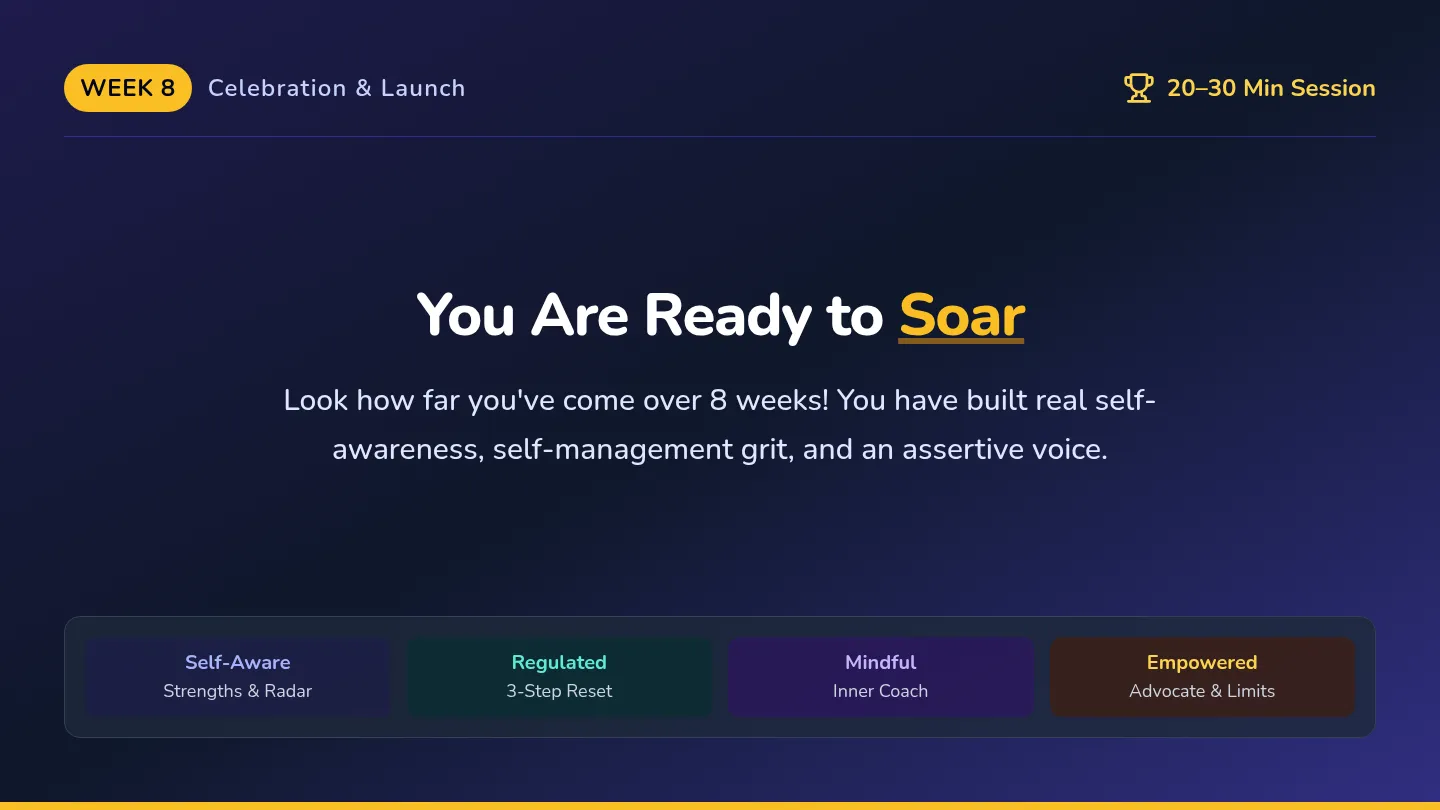
Future Launchpad Slides Week 8 Celebration & Launch
20–30 Min Session
You Are Ready to Soar
Look how far you've come over 8 weeks! You have built real self-awareness, self-management grit, and an assertive voice.
Self-Aware
Strengths & Radar
Regulated
3-Step Reset
Mindful
Inner Coach
Empowered
Advocate & Limits
Group Circle Affirmations & Standout Moments
Passing the Torch of Encouragement
Every member in this circle has contributed to our brave space.
My Biggest Growth
"The skill that helped me the most during our 8 weeks is..."
Peer Shoutout
"One brave thing I witnessed someone else do in this group..."
Future Promise
"When I face a hard moment next month, I promise myself I will..."
Facilitator Prompt: Let's go around our circle and share one standout victory!
Lifelong Mission Always Brave
You Have the Voice. You Have the Tools.
Confidence isn't never feeling scared. Confidence is feeling the butterflies and standing tall anyway!
"Speak your truth, protect your peace, and never stop growing!"
Congratulations Graduates of the Brave Voices Group!
Future Launchpad Worksheet Week 8
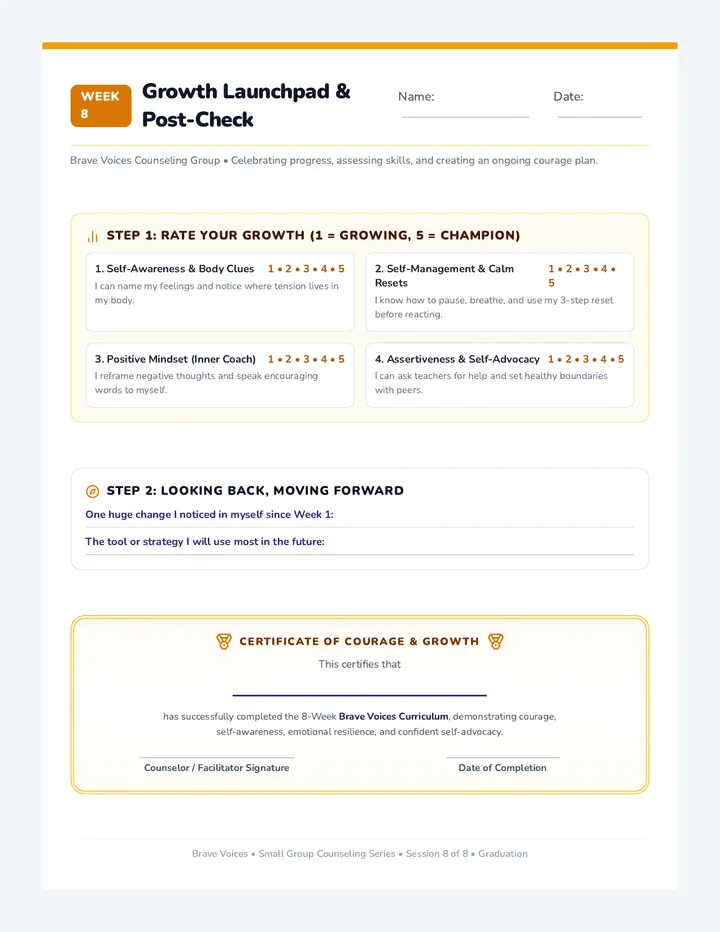
Growth Launchpad & Post-Check
Name:
Date:
Brave Voices Counseling Group • Celebrating progress, assessing skills, and creating an ongoing courage plan.
Step 1: Rate Your Growth (1 = Growing, 5 = Champion)
1. Self-Awareness & Body Clues 1 • 2 • 3 • 4 • 5
I can name my feelings and notice where tension lives in my body.
2. Self-Management & Calm Resets 1 • 2 • 3 • 4 • 5
I know how to pause, breathe, and use my 3-step reset before reacting.
3. Positive Mindset (Inner Coach) 1 • 2 • 3 • 4 • 5
I reframe negative thoughts and speak encouraging words to myself.
4. Assertiveness & Self-Advocacy 1 • 2 • 3 • 4 • 5
I can ask teachers for help and set healthy boundaries with peers.
Step 2: Looking Back, Moving Forward
One huge change I noticed in myself since Week 1:
The tool or strategy I will use most in the future:
Certificate of Courage & Growth
This certifies that
has successfully completed the 8-Week Brave Voices Curriculum , demonstrating courage, self-awareness, emotional resilience, and confident self-advocacy.
Counselor / Facilitator Signature
Date of Completion
Brave Voices • Small Group Counseling Series • Session 8 of 8 • Graduation