Study Smarter Lesson Plan Study Smarter, Not Harder
Lesson Plan: Academic Success Blueprint
Audience: 9th-10th Grade
Duration: 45 Minutes
Objective
Students will be able to differentiate between completing homework and actively studying for academic retention and apply basic time management techniques to their study schedule.
Why This Matters
Many students struggle academically not because they lack intelligence, but because they lack effective study strategies and time management skills. This lesson provides them with practical tools to improve their academic performance and reduce stress.
Materials
Whiteboard or Projector
Study Smarter Slide Deck
Teacher Script
Time Management Worksheet
Discussion Guide
Rubric for Study Plan
Prep (15 min)
• Review Slide Deck and technology.
• Read Teacher Script for talking points.
• Print Worksheet (one per student).
• Familiarize yourself with Discussion Guide and Rubric.
Lesson Procedure
Section & Time Activities & Instructions Warm-Up & Hook (5 Minutes)
Display first slide of the Slide Deck and use opening questions from the Teacher Script .
Facilitate a brief discussion to activate prior knowledge and highlight common challenges. Refer to Discussion Guide for prompts.
|
| Homework vs. Studying
Use slides 2-4 and the corresponding sections of the Teacher Script to explain key differences.
Provide clear examples of each (completion vs. retention).
Encourage student questions and brief sharing of current practices.
|
| Time Management Hacks
Transition to slides 5-7 to introduce chunking, scheduling, and prioritizing.
Explain "functional use" of time blocks.
Guide students through Part 1 of the Worksheet .
Circulate and provide individual support.
|
| Crafting Your Study Plan
Use slides 8-9 to guide students in completing Part 2 of the Worksheet .
Emphasize applying learned distinctions and time hacks.
Reference the Rubric criteria for evaluation.
|
| Wrap-Up & Next Steps
Quick share-out of one new strategy students plan to try.
Assign implementation of the study plan before the next session.
Collect completed Worksheets for review.
|
Instructional Approach: Interactive discussion, direct instruction, and practical application.
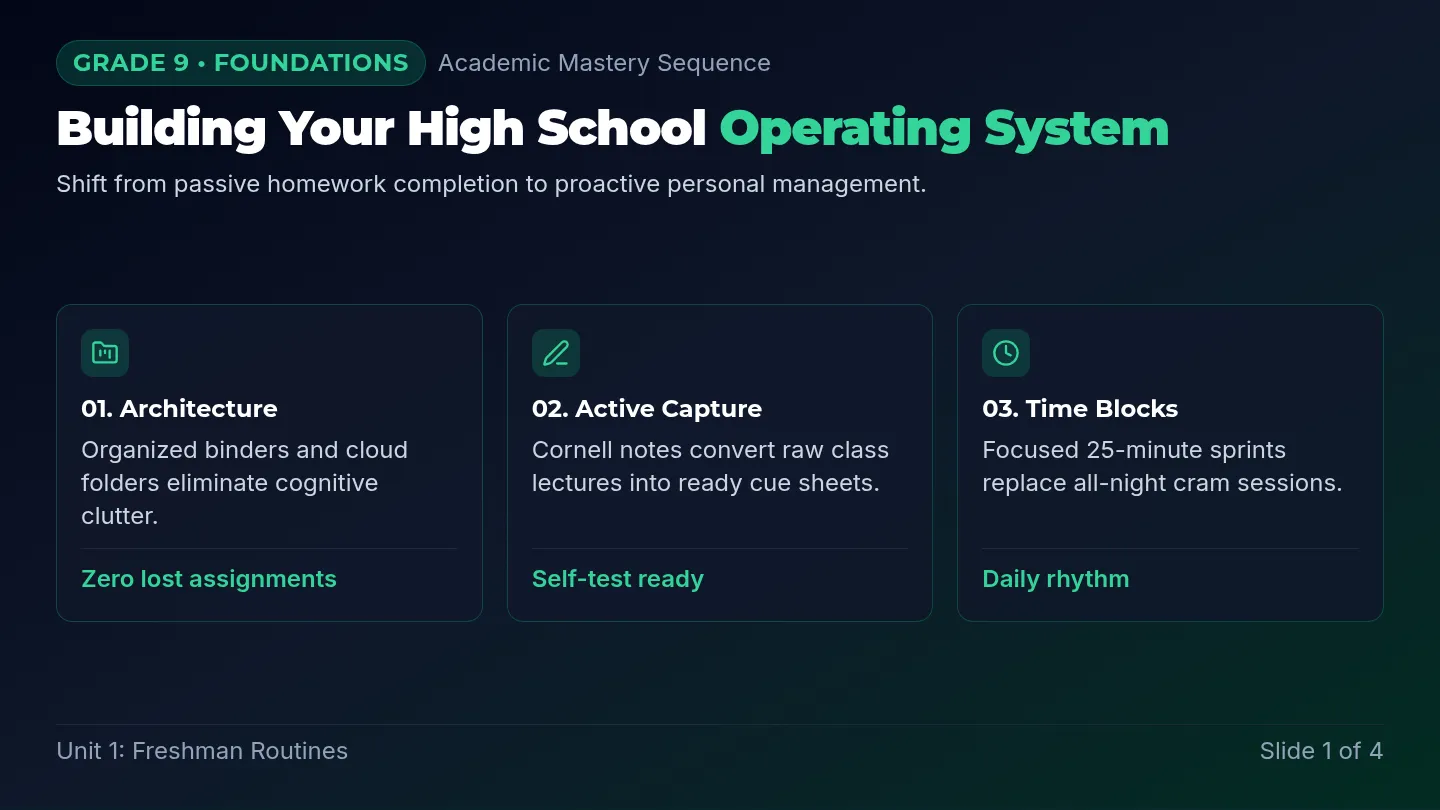
Study Smarter Slides Study Smarter,
Not Harder!
Are you spending hours on schoolwork but not seeing results? Let's fix that!
The Success Blueprint
Teacher Notes: Welcome students! Start with an engaging question about study habits.
Homework vs. Studying
What's the BIG Difference?
Homework
• Usually for completion
• Practicing what you already learned
• Shows you've done the work
Studying
• About understanding & remembering
• Preparing for long-term knowledge
• Actively engaging with material
Stage 1
Homework: The "Getting It Done"
Finishing assigned tasks
Practicing skills
Applying recent lessons
Often graded on completion
Examples
Math problems from last night, writing a rough draft, or answering end-of-chapter questions.
Stage 2
Studying: The "Making It Stick"
Deeply understanding concepts
Connecting new info to old
Spaced Repetition (reviewing)
Preparing for assessments
Examples
Making flashcards, teaching a friend, summarizing without notes, or taking practice quizzes.
Master Your Time
Concept: Functional Use
Ever feel like time just vanishes?specific purpose .
• No more "just doing homework" without a plan.
• Know exactly WHAT you're doing and WHY .
3 Essential Tools
1. Chunking
Break big tasks into small, manageable bites.
2. Prioritizing
Determine what is urgent and important (A, B, C).
3. Scheduling
Put it on the calendar! Short blocks add up.
Putting It Into Practice
Tonight's Plan Example:
6:00 - 6:30 PM
Homework (Math)
Complete Problems (Pg. 72, #1-10)
6:30 - 7:00 PM
Studying (Science)
Review notes, create 5 flashcards
7:00 - 7:30 PM
Teacher Script Study Smarter Teacher Script
Study Smarter, Not Harder!
Slide 1: Introduction
5 Minutes
Action: Display Slide 1. Scan the room for engagement.
"Good morning/afternoon, everyone! Take a look at our title slide today: 'Study Smarter, Not Harder!' How many of you have ever felt like you spend a ton of time on schoolwork, but the grades or the understanding just aren't clicking? Raise your hand if you can relate."
"It's a common feeling, right? Many students, especially in high school, work really hard, but sometimes we confuse 'doing work' with 'effective learning.' Today, we're going to explore some strategies to make your time spent on schoolwork really count. We'll learn how to get more out of your study time, reduce stress, and ultimately improve your grades."
"Before we dive in, let's have a quick chat. What's one thing you currently do when you 'study' or do 'homework'? Just a quick thought. No right or wrong answers here."
Note: Allow 2-3 students to share. Refer to the Discussion Guide for more prompts.
Slides 2–4: Homework vs. Studying
10 Minutes
"Alright, let's get into the core of it. We often use the words 'homework' and 'studying' interchangeably, but they're actually quite different, and understanding this difference is crucial for effective learning."
"As you can see on the slide, homework is generally about completion . It's about practicing what you've already learned, applying recent lessons, and showing that you've done the work. Often, it's graded for completion or effort."
"Studying , on the other hand, is about understanding and remembering . It's actively engaging with the material to make sure it sticks in your brain, preparing you for quizzes, tests, and future classes. It's about deep learning and long-term retention."
Action: Move to Slide 3 (Homework) then Slide 4 (Studying).
"When we talk about homework, we're thinking about math problems, rough drafts, or reading chapters. Studying is activities like making flashcards, teaching a concept to a friend, or taking practice quizzes."
"Can anyone think of another example of what 'studying' might look like, beyond just doing homework?"
Slides 5–7: Time Management
15 Minutes
"So, we know the difference. But how do we actually make time for both? This brings us to functional use of time . This means giving each block of time a specific purpose. Instead of just saying, 'I'm going to do homework,' you'll know exactly what you're doing and
Study Smarter Discussion Guide Study Smarter
Discussion Guide
9th & 10th Grade
Tier 2 Support
This guide provides prompts to deepen student engagement and understanding. Use these questions during the warm-up, after explanations, or to facilitate reflection.
Warm-Up & Hook
"What does 'studying' mean to you right now? Describe your typical study session."
"When you have a big test coming up, what's the first thing you usually do to prepare?"
"What's the biggest challenge you face? (e.g., getting started, staying focused, feeling overwhelmed)"
Homework vs. Studying
"Can you give an example of something you consider 'homework' and something 'studying' in your classes?"
"Why is it important to understand the difference? How might confusing them impact your learning?"
"Have you ever spent a lot of time on homework but still felt unprepared for a test? Why?"
Time Management & Functional Use
"How does 'chunking' big tasks help reduce stress? Can you give an example from your own life?"
"Why is it important to actually *schedule* your study time, rather than just hoping you'll get to it?"
Reflection & Application
"What potential challenges do you anticipate when trying to implement these strategies?"
"How might improving these skills impact your overall stress levels or free time?"
Time Management Worksheet Study Success Toolkit
Time Management & Study Skills Worksheet
Name:
Date:
Part 1: Homework vs. Studying
Decide if each activity is primarily Homework (H) (completion/practice) or Studying (S) (understanding/retention). Explain your reasoning.
1. Completing the odd-numbered problems from your Algebra textbook for tomorrow.
Why?
H or S?
2. Creating flashcards for vocabulary terms for your Spanish quiz next week.
Why?
H or S?
3. Rereading Chapter 3 of your History textbook and highlighting key dates.
Why?
H or S?
4. Writing a summary of a science concept without notes, then checking it.
Why?
H or S?
Part 2: My Functional Study Plan
Date of Plan:
Plan your next dedicated study time. Use Chunking (small tasks), Prioritizing (A-C), and Functional Use (be specific about H or S).
Time Block Subject What will you do? (Be Specific!) H / S Pri (A-C) 5:00 - 5:30 Math Complete Ch. 5, Pg. 120, #1-10 H A
Reflection
What is one specific challenge you might face when trying to follow this plan, and how will you overcome it?
Study Plan Rubric Scoring Rubric
Functional Study Plan Assessment
Total Score
/ 12
Use this rubric to evaluate the "My Functional Study Plan" section of the Time Management & Study Skills Worksheet.
Criteria 1 - Needs Improvement 2 - Partially Meets 3 - Meets Expectations 4 - Exceeds Expectations Differentiation (H vs. S) Shows little to no understanding of the difference between Homework and Studying. Attempts to distinguish between H and S, but with several inaccuracies or unclear reasoning. Accurately distinguishes between H and S for most tasks with clear justification provided in Part 1. Clearly and accurately distinguishes between H and S for all tasks, with sophisticated justification. Specificity & Functional Use Tasks are vague (e.g., "Study Math"). No clear function assigned to time blocks. Some tasks are specific, but others remain generic. Functional use is inconsistent. Most tasks are specific and actionable (e.g., "Pg. 10 #1-5"). Blocks have clear purposes. All tasks are highly specific, actionable, and clearly defined. Every block has a unique "functional" goal. Planning Tools (Chunk/Pri/Sched) No evidence of chunking or prioritizing. Schedule is incomplete or unrealistic. Limited use of chunking. Priorities are marked but don't seem to guide the task order. Evidence of chunking big tasks. Priorities (A, B, C) are clear and schedule is logical. Mastery of tools: tasks are perfectly chunked, priorities are strategic, and schedule includes necessary breaks.
Teacher Feedback
Next Step Recommendation
Focus on...
Chunking
Prioritizing
Consistency