Step In Their Shoes Slides Social-Emotional Learning Lab
Step In Their Shoes
How seeing through someone else’s eyes changes what we understand, say, and do.
Perspective-Taking Active Empathy
Session Discussion Guide
Concept Spotlight The Power of the Metaphor
01 / 06
Why "Shoes"?
You can’t judge how rough the trail is until you’ve felt the stones under someone else’s soles.
The Empathy Golden Rule:
Everyone is carrying bags you cannot see, walking on paths you have never traveled.
Your View
Shaped by your habits, experiences, and current mood.
Their View
Shaped by their backstory, unseen pressures, and hopes.
The Bridge
Choosing curiosity over snap judgments.
"Before reacting to what someone did, pause to ask what they might be feeling."
Step 1 Emotional Clue Detective
02 / 06
People Rarely Say: "I Feel Overwhelmed"
They show you through clues. Our job is to notice them before we react.
Body Language
• Crossed arms & looking down
• Slumped shoulders or fidgeting
• Tightened jaw or clenched fists
Voice & Tone
• Sharp, one-word replies ("Fine")
• Speaking unusually fast or soft
• Long pauses and sudden sighing
Hidden Context
• Bad news received earlier
• Feeling excluded or embarrassed
• Exhaustion or stress from home
Quick Detective Rule: When someone snaps, ask "What hurts?" not "Why are they mean?"
Step 2 The 360° Scenario Lens
03 / 06
Shared Event
"Jordan sits at a new lunch table without waiting for Alex."
Alex's Shoes
Hurt & Left Out
"Jordan and I always sit together. Did I do something wrong? Are they trying to ditch me for cooler friends?"
Alex feels: Insecure, betrayed, anxious about fitting in.
Jordan's Shoes
Overwhelmed
"I had a huge fight with my brother this morning. That table was quiet, and I just needed five minutes without talking."
Jordan feels: Exhausted, flooded, needing space to breathe.
Neither person is evil. Both experiences are real. Perspective bridges the gap.
Step 3 Response Toolbox
04 / 06
Words That Build Bridges vs. Walls
When someone is struggling, what you say can either validate or invalidate their feelings.
Dismissing (Builds Walls)
"You're making a big deal out of nothing." Tells them their feelings are wrong or foolish.
"At least it didn't happen to you like it did to me!" Turns the spotlight away from their struggle.
Validating (Builds Bridges)
"That sounds frustrating. I get why you're upset." Acknowledges their emotion without arguing.
"I'm here with you. Do you want to vent or need help?" Offers support without forcing immediate fixes.
Remember: Validation doesn’t mean agreeing with everything—it means honoring their reality.
Step 4 Conflict Repair Formula
05 / 06
Repairing After a Stumble
When perspective helps us see we caused harm, use the 3-part repair formula.
1. Own the Impact
Focus on Effect
Acknowledge what happened to them, not just your good intentions.
"I realize my joke made you feel singled out."
2. Name Their Shoe
Show You Understand
Show them you actually see their vantage point.
"If I were in your place, I’d be upset too."
3. Next Step Action
Commit to Change
Tell them what you will do differently next time.
"Next time I'll check in privately with you."
Avoid the Fake Apology: Never say: "I'm sorry IF you got offended."
Mission Ahead Classroom Challenge
06 / 06
Today's Walk Challenge: The 3-Second Pause
1
Pause Before Judging
When someone acts out or withdraws, count silently to three.
2
Ask the Hidden Question
Wonder: "What kind of pressure or struggle might they be carrying right now?"
3
Respond With Grace
Offer patient space or quiet support instead of quick irritation.
Ready to examine realistic scenarios on your worksheet! Let's Step In Their Shoes
Perspective Detectives Teacher Guide SEL Facilitator Resource • Grades 4–7
Perspective Detectives Teacher Guide
Lesson: Walking In Someone Else's Shoes • Duration: 45–55 Minutes
CASEL Core 2
Social Awareness & Relationships
Core Learning Objectives
Identify nonverbal and verbal clues of emotional states.
Analyze one shared conflict from two divergent viewpoints.
Formulate empathetic, non-defensive language and repair statements.
Lesson Toolkit & Setup
Slide Deck: Step In Their Shoes Slides (Slides 1–7)
Student Handout: Different Soles Scenario Worksheet
Formative Exit Slip: Empathy Check Exit Ticket
Optional: Tactile mismatched shoes for opening hook
Instructional Pacing Architecture
Time
Phase
Teacher Action & Slide Cue
Student Engagement
8 min
1. The Hook
Introduce shoes metaphor; display Slides 1–2. Ask: "Have you worn pinching shoes?"
Turn & talk: connect blisters to unseen emotional burdens.
12 min
2. Detective Skills
Teach 3 Clue Categories (Slide 3); analyze Lunch Scenario (Slide 4).
Identify physical cues; contrast Alex's and Jordan's viewpoints.
10 min
3. Language Lab
Model "Bridge vs. Wall" phrases (Slide 5) & repair formula (Slide 6).
Practice turning defensive statements into validating lines.
15 min
4. Scenario Work
Distribute Different Soles Worksheet ; facilitate paired case studies.
Complete Scenarios 1 & 2; write perspective repair script.
5 min
5. Closure & Slip
Introduce 3-Second Pause Challenge (Slide 7); collect Exit Ticket .
Complete individual exit slip and personal commitment.
Facilitation Scripts & Strategic Prompts
Phase 1 Script: Unpacking the Metaphor
"Imagine running a mile in someone else's tight boots with gravel inside. You wouldn't run fast, and you might snap if told to hurry up. People walk through school hallways carrying invisible stones—stress at home, fear of looking foolish, or feeling left out. Stepping in their shoes means asking 'Where does it pinch?' before getting angry."
Phase 2 Script: Probing the Lunch Table Conflict (Slide 4)
Prompt to Class: "Raise your hand if you can see why Alex felt hurt. Now, who can explain Jordan's choice without making Alex or Jordan into the villain?"
Key Facilitation Bridge: Highlight that both students can be completely sincere and still experience collision. Empathy isn't deciding who is right; it's discovering why each person reacted the way they did.
Step In Their Shoes • Instructional Teacher Guide Page 1 of 2
Common Misconceptions & Proactive Redirects
Classroom Management & Nuance
Misconception 1: "Empathy means letting bad behavior slide."
Redirect: Understanding why someone acted hurtfully does not excuse harm. You can say: "I understand you were overwhelmed, but slamming the chair wasn't safe."
Misconception 2: "Empathy is identical to sympathy."
Redirect: Sympathy looks down from above ("I feel sorry for you"). Empathy climbs down into the hole alongside them ("I know what feeling scared is like, and you're not alone").
Tiered Differentiation & Scaffolding Matrix
Emerging & ELL Support
Provide visual emotion feeling wheels. Offer sentence stems: "Person A feels ___ because ___." Pair with a peer partner.
Neurodivergent & Sensory
Teach concrete observable clues (tone, posture). Allow students to draw or bullet-point responses rather than write full paragraphs.
Advanced Extension
Challenge students to analyze multi-party conflicts with 3+ viewpoints (e.g., coach, bench player, referee) and explore systemic pressures.
Scenario Worksheet Exemplar Guide (Answer Key)
Scenario 1: Jordan & Maya (Group Science Poster)
Maya's Shoes: Stressed about grades; fears teammate isn't pulling weight; assumes silence means laziness.Jordan's Shoes: Intimidated by fast pace; struggles with complex instructions; fears looking incompetent.Empathetic Bridge: Maya asks: "Which part do you feel most comfortable starting with?" Jordan says: "I want to help, but let's read step 2 together."
Scenario 2: The Missed Recess Kick (Leo & Sam)
Leo's Shoes: Ultra-competitive, emotionally invested in winning, frustrated in the heat of the moment.Sam's Shoes: Mortified, embarrassed, worried teammates will ostracize him from future games.Empathetic Bridge: Leo owns impact: "I was frustrated about losing, but shouting at you was unfair. Missing a shot happens to everyone."
Repair Formula Criteria (Part 3 of Worksheet)
Look for: (1) Naming impact without "if" (no "if you were sad" ), (2) Perspective reflection ("I get why that felt hurtful" ), and (3) Actionable adjustment ("Next time I'll encourage instead of shout" ).
Home Connection Prompt: Suggest students ask an adult at home: "When was a time you misunderstood someone at work or home until you heard their side?" Share stories during morning meeting.
Step In Their Shoes • Instructional Teacher Guide Page 2 of 2
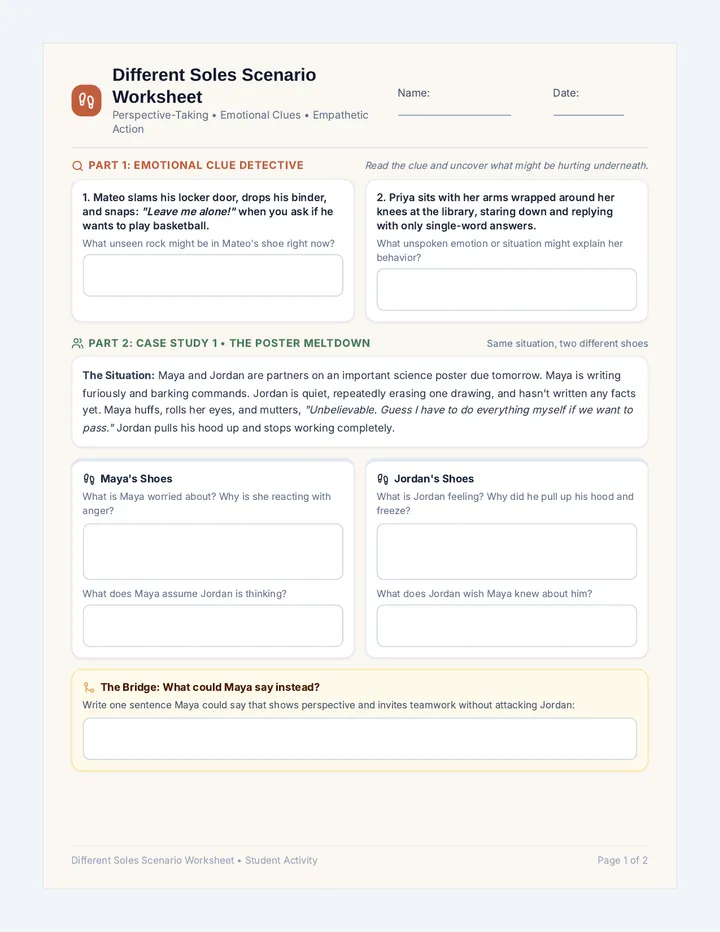
Different Soles Scenario Worksheet Different Soles Scenario Worksheet
Perspective-Taking • Emotional Clues • Empathetic Action
Name:
Date:
Part 1: Emotional Clue Detective
Read the clue and uncover what might be hurting underneath.
1. Mateo slams his locker door, drops his binder, and snaps: "Leave me alone!" when you ask if he wants to play basketball.
What unseen rock might be in Mateo's shoe right now?
2. Priya sits with her arms wrapped around her knees at the library, staring down and replying with only single-word answers.
What unspoken emotion or situation might explain her behavior?
Part 2: Case Study 1 • The Poster Meltdown
Same situation, two different shoes
The Situation: Maya and Jordan are partners on an important science poster due tomorrow. Maya is writing furiously and barking commands. Jordan is quiet, repeatedly erasing one drawing, and hasn't written any facts yet. Maya huffs, rolls her eyes, and mutters, "Unbelievable. Guess I have to do everything myself if we want to pass." Jordan pulls his hood up and stops working completely.
Maya's Shoes
What is Maya worried about? Why is she reacting with anger?
What does Maya assume Jordan is thinking?
Jordan's Shoes
What is Jordan feeling? Why did he pull up his hood and freeze?
What does Jordan wish Maya knew about him?
The Bridge: What could Maya say instead?
Write one sentence Maya could say that shows perspective and invites teamwork without attacking Jordan:
Different Soles Scenario Worksheet • Student Activity Page 1 of 2
Case Study 2 • Recess Tension & Conflict Repair
Student Name:
The Situation: During a tied recess kickball game with two outs, Leo kicked a high fly ball. Sam was running the bases, got confused by the shouts, stepped off base too early, and got tagged out. Leo kicked the dirt and yelled loudly: "Are you serious?! You just lost us the entire game, Sam!" Several kids laughed, and Sam walked off with red ears and tears in his eyes.
Sam's Experience
How does public embarrassment feel when you've made a mistake?
Leo's Perspective
What feeling took over Leo? What did he fail to notice?
Part 3: The 3-Step Conflict Repair Script
Transforming perspective into amends
Help Leo make sincere amends using the 3-step formula from class. Write Leo's exact words:
Step 1: Own the Impact (Do NOT say "I'm sorry if...")
Step 2: Name Their Shoe (Show you understand how Sam felt)
Step 3: Future Commitment (What will Leo do differently next time?)
Part 4: My Empathy Walk Pledge
Real life application
Think of a person at school or home with whom you sometimes clash. Describe one way you will step into their shoes before reacting the next time tension occurs:
Different Soles Scenario Worksheet • Student Activity Page 2 of 2
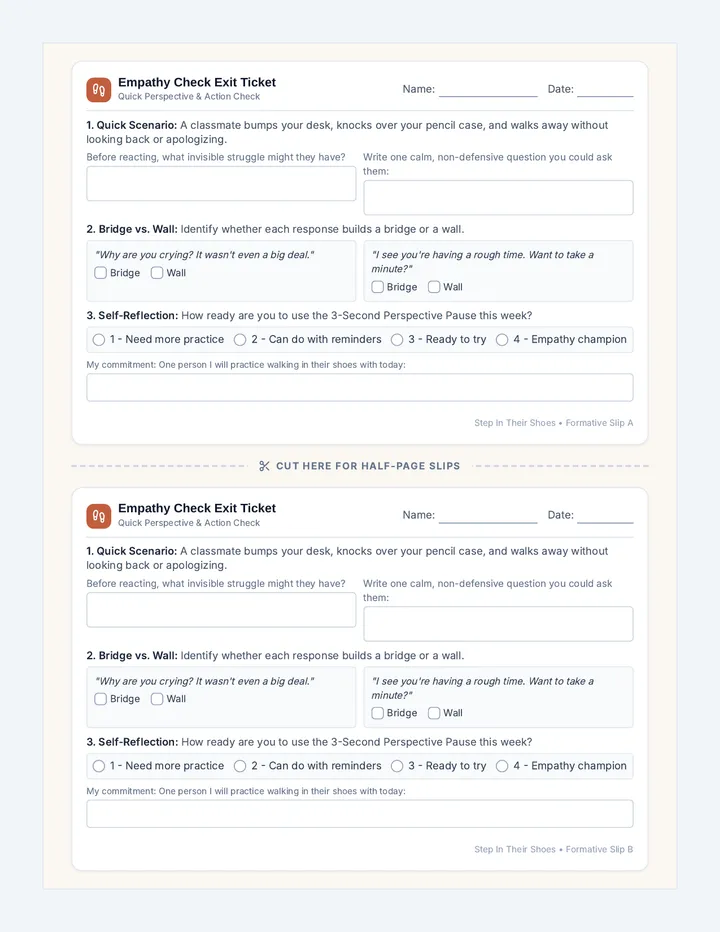
Empathy Check Exit Ticket Empathy Check Exit Ticket
Quick Perspective & Action Check
Name:
Date:
1. Quick Scenario: A classmate bumps your desk, knocks over your pencil case, and walks away without looking back or apologizing.
Before reacting, what invisible struggle might they have?
Write one calm, non-defensive question you could ask them:
2. Bridge vs. Wall: Identify whether each response builds a bridge or a wall.
"Why are you crying? It wasn't even a big deal."
Bridge Wall
"I see you're having a rough time. Want to take a minute?"
Bridge Wall
3. Self-Reflection: How ready are you to use the 3-Second Perspective Pause this week?
1 - Need more practice 2 - Can do with reminders 3 - Ready to try 4 - Empathy champion
My commitment: One person I will practice walking in their shoes with today:
Step In Their Shoes • Formative Slip A
Cut Here For Half-Page Slips
Empathy Check Exit Ticket
Quick Perspective & Action Check
Name:
Date:
1. Quick Scenario: A classmate bumps your desk, knocks over your pencil case, and walks away without looking back or apologizing.
Before reacting, what invisible struggle might they have?
Write one calm, non-defensive question you could ask them:
2. Bridge vs. Wall: Identify whether each response builds a bridge or a wall.
"Why are you crying? It wasn't even a big deal."
Bridge Wall
"I see you're having a rough time. Want to take a minute?"
Bridge Wall
3. Self-Reflection: How ready are you to use the 3-Second Perspective Pause this week?
1 - Need more practice 2 - Can do with reminders 3 - Ready to try 4 - Empathy champion
My commitment: One person I will practice walking in their shoes with today:
Step In Their Shoes • Formative Slip B