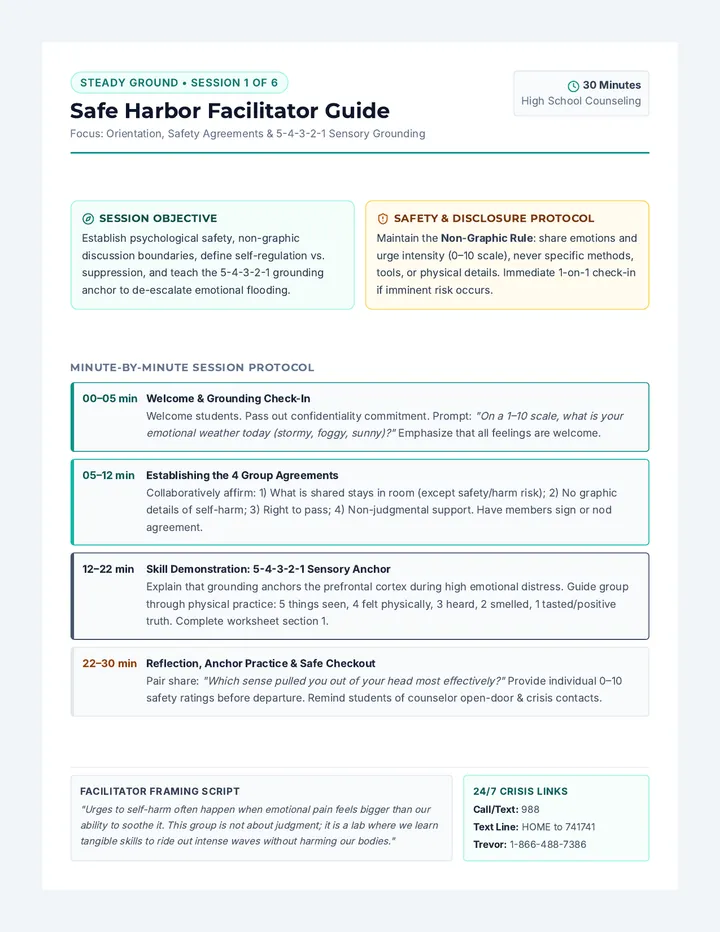
Thought Spirals Slides
Cognitive Science & Self-Regulation
High School Psychology & Wellness
The Cascade Effect:
Deconstructing Thought Spirals
How small triggers escalate into catastrophe—and how evidence-based circuit breakers stop the loop.
Spot the Distortions
Trace the Escalation
Apply the Circuit Breaker
The Mechanism
The Anatomy of a Spiral
A thought spiral is an automatic cascade where a single neutral or ambiguous event triggers rapid catastrophic conclusions.
01
The Trigger
An ambiguous or uncomfortable external event occurs.
"I got a C on my chemistry quiz."
02
The Distortion
The brain assigns an exaggerated, threatening interpretation.
"I am fundamentally terrible at science."
03
The Cascade
Future predictions leap directly to worst-case finality.
"My GPA is ruined. I won't get into college."
04
The Freeze
Physical anxiety spikes, leading to avoidance or complete shutdown.
Shuts notebook, avoids teacher, stops studying.
Key Takeaway: The problem is rarely the original trigger—it is the unchecked narrative that follows.
Cognitive Distortions
Four Traps High Schoolers Face
Our evolutionary threat-detection system misidentifies social and academic uncertainty as mortal danger.
1. Catastrophizing
Leaping directly from a minor setback to an apocalyptic worst-case scenario.
"I stumbled during my presentation intro. Everyone knows I'm incompetent."
2. Mind Reading
Assuming you know exactly what others think, almost always projecting negative judgment.
"They laughed quietly right after I walked past; they were definitely talking about me."
3. All-or-Nothing Thinking
Viewing situations in polarized categories: absolute perfection or total failure.
"I didn't get varsity captain, so my whole sports career has been a waste."
4. Emotional Reasoning
Assuming that because you feel intense dread or inadequacy, it must be an objective truth.
"I feel like an outsider in this friend group, so nobody actually wants me around."
Recognizing the specific label robs the irrational thought of its authority.
Deep Dive
Case Study: The Unread Message
Observe how the brain manufactures a crisis out of missing information.
The Unchecked Spiral
Level 1 (Trigger): Sent project draft to group chat at 4 PM. Left on read for two hours.
Level 2 (Mind Reading): "They hate my ideas and think my work is embarrassing."
Level 3 (Catastrophe): "They have a side chat without me. I am being pushed out of the group."
The Grounded Reality Check
What are the verifiable facts? Three people have not yet commented on a shared document.
What are alternative explanations? Soccer practice, family dinner, chores, or simply haven't checked their phone.
Grounded response: "I will focus on other work. If no one replies by 8 PM, I will send a polite check-in."
Rule of Thumb: Never assume malice or conspiracy when neutral busyness is a 95% likelihood.
The Toolkit
The 3-Step Circuit Breaker
A repeatable protocol to interrupt cognitive momentum before behavioral shutdown occurs.
1
CATCH IT
Label the internal surge with clinical detachment:
"I notice my brain is initiating a catastrophic spiral right now."
2
CHECK IT
Put the panic thought on trial against hard evidence:
"What is verifiable fact vs. what is an unproven assumption?"
3
CHANGE IT
Replace the catastrophic leap with a grounded neutral anchor:
"This feels stressful, but I have concrete steps I can take next."
Notice: This is NOT toxic positivity ("Everything is perfect!"). It is radical realism.
Independent & Peer Reflection
Classroom Discussion
Pair up with a partner or reflect independently on these two core questions.
Prompt 01 Survival vs. Reality
Why does our brain treat social awkwardness or an academic mistake like a life-or-death emergency?
Consider evolutionary psychology, human need for belonging, and how social media amplifies public evaluation.
Share: What physical signs tell you that your spiral has started?
Prompt 02 Grounded Reframing
Why does toxic positivity fail during a spiral, while "radical neutrality" actually works?
When someone tells you "Just be happy!" or "It doesn't matter!", why does your brain reject it? How does a neutral fact help instead?
Next: Turn to your Spiral Breakers Worksheet for personal application.
Ready to build your personal protocol? Proceed to Individual Reflection →
Spiral Breakers Worksheet
CBT Reflection Protocol Cognitive Reframing
Spiral Breakers: Deconstructing Cognitive Cascades
Name:
Date: Period:
The 3-Step Protocol: 1. Catch It (Label the spiral) • 2. Check It (Test facts vs. fiction) • 3. Change It (Construct neutral reality)
1 Case Study: Deconstructing the Spiral
Read the scenario & isolate the distortion
Scenario: Jordan accidentally misses the submission deadline for an AP English essay by 15 minutes due to a home Wi-Fi outage. Jordan immediately thinks: "My teacher is going to assume I'm irresponsible and don't care. She'll give me a zero, my GPA will tank, and my chances at my target college are over."
A. Objective Trigger (verifiable fact only, zero feelings):
B. Cognitive Distortion(s) (e.g., Catastrophizing, Mind Reading):
2 Reality Testing: The Circuit Breaker
Separate verifiable evidence from panic
What are the verifiable, known facts?
What are unverified catastrophic assumptions?
Jordan's Grounded Response (A realistic, actionable reframe Jordan can adopt right now):
3 Personal Protocol: My Circuit Breaker
Independent reflection on your own cognitive patterns
A. My Common Spiral Trigger (e.g., getting a low test score, waiting on a text reply, making an athletic error, speaking up in class):
B. The Runaway Story (What is the catastrophic or extreme prediction your brain automatically jumps to?):
C. My Grounded Reality Anchor (A truthful, calm statement + 1 concrete action step to break the momentum):
Cognitive Rule: You cannot stop an automatic initial thought, but you are 100% in charge of the response that follows. High School SEL • Resource 01