SMART Goal Lesson Plan Teacher Lesson Plan • Grades 6–8
SMART Goal Blueprint
Duration
30 Minutes
Learning Objective
Students will be able to transform a vague personal or academic wish into a complete SMART goal (Specific, Measurable, Achievable, Relevant, Time-bound).
Materials Needed
SMART Goal Slides (projected)SMART Goal Worksheet (1 per student)Timer (visible for 12-min independent work)
30-Minute Pacing Overview
0:00 – 5:00
Brief Intro (5m)
5:00 – 15:00
Guided Example (10m)
15:00 – 27:00
Individual Practice (12m)
27:00 – 30:00
Wrap-Up (3m)
1. Brief Introduction: Wish vs. Blueprint
5 Minutes • Slides 1–3
Hook (2 min): Ask students: "Raise your hand if you've ever said 'I want to get better grades' or 'I want to get fit'—and then nothing happened." Explain that wishes stay in your head, while goals have a blueprint.
Introduce SMART (3 min): Walk through Slide 3 briefly. Have students glance at the SMART reference box at the top of Page 1 of their worksheet: S pecific, M easurable, A chievable, R elevant, T ime-bound. Keep definitions punchy—save the deep thinking for the guided example.
2. Guided Example: Fixing a Vague Goal
10 Minutes • Slides 4–5
Display the vague starting goal: "I want to get better at math." Tell students they will help you upgrade it on Page 1 of their worksheet. Cold-call or take 1–2 quick ideas per letter:
Letter
Teacher Prompt & Model Answer
S – Specific
"What exact part of math?" → Raise my math quiz average by practicing fractions and word problems.
M – Measurable
"How will we know it worked?" → Complete 15 minutes of practice 3× a week and score 85%+ on quizzes.
A – Achievable
"Is 15 minutes 3× a week realistic?" → Yes, I can do it right after school before gaming/sports.
R – Relevant
"Why does this matter to you?" → I want to feel confident in class and keep my B+ grade.
T – Time-bound
"When is the finish line?" → By the end of this grading quarter (in 4 weeks).
SMART Goal Blueprint • Teacher Guide Page 1 of 2
SMART Goal Blueprint • Facilitation & Wrap-Up
Minutes 15:00 – 30:00
3. Individual Practice: Build Your Own Blueprint
12 Minutes • Slide 6
Have students flip to Page 2 of their SMART Goal Worksheet . Start a visible 12-minute timer. Students choose one personal, hobby, or school goal they genuinely care about for the next 2–4 weeks.
Teacher Circulation Checklist (Minutes 15–27):
Minute 17 Check: Scan to ensure everyone has picked a starting topic (if stuck, offer choices: reading, a sport/instrument, homework habits, sleep/screen time).Watch for "Vague M & T": Push students who write "do it more" or "soon" to pick an exact number (e.g., "3 days a week" ) and a calendar date.Final Statement: Remind students at the 4-minute warning to combine all five parts into one complete sentence in the My Final SMART Goal box and complete the self-check.
4. Wrap-Up: Partner Check & Commit
3 Minutes • Slide 7
Pair-Share (2 min): Students turn to a shoulder partner and read their Final SMART Goal aloud. The listener gives a thumbs-up if they hear both a number/measurement and a deadline .
Close (1 min): Collect worksheets (or have students keep them in their planner/folder) and announce a quick 2-week check-in date.
Differentiation & Supports
Need a boost: Provide a sentence frame: "By [date], I will [action] [how much/often] so that [why]." Early finishers: Have them write one potential obstacle and a backup plan on the back of their sheet.
Common Pitfalls to Catch
Goal is too big: "Get all A's" → Shrink to one class or one habit for 2–4 weeks.Missing "How": Focuses only on the outcome ("make the team") instead of the weekly action ("practice dribbling 20 min 4×/week").
SMART Goal Blueprint • Teacher Guide Page 2 of 2
SMART Goal Slides 30-Minute Workshop
SMART Goal Blueprint
How to turn vague wishes into an actual game plan.
S • M • A • R • T Intro → Guided Example → Your Turn
Part 1 • Brief Intro
Wish vs. Blueprint
A Wish
"I want to get better grades."
No clear target, no timeline, and no way to measure progress.
A SMART Goal
A clear, step-by-step target with a deadline.
You know what to do, how to track it, and when you'll finish.
The Framework
What Makes a Goal SMART?
S
Specific: What exactly do you want to accomplish?
M
Measurable: How will you track progress with numbers?
A
Achievable: Is it realistic for your schedule right now?
R
Relevant: Why does this matter to you ?
T
Time-bound: What is your exact deadline?
Part 2 • Guided Example
Let's Fix This Vague Goal
Starting Wish:
"I want to get better at math."
S — Specific
Raise my math quiz scores by practicing fractions and word problems.
M — Measurable
Practice 15 minutes, 3 times a week and score 85%+ on quizzes.
Part 2 • Guided Example (Continued)
Finish the Blueprint
A — Achievable
15 min right after school is realistic before gaming.
R — Relevant
Helps me feel confident and keep my B+ grade.
T — Time-bound
By the end of this grading quarter (4 weeks).
Complete SMART Goal:
"Over the next 4 weeks, I will practice math word problems for 15 minutes, 3 times a week after school, so I can score 85% or higher on my quarter quizzes."
Part 3 • Individual Practice
Build Your Own SMART Goal
12 Minutes
1
Flip to Page 2 of your worksheet and pick one real goal (school, sports, hobby, or habit) for the next 2–4 weeks.
2
Fill in all five boxes: S, M, A, R, and T . Make sure you include a number!
3
Combine them into one strong sentence in the My Final SMART Goal box.
Part 4 • Wrap-Up (3 Minutes)
Partner Check & Commit
Turn to a shoulder partner:
Read your Final SMART Goal out loud.
Listener: Give a thumbs-up if you hear BOTH a number (Measurable) and a deadline (Time-bound)!
Keep your blueprint somewhere you'll see it—we'll check in on your progress in 2 weeks!
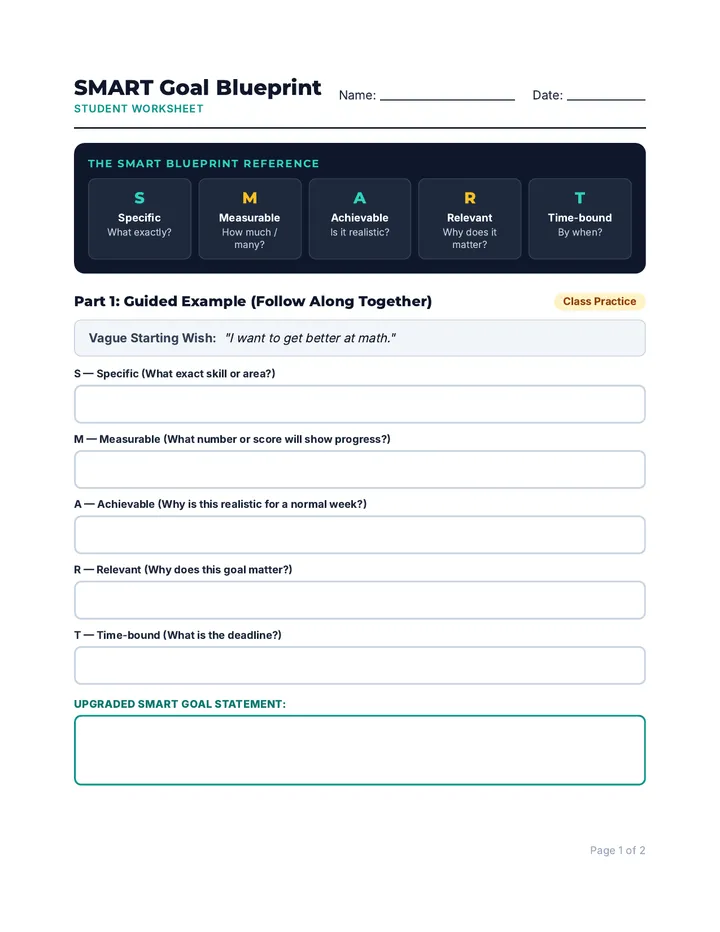
SMART Goal Worksheet SMART Goal Blueprint
Student Worksheet
Name: ________________________
Date: ______________
The SMART Blueprint Reference
S
Specific
What exactly?
M
Measurable
How much / many?
A
Achievable
Is it realistic?
R
Relevant
Why does it matter?
T
Time-bound
By when?
Part 1: Guided Example (Follow Along Together)
Class Practice
Vague Starting Wish: "I want to get better at math."
S — Specific (What exact skill or area?)
M — Measurable (What number or score will show progress?)
A — Achievable (Why is this realistic for a normal week?)
R — Relevant (Why does this goal matter?)
T — Time-bound (What is the deadline?)
Upgraded SMART Goal Statement:
Page 1 of 2
Part 2: Your Turn — Individual Practice
12 Minutes
1. Pick one area you want to improve over the next 2–4 weeks (school, sports, hobby, or daily habit) and write your starting idea:
2. Break it down using the SMART blueprint:
S — Specific (What exactly will I do?)
M — Measurable (How will I count or track it? Include a number!)
A — Achievable (When and how will this fit into my real schedule?)
R — Relevant (Why is this important to me right now?)
T — Time-bound (What is my exact target date or number of weeks?)
3. My Final SMART Goal (Combine all 5 parts into 1–2 clear sentences):
Self-Check Before Sharing: [ ] Includes a specific action [ ] Includes a number [ ] Includes a deadline
Page 2 of 2